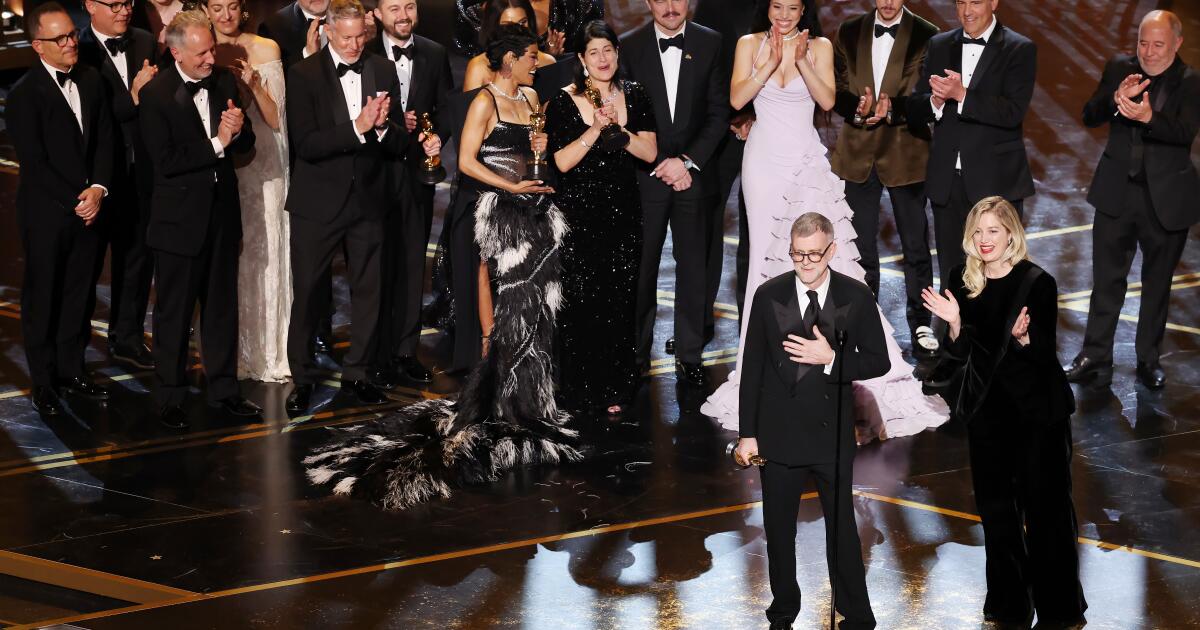
The crowd erupted in cheers at the 98th Academy Awards when “One Battle After Another” was announced as the winner of Best Picture.
The Paul Thomas Anderson film had a fantastic night, winning six Oscars. The movie tells the story of revolutionaries in California fighting against a determined federal government that aims to deport immigrants and silence opposition.
Wait, isn’t that what CNN airs every night?
The movie, which ran for over two and a half hours, wasn’t a financial success in the U.S., failing to recoup its $130 million production cost. However, it generated a lot of discussion and debate, keeping it relevant even after its theatrical run ended. Critics on the right criticized the film for seemingly celebrating violent opposition, while those on the left praised its timely and energetic approach.

Awards
‘One Battle After Another’ was named best picture at Sunday night’s Oscars.
The film is intended to be thought-provoking and meaningful. However, director Anderson, who recently won an Oscar for “One Battle,” has explained that it shouldn’t be seen as a statement about current events, but rather as a look at the ongoing challenges faced by American democracy.
He explained to my colleague, Glenn Whipp, back in September that similar situations were reported in the L.A. Times a century ago. He added that it’s self-centered to believe we’re witnessing something completely unprecedented.
The film “One Battle” isn’t as profound as many reviewers and fans have suggested. While trying to create a comedic take on a difficult time, Anderson lost sight of the bigger picture regarding resistance during the Trump era. His arguments and insights ultimately lack substance and impact.
“One Battle” has many strengths, including a gripping musical score, skillful camera work, and excellent performances. Sean Penn, who won Best Supporting Actor, is particularly noteworthy; his portrayal of the film’s villain is so strikingly similar to disgraced former Border Patrol commander Gregory Bovino that Bovino himself might deserve a credit for his contribution.
It’s rare to see Latinos portrayed with depth in media, where we’re often reduced to stereotypes like servants, fiery women, criminals, or aliens. That’s why I particularly enjoyed the subtle details in “One Battle,” from the use of terms like carnalito (a friendly term for ‘buddy’) and chota (slang for ‘police’) to a scene where Leonardo DiCaprio whistles at a group of Mexican men—a gesture that reminded me of how I playfully get my cousins’ attention at family gatherings.
It would have been better if the story felt more grounded in reality. Unfortunately, Latino characters are mostly supporting players, with the exception of Benicio del Toro’s witty karate instructor. Anderson’s biggest flaw is suggesting that left-wing rebellions rarely achieve their goals, a point he makes central to the film’s political themes.
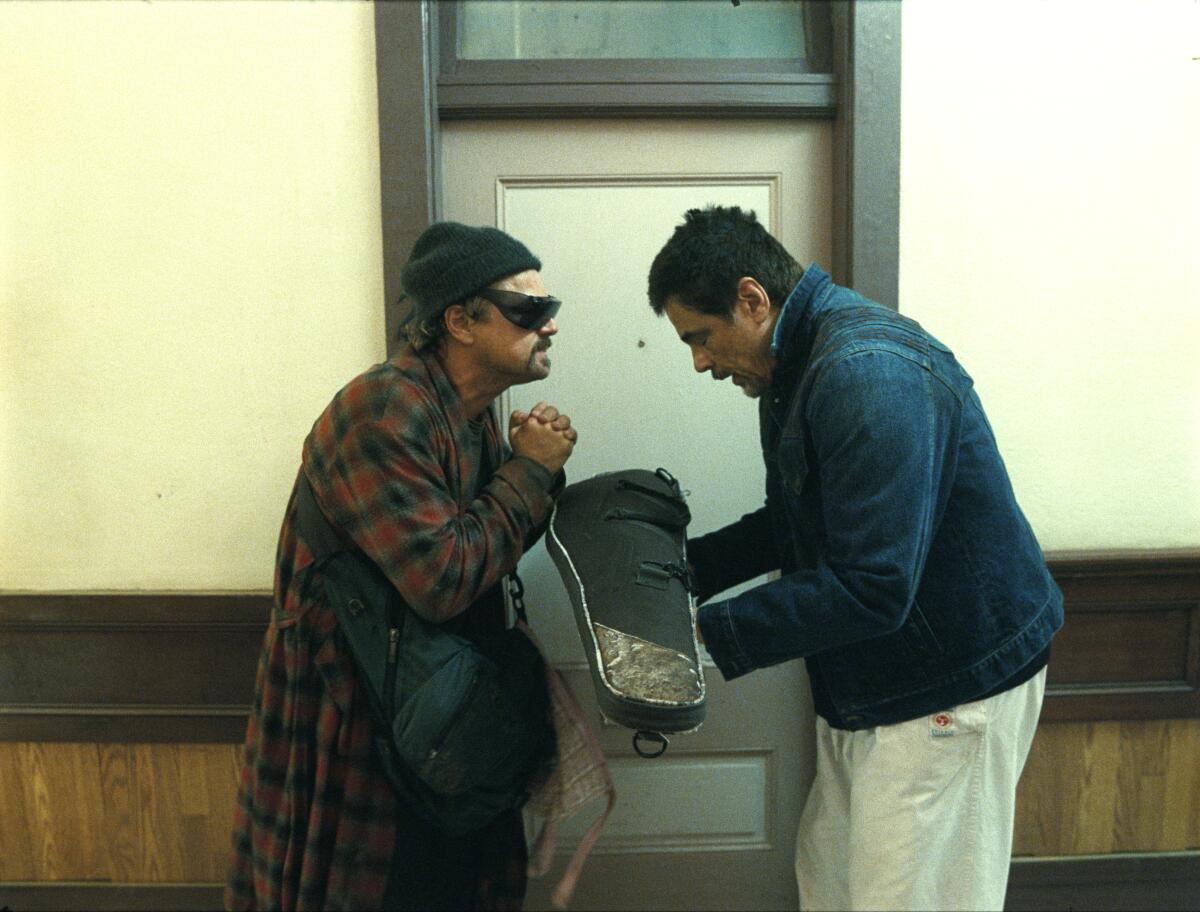
“One Battle” presents a vision of America where struggles against oppression don’t lead to meaningful change. The story centers on a group called the French 75, who begin by freeing people from an immigration detention camp on the U.S.-Mexico border. They then escalate to bombings and robberies in Los Angeles. Sixteen years later, surviving members are in hiding in a Northern California sanctuary city, while everyday life – like proms and casual drug use – continues for everyone else.
“One Battle” draws inspiration from Thomas Pynchon’s 1990 novel “Vineland.” The creator, Anderson, has updated the story by replacing President Reagan’s focus on the war on drugs with President Trump’s policies on deportations, while still maintaining Pynchon’s satirical portrayal of disillusioned activists.
I have to admit, the director really knows how to get a quick laugh. He seems to poke fun at things popular with progressives today – like using different pronouns, giving trigger warnings, or acknowledging the history of Native American lands. But I felt his portrayal of conservatives was really unfair. They came across as completely villainous and… well, just overwhelmingly white. It felt very Hollywood to me, ignoring the fact that people of all backgrounds have diverse political views. It just didn’t ring true, especially when you consider things like the record number of Latino voters who supported Trump in 2024, or the fact that people like Marco Rubio and Kash Patel – both of whom are people of color – hold prominent positions in government.
Anderson portrays familiar, almost stereotypical characters on the left – a hypersexualized Black female activist, a betrayed white man who uses drugs, and rigid new members – reminiscent of a comedic routine about hippies. He claims the right is successful due to its organization, while the left falls apart because of flawed leadership. Perfidia Beverly Hills, the outspoken leader of a revolutionary group, puts it bluntly: “Every revolution starts by fighting external enemies, but ultimately turns inward and fights itself.” The film also draws attention to how the camera fixates on Beverly Hills’ body in a disturbing way.
Unfortunately, her point rings true. However, the past four years have demonstrated that people are now driving change themselves, rather than relying on traditional leaders.

Movies
Paul Thomas Anderson, the filmmaker behind acclaimed movies like “Boogie Nights” and “There Will Be Blood,” is back with a powerful and intense new film exploring American protest and disagreement, inspired by Thomas Pynchon’s novel “Vineland.”
Even some of Trump’s supporters are now questioning his actions, and traditionally moderate suburban women are getting involved in groups monitoring immigration enforcement. Today’s activism isn’t limited to protests and violence; it’s happening through online organizing, in schools, and within communities. Latinos are not only helping undocumented immigrants, but are also actively voting against Republicans and challenging Trump directly in Congress.
Current events in this country demonstrate that the approach suggested in “One Battle” – that fighting against authoritarianism requires copying the tactics of radical groups from the 1970s like the Weather Underground and the Symbionese Liberation Army – isn’t the only way to resist.
Perfidia argues that only radical action, not voting or peaceful protest, will bring about change. This idea resonates with her daughter in the film, who embraces it as the movie ends, underscored by songs about revolution. Trump attempts to portray his political opponents as embracing this extreme viewpoint, and his supporters often label peaceful protesters as domestic terrorists.
Over the past few years, I’ve been to many protests, meetings, and gatherings, and at each one, the organizers have strongly condemned violence. Their reasoning is simple: it’s not an effective strategy. Those who disagree will almost always have greater force and more funding.
A consistent and vocal opposition to Trump’s harmful actions has been so successful that he’s reportedly asked Republican leaders to tone down their anti-immigrant language until after the midterm elections.

It’s puzzling that Anderson would portray those who oppose fascism as violent extremists. Is he genuinely out of touch with what’s happening, or is he attempting satire? He should really speak with people actively defending immigrants to get a better understanding. Otherwise, he might be more conservative than he lets on – which, honestly, isn’t uncommon in Hollywood.
This director, originally from the San Fernando Valley, is known for his ambitious and complex films featuring flawed characters – much like John Ford and Westerns, or A24 and independent cinema. He particularly excels at portraying his hometown, as seen in films like the adult film drama “Boogie Nights” and “Licorice Pizza,” which is a heartfelt tribute to the Valley.
“One Battle” doesn’t measure up to truly great films. In fact, the movie it won Best Picture over, Ryan Coogler’s “Sinners,” offers a much stronger and insightful critique of racism and human failings – and it’s a more entertaining and original film. “One Battle” feels similar to the 2006 Best Picture winner, “Crash,” which is often considered one of the worst ever for its insensitive portrayal of race relations.
While Anderson’s movie isn’t as flawed as “Crash,” it shares the same issues of being out of touch with reality and taking itself too seriously. The changes it depicts aren’t something in the future—they’re happening now.
Read More
- Limbus Company 2026 Roadmap Revealed
- After THAT A Woman of Substance cliffhanger, here’s what will happen in a second season
- Total Football free codes and how to redeem them (March 2026)
- XO, Kitty season 3 soundtrack: The songs you may recognise from the Netflix show
- ‘Project Hail Mary’s Unexpected Post-Credits Scene Is Worth Sticking Around
- The Division Resurgence Specializations Guide: Best Specialization for Beginners
- Wuthering Waves Hiyuki Build Guide: Why should you pull, pre-farm, best build, and more
- Guild of Monster Girls redeem codes and how to use them (April 2026)
- Gold Rate Forecast
- ‘Project Hail Mary’s Soundtrack: Every Song & When It Plays
2026-03-17 13:32