Bitcoin, that ever-persistent creature of the digital world, continues to linger below the $70,000 mark as the global markets brace themselves for the relentless tremors caused by the ever-increasing tensions in the Middle East. After a brief attempt to find some peace amidst the chaos, the cryptocurrency finds itself teetering on the precipice of uncertainty, as if it, too, were pondering its future amid the turmoil. The markets, it seems, are hanging on every development in the region, particularly around the infamous Strait of Hormuz, where oil tankers might soon be exchanging more than just cargo.
According to the most recent findings of the ever-watchful CryptoQuant analyst, Darkfost, it appears the geopolitical shockwaves have already made their mark on the energy markets. Oil prices, which are no strangers to volatility, have surged by more than 60% since the beginning of the year. This sharp rise reflects not only fear but a keen awareness of the ongoing potential for global supply disruptions. Indeed, the scale of this increase serves as a reminder that the markets, particularly those concerned with energy, remain as delicate as a finely crafted porcelain teacup in the hands of an overzealous child.
The Strait of Hormuz, a narrow and strategically significant maritime route, continues to hold the attention of the global market. For those unacquainted with the matter, let it be known that approximately 20% of the world’s daily oil exports pass through this very chokepoint. Should it falter, so too might the markets. Nearly 35% of all seaborne oil shipments depend on this lifeline remaining uninterrupted, and so, as tensions continue to escalate, the markets are pricing in the potential for prolonged instability, much to the chagrin of both traditional and digital assets.
Rising Oil Prices Add Pressure To Bitcoin’s Macro Environment
Darkfost, ever the observer, notes that any incident capable of disrupting the delicate flow of oil through the Strait of Hormuz could have immediate and profound effects on global oil prices. With such a substantial portion of the world’s energy supply passing through this critical corridor, even a whisper of risk has the power to send ripples through the energy markets. This surge in oil prices, therefore, is not just a reflection of the present, but a market’s effort to prepare for potential disruptions ahead.

But let us not stop at oil, for the implications stretch far beyond the energy sector. A sustained rise in oil prices, much like a persistent cough, has a way of feeding directly into inflation. Transportation, production, and logistics costs all rise in tandem, leaving the financial markets to face the inevitable consequences. The shockwaves of this surge threaten to alter expectations for monetary policy and interest rates, tightening the financial conditions in a manner no one could have predicted at the dinner table.
For Bitcoin, that ever-fluctuating enigma, this macroeconomic environment has proven to be less than ideal. History has shown that periods of rising oil prices tend to coincide with the later phases of Bitcoin’s market cycles, those unfortunate moments when risk appetite wanes and investors, ever the cautious bunch, rotate their capital toward safer assets. Such is the fate of speculative assets when the winds of uncertainty blow too strongly.
And let us not forget the rising geopolitical tensions, which hardly encourage a brave leap into speculative markets. Darkfost, ever the realist, contends that policymakers, including President Donald Trump, have every incentive to quash the energy shock before it grows too formidable, for prolonged acceleration of oil prices could easily tip the balance, leading to a most unwelcome financial instability.
Bitcoin Consolidates Near $67K After Sharp Correction
The weekly chart, ever the bearer of truth, shows Bitcoin finding solace near the $67,000 region after a sharp correction from the heady heights of $110,000 reached late in 2025. The recent decline, like a particularly inconvenient storm, gathered strength during the early months of 2026, pushing Bitcoin below its 50-week moving average and signaling a shift toward a more defensive market structure. The momentum, once so vibrant, has weakened considerably since Bitcoin lost its foothold between $90,000 and $95,000-those sacred regions that once held firm as key support zones during the latter stages of the rally.
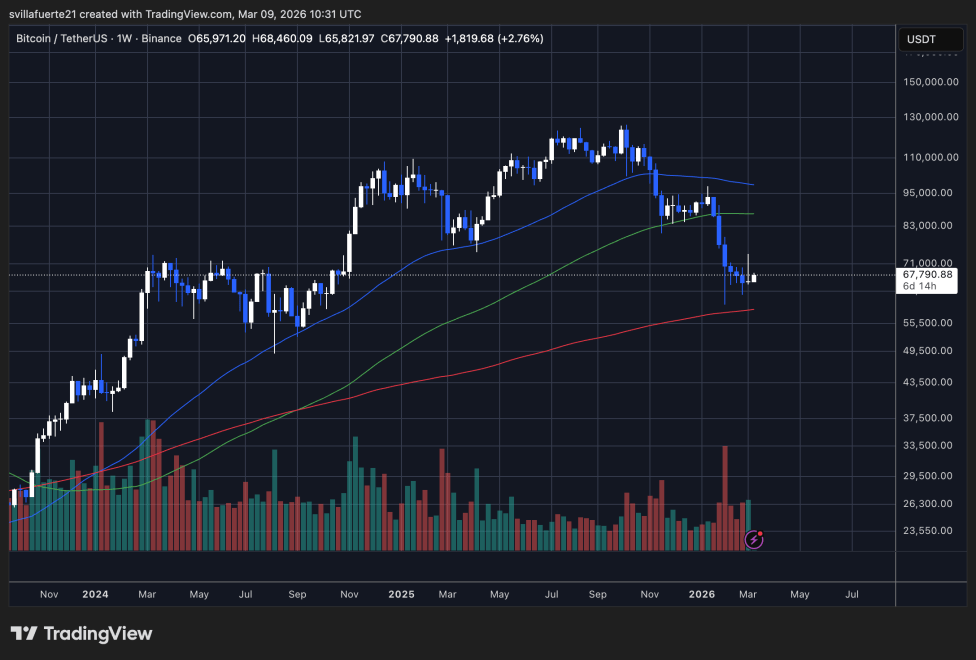
The current price action suggests Bitcoin is trying its best to establish a temporary consolidation range between $65,000 and $70,000-an area where buyers and sellers are evidently rethinking their next moves after the rapid sell-off. It is, as one might say, a moment of pause before the inevitable drama unfolds.
From a structural standpoint, the 100-week moving average remains slightly above the current price, hinting that the broader uptrend may be losing its sparkle. Meanwhile, the 200-week moving average, lurking near the mid-$50,000 region, continues to rise ever so steadily, providing a potential long-term support should selling pressure intensify. It’s almost as if Bitcoin, like a well-heeled debutante, is cautiously assessing its next move at the ball.
Volume activity has surged during the recent decline, suggesting that the correction was not without consequence. Significant distribution has taken place, and for Bitcoin to regain its bullish momentum, it would likely need to reclaim the $70,000-$75,000 region and maintain stability above its shorter-term moving averages. The suspense, as always, is palpable.
2026-03-09 21:12