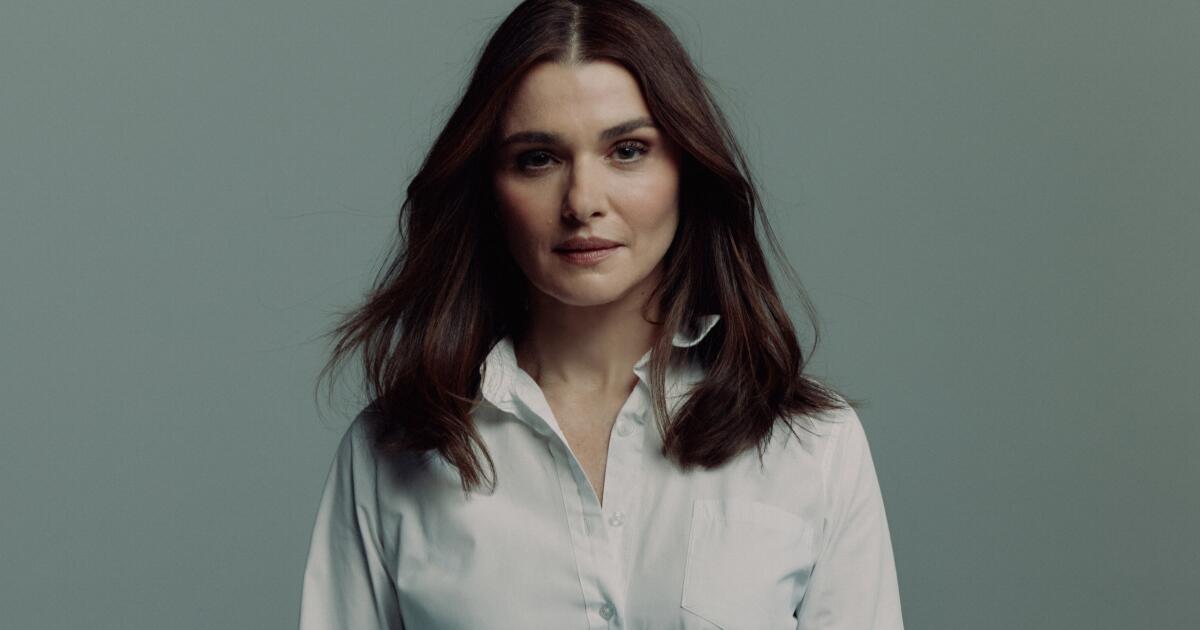
Rachel Weisz finished filming “Vladimir” almost six months ago, but she’s still finding it difficult to talk about her character. The character, simply known as “M” in the script, was so intricate that Weisz is having trouble putting into words what it was like to play her.
She admitted it was the first time she’d ever talked about it with anyone, sharing this while seated at a table in Goodfare, a London restaurant in Camden, on a very cold morning in early January. She joked that she might sound a little rusty.
A few days after the holidays, 55-year-old Weisz is gearing up to begin filming a new movie, “Séance on a Wet Afternoon.” However, she’s still processing her recent work on the series ‘M’, where she served as an executive producer and remained involved in the editing process, which was still happening when we spoke. She reflects on the character, admitting she’s still forming her own complete understanding of her.
The upcoming eight-part series, “Vladimir,” which premieres on March 5th, is adapted from Julia May Jonas’ 2022 novel of the same name. The story follows a literature professor (Rachel Weisz) at a small college as her husband (John Slattery) faces an investigation. Simultaneously, she finds herself increasingly attracted to a new coworker named Vladimir (Leo Woodall). The novel is narrated as a continuous inner monologue, and the series’ pilot was written by Jonas before any actors were cast. Weisz had already read and enjoyed the book—a friend had suggested it—before receiving the script.

She thought the novel and the pilot were excellent. This led to a meeting with Jonas, and ultimately, she was drawn to the opportunity to play the character. She believed it would be a difficult, but enjoyable, role.
Honestly, watching M’s life fall apart is heartbreaking. She gets completely fixated on Vladimir, and we’re shown these incredibly intense, almost dreamlike fantasies she has about him, which are then sharply contrasted with the really ordinary, everyday stuff happening around her. It’s like she’s losing touch with reality, and it spills over into everything – her job, her personal life. What’s really striking is that she’s constantly talking to us throughout it all, narrating her own descent, which makes it feel so much more personal and raw.
Jonas explains the novel relies heavily on the character’s inner thoughts. The challenge for the screen adaptation was finding a way to represent that internal voice. They used direct address – where the character speaks directly to the audience – but wanted to subvert the typical purpose of that technique. Usually, direct address is used to reveal the truth, but they aimed for something different.
But that’s not what always happens here.
Jonas wanted to change the story so that the main character is constantly bending the truth or directly lying when she speaks. He describes her as a narrator you absolutely can’t trust.
The predator’s wife: A dark debut novel with a #MeToo gender twist
Julia May Jonas’s novel, “Vladimir,” is a captivating reimagining of “Lolita,” but with a clever twist: the story is told from the perspective of the abuser’s wife, who is a delightfully complex and even mischievous character.
Throughout the show, the character M often speaks directly to the camera, a technique inspired by the actor’s experience with theater. Rachel Weisz recalls performing in a play by Neil LaBute in the 1990s where she addressed the audience directly, something she hadn’t done on screen before. She says she did think about who she was talking to, but doesn’t want to oversimplify her intentions.
She explains that she would often pretend to be talking to someone who wasn’t there while filming. The crew jokingly called this imaginary person her ‘special friend.’ The other actors had to act as if nothing was happening, and it wasn’t planned – she’d simply step out of character to ‘chat’ with this imaginary friend before continuing with the scene.
It eventually became second nature for her and the cast, she says.
Woodall shared, speaking from London via Zoom, that it was fascinating to watch Rachel and the other creators handle that situation. He was particularly impressed with Rachel’s ability to seamlessly move between staying in character within a scene, delivering a solo monologue, and immediately returning to the scene. He admitted it was a new kind of challenge for him, but surprisingly, it wasn’t as hard as he’d anticipated.

Each episode of the show is quick-paced, lasting about half an hour, and “Vladimir” is generally more humorous than dramatic. While Naomi Weisz usually appears in serious roles – her previous series was a remake of “Dead Ringers” – she’s proven her comedic talent before, especially in the satirical film “The Favourite.” Despite all the laughs in “Vladimir,” she doesn’t consider herself a comedian.
She explains that she approached everything with deep seriousness, focusing on fully understanding her partner’s perspective, her values, and what was important to her, as well as the ways she was trying to maintain a positive outlook.
She hesitated, then admitted, “I don’t know how to be funny. It just doesn’t come naturally to me.” She acknowledged that things were often absurd, and pointed out that this woman’s life—especially her marriage—was falling apart. As things got worse, it became increasingly difficult for her to maintain the pretense that everything was okay.
Weisz created her portrayal of the character largely through her own imagination and by focusing on what her co-star, Julia, said. Having lived in New York City and met many professors over the years gave her helpful insight. Despite the character’s questionable actions, like illegally entering her boss’s office, Weisz recognized she was generally competent at her work. According to Weisz, the character is facing personal and professional challenges – her husband is struggling, and her own reputation is at risk. However, she believes the character still sees herself as a well-liked and respected teacher.
When preparing to play M, Weisz felt it was crucial to fully understand and support the character. While she believes it’s always important to find a way to relate to the people you portray, she also felt this character was genuinely believable and psychologically realistic.
She explains that it’s difficult to perform well if the material doesn’t resonate with her. While she praised the writing as a strong starting point, she emphasized that she needs to fully understand and embody a character’s perspective to truly play them convincingly.
Jonas says what makes M compelling is that it’s hard to put a label on her or know what to expect.

Jonas describes her as unpredictable and fascinating. “You can’t figure her out,” he says. “Is she correct, mistaken, rational, or unstable? Is she a genius, or something else entirely? It’s impossible to know. That’s what makes watching her so captivating – you never know what she’ll do next, except that it will be thoughtful and intelligent.”
Filming for “Vladimir” started in July 2025 in Toronto, which they used to represent a typical college town. It was scheduled specifically during the summer break so my daughter, with Daniel Craig, could be with us. While I was on set, I really felt connected to my character, but I could always leave her behind at the end of the day. I constantly find myself explaining that I’m very different from M, even as I try to understand her motivations. It’s almost like I’m slowly realizing just how intense and unpredictable M appears to be in the show.
I really connected with the character and understood her motivations,” Weisz explains. “However, I had to distance myself from her when I finished filming. She represents what an audience member might fantasize about experiencing for themselves.
Jonas explains that the story is symbolic. He asks us to imagine physically restraining someone, and points out the film visually represents that idea. He believes it explores the primal, instinctual side of femininity within all of us.
Both Woodall and Jonas noticed how naturally Weisz seemed to understand her character. During filming, Woodall and Weisz didn’t talk about the connection between their characters, M and Vladimir.
I was really struck by how much this actress embraced improvisation on set. The director, Woodall, told me she actively wanted to be surprised by what the actors brought to the table. And honestly, it was refreshing! For someone with her profile – she’s a huge star and incredibly glamorous – she was wonderfully game to be silly and even make fun of herself. Woodall mentioned several times that after certain takes, she’d just lose it laughing, clearly having a blast letting go and fully committing to the humor.
Jonas describes Rachel as a wonderfully surprising actor. He admits that when he first watched her scenes, they often didn’t match his original vision. But on a second viewing, he’d always understand her choices. He believes this unpredictability is what makes her so captivating. She’s humorous, engaging, and a bit unconventional, but always fully invested in her performance, keeping audiences guessing.
Weisz dreamed of being an actress from a young age, but she didn’t consider it a viable career path until she went to college. She’s particularly attracted to writing and unique perspectives. She fondly recalls collaborating with Julia, saying, “I loved being a part of Julia’s creative world.” She’s a big fan of writers, though she personally prefers the collaborative nature of acting because she finds writing too isolating. She enjoys being around writers, calling them her favorite people.

When choosing roles, Rachel Weisz focuses on the quality of the script, but she’s otherwise open to all kinds of projects. She’s appeared in a diverse range of films, from small independent productions to critically acclaimed dramas and big-budget action movies, including several Marvel films. She won an Academy Award for her supporting role in “The Constant Gardener” in 2006 and received another nomination for “The Favourite.”
Early in my career, I took any job just to make ends meet,” she explains. “I wasn’t focused on specific roles. Now, I’m fortunate enough to be able to be selective. What matters most to me now is the quality of the character and the script – whether it’s a story I’d enjoy telling.
Following our conversation in January, Universal Pictures officially announced a fourth “Mummy” movie. Rachel Weisz and Brendan Fraser are both set to return as Evelyn and Rick O’Connell – Weisz wasn’t in the third film. Before the announcement, Weisz was hesitant to discuss it, saying, “They are definitely discussing it.” She also mentioned Brendan Fraser has been actively involved and that the project “sounds very interesting.”
What really struck me about Weisz’s performance is how deeply she connects with the why behind her character. In “Vladimir,” she doesn’t play for sympathy or glamour; she dives headfirst into what pushes this woman to the brink. It’s fascinating to watch her portray someone desperate to rewrite her own story, someone who can’t quite confront the truth of her life. And it’s not simple; this woman is also a gifted writer and a loving mother who genuinely wants what’s best for her family, which adds so many layers to the performance.
Weisz points out that people are full of contradictions. Someone might excel professionally but have a chaotic personal life – it’s simply part of being human. While her work often exaggerates these contrasts for comedic effect, she believes it reflects a very real truth about the human experience: we all contain seemingly opposing qualities.
Weisz has a natural feel for her character, M, but still has some uncertainties. She’s unsure if M knowingly participated in her husband’s actions – a sensitive topic, as she puts it – and the character’s ultimate fate remains unclear even to her. Throughout editing, Weisz found it difficult to view M objectively, explaining, “I just see her, not myself at all.”
As the interview ended, Weisz seemed concerned that I hadn’t gotten enough information. She wondered if she’d explained the show well enough, or if she’d spent too much time justifying her character’s actions.
She confirmed she still agrees with the other person’s perspective. She paused, searching for the right way to put it, but felt ‘reasonable’ wasn’t quite the best description.
The actor laughs. “I am aware that is not the right word.”
2026-02-26 14:34