Author: Denis Avetisyan
A new framework automatically extracts the underlying physical laws governing events in videos, offering a path toward interpretable AI and deeper understanding of visual phenomena.
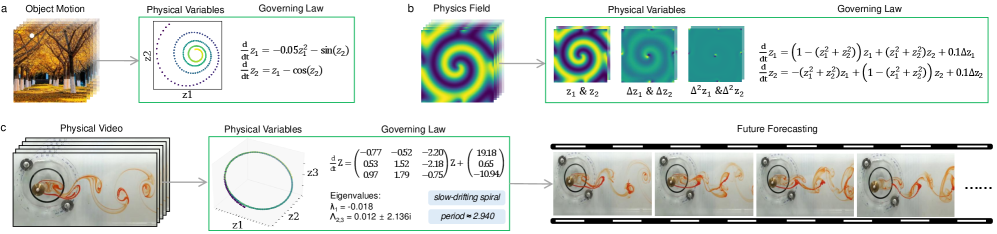
Pixel2Phys leverages a multi-agent system and iterative refinement to discover governing equations from visual data with improved accuracy and interpretability.
Discovering fundamental physical laws from raw visual data remains a significant challenge despite long-standing human efforts. To address this, we introduce Pixel2Phys: Distilling Governing Laws from Visual Dynamics, a multi-agent framework that automatically extracts interpretable governing equations directly from video observations. By iteratively refining variable identification and equation formulation, Pixel2Phys achieves improved accuracy and extrapolation capabilities compared to existing methods-effectively distilling concise, physically relevant representations from high-dimensional, noisy data. Could this approach pave the way for AI systems capable of autonomously uncovering the underlying principles governing complex physical phenomena?
Unveiling Hidden Dynamics: The Quest for Governing Equations
The quest to deduce the fundamental rules governing complex systems represents a cornerstone of scientific inquiry, spanning fields as diverse as climate modeling, epidemiology, and astrophysics. This challenge – inferring the underlying ‘Governing Equations’ from observational data – is not merely a matter of curve-fitting, but rather a search for the concise mathematical relationships that dictate a system’s behavior. Historically, scientists have relied on theoretical frameworks and empirical observations to formulate these equations; however, increasingly complex systems generate data too vast and intricate for manual analysis. The ability to automatically discover these governing equations from data promises to unlock deeper understanding, enable more accurate predictions, and ultimately, reveal the hidden mechanisms driving the world around us – a pursuit at the heart of modern scientific discovery.
The pursuit of understanding complex systems often hinges on deciphering relationships between numerous, interconnected physical variables. Traditional methods for modeling these systems frequently encounter difficulties stemming from the sheer volume of data and the inherent challenge of distinguishing genuine signals from random noise. Real-world observations are rarely pristine; they are typically contaminated with measurement errors, unobserved influences, and stochastic fluctuations. Consequently, algorithms struggle to accurately identify the underlying governing equations that dictate system behavior, leading to models that are either oversimplified – and miss crucial dynamics – or overly complex – and prone to overfitting the noise. This difficulty in separating signal from noise, combined with the high dimensionality of many physical systems, represents a significant bottleneck in scientific discovery, necessitating the development of more robust and efficient inference techniques.
Despite advancements in dynamical systems modeling, current techniques-including Latent-ODE, AE-SINDy, and Coord-Equ-often struggle to reliably identify the essential, low-dimensional dynamics governing complex systems. These methods, while capable of processing high-dimensional observational data, frequently fail to accurately distill the underlying processes into a simplified, interpretable form. The challenge stems from their susceptibility to being misled by irrelevant noise or spurious correlations within the data, leading to overparameterized models that capture superficial features rather than the core mechanisms. Consequently, predictions based on these models can be inaccurate, and the fundamental understanding of the system’s behavior remains elusive, hindering progress in fields ranging from climate science to neuroscience.
Pixel2Phys: A Collaborative Agent-Based System for Visual Equation Discovery
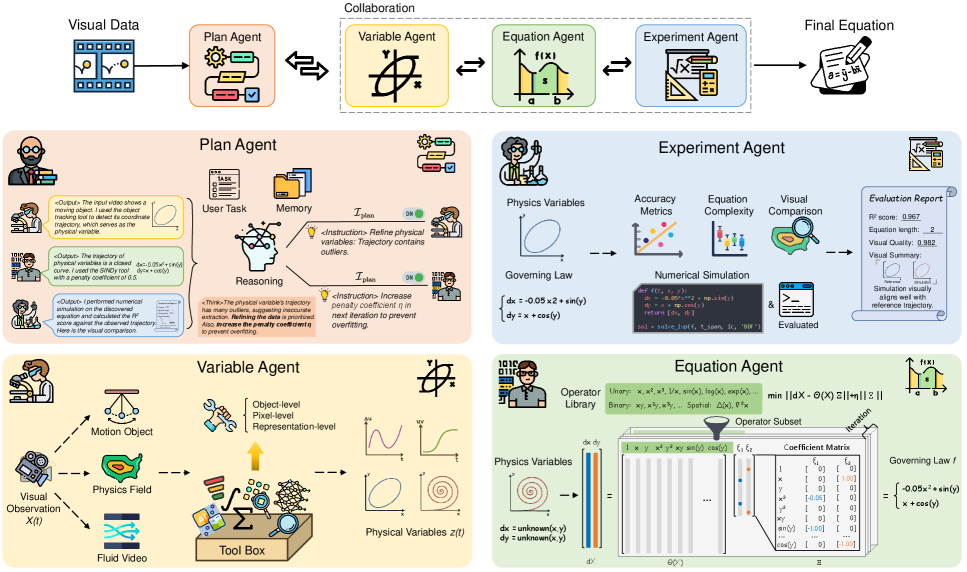
Pixel2Phys is a multi-agent system designed to address the challenge of Visual Equation Discovery by decomposing it into a series of discrete, manageable steps. This decomposition facilitates a modular approach where individual agents are responsible for specific sub-tasks within the overall problem. Rather than a monolithic solution, Pixel2Phys leverages the strengths of multiple specialized agents working in concert. This architecture allows for increased flexibility, scalability, and the potential for parallel processing of different aspects of equation discovery, ultimately improving efficiency and the ability to handle complex visual relationships. The system’s modularity also supports easier debugging and modification of individual components without impacting the entire framework.
The Plan Agent functions as the central control mechanism within the Pixel2Phys framework, responsible for task decomposition and agent orchestration. It receives the overarching goal of visual equation discovery and translates it into a sequence of actionable sub-goals for specialized agents. Specifically, the Plan Agent directs the Variable Agent to identify and define relevant physical quantities within the visual scene, and subsequently instructs the Equation Agent to formulate potential mathematical relationships between these variables. This hierarchical structure enables the system to address the complexity of the problem by breaking it down into modular tasks, with the Plan Agent maintaining overall control and coordinating the execution sequence.
The Pixel2Phys framework’s multi-agent architecture enables parallel processing of diverse solution hypotheses, significantly accelerating the Visual Equation Discovery process. Each specialized agent – such as the Variable Agent or Equation Agent – can independently explore potential components of a solution. Crucially, the Experiment Agent provides quantitative feedback on the validity of these proposed solutions, allowing the Plan Agent to iteratively refine the search strategy and prioritize promising avenues of exploration. This feedback loop, combined with the parallel processing capability, allows the system to efficiently converge on accurate equations by systematically evaluating and improving candidate solutions.
Agent Specialization: Extracting Meaning from Video Data
The Variable Agent employs a tiered approach to extracting physical variables from video data. The Object-Level Tool identifies and tracks discrete objects within the video stream, providing data points related to their position, velocity, and size. Complementing this, the Pixel-Level Tool analyzes raw pixel data to detect features like color changes, textures, and light intensities, which can indicate physical phenomena. Finally, the Representation-Level Tool processes the outputs of the other two tools, along with potentially pre-trained models, to derive higher-level physical variables such as temperature, density, or flow rates. This multi-tool architecture allows the agent to handle a wide range of video inputs and extract relevant data across varying scales and conditions.
The Representation-Level Tool utilizes a Physics-Informed Autoencoder (PIAE) to efficiently process high-dimensional data derived from video inputs. This autoencoder is specifically designed to learn the underlying physics governing the observed phenomena, incorporating physical constraints into its architecture and loss function. By enforcing these constraints, the PIAE not only reduces the dimensionality of the data – creating a lower-dimensional latent space – but also ensures that the learned representation is physically plausible and generalizable. This dimensionality reduction is crucial for managing computational complexity and enabling subsequent analysis, while the physics-informed component improves the robustness and accuracy of the extracted features compared to standard autoencoders.
The Equation Agent utilizes symbolic regression, a type of regression analysis that seeks to identify mathematical expressions describing the relationship between variables. Given the [latex]\textit{n}[/latex] physical variables extracted by the Variable Agent – representing quantities like position, velocity, and acceleration – the agent searches for equations built from basic arithmetic operations (+, -, *, /, ^) and functions (e.g., trigonometric, exponential, logarithmic) that best fit the observed data. This process does not require prior knowledge of the equation’s structure; the algorithm explores a vast space of possible equations, evaluating their accuracy using metrics such as R-squared or mean squared error. The output is a set of candidate governing equations, ranked by their ability to model the relationships within the extracted data, allowing for subsequent validation and refinement.
Unlocking Predictive Power: A Leap Beyond Existing Methods
The core of the system’s success lies in a dedicated ‘Experiment Agent’ that systematically evaluates potential mathematical equations describing the observed phenomena. This agent doesn’t rely on pre-defined models, but rather explores a vast solution space, employing rigorous statistical measures to quantify predictive power. Key among these are [latex]RMSE[/latex] (Root Mean Squared Error), which assesses the average magnitude of errors, and [latex]VPS[/latex] (Variance Preserved Score), designed to ensure the discovered equations accurately capture the inherent variability within the data. Through repeated testing and comparison, the agent identifies equations that not only fit the observed data but also generalize effectively to unseen states, ultimately revealing the hidden mechanisms driving the system’s behavior. This iterative process of hypothesis generation and evaluation is crucial for uncovering accurate and robust descriptions of complex dynamics.
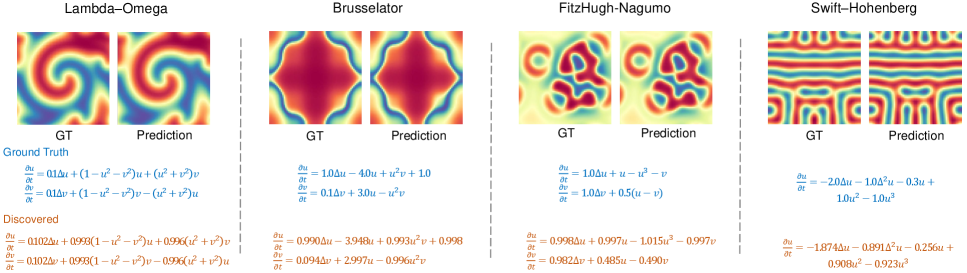
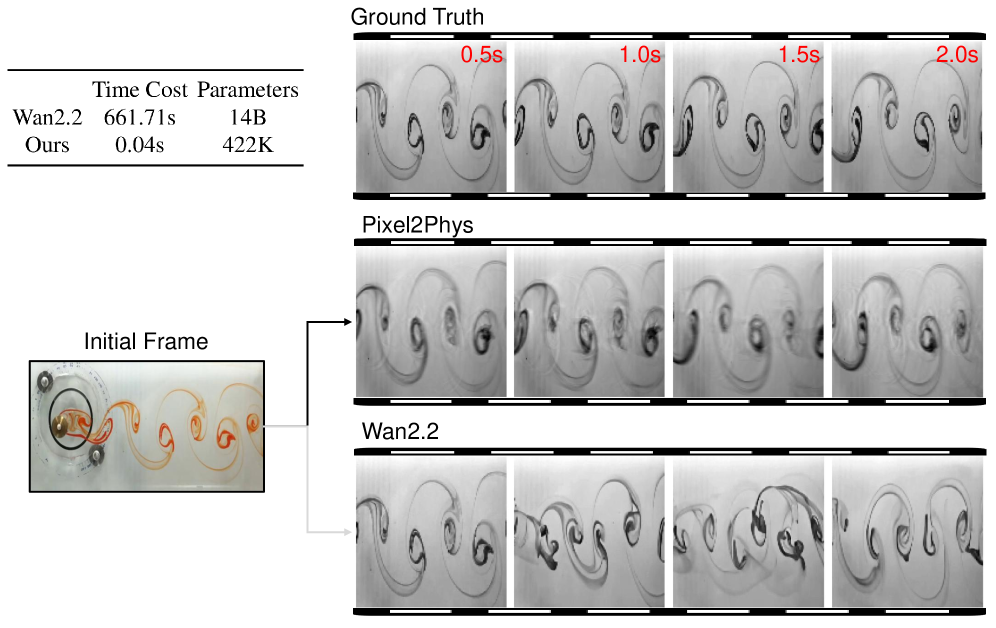
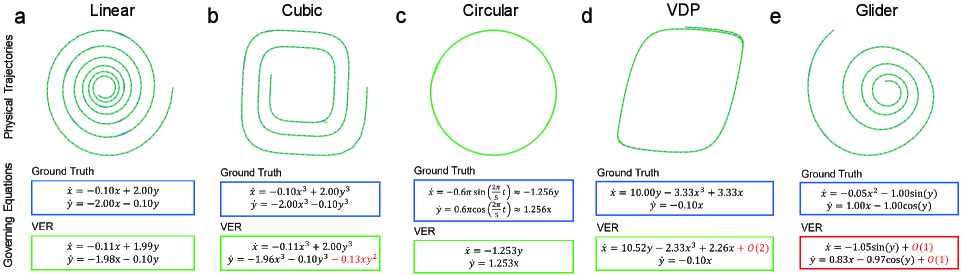
The innovative approach of Pixel2Phys demonstrably surpasses existing methods – including Latent-ODE, AE-SINDy, Coord-Equ, and Wan2.2 – in the critical task of discerning the underlying governing equations that dictate a system’s behavior. Rigorous testing reveals a substantial 45.35% improvement in extrapolation accuracy when compared to these established baselines. This enhanced ability to accurately predict future states isn’t merely incremental; it signifies a considerable leap forward in understanding and modeling complex dynamics, offering a more reliable foundation for scientific inquiry and predictive modeling across various applications.
The enhanced predictive capabilities of this approach are demonstrated through exceptional performance on benchmark datasets, notably achieving an R2 score of 0.9995 when predicting the evolution of the Glider system-a near-perfect correlation between predicted and actual states. Furthermore, consistently lower Root Mean Squared Error (RMSE) values across all evaluated datasets indicate a minimized discrepancy between the model’s output and ground truth. This heightened accuracy isn’t merely a statistical improvement; it facilitates a more profound comprehension of the underlying low-dimensional dynamics governing complex systems, allowing researchers to move beyond simply forecasting behavior to truly understanding the core principles at play and extrapolate with greater confidence.
The pursuit of Pixel2Phys echoes a fundamental tenet of elegant system design – that clarity, not complexity, underpins scalability. This framework, by iteratively refining variable extraction and equation formulation, demonstrates a commitment to distilling complex visual dynamics into interpretable governing laws. It acknowledges that a holistic understanding of the system-the interplay between multi-agent interactions and latent dynamics-is crucial for accurate equation discovery. As Carl Friedrich Gauss observed, “It is not enough to know; one must apply.” Pixel2Phys doesn’t merely observe visual phenomena; it actively applies symbolic regression and physics-informed machine learning to unlock the underlying principles, showcasing how structure truly dictates behavior within the system.
What’s Next?
The pursuit of governing equations from visual data, as exemplified by Pixel2Phys, inevitably bumps against the limits of inductive reasoning. The system correctly identifies patterns, but a clever algorithm does not equate to understanding. One suspects that the current emphasis on symbolic regression, while yielding interpretable results, risks overfitting to the form of equations rather than the underlying physics. The architecture, after all, demands sacrifices-in this case, perhaps a degree of robustness for the sake of legibility.
Future work will likely focus on disentangling correlation from causation within the observed dynamics. The multi-agent approach is promising, but truly robust discovery requires a framework that actively questions its own assumptions. Currently, the system excels at refining existing variables; a more ambitious goal would be to identify genuinely novel, latent quantities that explain the observed behavior.
Ultimately, the field faces a fundamental tension. Is the goal to replicate the human capacity for intuitive physics, or to build a system that surpasses it? The former demands a degree of prior knowledge and inductive bias; the latter requires a willingness to abandon familiar mathematical structures. It is a subtle difference, but one that will shape the trajectory of visual equation discovery for years to come.
Original article: https://arxiv.org/pdf/2602.19516.pdf
Contact the author: https://www.linkedin.com/in/avetisyan/
2026-02-24 14:11