Author: Denis Avetisyan
Researchers have developed a new framework for coordinating groups of legged robots, allowing them to navigate complex environments with improved robustness and flexibility.
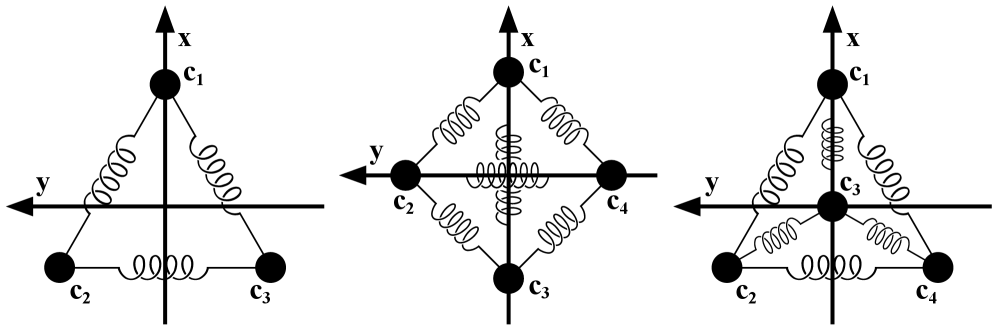
![A robotic system achieves coordinated movement through a distributed planning strategy, wherein a designated leader [latex]r_3[/latex] calculates a global path towards a desired formation, while subordinate robots navigate to assigned partial goals [latex]p_2, ..., p_N[/latex], maintaining formation integrity via virtual spring and damper connections.](https://arxiv.org/html/2602.18260v1/x1.png)
This work presents a role-adaptive formation path planning approach using virtual forces and dynamic leader-follower assignments for multi-quadruped robot systems in cluttered spaces.
Maintaining coordinated motion in teams of robots remains challenging in complex, unpredictable environments. This is addressed in ‘Role-Adaptive Collaborative Formation Planning for Team of Quadruped Robots in Cluttered Environments’, which introduces a novel framework for multi-robot navigation utilizing dynamic role assignment and a virtual force-based approach. The core contribution lies in a system that enables flexible, collision-free formation control by adaptively switching leadership and employing [latex]FM^2[/latex] path planning coupled with obstacle avoidance. Could this methodology pave the way for more robust and adaptable robotic teams capable of operating in truly unstructured real-world scenarios?
Deconstructing the Collective: The Challenge of Multi-Robot Navigation
The orchestration of multiple robotic agents introduces considerable difficulty, stemming from the inherent complexities of coordinating movement and decision-making across a distributed system. Unlike single robots navigating defined paths, a collective requires algorithms that account for inter-agent interference, communication delays, and the unpredictable nature of real-world environments. These challenges are dramatically amplified within complex spaces – think dense forests, cluttered warehouses, or even underwater – where obstacles, limited visibility, and dynamic changes demand constant adaptation and robust collision avoidance strategies. Successfully navigating such scenarios necessitates not just individual robot proficiency, but a cohesive system capable of decentralized problem-solving and maintaining a shared understanding of the surrounding world, a feat that pushes the boundaries of current robotics research.
Centralized control systems, while seemingly intuitive for coordinating groups of robots, encounter critical limitations as team size and environmental complexity increase. These architectures typically rely on a single processing unit to calculate and disseminate instructions to each robot, creating a bottleneck that hinders scalability; adding more robots exponentially increases computational load. Furthermore, the single point of failure presents a significant robustness issue – if the central unit malfunctions, the entire collective loses coordination. In dynamic scenarios – those with unpredictable obstacles or rapidly changing goals – the computational demands for recalculating optimal paths for every robot in real-time become prohibitive, leading to delays and potentially compromised mission success. Consequently, researchers are increasingly focused on decentralized approaches that distribute processing and decision-making across the robotic team, fostering both scalability and resilience.
Achieving robust formation control in multi-robot systems demands a delicate balance between maintaining pre-defined spatial relationships and reacting effectively to unforeseen changes in the environment. Robots must not only adhere to their designated positions relative to one another – a task requiring constant sensing and adjustment – but also dynamically adapt to obstacles, disturbances, or the failure of fellow team members. This necessitates algorithms capable of decentralized decision-making, allowing each robot to locally assess its surroundings and modify its trajectory without relying on a central coordinator. Successfully navigating this interplay between rigid structure and flexible response is crucial for applications ranging from coordinated search and rescue operations to precision agriculture and automated construction, where adaptability and resilience are paramount to mission success.
Emergent Order: Decentralized Strategies for Robust Formations
Behavior-based methods in formation control draw inspiration from biological systems, specifically the decentralized coordination observed in flocks of birds or schools of fish. These approaches prioritize the development of simple, reactive behaviors – such as maintaining a specific distance to neighbors, aligning with their velocity, or avoiding obstacles – which are executed locally by each robot. Rather than relying on a central controller or global planning, each robot responds directly to its immediate environment and the actions of nearby robots, leading to emergent formation behavior. This localized interaction minimizes communication requirements and increases the robustness of the formation to individual robot failures or communication disruptions, as the overall formation is not dependent on any single point of control.
The Virtual Structure Approach to multi-robot formation control conceptualizes the collective of robots as a single rigid body in a virtual space. This allows for the simplification of coordination algorithms; instead of each robot individually calculating trajectories relative to all others, calculations are performed on the virtual structure as a whole. The desired formation is represented by a graph where nodes represent robots and edges define the desired inter-robot distances and orientations. Transformations applied to the virtual structure – such as changes in direction or velocity – are then translated to individual robot commands, reducing computational complexity and facilitating predictable collective behavior. This method is particularly effective in scenarios requiring precise formation maintenance and coordinated maneuvers.
Maintaining a stable formation necessitates consistent proximity and collision avoidance between robots. Current strategies define a minimum inter-robot distance of 2 * 0.30 meters – or 0.60 meters – to guarantee safe operation. This distance is a critical parameter, directly influencing the formation’s robustness and preventing physical contact during movement or dynamic adjustments. Methods employed to achieve this include distributed sensing, local communication, and reactive behaviors that adjust robot velocities based on the positions of neighboring units, ensuring that the defined safety margin is consistently upheld.
Adaptive Swarms: Enhancing Adaptability with Dynamic Role Assignment
Leader-follower architectures represent a hierarchical approach to formation control wherein one or more robots are designated as leaders, and the remaining robots function as followers, maintaining a predefined spatial relationship with the leaders. This framework simplifies path planning by decomposing the problem into leader trajectory generation and follower tracking; the leaders define the overall formation path, while followers utilize local sensing and control algorithms – typically based on inter-robot distances and bearings – to adhere to the desired formation geometry. This approach is computationally efficient and scalable, particularly when compared to fully decentralized methods, as it reduces the complexity of coordinating movement across the entire group; however, the system’s robustness is dependent on the continued functionality of the leader unit(s).
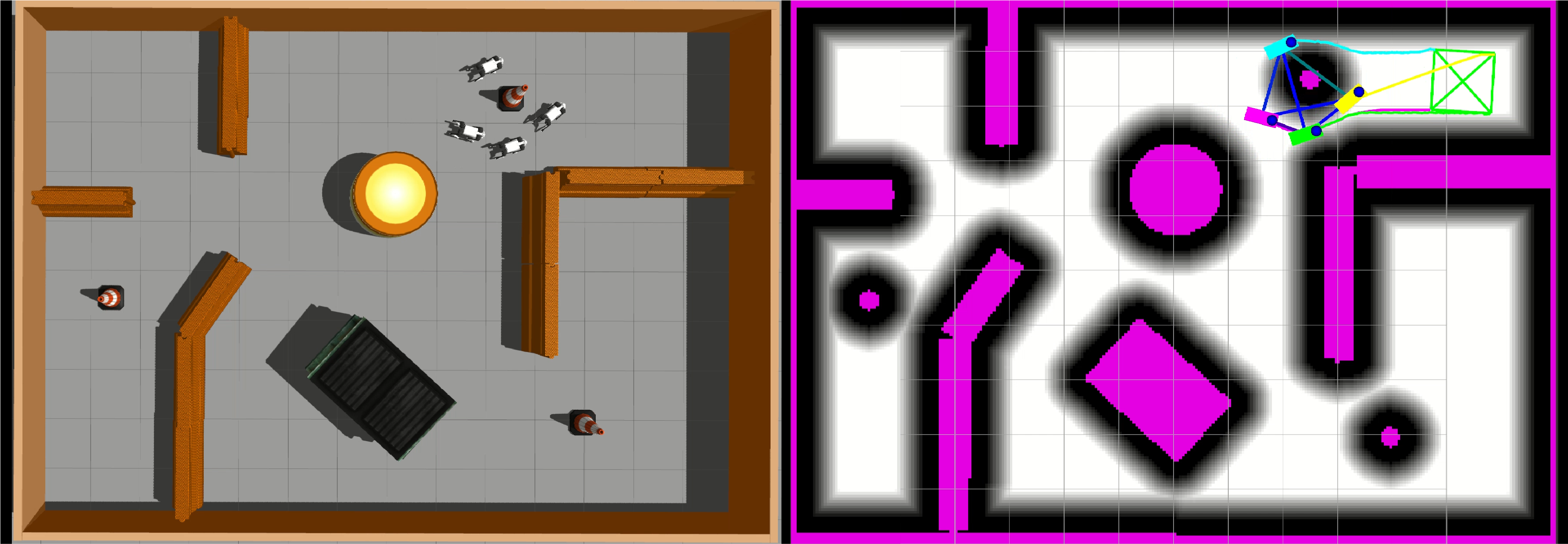
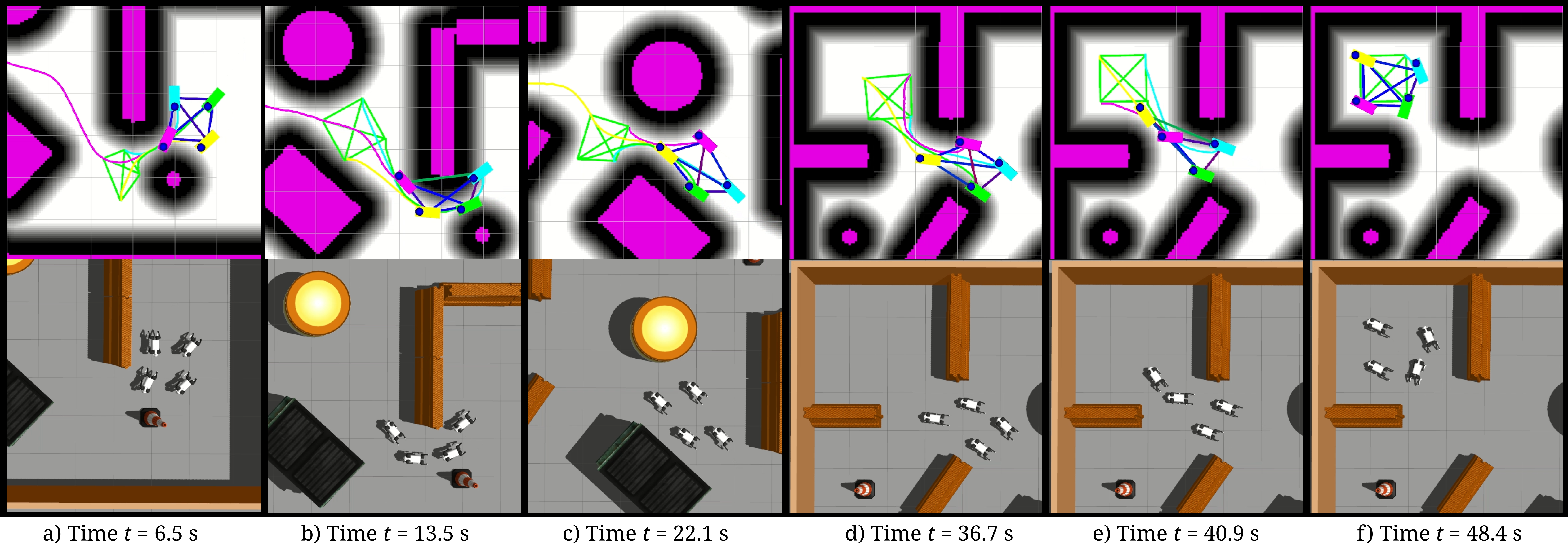
Role adaptation builds upon leader-follower architectures by enabling robots to change assignments within a formation during operation. This dynamic reassignment is crucial for maintaining formation integrity when individual robots experience failures or encounter obstacles. Instead of relying on static roles, the system allows robots to transition between leader, follower, or even vacant positions, redistributing workload and navigational responsibility. This adaptability enhances the overall resilience of the robotic formation, preventing complete disruption from single-point failures and enabling continued operation in dynamic environments, as demonstrated in testing scenarios utilizing between three and four robots in both a 9.5 x 6.5 m laboratory space and a 14×10 m simulated environment.
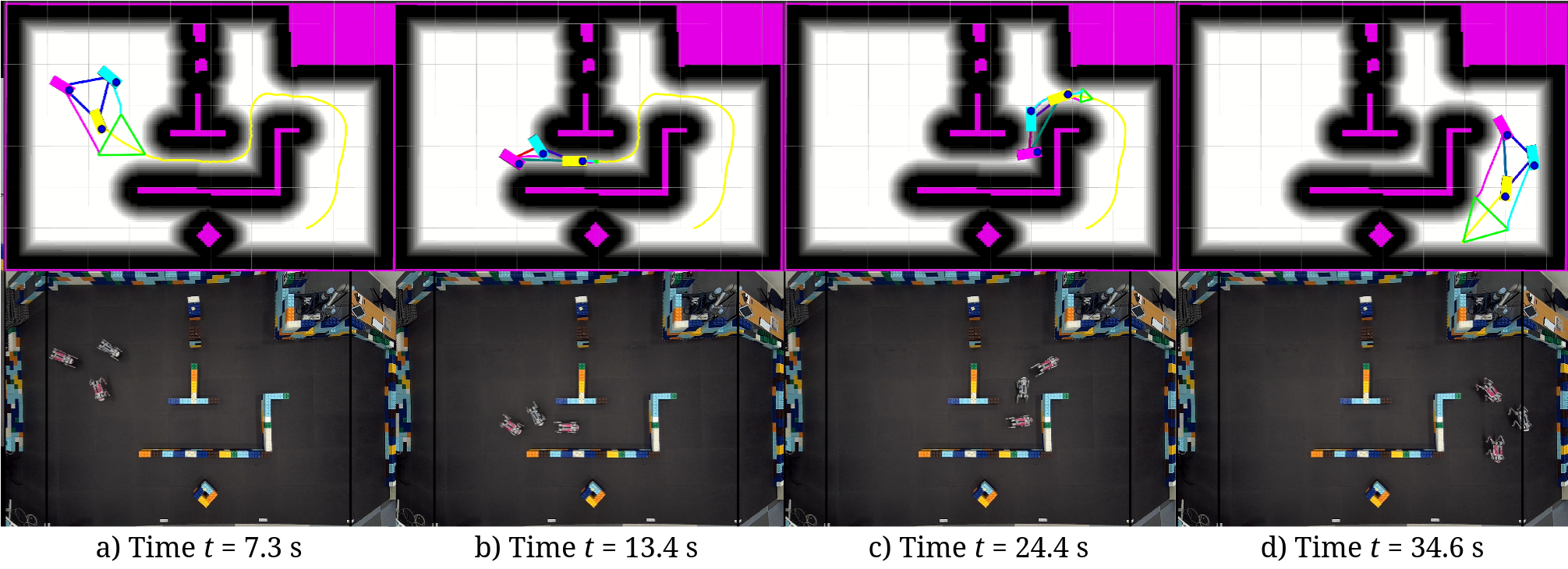
Evaluation of the proposed dynamic role assignment strategies was conducted using both physical experiments and simulation. Physical testing took place within a 9.5 x 6.5 meter laboratory environment, while the simulation environment measured 14 x 10 meters. These tests utilized robot groups consisting of either 3 or 4 units to assess the system’s ability to maintain formation integrity in the presence of individual robot failures and unanticipated obstacles. Results from both the physical and simulated environments demonstrate the effectiveness of dynamic role assignment in preserving formation stability under adverse conditions.
Simulating the Collective: Validation and the Pursuit of Robustness
The CHAMP Framework offers researchers and developers a versatile, open-source environment for modeling and analyzing the complex dynamics of quadruped robot movement and control. Built for adaptability, CHAMP isn’t limited to specific robot designs; it readily accommodates varied morphologies and kinematic structures, enabling exploration of diverse locomotion strategies. This flexibility is achieved through a modular architecture, allowing users to easily integrate custom components, sensors, and control algorithms. Beyond basic simulation, the framework provides tools for generating realistic environments, defining complex terrains, and applying external forces, which are critical for testing robot robustness. By providing a freely available and extensible platform, CHAMP aims to accelerate progress in legged robotics by fostering collaboration and simplifying the process of algorithm development and validation.
Accurate validation of robotic simulations relies heavily on the availability of precise, real-world data for comparison, and Vicon motion capture systems provide just that. These systems utilize arrays of infrared cameras to track the three-dimensional positions of markers placed on a robot, delivering highly accurate ground truth data regarding its movements. This data is crucial for verifying the fidelity of the simulation; discrepancies between simulated and captured movements can reveal flaws in the simulation’s physical models or control algorithms. By comparing the robot’s behavior in both the virtual and physical worlds, researchers can refine simulations to more realistically represent real-world performance, ultimately improving the reliability and robustness of robotic systems before deployment.
Through the integration of a robust simulation environment and precise motion capture data, researchers can now rigorously test and refine formation control strategies for quadruped robots in environments mirroring real-world complexity. Simulations operate at a rate of 20 Hz, providing a high-fidelity representation of dynamic movement, while an incorporated inflation radius of 0.30 meters – roughly half the length of a Unitree Go1 robot – effectively models obstacle avoidance behavior. This approach allows for systematic evaluation, enabling comparative analysis of various control algorithms and parameters without the risks and logistical challenges of physical experimentation, ultimately accelerating the development of more reliable and adaptable multi-robot systems.
The pursuit of robust robotic collaboration, as detailed in this framework for quadruped navigation, isn’t about imposing order-it’s about discovering the inherent order within chaos. The system’s adaptive role assignment, allowing robots to fluidly shift between leader and follower, mirrors a fundamental principle of complex systems: stability arises from dynamic equilibrium, not rigid control. As Carl Friedrich Gauss observed, “I prefer a beautiful hypothesis to a correct but messy one.” This research doesn’t simply solve the problem of formation path planning in cluttered environments; it elegantly models a solution, prioritizing adaptability and inherent stability over brute-force obstacle avoidance. The beauty lies in allowing the system to self-organize, echoing Gauss’s preference for elegance in understanding the universe.
Beyond the Formation
The presented framework, while demonstrating a capacity for coordinated locomotion in complex spaces, inevitably highlights the brittleness inherent in assigning ‘roles’ at all. The system functions by mitigating the problems arising from leader-follower architectures, rather than truly transcending them. One suspects the next iteration will require embracing genuine peer-to-peer negotiation-a constant re-evaluation of capability and intent, rather than pre-defined hierarchies. Consider the implications of a robot deliberately ‘failing’ a leadership challenge, forcing a more robust, distributed solution from the swarm.
Current obstacle avoidance strategies, predicated on reactive forces, reveal a fundamental limitation: they treat the environment as largely passive. True robustness demands anticipating environmental change-a fallen branch, a shifting load, even the deliberate interference of an external agent. The current model reacts; a future system must predict, and perhaps even manipulate, its surroundings to maintain formation. This necessitates integrating sensory input beyond simple collision detection-understanding material properties, predicting trajectories, and modeling the intent of other actors in the space.
Ultimately, the pursuit of ‘robustness’ through increasingly complex control algorithms feels somewhat circular. The real innovation will lie not in perfecting the plan, but in engineering a system that thrives despite its inevitable failures. A truly adaptive formation isn’t one that avoids chaos, but one that learns from it, reconfiguring itself not around a pre-defined goal, but around the emergent opportunities presented by an unpredictable world.
Original article: https://arxiv.org/pdf/2602.18260.pdf
Contact the author: https://www.linkedin.com/in/avetisyan/
2026-02-24 05:34