Author: Denis Avetisyan
Researchers have developed a system that transforms student performance data into engaging narratives, offering a more human-centered way to understand learning progress.
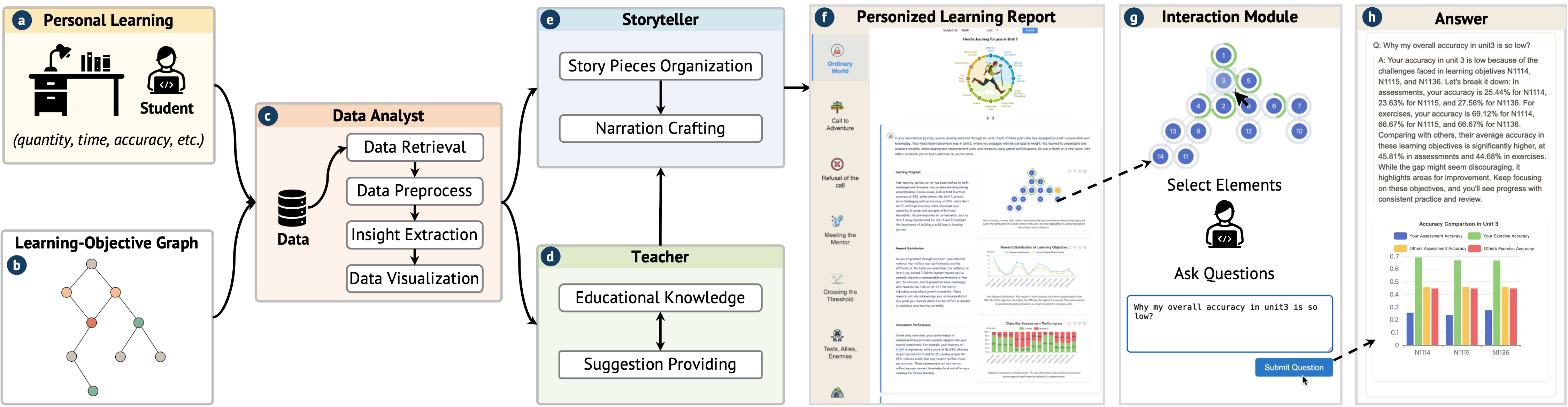
StoryLensEdu leverages multi-agent systems and large language models to automatically generate interactive, personalized learning reports.
While personalized learning is widely recognized as crucial for student success, conventional learning analytics often fall short in providing interpretable and engaging feedback. To address this, we introduce StoryLensEdu: Personalized Learning Report Generation through Narrative-Driven Multi-Agent Systems, a novel system that automatically generates interactive learning reports by integrating data-driven insights with the compelling structure of narrative storytelling. This multi-agent system leverages large language models to transform raw learning data into personalized accounts of student progress, enhancing both comprehension and engagement. Could this approach unlock new avenues for fostering self-regulated learning and deeper understanding of the learning process itself?
The Illusion of Insight: Why Dashboards Fail Us
Despite their capacity to collect and display extensive data, traditional learning analytics dashboards frequently fall short in converting raw information into genuinely useful knowledge for both students and educators. These interfaces often present data as isolated metrics – grades, completion rates, time spent on tasks – without providing the necessary context or interpretation to facilitate meaningful action. The sheer volume of data can be overwhelming, leading to analysis paralysis rather than informed decision-making. Consequently, valuable insights remain hidden within the numbers, hindering students’ ability to identify areas for improvement and limiting teachers’ capacity to provide targeted support. The focus tends to be on what happened, rather than why it happened, and crucially, what can be done to change future outcomes, ultimately diminishing the potential of learning analytics to drive positive change.
The capacity for self-directed learning, while increasingly valued, often presents a significant challenge for students navigating complex educational landscapes. Research indicates that learners frequently require more than simply access to data; they benefit substantially from personalized guidance that adapts to their individual progress and learning styles. Crucially, this support isn’t solely about identifying knowledge gaps, but also providing contextualized feedback – explanations that connect performance to specific learning objectives and suggest actionable steps for improvement. Without such tailored support, students may struggle to interpret data effectively, leading to frustration, disengagement, and ultimately, hindering their ability to take ownership of their learning journey. This highlights the need for learning analytics systems that move beyond merely presenting data and instead actively facilitate understanding and informed action.
The prevailing approaches to learning analytics often present data as isolated metrics, overlooking the powerful role of narrative in fostering genuine student engagement. Research indicates that information is far more readily absorbed and retained when framed within a compelling story or contextualized journey. A lack of narrative structure diminishes intrinsic motivation, leaving students to passively receive data rather than actively interpret it and apply it to their learning process. Consequently, insights remain abstract and fail to translate into behavioral changes or improved self-regulation. By integrating narrative elements – such as personalized learning paths, progress visualizations that tell a story of growth, and feedback framed as encouraging milestones – learning analytics can move beyond simply reporting data to inspiring meaningful action and a deeper connection to the learning experience.
The Multi-Agent System: A Decentralized Approach to Insight
StoryLensEdu employs a Multi-Agent System (MAS) architecture to convert unprocessed student data into individualized learning reports. This approach utilizes a decentralized computational model where distinct, autonomous agents collaborate to achieve a common goal – generating comprehensive student progress narratives. Raw data, sourced from learning management systems and assessments, is first ingested and processed by dedicated agents. This decomposition of the reporting task allows for specialized data handling and analysis, contrasting with traditional, monolithic reporting systems. The MAS framework facilitates a modular design, enabling easier adaptation to new data sources and reporting requirements, and supports scalability for large student populations.
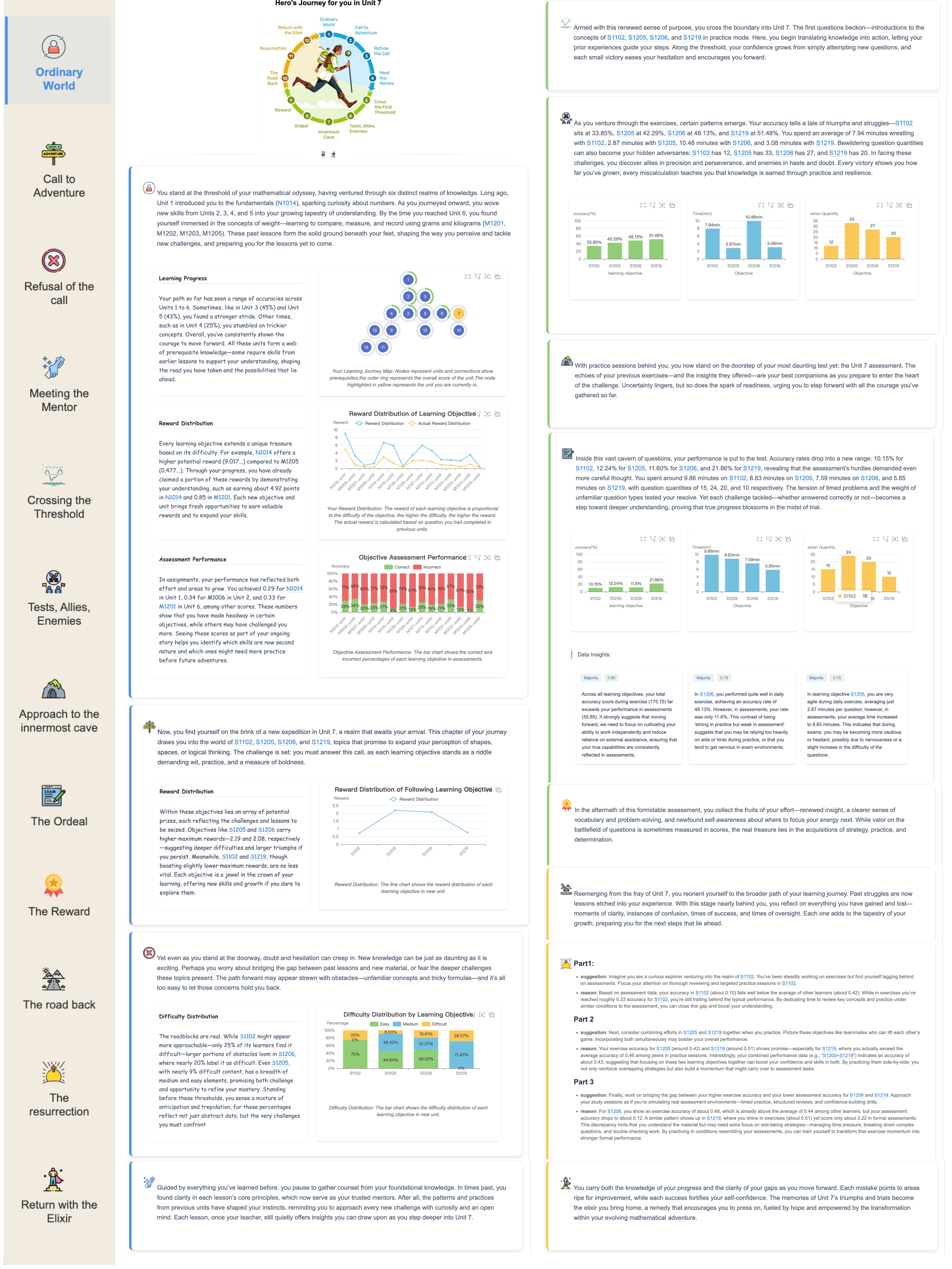
StoryLensEdu employs a multi-agent system comprised of three distinct agents: the Data Analyst, the Teacher, and the Storyteller. The Data Analyst agent is responsible for processing raw student data, identifying patterns, and extracting key performance indicators. The Teacher agent then interprets this analyzed data to formulate educational insights and recommendations tailored to individual student needs. Finally, the Storyteller agent translates these insights into a cohesive and understandable narrative report, presenting the information in a compelling and accessible format. This division of labor allows for both rigorous data analysis and effective communication of educational progress.
StoryLensEdu’s decomposition of the learning report generation process into distinct agent roles – data analysis, educational interpretation, and narrative construction – enables a level of performance beyond traditional static dashboards. Static dashboards typically present data without contextualization or personalized interpretation, requiring educators to manually synthesize insights. In contrast, StoryLensEdu’s modular design allows for rigorous quantitative analysis of student data by the Data Analyst agent, followed by pedagogical framing from the Teacher agent, and finally, the creation of a coherent and understandable narrative by the Storyteller agent. This division of labor ensures both analytical accuracy and narrative clarity, addressing the limitations of systems that attempt to combine these functions within a single, monolithic structure.
The Anatomy of Insight: How StoryLensEdu Constructs Narratives
The Data Analyst Agent functions by leveraging Large Language Model (LLM)-powered agents to process student data and identify key performance indicators. This agent doesn’t simply report raw data; it structures its analysis around a pre-defined Learning Objective Graph, which maps out the sequential skills and knowledge required for mastery of a subject. The LLM agents are trained to recognize patterns in student work – including assignment submissions, quiz results, and participation metrics – and correlate these patterns with specific nodes within the Learning Objective Graph. This allows the agent to pinpoint not only what a student is struggling with, but where in the learning pathway the difficulty arises, providing a granular understanding of individual student needs. The output of this agent is a structured set of insights organized by learning objective, forming the foundation for further refinement by the Teacher Agent.
The Teacher Agent functions as a critical validation layer, reviewing data insights generated by the Data Analyst Agent to confirm pedagogical soundness and alignment with established learning objectives. This agent doesn’t simply accept raw data; it applies educational expertise to assess the validity of identified patterns and potential interventions. Importantly, the Teacher Agent personalizes recommendations by considering individual student profiles, learning styles, and pre-existing knowledge gaps. This tailoring process ensures that suggestions are not only accurate from an educational standpoint, but also appropriately leveled and targeted to maximize impact for each learner, addressing specific needs rather than offering generalized advice.
The Storyteller Agent utilizes the Hero’s Journey narrative framework – a common archetypal story structure consisting of stages like the Ordinary World, Call to Adventure, Crossing the Threshold, Tests, Allies, and Enemies, Approach, Crisis, Treasure, and Return – to present student performance data in an engaging format. This framework transforms analytical insights into a narrative where the student is positioned as the ‘hero’ overcoming learning ‘challenges’. Specifically, extracted data points, such as skill proficiency levels and areas requiring improvement, are mapped to relevant stages within the Hero’s Journey, creating a personalized storyline that highlights progress and motivates continued learning. The resulting report isn’t simply a list of data, but a structured narrative designed to enhance comprehension and emotional connection with the learning process.
Evaluation of the StoryLensEdu report generation process demonstrates consistently high clarity, as evidenced by mean scores of 4.5 out of 5 from both student and teacher user groups. This score reflects the system’s ability to effectively communicate data-driven insights in a manner accessible and understandable to diverse audiences. The layered approach – combining data analysis, educational refinement, and narrative structuring – is directly correlated with these positive clarity ratings, indicating a successful balance between informative content and user engagement. These scores are based on aggregated responses from pilot program participants and represent a statistically significant improvement over traditional reporting methods.
Beyond Observation: Empowering Learners Through Interactive Exploration
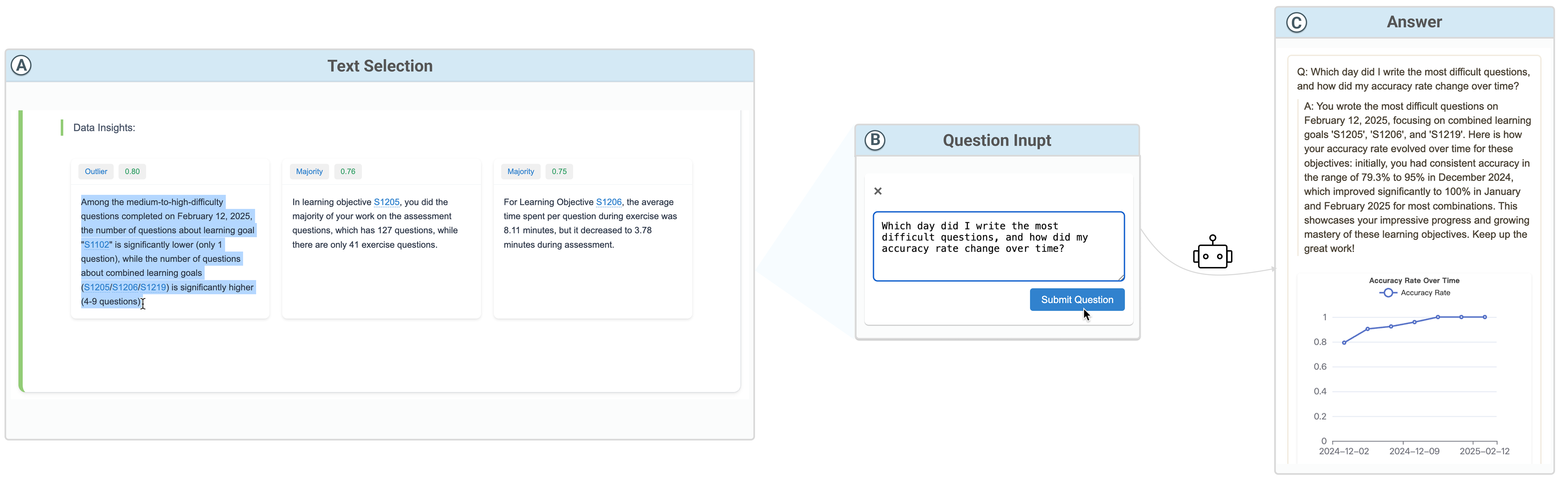
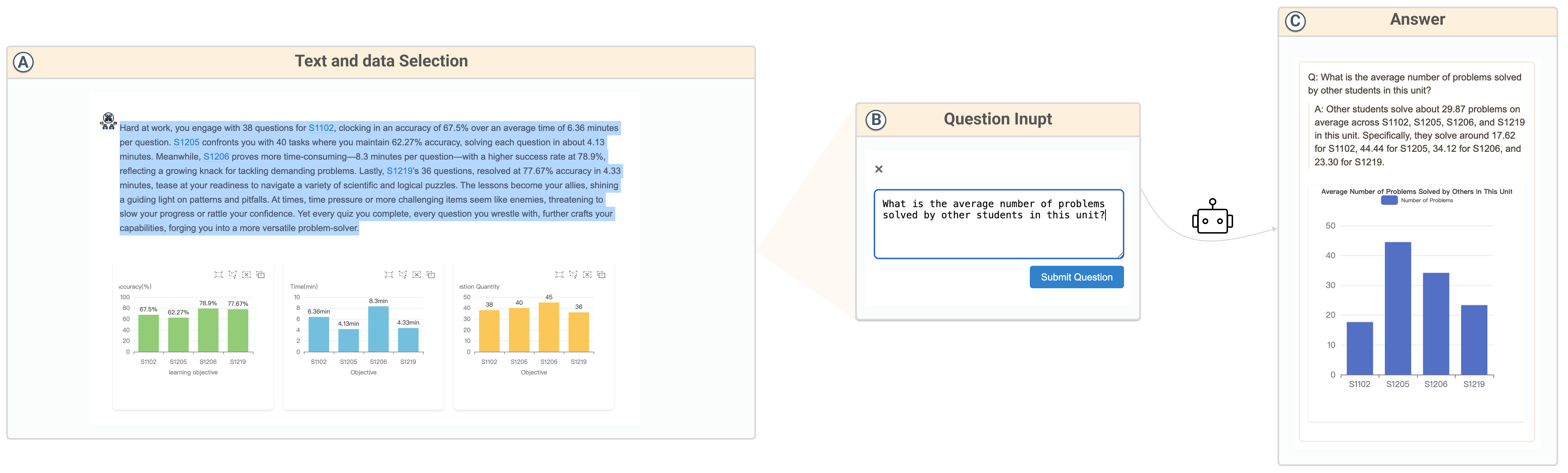
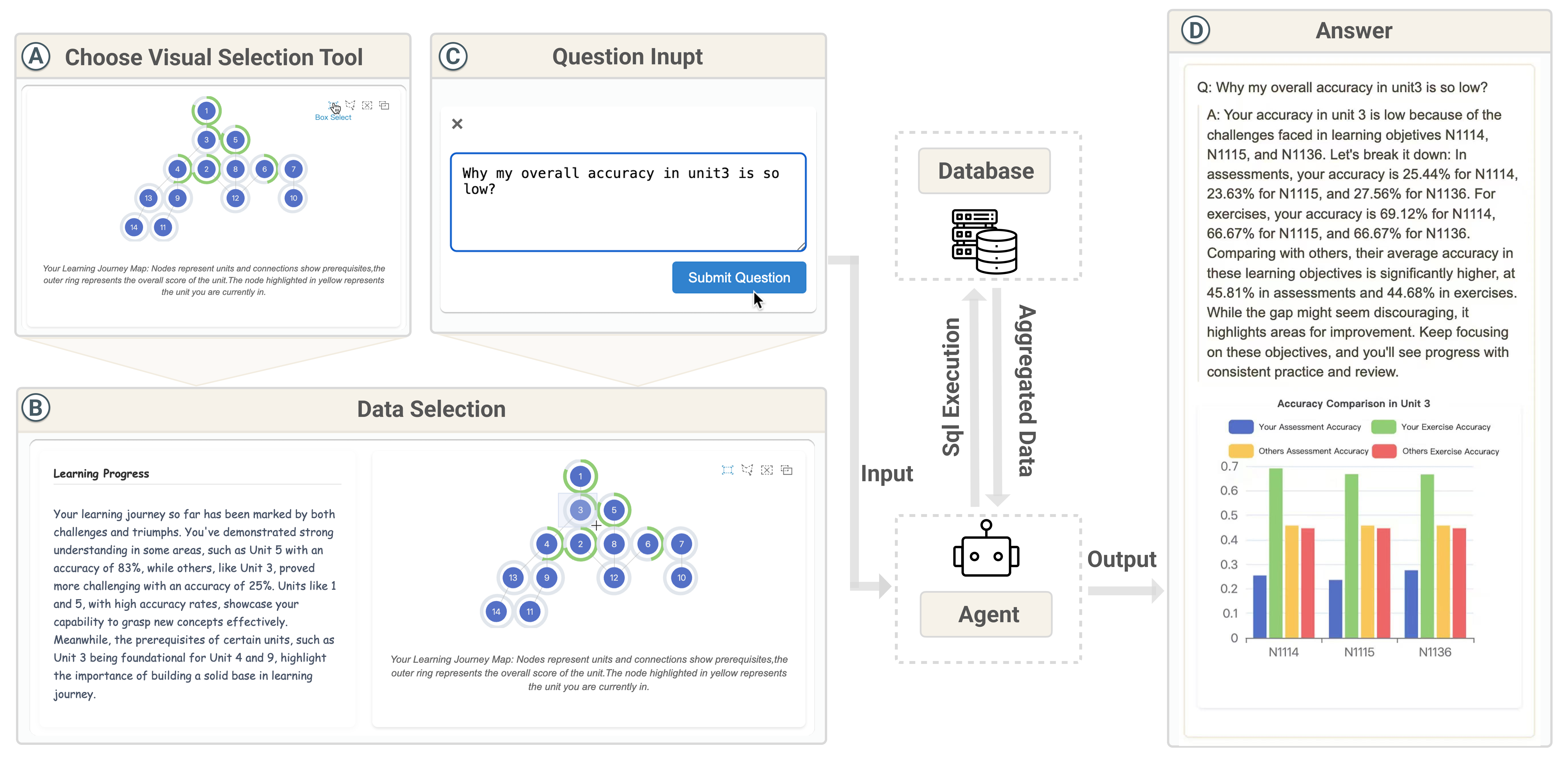
StoryLensEdu distinguishes itself through an integrated Interactive Question Answering system, moving beyond static report generation to facilitate dynamic data exploration. This functionality permits both students and educators to directly query the visualized information, uncovering the specific details underpinning broader trends and insights. Rather than passively receiving summaries, users can pose targeted questions – such as “Which students struggled most with this concept?” or “How did performance change over time?” – and receive immediate, data-driven answers. This capability not only deepens understanding of the generated reports, but also cultivates analytical skills as users learn to formulate insightful questions and interpret the resulting evidence, effectively transforming data into actionable knowledge.
StoryLensEdu moves beyond passive reception of information by actively involving students in the learning process. The platform’s interactive features allow learners to question, probe, and dissect generated reports, fostering a sense of intellectual ownership over the material. Rather than simply receiving conclusions, students construct their own understanding through exploration of the underlying data, leading to deeper engagement and improved retention. This approach cultivates a proactive learning style where students are not merely told what to think, but empowered to discover it for themselves, thereby strengthening critical thinking skills and a more personalized learning journey.
StoryLensEdu actively supports formative assessment by providing students with opportunities to pinpoint specific areas needing further development and adjust their approaches to learning. The platform doesn’t simply deliver information; it encourages introspection and self-evaluation, enabling students to move beyond rote memorization. Through interactive exploration of generated reports, students can identify knowledge gaps and refine their learning strategies in real-time, fostering a more dynamic and personalized educational experience. This emphasis on self-directed improvement cultivates not only a deeper understanding of the subject matter, but also the essential skills necessary for lifelong learning and academic success.
Evaluations of StoryLensEdu reveal a notably intuitive design, consistently scoring high marks from both students and educators. Student assessments averaged 4.6 out of 5 regarding the clarity of presented charts, while teachers rated chart clarity even higher at a perfect score of 5.0. Further reinforcing the platform’s ease of use, students and teachers respectively provided scores of 4.6 and 4.8 when evaluating the interactive exploration features, indicating a strong capacity for users to readily navigate and benefit from the deeper data insights offered by the system. These findings suggest that StoryLensEdu effectively bridges the gap between complex data and accessible understanding, fostering a user experience that is both engaging and informative.
StoryLensEdu transcends the role of a simple educational tool, striving instead to foster the development of self-directed learning capabilities in students. The platform is designed not merely to deliver information, but to equip learners with the skills to actively monitor their own comprehension, identify knowledge gaps, and strategically adjust their learning approaches. By encouraging ongoing reflection and providing accessible data regarding individual progress, StoryLensEdu aims to cultivate intrinsic motivation and a proactive stance toward education. This focus on self-regulation extends beyond the immediate curriculum, preparing students to become independent, resourceful, and lifelong learners capable of navigating complex information and pursuing knowledge throughout their lives.
The system, as described, doesn’t build understanding; it cultivates it. StoryLensEdu, with its multi-agent choreography and LLM-driven narratives, recognizes this implicitly. It doesn’t merely present data; it weaves a story around the data, attempting to resonate with the individual learner. This echoes a sentiment articulated by Carl Friedrich Gauss: “I would rather explain one idea to one person than explain ten ideas to a hundred.” The system aims for that singular connection, that personalized resonance. The core concept of personalized learning isn’t about scaling information, but about focusing attention-a single, clear signal amidst the noise, delivered through a carefully constructed narrative. The agents aren’t constructing reports, they are tending an ecosystem of understanding.
What Lies Ahead?
StoryLensEdu, in its attempt to weave narrative from the threads of learning data, illuminates a fundamental tension. The system doesn’t solve the problem of personalized learning; it merely externalizes the inherent instability of any model attempting to represent a student. Each generated report isn’t a conclusion, but an invitation to further questioning-a beautifully rendered map of what remains unknown. Monitoring, after all, is the art of fearing consciously.
The true challenge isn’t generating more compelling visualizations or refining the prompts to large language models. It’s accepting that any such system will inevitably propagate its own blind spots, amplifying certain patterns while obscuring others. The system’s value resides not in its predictive power, but in its capacity to reveal the limits of prediction. That’s not a bug-it’s a revelation.
Future work must abandon the quest for a definitive “student model.” Instead, research should focus on systems that actively negotiate their understanding with the learner, treating each report not as a statement of truth, but as a provisional hypothesis. True resilience begins where certainty ends, and the most valuable learning analytics won’t offer answers, but cultivate a more sophisticated and humble form of inquiry.
Original article: https://arxiv.org/pdf/2602.17067.pdf
Contact the author: https://www.linkedin.com/in/avetisyan/
2026-02-22 23:17