Author: Denis Avetisyan
New research demonstrates how grounding artificial intelligence in executable environments and reflective agents dramatically improves its ability to solve complex agricultural challenges.
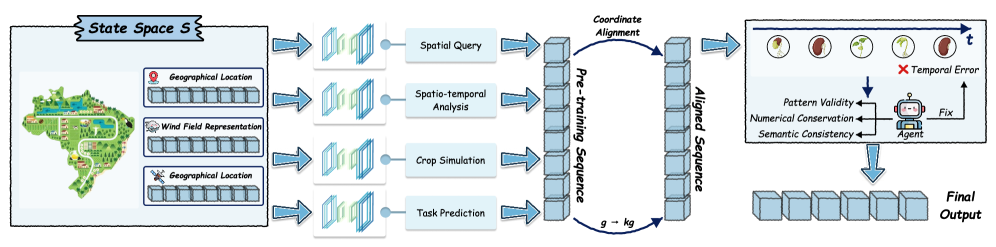
This paper introduces AgriWorld, a framework for verifiable agricultural reasoning using code-executing agents and spatiotemporal data.
While foundation models excel at forecasting in agriculture, they lack the interactive reasoning needed for complex real-world workflows, and large language models struggle with high-dimensional spatiotemporal data-a limitation addressed by ‘AgriWorld:A World Tools Protocol Framework for Verifiable Agricultural Reasoning with Code-Executing LLM Agents’. This work introduces an agentic framework, AgriWorld, providing a Python execution environment and a reflective agent, Agro-Reflective, to bridge this gap and enable verifiable reasoning over agricultural data. Experiments demonstrate that grounding LLMs in executable code significantly outperforms text-only and direct tool-use approaches-validating execution-driven reflection for reliable agricultural insights. Could this framework unlock a new era of data-driven decision-making and automated problem-solving in agronomy?
The Inevitable Friction of Spatial and Temporal Data
Conventional artificial intelligence systems in agriculture often falter when faced with the intricate interplay of space and time that defines real-world farming. These systems typically struggle to effectively integrate data streams such as remote sensing imagery – revealing crop health and field variations – with dynamic weather patterns and highly localized field conditions like soil moisture and nutrient levels. This difficulty arises because traditional algorithms are often designed for static datasets or simple time series, lacking the capacity to reason about how conditions change across a field over time. Consequently, interpreting the combined effect of these factors – for example, predicting the impact of forecasted rainfall on crop stress in a specific soil type – proves challenging, limiting the potential for truly optimized and responsive agricultural practices.
Despite the remarkable advancements in natural language processing, Large Language Models (LLMs) encounter significant limitations when applied to precision agriculture. These models excel at identifying patterns and generating text, but they fundamentally lack the built-in capacity to directly process and reason with the complex spatiotemporal data crucial for effective farming. Unlike data types readily consumed by LLMs – such as text or code – agricultural data consists of dynamic, geographically-referenced information like satellite imagery, weather forecasts, soil conditions, and crop growth stages. Bridging this gap requires translating this rich data into a textual format, a process that inevitably leads to information loss and hinders the model’s ability to make nuanced, location- and time-sensitive decisions. Consequently, while LLMs can assist with tasks like summarizing agricultural reports, their potential for truly automating complex tasks – such as optimizing irrigation schedules or predicting crop yields with high accuracy – remains largely unrealized without substantial modifications and integration with specialized spatiotemporal data processing techniques.
Agricultural automation’s next leap forward demands a shift from purely text-based artificial intelligence to systems capable of robust spatiotemporal reasoning. Traditional methods struggle to integrate the dynamic interplay of location, time, and environmental factors crucial to crop health and yield prediction; analyzing data from remote sensors, weather forecasts, and in-field observations requires understanding how conditions change across space and over time. Simply processing text descriptions of these conditions is insufficient; effective automation necessitates algorithms that can directly interpret patterns in spatiotemporal data, enabling proactive adjustments to irrigation, fertilization, and pest control. This move beyond text allows for more precise interventions, optimizing resource use and ultimately enhancing agricultural sustainability and productivity by responding to the evolving conditions of each field, at each moment.
Constructing a Digital Twin: The World-Tools-Protocol Framework
The World-Tools-Protocol Framework establishes an agricultural assistant by implementing the AgriWorld executable environment. This environment serves as a standardized interface, offering a unified Application Programming Interface (API) for fundamental agricultural operations. Core functionalities, including data retrieval, task execution, and result reporting, are accessible through this API, irrespective of the underlying tool or data source. AgriWorld abstracts the complexities of individual agricultural tools, presenting a consistent interaction model for external agents and enabling programmatic control over agricultural processes. This formalization allows for reproducible experimentation and automated workflows within the agricultural domain.
The World-Tools-Protocol Framework facilitates the integration of critical agricultural functionalities through standardized interfaces. Specifically, the framework supports Geospatial Querying, allowing for data retrieval regarding field boundaries, soil types, and environmental conditions, and Crop Simulation, enabling predictive modeling of yield, growth stages, and resource requirements. These tools are not operated in isolation; the framework provides a unified execution environment, `AgriWorld`, and API, ensuring seamless data exchange and coordinated operation between querying, simulation, and other integrated agricultural technologies. This cohesive system enables complex agricultural tasks to be broken down into discrete, executable steps, improving efficiency and analytical capabilities.
The World-Tools-Protocol Framework addresses the challenge of translating Large Language Model (LLM) outputs into actionable agricultural tasks by establishing a defined protocol for interaction with a dedicated executable environment. This environment, `AgriWorld`, serves as an intermediary, receiving instructions formulated according to the protocol and converting them into concrete operations on agricultural data and simulations. Specifically, LLM reasoning is decoupled from the complexities of tool execution; the LLM proposes a high-level plan, which the framework then interprets and executes via integrated tools like geospatial querying and crop simulation. This separation ensures reliable and verifiable execution of LLM-driven agricultural strategies, preventing direct manipulation of real-world systems and enabling controlled experimentation and validation of LLM recommendations.
The Agro-Reflective Agent: An Iterative Loop of Correction
The Agro-Reflective Agent is a Large Language Model (LLM) enhanced with external tools to facilitate verifiable reasoning and self-correction processes. This agent operates within the World-Tools-Protocol Framework, a system designed to connect the LLM to a suite of specialized tools and to standardize the communication between the LLM and these tools. The tool-augmentation allows the agent to move beyond purely generative capabilities and perform actions with verifiable outputs, increasing reliability and enabling iterative refinement of its responses. This framework allows the agent to not only generate answers, but to validate them through external tools, forming the basis of its reflective capabilities and improving performance on complex tasks.
The Agro-Reflective Agent employs an iterative execute-observe-refine loop to maintain action accuracy and validity. This process begins with the agent executing a task based on available tools and data. Following execution, Execution Feedback is generated, providing a detailed assessment of the action’s outcome and any discrepancies between the expected and actual results. This feedback is then used to refine the agent’s subsequent actions, enabling it to correct errors and improve performance over multiple iterations. The loop continues until a pre-defined level of accuracy is achieved or a maximum number of iterations is reached, ensuring reliable and verifiable reasoning throughout the process.
The Agro-Reflective Agent incorporates three core capabilities essential for robust spatiotemporal data processing: Spatial Alignment, which georeferences data to a consistent coordinate system; Unit Conversion, enabling calculations across differing measurement systems; and Time-Series Analytics, facilitating the analysis of data collected over time. These functionalities collectively contribute to the agent’s performance, demonstrated by a state-of-the-art aggregate Quality Assurance (QA) score of 7.72 out of a possible 5.41 on the AgroBench benchmark, indicating a high degree of accuracy and reliability in agricultural data analysis.
Validation as a Principle: Establishing Confidence in the System
To establish confidence in the performance of the Agro-Reflective Agent, a comprehensive Verifiable Evaluation Suite was developed, centered around the principle of automated, reproducible testing. This suite leverages Executable Checkers – programs designed to rigorously assess the agent’s outputs against predefined criteria – enabling consistent and objective evaluation. By automating the testing process, the suite minimizes subjective bias and ensures that performance gains aren’t simply artifacts of specific test conditions. This methodical approach moves beyond simple performance metrics, fostering a deeper understanding of the agent’s capabilities and limitations in a manner that’s both transparent and easily verifiable by the wider research community.
To rigorously assess the capabilities of the agent in practical agricultural scenarios, researchers developed AgroBench, a dedicated benchmark focusing on realistic farming tasks. This benchmark moves beyond generalized evaluations by specifically challenging the agent with complexities inherent to agriculture, such as crop yield prediction and resource management. Notably, the agent demonstrated substantial performance gains when evaluated on AgroBench, significantly exceeding the capabilities of large, general-purpose models that lack specialized agricultural knowledge. This outcome highlights the importance of targeted evaluation metrics and datasets for assessing the effectiveness of artificial intelligence in domain-specific applications, demonstrating that tailored training and assessment yield substantially improved results in complex real-world contexts.
The system demonstrates a marked advantage when processing intricate spatiotemporal datasets, notably remote sensing data, achieving a substantial 47% reduction in forecasting error as measured by a Normalized Root Mean Squared Error (NRMSE) of 0.18 when contrasted with a one-shot baseline. This capability extends to maintaining accuracy even when applied to geographically distinct areas – spatial out-of-distribution testing revealed only a 12% drop in performance, a significant improvement over the 55% decrease observed in text-only models. These results highlight the framework’s robustness and its ability to generalize effectively, suggesting a superior capacity to handle the complexities inherent in real-world agricultural forecasting and spatial analysis.
The Inevitable Expansion: Towards a Generalizable Agricultural Intelligence
Future investigations are set to refine the large language model’s performance through the implementation of Low-Rank Adaptation. This technique allows for efficient customization of the model to unique agricultural contexts, such as specific geographical regions and individual crop types, without the need for extensive retraining. By focusing on adapting only a small subset of the model’s parameters, researchers aim to significantly reduce computational costs and accelerate the development of specialized agricultural AI tools. This targeted approach promises to enhance the model’s accuracy and relevance in diverse farming environments, ultimately improving its ability to address localized challenges and optimize crop yields with minimal resource expenditure.
The potential of the Agro-Reflective Agent is directly linked to the continued development of its operational environment, AgriWorld. Expanding AgriWorld’s API and toolset isn’t simply about adding features; it’s about creating a more nuanced and comprehensive digital representation of agricultural realities. Future iterations will incorporate tools for advanced soil analysis, hyper-local weather forecasting, and detailed pest and disease modeling, allowing the agent to formulate more informed and effective strategies. A richer API will also facilitate integration with external data sources – satellite imagery, market prices, and supply chain logistics – fostering a truly interconnected and responsive agricultural intelligence system. This broadened capability promises to move the agent beyond task completion toward proactive problem-solving and optimization across the entire farming lifecycle, ultimately enhancing agricultural resilience and productivity.
The developed framework demonstrates a significant advancement in intelligent agricultural systems, offering both scalability and the ability to generalize across diverse farming scenarios. Rigorous counterfactual analysis reveals a substantial performance increase – achieving a 71.4% success rate in evaluating ‘what if’ scenarios – compared to a 43.8% rate observed in a baseline ‘one-shot’ approach. This improved capability suggests the framework isn’t simply memorizing solutions, but rather developing a robust understanding of agricultural dynamics, allowing it to adapt and problem-solve effectively even when faced with altered conditions. The demonstrated generalization potential positions this work as a promising foundation for addressing the increasingly complex challenges facing modern agriculture, from optimizing resource allocation to mitigating the impacts of climate change.
The pursuit of verifiable agricultural reasoning, as detailed in this work, echoes a fundamental truth about complex systems. It isn’t simply about assembling components-large language models, spatiotemporal data, executable environments-but about fostering an ecosystem where errors propagate and dependencies accumulate. As Carl Friedrich Gauss observed, “Errors creep in everywhere, even in the best calculations.” This paper’s emphasis on grounding LLMs in an executable, reflective agent isn’t about eliminating error-that is an impossible task-but about creating a system that can detect and, potentially, mitigate the inevitable creep of inaccuracies inherent in reasoning about the real world. The Agro-Reflective loop, therefore, isn’t a solution, but a continuous adaptation to the ever-present potential for systemic failure.
The Growing Season Ahead
The pursuit of verifiable reasoning in complex domains invariably reveals the limitations of ‘grounding’ itself. This work, while demonstrating improved accuracy through executable environments, merely postpones the inevitable drift. Every carefully constructed ‘World-Tools-Protocol’ is, at its core, a prediction of future incompatibility. Scalability is just the word used to justify complexity, and a perfectly mirrored agricultural reality within code remains an asymptotic goal. The system doesn’t solve the problem of spatiotemporal uncertainty; it encodes a specific, and therefore temporary, understanding of it.
Future efforts will likely concentrate on the meta-level – not on building more elaborate tools, but on cultivating the capacity for systems to adapt to their own failures. Agro-reflective agents, capable of revising their internal models based on observed discrepancies, suggest a more promising path than ever-more-detailed simulations. The focus shifts from correctness to resilience – from seeking the ‘right’ answer to building systems that gracefully accommodate being wrong.
Ultimately, the perfect architecture is a myth to keep sane. The real challenge isn’t building an intelligent agricultural assistant; it’s accepting that any such creation will be a transient artifact, constantly in need of tending and revision. Everything optimized will someday lose flexibility, and the most valuable systems will be those designed to acknowledge, and even embrace, their own eventual obsolescence.
Original article: https://arxiv.org/pdf/2602.15325.pdf
Contact the author: https://www.linkedin.com/in/avetisyan/
2026-02-18 16:53