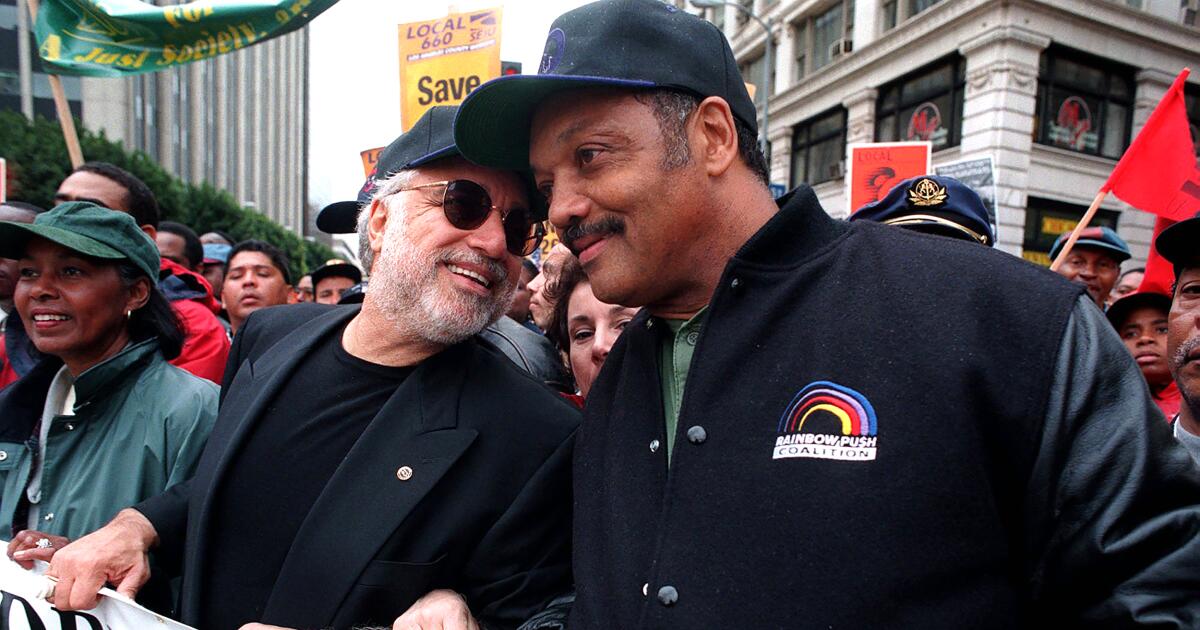
In 1994, the Rev. Jesse Jackson declared war on Hollywood.
The civil rights leader, who passed away on Tuesday, also challenged the entertainment industry, arguing that it suffered from systemic racism. He specifically criticized the underrepresentation of people of color and women – a problem that remains relevant even now.
Jesse Jackson used his energetic and passionate approach to challenge leaders in the entertainment industry. He created the Rainbow Coalition on Fairness in the Media – a branch of his existing Rainbow Coalition dedicated to social and economic justice – and warned that projects lacking diversity would face public boycotts.
During a press conference, Jackson drew parallels between his campaign and the historic Selma march, as well as other civil rights protests. He stated that some entities believe they can exclude people from being recruited, hired, promoted, represented, or included in decision-making. However, he emphasized the power of consumers and viewers to demand change, asserting that media companies have an opportunity to address these issues and improve their inclusivity efforts now.
This announcement stood out sharply from Jackson’s earlier, lively appearances on “Saturday Night Live” in 1984 and his beloved reading of “Green Eggs and Ham” on the show in 1991.
Despite being a naturally commanding and media-friendly figure, Jesse Jackson’s presidential campaign struggled to gain real traction, with inconsistent results. He didn’t receive widespread support from Black actors and creatives in Hollywood, and some civil rights leaders felt he’d lost sight of key issues. The lack of support was even publicly highlighted when Whoopi Goldberg joked about his campaign while hosting the 1996 Oscars.
By 1997, the battle had fizzled out and Jackson had moved on to more political concerns.
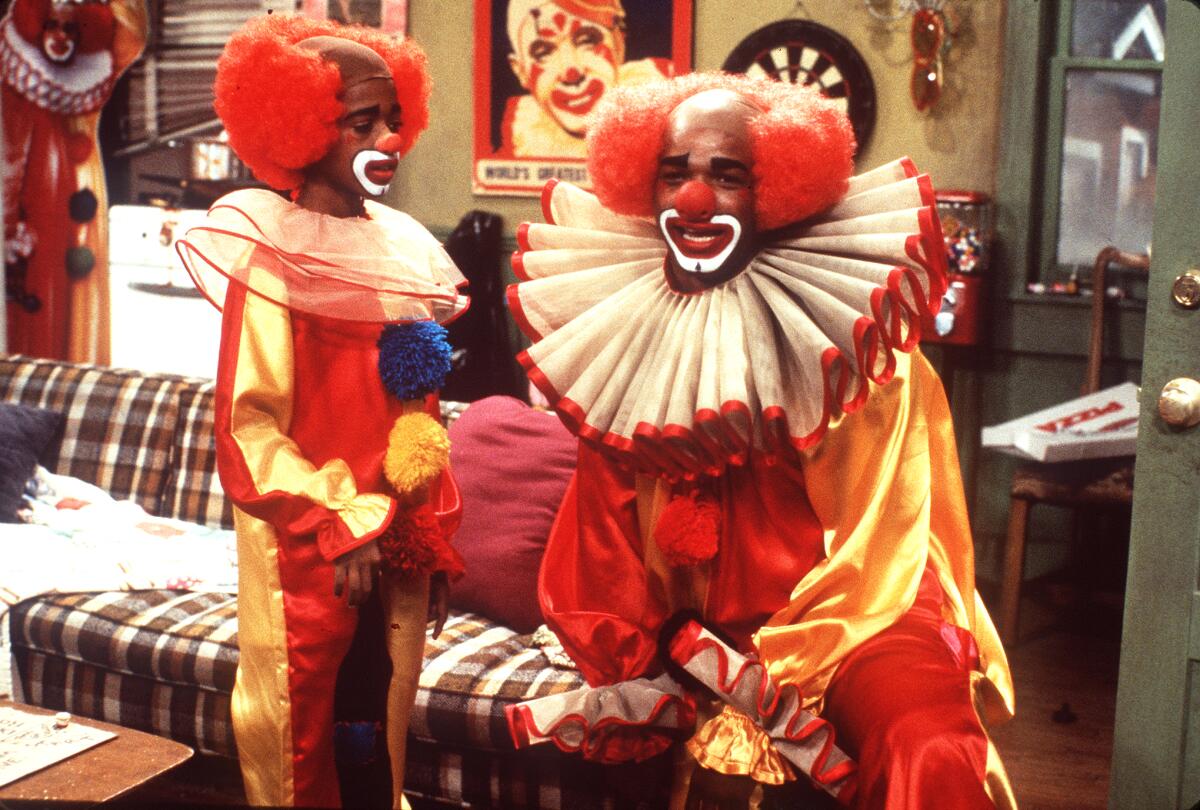
As a longtime movie and TV fan, I remember a real turning point back in July 1994. Several shows on Fox that really showcased Black talent – things like “South Central,” “Roc,” “In Living Color,” and even “The Sinbad Show” – were all suddenly canceled. It felt like a huge step backward, and honestly, I shared Michael Jackson’s worry that the fall TV season wouldn’t offer much more diversity. It was frustrating to see those voices disappear so quickly.
Jackson expressed worry about several shows being cancelled by Fox this season. He shared this concern at a press conference held at the African American Community Unity Center, alongside Brotherhood Crusade founder Danny Bakewell and comedian Sinbad, known for his self-titled sitcom.
Jackson pointed out that this issue wasn’t unique to one network. He cited data from NBC, describing it as significant and concerning, and predicted similar problems with CBS’s upcoming fall programming. He argued that all these networks were essentially repeating patterns of racism, which he called institutional racism, and that this was evident both in who they hired and the kinds of stories they chose to tell.
He also expressed concern about the lack of diversity in network news and prime-time television, specifically the underrepresentation of people of color and women both on-screen and behind the scenes. He was particularly critical of the tendency to cast Black actors primarily in roles involving crime.
Jackson stated at the press conference that after contacting the networks, the responses have mostly been attempts to defend actions that are indefensible. While they remain open to discussion, they are also prepared to take more forceful action if necessary, and are now calling for direct action to address the issue.
I recently spoke with someone who had some strong words for the Sunday morning political talk shows. He pointed out that these shows consistently lack diversity among their hosts, and that this has a real impact on the national conversation. He argued that a group of all-white hosts are essentially deciding who gets a voice in shaping public policy, and that just isn’t representative of the country we should be.
The commission he recently created was investigating how companies hire and how minorities are portrayed. He promised protests and other measures would be taken if substantial improvements weren’t made.
However, the promised protests never happened, and no boycotts were organized. About a year after he first spoke out, people both within and outside the television industry noted that networks had largely dismissed Jackson’s concerns, and the situation remained unchanged.
At the time, some leaders doubted his willingness to take strong action, feeling he wasn’t fully committed to it.
Sonny Skyhawk, who leads the group American Indians in Film and worked with Jackson, believes the protest against the television networks wasn’t forceful enough.
In a 1995 interview, Skyhawk admitted it was difficult to fault the individual for a lack of effort, but expressed frustration with the situation. They weren’t sure what the problem was or why progress had stalled, but believed the person had become distracted by other priorities.
Sherrie Mazingo, a broadcast journalism leader at USC at the time, wasn’t shocked that the Jackson campaign was losing momentum. She explained that this kind of situation – protests, accusations, and controversy – happens frequently in politics and rarely leads to lasting change. According to Mazingo, it’s a recurring pattern with little actual impact.
Mazingo pointed to a similar campaign from the NAACP in the early 1980s, which challenged how Hollywood hired people. They considered boycotting films that didn’t include Black actors or filmmakers, but the boycott never actually happened.
Mazingo explained that when someone within a company tries to champion a cause, they often face constant resistance. After repeatedly trying to make progress and spending considerable effort and resources, they may launch a full-scale effort, but it rarely leads to substantial change – usually just a few minor, symbolic concessions.
Sumi Haru, the former president of the Assn. of Asian Pacific Artists, explained that Jackson had become distracted by current events, including the increasing conservatism in Washington, D.C., and debates over ending affirmative action.
Haru explained that he had to concentrate on the civil rights work, and affirmative action was the more important issue.
Billie Green, head of the Beverly Hills/Hollywood NAACP, believes Jackson’s campaign could have achieved better results by collaborating with other groups that have members working in television.
Jackson defended his actions, emphasizing that challenging Hollywood remained a key priority. He highlighted his efforts to maintain funding for public television, his opposition to the cancellation of the show “My Brother and Me,” his protests against conservative talk radio, and a campaign he led—sending a fax to 8,000 people urging them to persuade CBS to revive the series “Under One Roof.”
“It’s going to get more intense,” Jackson said.
In 1996, Jackson became concerned about the lack of Black representation at the Academy Awards. With only one Black nominee out of 166, he organized potential protests in major cities and encouraged Black attendees of the Oscars to wear something that showed their support against what he saw as Hollywood’s racism and disregard for Black culture.
Okay, so during the Oscars – and Quincy Jones was a big part of producing it – Whoopi Goldberg, who was hosting that year, actually made a pointed comment about a civil rights leader who was protesting nearby. It was a bit of a surprising moment, honestly, seeing that happen during the show.
So, Jesse Jackson asked me to wear a ribbon, and of course I did! But I actually had something I wanted to say to him, and it was a little funny because I realized he wasn’t even watching. I thought, ‘Oh well, no point then!’ The audience really got a kick out of it, though – lots of applause and laughter.
Whoopi Goldberg’s comments sparked controversy, with some industry leaders finding them disrespectful to the ongoing efforts to increase diversity in film. Others, however, thought Samuel L. Jackson’s response was poorly considered and came at the wrong time. Notably, several prominent African American figures, like Oprah Winfrey, Sidney Poitier, and Laurence Fishburne, chose not to wear rainbow ribbons in support of Jackson and his Rainbow Coalition.
Despite focusing on other projects, Jackson remained involved in Hollywood issues. In 2002, he and Reverend Al Sharpton led a protest against the movie “Barbershop” because it contained jokes about Jackson himself, as well as civil rights leaders Rosa Parks and Martin Luther King Jr. They also threatened to organize a boycott of the 2004 film “Soul Plane.”
2026-02-18 04:02