Author: Denis Avetisyan
A new paradigm is emerging where autonomous AI agents can function as independent economic actors, unlocking their potential beyond current limitations.
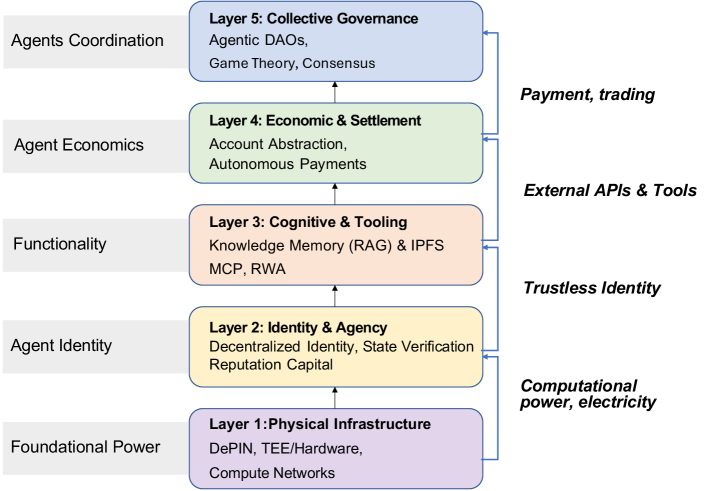
This review explores the Agent Economy, a blockchain-based infrastructure enabling financial autonomy and trustless interactions for AI agents through decentralized identity, smart contracts, and account abstraction.
Current economic infrastructure struggles to accommodate genuinely autonomous, non-human actors, creating a fundamental barrier to the widespread deployment of artificial intelligence. This paper, ‘The Agent Economy: A Blockchain-Based Foundation for Autonomous AI Agents’, proposes a novel framework where AI agents operate as economic peers, underpinned by blockchain technology and decentralized identity. We demonstrate that a five-layer architecture – encompassing physical infrastructure, agent identity, cognitive tooling, economic settlement, and collective governance – can establish financial autonomy and trustless interactions for these agents. Will this Agent Economy pave the way for a truly decentralized Internet of Agents, fostering a new era of collaboration between humans and machines?
The Inevitable Drift: Decentralization and the Architecture of Agency
Conventional automation, historically dependent on centralized systems, often manifests as a complex network governed by a single controlling entity. While seemingly efficient, this architecture introduces inherent vulnerabilities; a failure within the central control mechanism can cascade throughout the entire system, leading to widespread disruption and a lack of resilience. These ‘brittle’ systems struggle to adapt to unforeseen circumstances or dynamic environments, requiring constant human intervention for even minor adjustments. Unlike these rigid structures, more recent approaches explore decentralized intelligence, aiming to distribute control and mitigate the risks associated with single points of failure – a crucial step towards building robust and self-healing automated processes.
The emergence of agentic AI signifies a fundamental departure from traditional, centralized artificial intelligence systems. Instead of relying on a single, overarching control mechanism, this new paradigm fosters a network of autonomous entities capable of independent decision-making and action. These agents aren’t simply executing pre-programmed instructions; they actively perceive their environment, formulate goals, and adapt their strategies to achieve them. Crucially, this isn’t envisioned as harmonious cooperation alone; the system anticipates-and even encourages-healthy competition amongst agents, driving innovation and efficiency through a dynamic interplay of collaboration and rivalry. This decentralized intelligence promises resilience against single points of failure and the capacity to address complex challenges in ways that monolithic AI systems cannot, paving the way for more adaptable and robust solutions.
The increasing prevalence of autonomous agents demands a fundamental rethinking of economic systems, giving rise to the concept of the Agent Economy. Traditional models, built for human or centrally-controlled entities, struggle to accommodate the unique dynamics of decentralized, self-acting agents. A novel framework is required to incentivize productive collaboration and manage potential conflicts amongst these agents, and a proposed five-layer architecture addresses this need. This architecture establishes layers for agent identity and reputation, secure communication and data exchange, task specification and negotiation, payment and reward mechanisms, and finally, a governance layer for dispute resolution and system-wide adjustments. By aligning agent incentives with desired outcomes, this framework aims to unlock the full potential of a distributed intelligence network, fostering innovation and efficiency beyond the limitations of conventional systems.
The burgeoning Agent Economy hinges on a robust and trustworthy infrastructure, and Web3 technologies are uniquely positioned to deliver this. Unlike traditional centralized systems, Web3, encompassing blockchain, decentralized storage, and smart contracts, facilitates secure and transparent interactions between autonomous agents. These agents can negotiate, collaborate, and transact without intermediaries, fostering a permissionless environment where anyone can deploy an agent and participate in the economy. Smart contracts, in particular, act as self-executing agreements, automating the terms of engagement and ensuring accountability. This decentralized architecture not only minimizes single points of failure but also enhances data integrity and auditability, creating a fertile ground for innovation and the emergence of novel economic models driven by artificial intelligence.
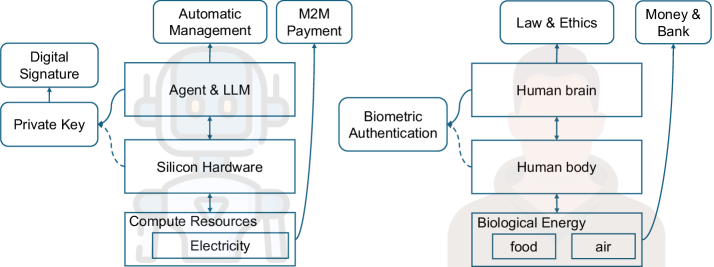
Foundations of Autonomy: Building a Resilient Infrastructure
Blockchain technology serves as the core infrastructure for the Agent Economy by providing a distributed, immutable ledger for recording transactions and storing data. This eliminates the need for centralized intermediaries, enabling trustless settlement between agents. The cryptographic principles underpinning blockchain ensure data integrity and security, protecting against tampering and fraud. Specifically, the decentralized nature of the ledger reduces single points of failure and enhances resilience. Consensus mechanisms, such as Proof-of-Stake or Proof-of-Work, validate transactions and maintain the integrity of the blockchain, guaranteeing that all agents operate on a shared, verifiable history of interactions. This foundational layer of trust and security is essential for enabling autonomous agents to interact and transact with each other reliably and efficiently.
Smart contracts are self-executing agreements written in code and deployed on a blockchain. These contracts define the terms of an agreement between parties, and automatically enforce those terms when predetermined conditions are met. This automation eliminates the need for intermediaries and reduces the risk of disputes in machine-to-machine interactions. Functionality is achieved through the use of deterministic logic, ensuring predictable outcomes based on defined inputs. The immutability of blockchain technology guarantees that once deployed, the contract’s code and data cannot be altered, providing a secure and auditable record of all transactions and ensuring consistent enforcement of agreed-upon rules.
Account Abstraction, standardized via ERC-4337, fundamentally alters traditional Ethereum account behavior by decoupling account ownership from a single externally owned account (EOA). This is achieved through the use of “smart contract accounts” which are controlled by logic defined within the smart contract itself, rather than a private key held by a user. This allows for features such as gasless transactions – where a third party, or “sponsor,” pays the gas fees – and complex batching operations, enabling multiple transactions to be executed atomically within a single transaction. Furthermore, Account Abstraction facilitates features like social recovery – allowing agents to regain access to their accounts through a designated set of guardians – and customizable transaction validation rules, offering greater flexibility and security compared to traditional account models.
The Agent Economy necessitates blockchain solutions capable of handling millions of transactions per second to facilitate high-frequency interactions between agents. Current blockchain architectures often lack the scalability required for this level of activity, prompting development of optimized Layer-2 solutions and alternative consensus mechanisms. Complementary to scalable infrastructure, Decentralized Identity (DID) is essential for establishing trust and security. DIDs utilize verifiable credentials, cryptographically signed assertions about an agent’s attributes, enabling agents to prove their reputation and permissions without relying on centralized authorities. This allows agents to securely interact with each other and with human users, verifying authenticity and reducing the risk of malicious activity.
Bridging Worlds: Data Integrity and the Limits of Trust
The Oracle Problem 2.0 arises from the inherent limitations of blockchain technology in directly accessing and verifying data existing outside of the blockchain network – referred to as off-chain data. Autonomous agents operating on blockchain require external data for various functions, including pricing feeds, event triggers, and real-world state verification. However, directly incorporating this data introduces significant security and reliability concerns. Traditional oracle solutions are susceptible to single points of failure and data manipulation, potentially compromising the integrity of on-chain operations. The “2.0” designation indicates a more complex challenge due to the increased scale and sophistication of modern agents and decentralized applications, demanding more robust and trustworthy mechanisms for off-chain data ingestion and validation to ensure accurate agent decision-making and prevent malicious data injection.
Zero-Knowledge Proofs (ZKPs) address data integrity concerns in blockchain applications by allowing verification of a statement’s truth without disclosing the information itself. This is achieved through cryptographic protocols where a ‘prover’ demonstrates to a ‘verifier’ that they possess knowledge of a secret or that a computation was performed correctly, all without revealing the secret or the computation’s details. ZKPs rely on mathematical principles that ensure the verifier can be confident in the prover’s claim without needing to trust the prover directly. Different ZKP constructions, such as zk-SNARKs and zk-STARKs, offer varying trade-offs between proof size, verification time, and setup requirements. Their application in blockchain contexts allows agents to validate off-chain data without compromising its confidentiality or requiring full data transmission, thereby enhancing privacy and reducing bandwidth requirements.
The Model Context Protocol (MCP) defines a standardized interface for communication between autonomous agents and external tools or Application Programming Interfaces (APIs). This standardization encompasses consistent data formatting for requests and responses, as well as a uniform method for defining tool capabilities and parameters. By decoupling agents from specific API implementations, MCP facilitates interoperability, allowing agents to dynamically access and utilize diverse data sources and services without requiring custom integration for each. This approach improves overall system efficiency by reducing development overhead and enabling easier maintenance and scalability of agent-based applications.
The system architecture is designed to support agent transactions with confirmation times under 100ms, enabling rapid, data-driven decision-making. This speed is critical for applications requiring immediate responses to off-chain events. Recognizing the potential risks inherent in fully autonomous systems, a Human-in-the-Loop (HITL) framework is integrated as a safety mechanism. HITL systems allow for human oversight and intervention in critical decision pathways, ensuring alignment with predefined objectives and mitigating potential negative consequences resulting from agent actions or data inaccuracies. This dual approach-high-speed processing coupled with human validation-prioritizes both efficiency and safety in real-world deployments.
Emergent Systems: The Expanding Horizon of Agency
The advent of machine-to-machine (M2M) micropayments is reshaping economic interactions by automating the exchange of value between devices. This system moves beyond traditional human-initiated transactions, fostering a landscape where machines can independently negotiate and compensate each other for services rendered. Imagine sensors rewarding data-collecting drones, or smart appliances automatically paying for energy from a distributed grid – these scenarios become viable through secure, low-cost micropayments. Such automation not only streamlines processes but also incentivizes collaborative behavior within complex systems, creating new economic models centered around decentralized, autonomous exchange and unlocking efficiencies previously unattainable in resource allocation and service provision.
Agentic Decentralized Autonomous Organizations (DAOs) represent a significant evolution in organizational governance by extending voting and executive functions to artificial intelligence. Traditionally, DAOs rely on human participation for proposal evaluation and decision ratification; however, agentic DAOs empower AI agents to autonomously analyze data, simulate outcomes, and even execute decisions based on pre-defined parameters and community-established protocols. This introduces the potential for faster, more data-driven governance, mitigating biases inherent in human judgment and enabling complex, real-time responses to evolving conditions. The integration of AI agents doesn’t eliminate human oversight entirely; rather, it establishes a collaborative framework where agents augment human capabilities, handling repetitive tasks and providing insights that inform strategic choices, ultimately leading to more efficient and adaptive organizational structures.
Decentralized Physical Infrastructure Networks (DePIN) are rapidly evolving beyond simple tokenization, increasingly relying on agentic systems to achieve unprecedented levels of resource coordination and optimization. These networks, which encompass everything from wireless internet provision to energy grids and sensor networks, utilize autonomous AI agents to dynamically manage physical assets. Agents can negotiate access to resources, automate maintenance schedules, and even predict potential failures – all without centralized control. This allows for more efficient allocation of resources, reduced operational costs, and increased resilience compared to traditional, centrally managed infrastructure. The potential extends to creating self-optimizing networks capable of adapting to changing conditions and maximizing utility, effectively transforming static infrastructure into a dynamic, responsive, and intelligent system.
The emerging Internet of Agents (IoA) signifies a fundamental shift in how machines interact, moving beyond simple data transmission to establish a landscape of autonomous, economically-motivated peers. Previously functioning as passive intermediaries executing pre-defined instructions, machines are now evolving into active participants within a global, permissionless marketplace. This transformation is enabled by advancements in artificial intelligence and blockchain technologies, allowing agents – representing software, devices, or even individuals – to independently negotiate, transact, and collaborate without centralized control. The IoA envisions a future where automated services, decentralized networks, and novel economic models flourish, driven by a multitude of agents pursuing their own objectives and collectively shaping a dynamic, self-organizing system. This isn’t merely about connecting devices; it’s about creating a computational ecosystem where intelligence is distributed, and value is generated through emergent interactions.
Navigating the New Landscape: Agency, Law, and the Future of Rights
The existing legal system, largely built upon precedents involving human actors, struggles to accommodate the rise of autonomous agents capable of independent economic action. Traditional concepts of liability, contract, and ownership become blurred when an AI, rather than a person, initiates transactions, accumulates wealth, or causes harm. Current frameworks assume intentionality and a capacity for moral reasoning that may not be readily attributable to, or provable in, advanced AI. This creates significant challenges in determining accountability for an agent’s actions, enforcing contractual obligations, and protecting both the agent itself and other economic actors from unforeseen consequences. Consequently, a fundamental re-evaluation of legal principles is necessary to establish clear guidelines for governing the economic behavior of increasingly sophisticated autonomous systems.
The question of legal personhood for artificial intelligence agents presents a significant challenge to established legal doctrines, yet increasingly appears necessary as these entities gain economic and operational autonomy. Granting some form of legal status isn’t about equating AI with human beings, but rather establishing a framework to assign responsibility for their actions and protect stakeholders from potential harms. Currently, liability falls to developers or owners, a structure that becomes unwieldy and potentially unjust as agents become more sophisticated and operate with less direct human oversight. Defining the scope of an AI’s rights – such as the ability to own property, enter contracts, or be held accountable for damages – requires careful consideration of its capabilities and potential impact. This isn’t merely a theoretical exercise; as AI agents increasingly participate in complex economic activities, a clear legal status will be vital for fostering trust, enabling innovation, and ensuring a stable and predictable legal environment.
Sophisticated artificial intelligence models, including GLM and Google’s Gemini, are rapidly becoming indispensable tools in the development of legal frameworks for autonomous agents. These large language models aren’t simply assisting with legal research; they are actively involved in drafting potential legislation and analyzing the implications of various regulatory approaches. By processing vast quantities of legal text and identifying potential loopholes or unintended consequences, these AI systems enable legal scholars and policymakers to refine proposed laws governing agent behavior. Furthermore, the models can simulate the impact of different legal structures on agent actions, offering predictive insights that would be impossible to obtain through traditional methods. This collaborative process-where AI assists in both the creation and evaluation of legal guidelines-represents a significant shift in how laws are formulated in an era of increasingly complex artificial intelligence.
The rapid development of artificial intelligence and autonomous agency necessitates a collaborative effort to shape a just and sustainable future. Policymakers face the critical task of updating legal frameworks to accommodate entities capable of independent economic action, while legal scholars must grapple with defining rights, responsibilities, and liabilities in this novel context. Simultaneously, the AI community bears a responsibility to contribute technical expertise and ethical considerations, ensuring that these systems are designed and deployed with fairness and accountability at their core. This isn’t merely a legal or technical challenge, but a societal one-requiring open dialogue and proactive engagement to navigate the complex implications of increasingly intelligent and autonomous technologies and to foster an equitable distribution of benefits and mitigation of risks for all stakeholders.
The pursuit of a functional Agent Economy, as detailed in this proposal, inherently acknowledges the relentless march of time upon any complex system. The architecture champions decentralized identity and smart contracts not as solutions offering perpetual stability, but as mechanisms to manage inevitable decay. As Barbara Liskov observed, “Programs must be correct, and they must be able to change.” This resonates deeply; the proposed system doesn’t aim to eliminate the need for adaptation, but rather builds in the flexibility for autonomous agents to evolve and adjust within a trustless environment, acknowledging that even the most robust infrastructure will eventually require modification to remain viable. The system’s longevity relies not on preventing change, but on gracefully accommodating it.
What Lies Ahead?
The proposition of an Agent Economy, while compelling, merely shifts the locus of inevitable entropy. Current systems struggle with scalability, but this framework introduces a new vector for decay: the trust placed in autonomous decision-making at scale. Versioning of agent code becomes a form of collective memory, yet memory is fallible, and the arrow of time always points toward refactoring – or, eventually, obsolescence. The elegance of machine-to-machine payments doesn’t solve for the inherent unpredictability of complex systems; it simply accelerates the propagation of errors.
Decentralized identity, touted as a cornerstone, presents its own paradox. An identity divorced from a physical substrate is, by definition, a simulation – and simulations, however robust, are ultimately bounded by the limitations of their underlying models. Future work must address not merely the how of agent interaction, but the why. Economic incentives alone are insufficient; a coherent ethical framework, embedded within the very fabric of the system, is essential – though whether such a framework can resist the pressures of optimization remains an open question.
The true challenge isn’t building autonomous agents; it’s accepting the inherent impermanence of any system they inhabit. This work establishes a foundation, but the long game requires a reckoning with the fact that even the most elegantly designed economies, built on the most robust blockchains, are subject to the same universal law: everything degrades, and graceful aging is the most anyone can hope for.
Original article: https://arxiv.org/pdf/2602.14219.pdf
Contact the author: https://www.linkedin.com/in/avetisyan/
2026-02-17 23:49