Author: Denis Avetisyan
A new framework leverages multiple AI perspectives to overcome limitations in contextual understanding and unlock more effective human-machine co-creativity.
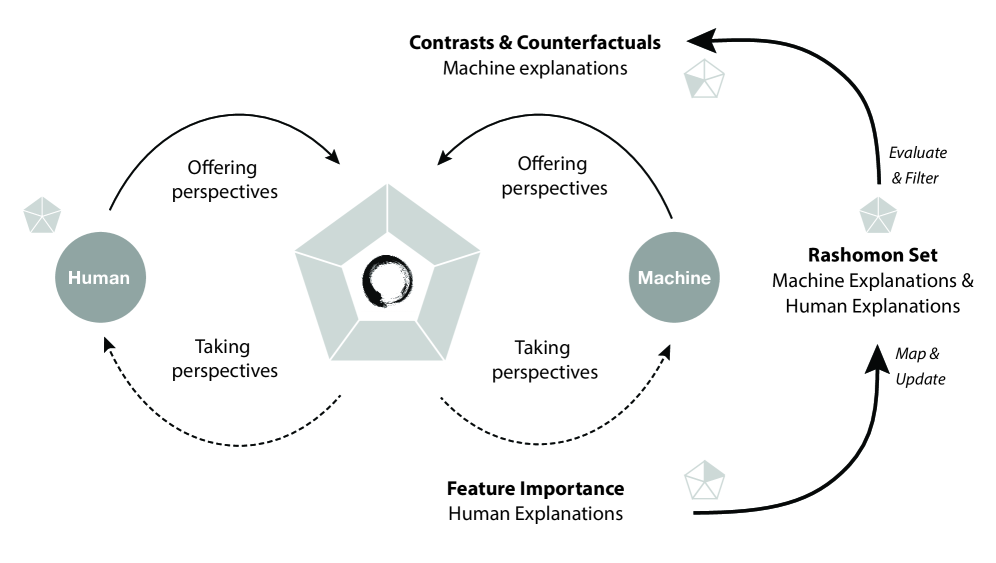
This paper introduces Pluri-perspectivism, utilizing XAI techniques like the Rashomon Machine to enhance embodied AI and facilitate richer creative experiences.
While intelligent systems promise to augment creativity, current generative AI struggles with the contextual understanding vital for truly collaborative creation. This paper, ‘Designing a Rashomon Machine: Pluri-perspectivism and XAI for Creativity Support’, introduces Pluri-perspectivism, a novel framework leveraging Explainable AI (XAI) – specifically methods like the Rashomon Technique – to bridge the epistemological gap between human and machine. By fostering the exchange of diverse ‘perspectives’, Pluri-perspectivism aims to reintroduce productive friction and enhance human agency within human-machine co-creative processes. Can this approach unlock more effective and nuanced forms of creative exploration, moving beyond the limitations of disembodied AI models?
Beyond Computation: The Embodied Foundation of Creativity
For decades, the prevailing model of cognition likened the mind to a computer – an information processor manipulating symbols according to predefined rules. However, this computational framework falters when attempting to account for the hallmarks of creativity: the generation of genuinely novel ideas and the fluid adaptation to unforeseen circumstances. The rigidity of algorithmic processes struggles to replicate the spontaneous insights, playful explorations, and embodied improvisations that characterize creative acts. While computation excels at solving well-defined problems, creativity often arises from ambiguous situations, requiring a dynamic interplay between perception, action, and the environment – a realm where purely internal symbol manipulation proves insufficient. This disconnect highlights a fundamental limitation of the computational view, prompting a re-evaluation of how cognition truly gives rise to innovative thought and behavior.
The theory of 4E Cognition challenges traditional understandings of the mind by positing that cognitive processes aren’t confined to the brain, but are deeply rooted in the body and its interactions with the environment. This perspective asserts cognition is fundamentally embodied – shaped by the physical characteristics of the body; embedded – situated within a specific physical and cultural context; enacted – brought forth through dynamic sensorimotor interactions; and extended – reaching beyond the brain and body to incorporate external tools and resources. Consequently, thinking isn’t merely internal computation, but a continuous, reciprocal process of perceiving, acting, and adapting within a world that is itself integral to the cognitive event; it suggests that intelligence emerges from this ongoing coupling, rather than existing as a pre-programmed set of rules.
The prevailing paradigm of artificial intelligence, historically focused on symbolic manipulation and abstract reasoning, is increasingly recognized as insufficient for replicating genuine creativity. A burgeoning perspective champions systems grounded in perceptual and action-oriented engagement with the environment – mirroring how biological intelligence functions. This approach moves beyond processing disconnected symbols; instead, it prioritizes the development of AI agents capable of interacting with, and learning from, the dynamic complexities of the real world through sensory input and physical action. Such systems, by embodying cognition, are better positioned to generate novel solutions and exhibit the fluidity characteristic of creative thought, as innovation often arises not from logical deduction, but from embodied exploration and the serendipitous discovery of unexpected relationships within a richly textured environment.
Mapping Creative Potential: A Pluri-perspectival Approach
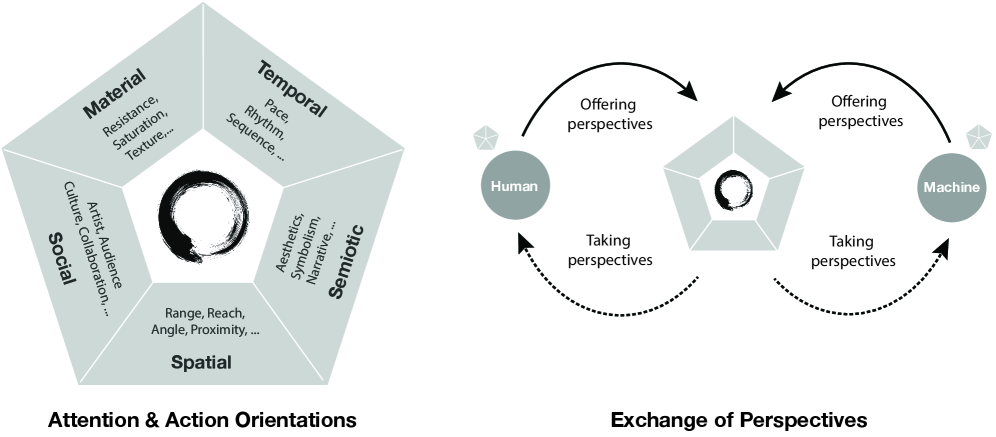
Pluri-perspectivism provides a structured approach to analyzing creative potential by acknowledging the interplay of multiple contextual dimensions. These dimensions include social factors – encompassing cultural norms and audience reception; semiotic considerations – relating to the interpretation of signs and symbols; spatial elements – concerning the physical environment and arrangement; material properties – encompassing the characteristics of used mediums; and temporal aspects – addressing the historical context and evolution of ideas. By systematically mapping these factors, pluri-perspectivism moves beyond a single, fixed interpretation of creative output and facilitates the exploration of a broader solution space, recognizing that validity isn’t limited to a singular outcome but is relative to the considered perspectives.
Acknowledging multiple contextual factors – social, semiotic, spatial, material, and temporal – necessitates a departure from solutions predicated on a single ‘correct’ answer. Genuine exploration, particularly within creative domains, benefits from recognizing the validity of diverse perspectives, each informed by its unique contextual basis. This approach allows for the consideration of multiple viable interpretations and outcomes, rather than converging on a predetermined, potentially limiting, solution. The acceptance of multiple perspectives does not imply relativism, but rather a recognition that understanding is shaped by the observer’s position and the encompassing conditions; therefore, a comprehensive assessment requires integrating these varied viewpoints.
Traditional Explainable AI (XAI) methods often focus on identifying the features most directly influencing a model’s output, providing a limited view of complex creative processes. Pluri-perspectivism enhances XAI by incorporating multiple contextual dimensions – social, semiotic, spatial, material, and temporal – into the explanatory framework. This allows for the generation of explanations that are not solely feature-based, but also account for the broader context in which the creative output was generated. Consequently, the resulting explanations are more nuanced, revealing a wider range of potential influences and providing a more comprehensive understanding of the creative reasoning behind a given output. This expanded explanatory power is critical for applications where subjective interpretation and diverse viewpoints are paramount.
The Rashomon Machine leverages the principles of pluri-perspectivism to generate multiple explanations for a single event or creative output. This is achieved by systematically varying the contextual parameters – encompassing social, semiotic, spatial, material, and temporal factors – used to interpret the data. Each variation yields a distinct, yet valid, explanation, effectively mirroring the subjective nature of perception and interpretation as demonstrated in the film Rashomon. The machine doesn’t seek a single ‘true’ explanation, but rather constructs a diverse set of plausible interpretations, offering a more comprehensive understanding than traditional, single-perspective approaches. This capability extends beyond simple explanation; it allows for the identification of hidden assumptions and biases inherent in any given interpretation.
Generating Diverse Explanations: The Rashomon Machine
The Rashomon Machine employs a ‘Rashomon Set’ to model a creative state not as a single definitive explanation, but as a distribution of multiple, equally valid interpretations. This set comprises diverse explanations generated by varying input features or model parameters while maintaining consistent performance according to predefined metrics. Each explanation within the set represents a plausible pathway to the observed creative output, and the collection as a whole encapsulates the system’s uncertainty or ambiguity regarding the underlying generative process. The size and diversity of the Rashomon Set directly correlate with the complexity and multi-faceted nature of the creative state being analyzed, providing a more nuanced representation than a singular, deterministic explanation.
The Rashomon Machine employs Counterfactual Explanations and Contrastive Explanations as core mechanisms for generating a diverse set of plausible interpretations. Counterfactual Explanations identify minimal changes to input features that would alter the model’s output, effectively demonstrating “what if” scenarios. Contrastive Explanations, conversely, pinpoint the features that differentiate a particular instance from others, revealing which aspects were crucial in driving the observed outcome. Both techniques function by perturbing inputs and observing resulting changes in the model’s behavior, thereby creating divergent trajectories and a range of alternative possibilities without requiring retraining or modification of the underlying model.
Feature importance analysis within the Rashomon Machine operates by quantifying the contribution of individual input features to the generation of diverse explanations within the Rashomon Set. This is achieved through methods such as permutation importance or SHAP values, which assess how much the model’s output changes when a specific feature is altered. The resulting feature importance scores enable the identification of key influencing factors driving the creative process, and crucially, allow for assessment of ‘human orientation’ – determining to what extent generated explanations align with or emphasize features typically valued by human creators. This facilitates understanding of the model’s internal reasoning and informs strategies for guiding the creative process towards desired outcomes or identifying potential biases in the generative model.
The Rashomon Machine intentionally diverges from traditional optimization approaches which seek a single, definitive solution. Instead, it generates a ‘Rashomon Set’ of multiple, equally valid outputs representing diverse possibilities for a given input. This is not a failure of the system to converge, but a core design principle enabling human-machine co-creation. By presenting a landscape of options, the system allows human users to explore alternative creative directions, evaluate trade-offs, and ultimately guide the process towards a desired outcome, leveraging human judgment and aesthetic preference in conjunction with computational power. The emphasis shifts from automated problem-solving to augmented creativity, where the machine serves as a generative tool and the human remains in control of final selection and refinement.
Co-Creating Meaning: Towards Participatory Creativity
The refinement of a Rashomon Machine’s outputs through In-Context Explainable AI (XAI) represents a significant shift in how machine learning systems communicate their reasoning. Rather than offering a single, generalized explanation, this approach dynamically tailors insights to the specific context of a query, the expertise of the user, and relevant domain knowledge. This nuanced delivery isn’t merely about clarity; it acknowledges that interpretations are rarely objective and are instead constructed through the interplay between data and human understanding. By factoring in situational awareness and user profiles, In-Context XAI transforms the Rashomon Machine from a generator of multiple plausible explanations into a responsive system that delivers the most relevant explanation – fostering trust and facilitating more effective collaboration between humans and artificial intelligence.
The notion that data possesses intrinsic meaning is increasingly challenged by a shift towards participatory sense-making. Rather than assuming objective truths reside within datasets, this perspective posits that meaning emerges from the dynamic interplay between data and the interpreting agent – be it a human, a machine, or a collaborative system. Consequently, understanding isn’t a process of discovery, but of co-creation, shaped by individual experiences, contextual knowledge, and the specific interactions undertaken. This fundamentally alters the relationship with information; data becomes a catalyst for dialogue, prompting exploration and negotiation of meaning rather than passively received wisdom. It suggests that robust insights aren’t simply extracted from data, but actively built through iterative engagement and shared interpretation, fostering a more nuanced and adaptable understanding of complex phenomena.
The conventional approach to innovation often centers on problem-solving – identifying a difficulty and engineering a solution. However, a shift towards possibility thinking reorients this process, emphasizing proactive exploration beyond immediate needs. This framework doesn’t merely ask ‘how can we fix this?’, but rather ‘what else could be?’, actively imagining and prototyping potential futures. By prioritizing the generation of diverse options and embracing uncertainty, possibility thinking allows for the identification of opportunities previously obscured by a narrow focus on existing challenges. This proactive stance fosters a dynamic interplay between anticipating future trends and intentionally shaping them, ultimately unlocking novel pathways for growth and creative advancement that extend far beyond incremental improvements.
The integration of human intuition with machine intelligence represents a paradigm shift in creative processes, moving beyond automation to true collaboration. This framework acknowledges that while machines excel at processing data and identifying patterns, humans possess uniquely valuable skills in abstract thought, contextual understanding, and the ability to envision novel possibilities. By combining these strengths – the machine’s computational power with the human capacity for imaginative leaps – a synergistic relationship emerges. This allows for the exploration of a far wider creative space than either could achieve independently, fostering innovation and unlocking new levels of potential in fields ranging from artistic expression to scientific discovery. The result isn’t simply enhanced productivity, but the generation of genuinely original ideas and solutions born from a uniquely combined intelligence.
The pursuit of truly creative AI, as detailed in the exploration of pluri-perspectivism, necessitates a focus on what remains essential after layers of complexity are stripped away. Ken Thompson observed, “Sometimes it’s better to rewrite the program than debug it.” This resonates deeply with the paper’s core idea; rather than endlessly refining existing AI to mimic human creativity, a fundamental shift toward contextual grounding and multiple perspectives – a ‘Rashomon Machine’ approach – offers a more elegant solution. The work champions a system where understanding isn’t about adding more features, but about distilling the essence of different viewpoints to facilitate meaningful human-machine co-creativity.
What Remains to be Seen
The pursuit of ‘creative AI’ often feels like an exercise in elaborate justification – constructing complex architectures to mimic processes whose fundamental nature remains stubbornly opaque. This work, by foregrounding pluri-perspectivism and the Rashomon Machine, at least acknowledges the inherent multiplicity of ‘truth’ within any generative process. The critical step, however, lies not in generating diverse explanations, but in discerning which, if any, are genuinely useful. Current methods tend toward combinatorial explosion; a surfeit of perspectives rarely equates to deeper understanding.
The emphasis on contextual grounding and embodied AI is a necessary correction. Yet, the true limitation isn’t merely a lack of sensory input; it’s the assumption that ‘context’ can be fully captured, quantified, and fed into an algorithm. Human creativity thrives on ambiguity, on the gaps between information, on the artful misinterpretation of signals. Replicating this requires not more data, but a principled subtraction – a deliberate pruning of superfluous detail.
Future work should prioritize the development of metrics for ‘explanatory frugality’ – assessing the value of an explanation not by its complexity, but by its simplicity. The goal isn’t to build machines that seem creative, but to understand what constraints, what limitations, are actually required for genuine novelty to emerge. Perhaps, the most profound insight will be realizing how little a machine actually needs to know.
Original article: https://arxiv.org/pdf/2602.14232.pdf
Contact the author: https://www.linkedin.com/in/avetisyan/
2026-02-17 16:59