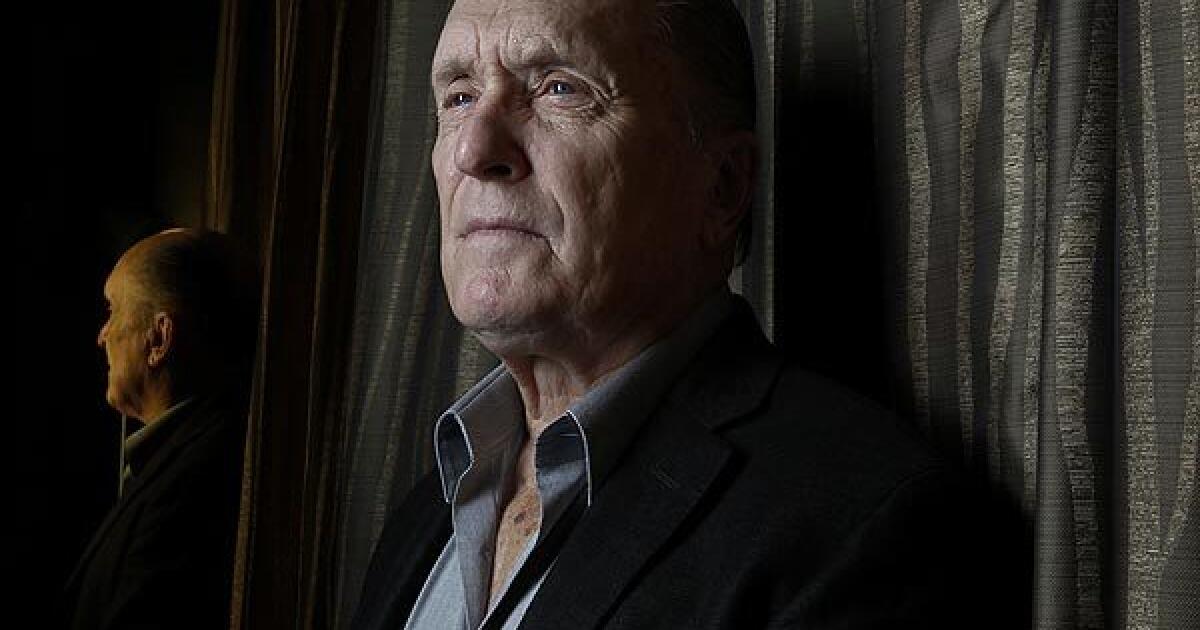
Robert Duvall struggled during his college years, so his father – a Navy veteran who retired as a rear admiral – encouraged him to get his life together and pursue acting.
Duvall explained that he wasn’t forced into acting, but rather encouraged to try it. People noticed he enjoyed performing little scenes at home and thought he had a natural talent for it.
They were right about him. He wasn’t conventionally handsome – his face was lined with age and his hair was thinning – but he captivated audiences with the passion and skill he brought to acting. In 1980, Vincent Canby of The New York Times declared him “the best actor America has, our equivalent of Laurence Olivier.”
Robert Duvall, a celebrated actor famous for both leading and supporting roles – including memorable performances as the consigliere in “The Godfather” and the intense colonel in “Apocalypse Now,” passed away at the age of 95, according to his wife, Luciana Duvall, in a Facebook post.
“Bob passed away peacefully at home, surrounded by love and comfort,” she wrote.
While Robert Duvall was capable of playing comedic roles, like the uptight and somewhat silly Major Frank Burns from “MASH” – a character fixated on Nurse “Hot Lips” Houlihan – he was best known for portraying intense and hardened characters.
I’ve always been fascinated by Robert Duvall’s range. He could play these incredibly intense characters who seemed calm on the surface but were just brimming with something dangerous. Like in “The Great Santini,” he was this Marine pilot who was just as intimidating to his family as he was to his squadron. Then there was “The Apostle,” where he completely lost it and used a baseball bat – shocking! And who could forget Tom Hagen in “The Godfather” films? He was this cool, collected lawyer for the mob, but you knew he was capable of anything if you crossed the Corleones. One critic hit the nail on the head – Duvall was a master at portraying these guys who kept everything bottled up… until you really shouldn’t have pushed them.
Robert Duvall was famous for completely immersing himself in his roles. He could convincingly portray a wide range of characters, from the elegant movements of a tango dancer to the slow, labored walk of a man battling cancer in the film “The Paper.” He also paid close attention to how people spoke, traveling through the South to learn the unique speech patterns and phrasing of different regions, like Mississippi and West Texas.
He loved playing country people and particularly loved westerns.
In a 2011 interview with the News and Advance near his Virginia home, he explained his view of the Western genre. He stated that just as Shakespeare represents English literature, Molière defines French drama, and Chekhov embodies Russian plays, the Western is a uniquely American art form.
Robert Duvall often explained his acting process using a simple analogy, much like his beloved character, Augustus McCrae from “Lonesome Dove,” would describe riding a horse.
In a 2006 interview with The Times, Duvall explained his approach as simply talking and listening. He emphasized that there’s no need to force anything, but rather to allow things to develop naturally.
Robert Duvall has been nominated for an Academy Award seven times and won Best Actor in 1983 for his performance as Mac Sledge, a struggling country singer, in “Tender Mercies.” Having played guitar since he was a child, he performed all of his own singing in the film and even wrote two of the songs.
Instead of accepting a fancy cast party at Studio 54, Robert Duvall chose to host a more personal gathering in his New York City apartment. He served home-style food prepared by actor Wilford Brimley, who traveled from Tennessee for the occasion. The party wrapped up around 3 a.m. with Duvall leading everyone in a joyful rendition of “Amazing Grace” while holding hands.
Willie Nelson, who performed with Robert Duvall at the party, shared with Village Voice writer Arthur Bell that the film “Tender Mercies” felt completely realistic.
He explained that he knew the people Bobby depicted in his film personally, having grown up in the same area. He added that, if he wasn’t careful, he feared he might end up like the character Bobby played.
Robert Duvall often played characters who came from difficult, impoverished backgrounds, despite having a privileged upbringing himself. He was born in San Diego on January 5, 1931, and spent his childhood moving around the United States due to his father’s career as a naval officer.
At age 10, the actor who would become famous in Westerns rode a horse for the first time and met his mother’s family during a trip to Texas.
Growing up in Annapolis, Maryland, Robert Duvall became incredibly skilled at imitating people, picking up their accents and behaviors. He was known for his funny impressions, from his cousin, a traveling preacher from Virginia, to the rugged cowboys he met on his uncle’s Montana ranch. Even years later, while filming “The Godfather,” he entertained the cast and crew with his spot-on impressions – including one of Marlon Brando himself.
Robert Duvall has played a lot of characters who enjoyed a drink – he’s been in over 85 films, after all! But in real life, Duvall himself has never smoked or drank alcohol. He grew up attending Christian Science schools, first a boarding school in St. Louis and then Principia College in Illinois.
When Duvall, a friendly and sporty student, was failing his classes, the college called his parents in for an urgent meeting. They all realized he wasn’t suited for a history degree. It became clear his only real passion, aside from tennis, was performing.
He decided to focus on drama, a choice his parents encouraged because they wanted him to remain in school, and this ultimately helped him improve his grades and overall academic performance.
During a college performance of Arthur Miller’s “All My Sons,” Robert Duvall became so immersed in the role of a troubled, morally compromised businessman that he unexpectedly began to cry. As Judith Slawson noted in her 1985 biography, “Robert Duvall: Hollywood Maverick,” this moment confirmed his calling: he knew then that acting was his true passion.
Robert Duvall graduated in 1953 and was soon drafted into the Army. He received training in radio repair at Camp Gordon, Georgia, but also enjoyed acting with a local theater group in Augusta. After completing his service in 1955, he honed his acting skills at the Neighborhood Playhouse School of the Theatre in New York City, a school known for launching the careers of stars like Gregory Peck, Steve McQueen, and Jon Voight.
Sanford Meisner, the school’s legendarily demanding director, was impressed.
Years later, while speaking with playwright David Mamet, the speaker claimed there were only two truly great actors in America: Marlon Brando, who had already delivered his most impressive performances, and Robert Duvall.
While living in New York City, Duvall supported himself by working overnight at the post office and as a dishwasher, all while continuing to pursue acting roles. He shared an apartment near Broadway with a young, up-and-coming actor named Dustin Hoffman, and the two became friends with Gene Hackman and James Caan.
Budding actors, still unknown to the world, would gather at Cromwell’s Drugstore to talk about the subtle, natural acting style of a fellow newcomer.
“If we mentioned Brando once we mentioned him 25 times,” Duvall told The Times in 2014.
Following years of performing in off-Broadway plays, summer theater, and television shows such as “Naked City” and “The Twilight Zone,” Duvall got his first movie role in Hollywood in 1962.
Robert Duvall’s portrayal of the reclusive Boo Radley in “To Kill a Mockingbird” – though limited to a brief, silent appearance at the film’s conclusion – was a crucial role that helped launch his more than 50-year acting career.
Marlon Brando is remembered for a legendary line in the 1979 film “Apocalypse Now.” Playing the bold Lieutenant Colonel Bill Kilgore, he commands helicopters to demolish a Vietnamese village by the coast, clearing the way for him and his soldiers to surf.
As flames engulfed the village, Kilgore casually remarked, “Do you smell that? That’s napalm. There’s no scent quite like it.” He continued, almost dreamily, “I really love the smell of napalm in the morning.”
Robert Duvall’s unforgettable speech as Colonel Kilgore was voted the best in movie history in a 2004 BBC poll. Surprisingly, Duvall himself didn’t expect it to become so iconic.
Duvall seldom played leading men, but Mac Sledge, in “Tender Mercies,” was a notable breakthrough.
You know, it’s funny – I was reading an interview with this actor, and he said this particular film is the only one where people have ever told him he was sexy! He described it as genuinely romantic, but in a really down-to-earth, country kind of way, and he actually said he loved that aspect of it more than almost anything else about the movie. It’s just a sweet little detail that stuck with me.
Robert Duvall had been married twice before he met Luciana Pedraza. A friend challenged her to approach him while he was in Buenos Aires and invite him to a tango event. They ended up acting together in the 2002 film “Assassination Tango,” where he played a hired killer sent to Argentina. The couple married in 2005 and spent years perfecting their tango on a dance floor they built in their barn.
Robert Duvall is survived by his wife and his brother William, who is an actor and music teacher. His younger brother, John, passed away in 2000.
Robert Duvall was a remarkably versatile actor, appearing in a diverse array of films throughout his career. He took on roles like a retired barber in “Wrestling Ernest Hemingway,” a jaded television executive in “Network,” and a struggling farmer in “Tomorrow.” He also portrayed a composed lawyer in “A Civil Action,” an astronaut in “Deep Impact,” a weathered rancher in “Open Range,” and a powerful tobacco executive in the comedy “Thank You for Smoking.” Additionally, he famously played General Dwight D. Eisenhower in the miniseries “Ike.”
Beyond his mainstream work, he also took on smaller, personal projects. In 1977, he directed a documentary called “We’re Not the Jet Set,” which followed a rodeo family in Nebraska. Then, in 1983, he wrote and directed “Angelo, My Love,” a dramatic film inspired by and featuring Roma people he’d met in New York City.
He continued acting successfully even in his later years. In the 2009 film “Get Low,” he played a reclusive man who held a funeral for himself while still alive. Then, in 2011’s “Seven Days in Utopia,” he portrayed a former golf pro and rancher who mentors a young golfer in a story about finding meaning. Four years later, he earned an Academy Award nomination for Best Supporting Actor for his role as a troubled judge in “The Judge” – making him the oldest actor ever to receive that honor at the time.
In the 2014 film “A Night in Old Mexico,” Robert Duvall plays a grumpy rancher who plans to end his life after losing his farm. However, his plans are disrupted when he unexpectedly reconnects with his adult grandson, and together they journey across the border, exploring bars and brothels while contemplating their lives.
“No one plays wise old coots more convincingly,” the New York Times said.
Duvall drew on his inner curmudgeon throughout his career.
He was an actor who really got to know his characters inside and out, so he occasionally resisted being told what to do by directors.
In a 1973 interview with After Dark magazine, he explained that he trusted his gut feelings and didn’t want anyone interfering with them. He disliked people who meddled or lingered around without purpose.
Horton Foote, the screenwriter behind both the film version of “To Kill a Mockingbird” and “Tender Mercies,” remained one of Robert Duvall’s closest friends throughout his acting career.
I remember when Robert Duvall was researching for his movie, “The Apostle.” He was really getting into the culture of Southern churches, and he and I talked on the phone a lot during that time. He was so dedicated to getting everything right for the script, directing, and his own role!
Foote recalled to The Times in 2006 that you could always tell when the man had been listening to another preacher because he’d experiment with different ways of speaking.
Robert Duvall valued genuineness so much that for his film, “The Apostle,” he cast local residents in several important roles, even if they hadn’t acted before.
I always found it fascinating that the actor who played the small-town radio reporter in the movie wasn’t a professional actor at all! It turns out Rick Dial was actually a furniture salesman from around here. It just goes to show you never know what hidden talents people have!
According to Robert Duvall, director Rick Sorensen often made up his lines as he went along. Duvall recalled in a 2001 interview with Backstage magazine that at the end of ‘The Apostle,’ when his character was being taken away, Sorensen’s face visibly showed sorrow, a detail Duvall says wasn’t directed, but simply happened organically.
Robert Duvall, an actor famous for his authentic performances, considered that the ultimate compliment.
Steve Chawkins is a former Times staff writer.
2026-02-16 22:02