Author: Denis Avetisyan
Researchers are leveraging the power of generative AI to dramatically simplify the optimization of reconfigurable intelligent surfaces in advanced wireless networks.
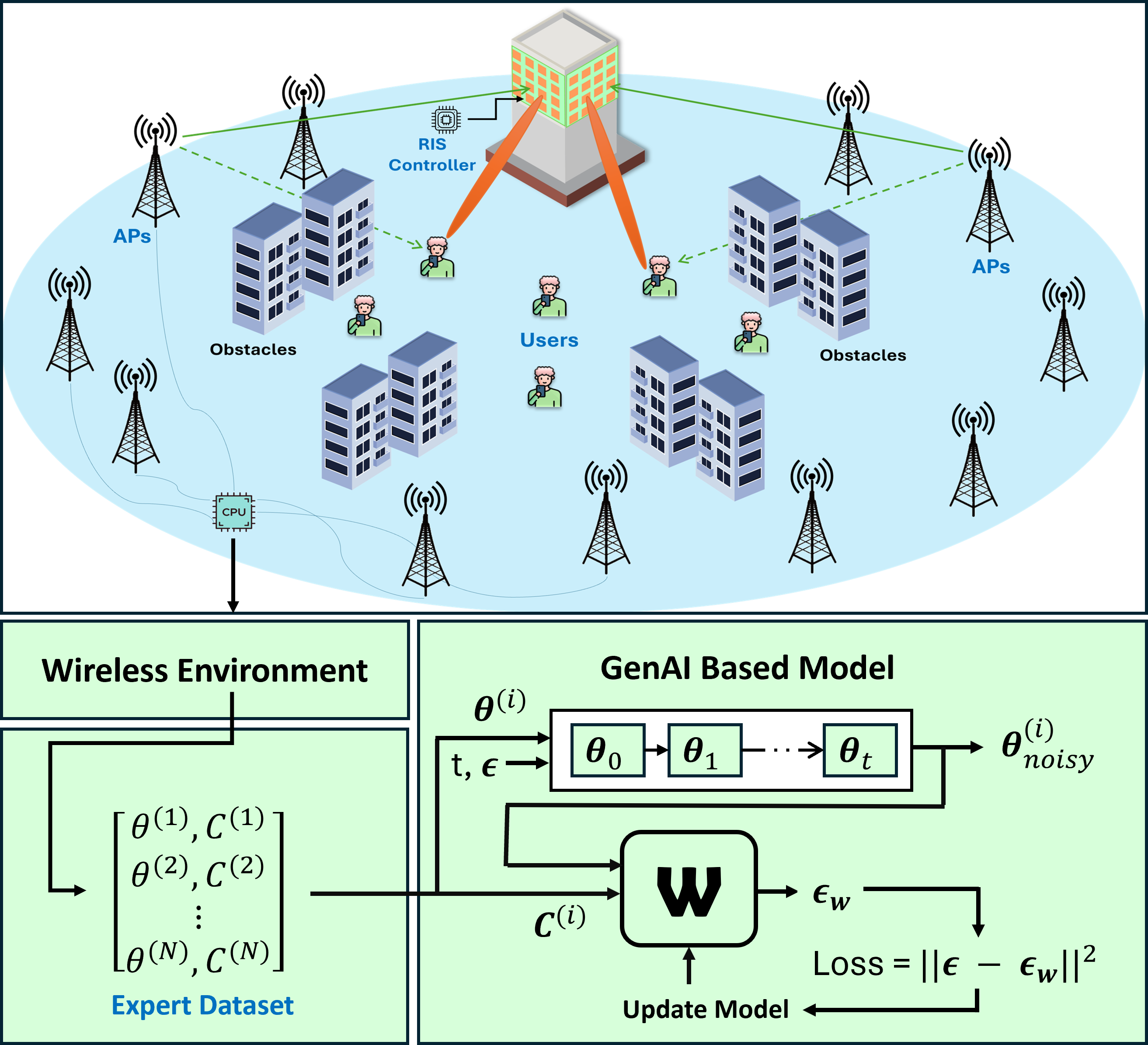
This work presents generative AI-driven diffusion models for efficient phase shift optimization in cell-free massive MIMO systems with reconfigurable intelligent surfaces, achieving performance comparable to traditional methods with reduced computational complexity.
Achieving optimal performance in next-generation wireless networks demands increasingly sophisticated methods for managing signal reflection and interference. This is addressed in ‘Generative AI-Driven Phase Control for RIS-Aided Cell-Free Massive MIMO Systems’, which investigates the application of generative artificial intelligence to optimize phase shifts in reconfigurable intelligent surfaces (RIS) within cell-free massive multiple-input multiple-output systems. The authors demonstrate that diffusion model-based generative approaches-specifically generative conditional diffusion model (GCDM) and generative conditional diffusion implicit model (GCDIM)-can match the sum spectral efficiency of expert algorithms while substantially reducing computational complexity, with GCDIM achieving a [latex]98\%[/latex] reduction in computation time. Could these findings pave the way for real-time, energy-efficient phase control in ultra-dense wireless deployments?
The Inevitable Complexity of Wireless
Conventional wireless communication systems consistently struggle to deliver reliable coverage and maximize spectral efficiency, particularly within the increasingly complex radio environments of modern life. Obstructions like buildings, foliage, and even the human body cause signal degradation through absorption, scattering, and reflection, leading to dead zones and reduced data rates. These limitations are exacerbated by the finite and increasingly congested radio frequency spectrum, hindering the ability to support the ever-growing demand for wireless connectivity. Moreover, static infrastructure struggles to adapt to dynamic changes in the environment or user locations, further diminishing performance and necessitating costly infrastructure upgrades to maintain adequate service. This inherent inflexibility presents a significant challenge to realizing the full potential of ubiquitous wireless access.
Reconfigurable Intelligent Surfaces (RIS) represent a paradigm shift in wireless communication by moving beyond simply transmitting and receiving signals. These surfaces, constructed from numerous individually controllable reflecting elements, can intelligently manipulate electromagnetic waves, effectively reshaping the wireless environment. However, realizing the full benefits of RIS hinges on the precise optimization of phase shifts applied to each element; a carefully calculated reflection pattern is crucial for constructively combining signals and focusing energy towards intended receivers. This optimization process isn’t trivial, demanding sophisticated algorithms to account for dynamic channel conditions and complex multi-path propagation – a poorly optimized RIS can actually degrade signal quality instead of improving it. The potential rewards, however, are substantial: enhanced coverage, increased spectral efficiency, and dramatically improved reliability, particularly in challenging indoor or urban environments where direct signal paths are often blocked or weakened.
The realization of reconfigurable intelligent surface (RIS) technology’s potential hinges decisively on sophisticated optimization techniques. While RIS promises to reshape wireless communication by intelligently controlling signal reflection, simply deploying these surfaces isn’t enough; each reflecting element must be tuned with extreme precision. Effective optimization algorithms account for the dynamic wireless environment, including signal blockage, interference, and user location, to determine the ideal phase shifts for each RIS element. This precise control maximizes constructive interference at the receiver, dramatically boosting signal strength and expanding coverage-effectively circumventing the limitations of traditional wireless systems that struggle with signal propagation in complex environments. Researchers are actively exploring various optimization strategies, from machine learning-based approaches to computationally efficient algorithms, all aimed at unlocking the full benefits of RIS and enabling a new era of spectral efficiency and reliable connectivity.
Trading Complexity for Computation
Generative Artificial Intelligence (GenAI) presents a significant advancement in tackling complex optimization problems, particularly in the domain of Reconfigurable Intelligent Surface (RIS) control. Traditional methods for determining optimal RIS phase shifts often rely on iterative algorithms which can be computationally expensive and time-consuming, especially in dynamic environments. GenAI, through techniques like deep learning, offers the potential to directly learn the relationship between system parameters – such as channel characteristics and user locations – and the desired RIS configuration. This allows for the generation of near-optimal solutions with reduced computational overhead, enabling real-time adaptation and improved performance in wireless communication systems. The core benefit lies in the ability of GenAI models to approximate complex functions and bypass the need for explicit optimization procedures.
Generative Conditional Diffusion Models (GCDM) represent a non-iterative approach to Reconfigurable Intelligent Surface (RIS) phase shift optimization. Traditional methods rely on iterative algorithms to converge on optimal phase configurations given channel state information. In contrast, GCDMs are trained to directly map channel conditions to the corresponding optimal phase shifts, effectively bypassing the need for iterative computations. This is achieved through a diffusion process where noise is progressively added to the optimal phase shifts during training, and the model learns to reverse this process, generating optimal configurations from noisy inputs conditioned on the channel state. The resulting model then directly outputs the desired phase shift vector, significantly reducing computational complexity and latency compared to iterative optimization techniques.
Diffusion models, a type of generative AI, are employed to establish a direct relationship between wireless channel characteristics and the corresponding optimal Reconfigurable Intelligent Surface (RIS) phase shift configurations. This learning process involves training the diffusion model on a dataset of channel states and their associated optimal RIS settings, enabling the model to predict the ideal phase shifts given new, unseen channel conditions. The model learns to progressively denoise a random input, guided by the channel information, ultimately generating a phase shift vector that maximizes signal quality. This contrasts with traditional iterative optimization methods which require repeated calculations to converge on a solution, offering a potentially faster and more efficient approach to RIS control.
Robustness Through Statistical Modeling
Generative Conditional Diffusion Models (GCDM) exhibit enhanced performance when operating with Imperfect Channel State Information (CSI), a common limitation in practical wireless deployments. Accurate CSI is often unattainable due to estimation errors and feedback delays; GCDM mitigates the impact of these inaccuracies by leveraging a diffusion-based generative approach. This allows the model to synthesize plausible RIS control signals even with noisy or incomplete channel estimates, resulting in improved system robustness and reliability compared to methods reliant on precise CSI. The model’s ability to function effectively under these non-ideal conditions makes it particularly well-suited for real-world implementations where perfect channel knowledge is rarely available.
The proposed model incorporates mechanisms to effectively capture spatial correlation within the wireless channel, which is crucial for reliable Reconfigurable Intelligent Surface (RIS) control. By explicitly modeling the correlation between different channel elements, the system demonstrates increased robustness to imperfections in Channel State Information (CSI). This is achieved through a learned representation of how signals propagate in spatially correlated environments, allowing the RIS to maintain performance even when confronted with noisy or incomplete CSI estimates. The ability to leverage spatial correlation mitigates the impact of estimation errors, improving the reliability of beamforming and signal optimization techniques employed by the RIS.
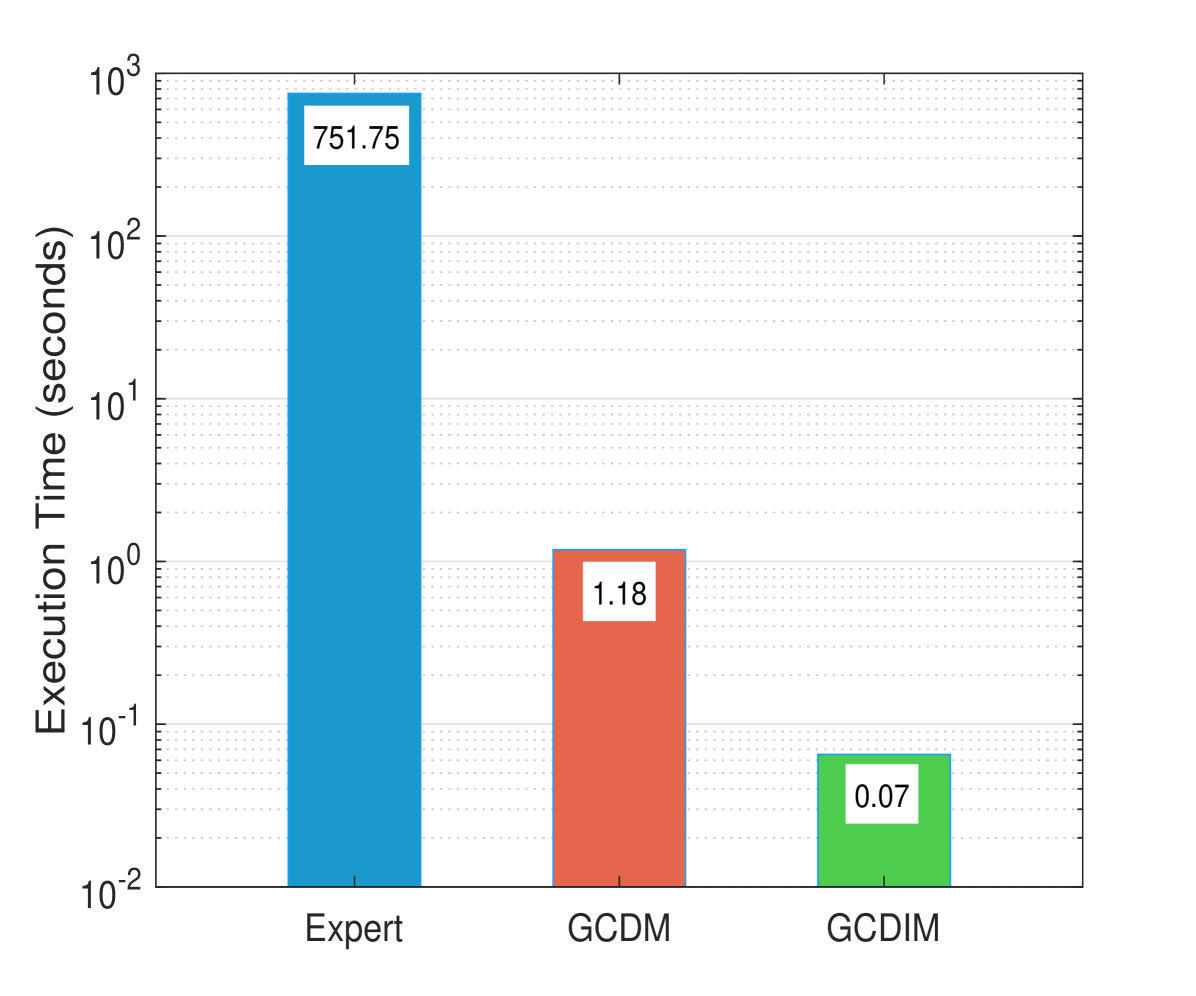
The Generative Conditional Diffusion Implicit Model (GCDIM) represents a significant advancement in Reconfigurable Intelligent Surface (RIS) control by substantially decreasing computational demands while preserving accuracy. Specifically, GCDIM achieves a 98% reduction in processing time compared to conventional expert algorithms; benchmark tests demonstrate a reduction from 752 seconds to 0.07 seconds. This accelerated generation process is achieved through the diffusion implicit model framework, enabling rapid and efficient RIS control signal generation without compromising the quality of the generated signals. This efficiency is critical for real-time applications and large-scale RIS deployments.
The Inevitable Compromise Between Theory and Reality
The implementation of the Unet architecture proved instrumental in bolstering the performance of both the Generative Communication Diffusion Model (GCDM) and the Generative Channel Diffusion Intelligent Model (GCDIM). This convolutional neural network, originally designed for biomedical image segmentation, excels at generative tasks due to its unique U-shaped structure which captures both contextual information and fine-grained details. By leveraging this architecture, the models are better equipped to learn the intricate relationship between wireless channel conditions and the corresponding optimal configurations for Reconfigurable Intelligent Surfaces (RIS). The Unet’s ability to effectively encode and decode complex data allows for a more precise mapping, ultimately leading to improved performance in controlling and optimizing wireless communication systems.
The Unet architecture proves instrumental in allowing these models to decipher the intricate relationship between wireless channel conditions and the ideal configurations for Reconfigurable Intelligent Surfaces (RIS). This convolutional neural network, designed for generative tasks, effectively learns to map fluctuating signal strengths and interference patterns to the precise angles and phase shifts needed to optimize RIS control. By processing channel information through its encoder-decoder structure, the model identifies critical features and translates them into actionable RIS settings, enabling highly adaptive and efficient beamforming. This learned mapping circumvents the need for computationally intensive, real-time optimization, allowing for swift adjustments to dynamic wireless environments and significantly improving spectral efficiency.
The synergy between diffusion models and Unet architectures delivers a powerful solution for Reconfigurable Intelligent Surface (RIS) control, demonstrating both accuracy and speed. This combined approach allows for efficient optimization of RIS configurations, achieving a sum spectral efficiency on par with that of established, expert-designed algorithms. Notably, the GCDIM model, leveraging this architecture, completes its calculations in a remarkably swift 0.07 seconds, presenting a significant advantage for real-time wireless communication systems and paving the way for practical implementation of intelligent reflecting surfaces in future networks.
The Next Iteration: More Tools for a More Complex Problem
Recent advancements in generative modeling for wireless control have seen a notable shift towards diffusion models, such as those implemented in Generative Communication Diffusion Models (GCDM) and GCDIM. These models surpass earlier techniques like Variational Autoencoders (VAE) and Generative Adversarial Networks (GAN) through a fundamentally different approach to data generation. Instead of directly learning a mapping from random noise to data, diffusion models progressively add noise to data until it becomes pure noise, then learn to reverse this process, effectively ‘denoising’ to generate new samples. This iterative refinement process allows diffusion models to capture intricate data distributions with greater fidelity and stability, addressing common issues like mode collapse often seen in GANs and blurry outputs from VAEs. The result is a capacity to generate more realistic and diverse control signals for reconfigurable intelligent surfaces (RIS), promising substantial improvements in wireless communication performance and adaptability.
The next generation of reconfigurable intelligent surface (RIS) control likely won’t rely on a single generative model, but instead will integrate the advantages of several. Current research suggests combining diffusion models – like those underpinning GCDM and GCDIM – with the strengths of variational autoencoders (VAE) and generative adversarial networks (GAN). VAEs excel at efficient data encoding and decoding, providing a fast initial solution, while GANs are adept at generating highly realistic and detailed data, refining the control signals. A hybrid approach could leverage VAEs for rapid, broad-stroke RIS configuration, followed by GAN- or diffusion model-based refinement to optimize performance in complex and changing wireless environments. This synergistic combination promises more robust, adaptable, and ultimately, more effective RIS control, unlocking the full potential of intelligent reflecting surfaces.
The advent of artificial intelligence in wireless control heralds a transformative shift, poised to redefine the landscape of modern communication. Traditional systems, often reliant on pre-defined rules and static configurations, are giving way to networks capable of independent learning and adaptation. This AI-driven paradigm enables wireless systems to proactively anticipate and respond to fluctuating signal conditions, user demands, and network congestion, optimizing performance in real-time. Consequently, bandwidth can be allocated with unprecedented efficiency, energy consumption minimized, and overall network capacity dramatically increased – essential advancements for accommodating the exponential growth of connected devices and data-intensive applications in the years to come. The promise lies not merely in incremental improvements, but in the creation of truly intelligent networks capable of self-optimization and resilient operation in an increasingly complex wireless world.
The pursuit of optimized phase shifts in cell-free mMIMO, as detailed in this work, inevitably recalls a certain pragmatism. The researchers demonstrate GenAI’s capability in reducing computational complexity – a commendable feat, certainly. However, one anticipates that these elegantly crafted diffusion models, while currently outperforming traditional methods, will eventually succumb to the realities of production deployment. As Grace Hopper observed, “It’s easier to ask forgiveness than it is to get permission.” This sentiment resonates; the initial efficiency gains will likely be eroded by unforeseen edge cases and the ever-present need to adapt to real-world signal interference. The models might become tomorrow’s tech debt, requiring constant refinement and patching, even as new, more ‘efficient’ approaches emerge.
The Inevitable Complications
The demonstrated reduction in computational complexity is…pleasant. It’s easy to envision a scenario where these diffusion models become the preferred method for RIS phase optimization. Until, of course, production networks encounter actual channel conditions. The simulations assume a certain level of stationarity, a luxury rarely afforded in the real world. They’ll call it ‘adaptive learning’ and ask for more funding to handle the non-stationary parts. It’s a familiar pattern.
A more pressing concern lies in scaling these models. The current validation focuses on a relatively constrained system. Extending this approach to truly massive MIMO configurations – the kind that actually justify the complexity – will undoubtedly expose limitations in the diffusion process itself. The ‘conditional generation’ aspect is particularly vulnerable; real-world interference isn’t neatly categorized. It’s a graceful facade over what used to be a simple bash script, really.
The documentation, predictably, omits any discussion of retraining frequency. Maintaining the accuracy of these generative models in a dynamic environment will require constant updates. And when the model hallucinates a phase shift that doesn’t exist? Someone will have to debug that. It’s a solvable problem, certainly. Just another layer of complexity added to a system already straining at the seams. Tech debt is just emotional debt with commits, after all.
Original article: https://arxiv.org/pdf/2602.11226.pdf
Contact the author: https://www.linkedin.com/in/avetisyan/
2026-02-15 19:31