Author: Denis Avetisyan
This review explores how artificial intelligence is transforming cooperative spectrum sensing to unlock greater efficiency and reliability in wireless networks.
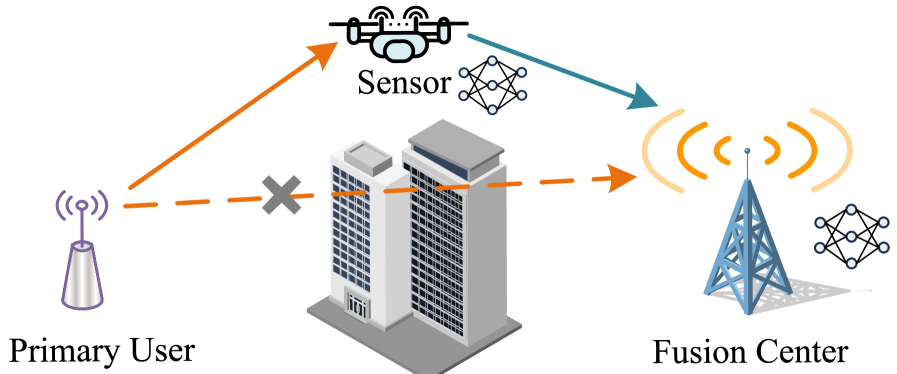
A comprehensive survey of deep learning, semantic communication, and reinforcement learning techniques for collaborative spectrum sensing in cognitive and intelligent wireless systems.
Increasing spectral congestion and the demand for efficient resource allocation necessitate intelligent approaches to wireless communication. This paper, ‘Collaborative Spectrum Sensing in Cognitive and Intelligent Wireless Networks: An Artificial Intelligence Perspective’, surveys recent advances in applying artificial intelligence-specifically deep learning and semantic communication-to enhance cooperative spectrum sensing. By classifying AI-driven techniques into discriminative, generative, and reinforcement learning models, we demonstrate significant potential for improving sensing accuracy and reducing overhead. Will these innovations pave the way for truly adaptive and robust wireless networks capable of meeting the challenges of future communication demands?
Navigating the Challenges of Dynamic Spectrum Access
Conventional approaches to spectrum sensing, such as Energy Detection and Maximum-Eigenvalue Detection, face significant hurdles when deployed in real-world radio environments. These methods, while mathematically straightforward, often assume simplified conditions that rarely hold true in practice. Complex scenarios – including fading channels, interference from multiple sources, and rapidly changing signal characteristics – diminish their performance. Energy Detection, for instance, struggles to differentiate between genuine signals and noise, leading to false alarms or missed detections. Maximum-Eigenvalue Detection, while more robust, requires accurate estimates of the noise covariance matrix, which becomes exceedingly difficult in dynamic environments. Consequently, these traditional techniques frequently lack the sensitivity and adaptability needed to reliably identify available spectrum opportunities, hindering the progress of cognitive radio and efficient spectrum utilization.
Traditional spectrum sensing techniques frequently falter when tasked with identifying fleeting or intermittent radio signals. Methods such as energy detection, while computationally simple, are highly susceptible to noise and may miss weak, short-duration transmissions. Similarly, maximum-eigenvalue detection, designed to distinguish signals from noise, can be thrown off by rapidly changing channel conditions or the presence of multiple interfering sources. This lack of sensitivity and adaptability is particularly problematic in modern radio environments characterized by bursty data transmissions and a proliferation of wireless devices. Consequently, these established approaches struggle to provide a reliable assessment of spectrum availability, hindering the effectiveness of cognitive radio systems designed to dynamically access unused frequencies and prompting research into more sophisticated sensing paradigms.
The relentless growth of wireless communication technologies fuels an ever-increasing demand for available radio spectrum, yet this resource remains finite. This scarcity, coupled with the emergence of cognitive radio – systems designed to intelligently utilize unused frequencies – compels a shift towards more sophisticated spectrum sensing. Traditional methods, while functional in static environments, struggle with the complexities of real-world radio landscapes where signals are often weak, intermittent, or masked by interference. Consequently, research focuses on developing robust techniques capable of accurately identifying and exploiting fleeting opportunities within the spectrum, enabling cognitive radios to dynamically adapt and efficiently share this valuable resource without causing disruption to primary users. This drive for intelligent sensing is not merely an academic pursuit, but a critical component in realizing the full potential of future wireless networks and accommodating the exponential growth of connected devices.
The Dawn of AI-Powered Spectrum Sensing
Traditional spectrum sensing techniques, reliant on energy detection, matched filtering, and cyclostationary feature analysis, encounter limitations in dynamic and noisy radio frequency (RF) environments. These methods struggle with low signal-to-noise ratio (SNR) conditions, interference, and identifying weak or transient signals. Artificial intelligence, and specifically deep learning, addresses these challenges by enabling adaptive and robust signal processing. Deep learning algorithms can be trained on large datasets of RF signals to learn complex patterns and features, exceeding the capabilities of manually engineered algorithms. This data-driven approach allows for improved detection of signals even in highly congested or noisy environments, and facilitates real-time adaptation to changing spectrum conditions without requiring explicit programming for every scenario.
Deep Learning models, specifically Convolutional Neural Networks (CNNs) and Recurrent Neural Networks (RNNs), exhibit enhanced spectrum sensing capabilities through their ability to automatically extract hierarchical features from raw radio frequency (RF) data. CNNs excel at identifying spatial patterns within signals, proving effective for wideband spectrum analysis and interference classification. RNNs, conversely, are designed to process sequential data, making them suitable for time-varying signals and predicting future spectrum occupancy. Both architectures utilize multiple layers of interconnected nodes, enabling them to learn non-linear relationships and complex signal characteristics without explicit feature engineering. This adaptability allows the models to generalize to unseen environments and dynamically adjust to changes in noise, interference, and signal propagation, improving sensing performance in real-world scenarios.
Deep learning models demonstrate improved spectrum sensing accuracy, notably in low signal-to-noise ratio (SNR) environments where traditional methods struggle. Recent research indicates that Convolutional Neural Networks (CNNs) and Recurrent Neural Networks (RNNs) can effectively identify weak signals obscured by noise, achieving higher probabilities of detection and lower false alarm rates compared to energy detection or matched filtering techniques. This improvement stems from the models’ ability to learn complex signal features and discriminate between noise and genuine transmissions, even when the signal power is minimal. Studies have shown performance gains of up to 10-15 dB in SNR threshold for reliable detection using these advanced AI approaches.
Harnessing Collective Intelligence: Collaborative Sensing Architectures
Collaborative spectrum sensing enhances detection reliability and accuracy by aggregating observations from multiple sensors. Individual sensors are often limited by factors such as shadowing, multipath fading, and noise, leading to potentially inaccurate assessments of spectrum occupancy. By combining data from geographically distributed sensors, these limitations can be mitigated through techniques like averaging or weighted fusion. This approach provides a more robust and representative understanding of the radio frequency environment, reducing the probability of false alarms and missed detections compared to single-sensor implementations. The collective intelligence of the sensor network improves the overall performance and resilience of spectrum sensing systems, especially in complex and dynamic radio environments.
Graph Neural Networks (GNNs) offer advantages for collaborative spectrum sensing due to their ability to model relationships between sensors as nodes within a graph structure. This allows the network to move beyond treating sensor data as independent observations and instead leverage spatial correlations; sensors in close proximity or experiencing similar interference patterns can directly influence each other’s processing. GNNs employ message passing algorithms where nodes aggregate information from their neighbors, enabling the network to learn a representation of the entire sensing environment. This holistic approach facilitates more accurate spectrum detection and improved robustness against noise and fading, as the model can infer information from the network-wide context rather than relying solely on individual sensor readings. The learned graph representation allows for generalization to varying network topologies and sensor deployments without requiring extensive retraining.
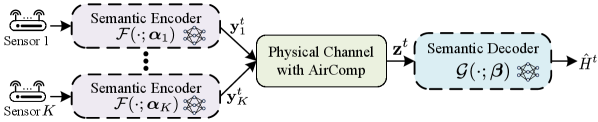
Traditional Orthogonal Multiple Access (OMA)-based reporting in collaborative sensing systems incurs a reporting overhead that increases linearly with the number of sensors, denoted as K. This is because each sensor typically transmits its individual sensing results. In contrast, AirComp-based reporting utilizes signal processing techniques to compress and aggregate sensing data at the sensors, allowing the transmission of a single, combined signal. This fundamentally alters the scaling behavior; the reporting overhead with AirComp remains constant regardless of the network size (K). Consequently, AirComp offers a significant advantage in large-scale deployments where minimizing communication overhead is crucial for efficient spectrum sensing and resource allocation.
The Elegance of Semantic Communication and Over-the-Air Computation
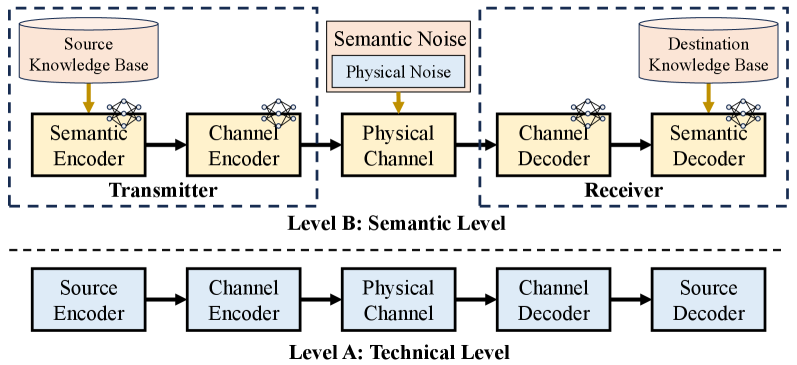
Conventional communication systems prioritize the faithful reconstruction of transmitted signals, often sending redundant data. Semantic communication, however, shifts this focus to reliably conveying the meaning of the information itself. This approach recognizes that not all signal details are crucial for understanding the message; instead, it encodes and transmits only the essential semantic elements. By discarding irrelevant information, semantic communication dramatically reduces bandwidth requirements and improves communication efficiency, particularly in resource-constrained environments. This is achieved through techniques like source coding that concentrate on perceptual importance, allowing for a more streamlined and effective transmission process focused on what is understood, not simply what is sent. The result is a system that optimizes for comprehension, rather than mere replication, paving the way for more sustainable and efficient wireless networks.
Over-the-Air Computation (AirComp) represents a paradigm shift in wireless communication by harnessing the inherent superposition property of wireless channels. Instead of individually transmitting data from multiple devices to a central processor, AirComp allows devices to simultaneously transmit encoded data as superimposed waveforms; the wireless medium itself then performs the computation – such as summation or averaging – directly. This effectively transforms the communication channel into a distributed computational resource, drastically reducing transmission time and energy consumption. The result is an efficient mechanism for data aggregation, particularly useful in scenarios like federated learning or sensor networks where numerous devices contribute to a collective result. By shifting the computational burden from digital processors to the physical layer, AirComp offers a pathway toward significantly improved spectral efficiency and reduced latency in wireless systems, potentially enabling real-time data analytics and control in resource-constrained environments.
Traditional wireless communication prioritizes the accurate delivery of raw data, often transmitting redundant information and consuming valuable spectral resources. However, a paradigm shift towards semantic communication enables the concurrent aggregation of distilled, meaningful representations directly over the air. This innovative approach bypasses the need to transmit entire datasets, instead leveraging the superposition properties of wireless channels to combine semantic information from multiple sources. Consequently, spectral efficiency is dramatically improved; the system effectively accomplishes more with less bandwidth by focusing on what is communicated, rather than how it is communicated, paving the way for more sustainable and scalable wireless networks. This concurrent aggregation minimizes collisions and maximizes data throughput, particularly beneficial in densely populated wireless environments.
Envisioning the Future of Intelligent Wireless Systems
Deep reinforcement learning offers a dynamic approach to managing the increasingly congested wireless spectrum. Rather than relying on pre-programmed, static configurations, this technology allows wireless systems to learn optimal sensing and reporting strategies through trial and error. An intelligent agent, powered by deep neural networks, continuously analyzes the radio environment, predicting how different transmission configurations will impact spectrum utilization and interference levels. Through this iterative process, the system proactively adjusts parameters – such as transmission power, frequency bands, and reporting intervals – to maximize efficiency and minimize disruptions for other users. This adaptive capability is particularly crucial in dense networks and rapidly changing environments, promising a significant leap forward in the performance and reliability of future wireless communication systems.
Variational Autoencoders (VAEs) represent a significant advancement in how wireless spectrum signals are processed and communicated. These neural networks learn to compress complex radio frequency data into a lower-dimensional ‘latent space’ – effectively creating a streamlined representation while retaining essential information. This compression isn’t simply about reducing file size; it unlocks substantial benefits for wireless systems. By transmitting and storing these compact representations instead of raw signals, bandwidth requirements are dramatically lowered, leading to faster data rates and reduced energy consumption. Furthermore, the inherent noise-reduction capabilities of VAEs improve signal quality and enhance the resilience of wireless communications against interference. This approach paves the way for more efficient spectrum utilization, enabling a greater number of devices to operate within the available frequency bands without compromising performance – a crucial step toward the next generation of wireless networks.
The synergistic combination of deep reinforcement learning and variational autoencoders heralds a transformative shift in wireless system design. These technologies move beyond static configurations, enabling networks to dynamically adapt to fluctuating demands and challenging radio environments. By intelligently optimizing sensing and reporting – and simultaneously compressing spectral data for efficient transmission – future wireless systems promise substantial gains in both performance and resource utilization. This convergence doesn’t merely improve existing capabilities; it establishes a foundation for inherently secure communication, as adaptive strategies can proactively mitigate interference and detect anomalies, creating robust and resilient networks capable of supporting the ever-increasing demands of a connected world.
The study meticulously charts a course through the complexities of cooperative spectrum sensing, revealing how artificial intelligence, specifically deep learning and semantic communication, can orchestrate a more harmonious and efficient use of wireless resources. This pursuit of optimized performance through intelligent systems echoes Hannah Arendt’s observation that “political action is conditioned by speech, and speech, in turn, is conditioned by thought.” Just as careful thought shapes meaningful communication, the refined algorithms detailed within this work aim to shape spectrum sensing into a more elegant and robust process, enabling a more nuanced ‘conversation’ between devices and ultimately, a more effective wireless network. The emphasis on semantic communication, allowing devices to share not just data but meaning, further exemplifies this principle of thoughtful exchange.
Beyond the Horizon
The pursuit of elegant spectrum sensing, as detailed within, reveals a familiar truth: solving one problem often clarifies the contours of another. The integration of artificial intelligence, while demonstrably effective, merely shifts the locus of complexity. Current approaches, reliant on expansive datasets and computationally intensive models, risk becoming brittle in the face of truly novel or adversarial conditions. A harmonious system demands more than just accurate detection; it requires an intrinsic understanding of the signal’s meaning, not simply its presence.
Future work must address the inherent trade-offs between model complexity, real-time constraints, and generalization ability. Semantic communication, currently a promising thread, needs to mature beyond proof-of-concept demonstrations. The challenge lies not simply in transmitting what is detected, but in conveying why it matters. Generative models, while capable of synthesizing realistic data, remain fundamentally limited by the biases embedded within their training sets. A truly intelligent system will be able to identify-and correct for-these limitations, exhibiting a level of self-awareness currently beyond its reach.
Ultimately, the ideal design unites form and function. Cooperative spectrum sensing, infused with artificial intelligence, holds the potential to unlock significant gains in wireless communication efficiency. However, the true measure of success will not be the complexity of the algorithms employed, but the simplicity and robustness of the resulting system – a whisper, not a shout, in the increasingly crowded electromagnetic landscape.
Original article: https://arxiv.org/pdf/2602.09615.pdf
Contact the author: https://www.linkedin.com/in/avetisyan/
2026-02-12 00:42