Author: Denis Avetisyan
A new framework uses the power of language models and knowledge graphs to intelligently explore chemical possibilities, accelerating the search for sustainable materials.
GraphAgents leverages multi-agent AI and knowledge graphs to enhance hypothesis generation for materials design, with a focus on PFAS alternatives.
Despite the increasing accessibility of scientific information, connecting disparate knowledge remains a critical bottleneck, particularly in complex fields like materials science. To address this, we introduce ‘GraphAgents: Knowledge Graph-Guided Agentic AI for Cross-Domain Materials Design’, a multi-agent framework that leverages large-scale knowledge graphs to enhance hypothesis generation for materials discovery. Our approach demonstrates improved performance over single-prompting methods in identifying sustainable alternatives to per- and polyfluoroalkyl substances (PFAS), showcasing the value of distributed reasoning and relational knowledge. Could this framework unlock a new paradigm for materials design, accelerating the discovery of innovative and sustainable materials across diverse applications?
The Challenge of Material Discovery: A Paradigm of Inefficiency
The development of new materials, historically, has been a remarkably painstaking process. Innovation often hinges on synthesizing and testing numerous candidate compositions, a cycle demanding significant time and resources. This traditional, trial-and-error approach isn’t merely inefficient; it’s fundamentally limited by the sheer breadth of possible material combinations. Each experiment carries a cost, not just in monetary terms, but also in wasted effort when a promising avenue proves fruitless. Consequently, breakthroughs are often delayed, and the potential for materials to address critical challenges – from energy storage to sustainable construction – remains unrealized. The slow pace of discovery necessitates a paradigm shift towards more predictive and efficient methods, capable of navigating the vast ‘materials space’ with greater speed and accuracy.
The sheer scale of potential materials-combinations of elements and their arrangements-presents an almost insurmountable challenge to traditional discovery methods. This “materials space” is effectively infinite, dwarfing the number of materials currently known and studied. Consequently, researchers are increasingly turning to computational techniques-modeling, simulation, and data analysis-to predict material properties and guide experimental efforts. These in silico approaches offer the potential to drastically accelerate the discovery process, sifting through vast chemical landscapes to identify promising candidates far more efficiently than relying solely on trial-and-error synthesis and characterization. By leveraging the power of algorithms and high-performance computing, scientists aim to move beyond serendipitous breakthroughs and towards a more rational, predictive paradigm for materials innovation, unlocking new possibilities for technological advancement.
Current computational materials science frequently employs methods like high-throughput screening and machine learning, yet these often struggle with the intricate web of relationships governing material behavior. While adept at identifying correlations, these approaches frequently lack the capacity for causal reasoning – understanding why certain material combinations yield specific properties. This limitation stems from a reliance on statistical patterns rather than a deep understanding of the underlying physics and chemistry. Consequently, predictions can be inaccurate when extrapolating beyond the training data, and the discovery of truly novel materials-those with properties not readily apparent from existing knowledge-remains a significant challenge. Bridging this gap requires developing computational frameworks that integrate fundamental principles with data-driven insights, enabling a more nuanced and predictive understanding of the materials landscape.
Graph-Based Reasoning: Structuring Knowledge for Material Innovation
Knowledge Graphs in materials science utilize a graph structure – nodes representing materials, properties, and processes, and edges defining relationships between them – to organize and represent complex data. This structured representation allows for efficient reasoning through graph traversal and querying. Nodes can be associated with quantitative data, such as [latex]T_{melting}[/latex] or band gap energy, and qualitative data like material class or synthesis method. Relationships define how these entities connect – for example, ‘is_a’ to denote hierarchical classifications, ‘has_property’ to link materials to their characteristics, or ‘requires_process’ to indicate synthesis routes. This organization facilitates automated inference; for instance, identifying materials with specific properties by traversing the graph based on defined relationships, or predicting the outcome of a process based on the properties of input materials and known process-property relationships.
Multi-Agent AI frameworks address materials design complexity by distributing the problem-solving process across multiple autonomous agents. Each agent is assigned a specific sub-task, such as property prediction, structure generation, or synthesis planning, and operates with its own knowledge and objectives. Communication and coordination between agents, often facilitated through a central orchestrator or distributed negotiation protocols, enable the integration of individual solutions into a cohesive design. This decomposition allows for parallel processing, improved scalability, and the potential for agents to specialize in specific areas of materials expertise, ultimately accelerating the discovery of novel materials with desired characteristics.
Combining evidence-grounded retrieval with controllable graph traversal significantly accelerates materials hypothesis generation and discovery by efficiently navigating complex materials knowledge graphs. Evidence-grounded retrieval identifies relevant substructures and properties from a corpus of materials data, providing initial nodes for graph traversal. Controllable traversal then allows systematic exploration of the graph, following specific relationships – such as chemical composition, crystal structure, or processing parameters – to identify potential materials candidates. This approach reduces the search space compared to exhaustive methods, and the grounding in experimental evidence increases the reliability of generated hypotheses. The combination enables the automated formulation of testable predictions based on existing data, streamlining the materials design process and reducing reliance on trial-and-error experimentation.
The Graph Agent Architecture: A Systematic Approach to Design
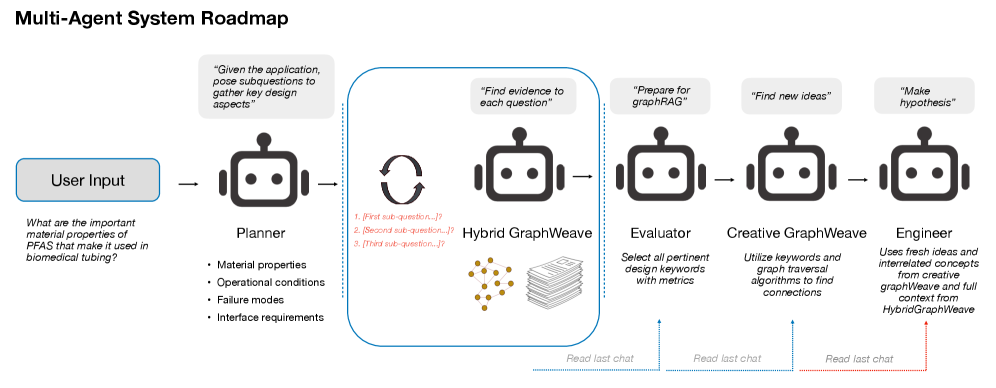
The Graph Agents framework employs a multi-agent system consisting of three specialized agents: the Planner, the Evaluator, and the Engineer. The Planner agent is responsible for initially defining the design space and generating potential material combinations. Subsequently, the Evaluator agent assesses these combinations based on predefined criteria and available knowledge, ranking them according to their feasibility and potential performance. Finally, the Engineer agent refines the top-ranked designs, optimizing material properties and generating detailed specifications for synthesis or further analysis. This sequential orchestration of agents facilitates a systematic and iterative design process, leveraging the strengths of each agent to explore a broad solution space and converge on optimal material designs.
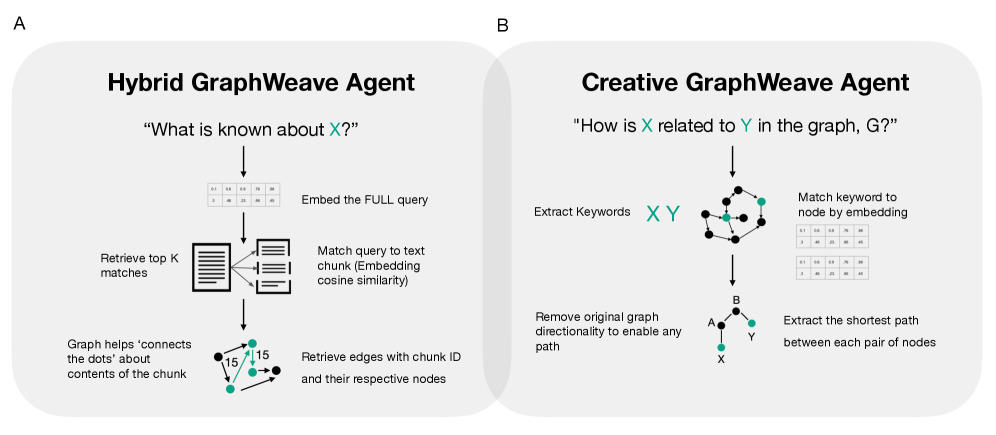
The Hybrid GraphWeave Agent functions by consolidating information from both unstructured text sources and formalized, structured knowledge graphs. This integration is achieved through a unified data representation that allows the agent to query and reason across both modalities simultaneously. Specifically, the agent leverages the breadth of information contained within raw text – such as research articles and reports – while also utilizing the precision and relationships defined within the knowledge graph. This dual access enables comprehensive information retrieval and facilitates a more nuanced understanding of complex relationships between entities and concepts, exceeding the capabilities of systems reliant on either data type in isolation.
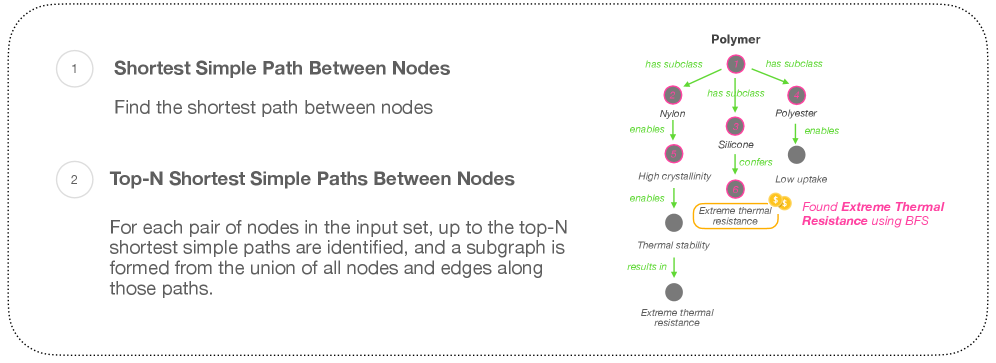
The Creative GraphWeave Agent utilizes a suite of pathfinding algorithms to identify potential material connections within the knowledge graph. These algorithms – Breadth-First Search, Depth-First Search, Shortest Simple Path, and Top-N Shortest Simple Path – are employed to traverse the graph and discover relationships between materials. The search process is guided by designated ‘Semantic Stops’, which represent key concepts or properties that define relevant pathways. This approach enables the agent to explore diverse material combinations and prioritize those with the highest potential for innovation, effectively searching for novel connections beyond immediately obvious associations.
The Graph Agents framework leverages LLama-3 as its core language model, providing the reasoning and text generation capabilities for each agent. To facilitate ongoing improvement and specialization without extensive retraining, the system incorporates X-LoRA (eXtreme Low-Rank Adaptation). X-LoRA enables parameter-efficient fine-tuning of LLama-3, allowing the agents to adapt to specific tasks and datasets – such as the PFAS-Specific and Material Properties Knowledge Graphs – with a significantly reduced computational cost and data requirement compared to full model updates. This continual learning approach ensures the agents maintain and improve their performance over time as new information becomes available.
The PFAS-Specific Knowledge Graph currently consists of 4,716 articles, representing a data yield of approximately 97.8%. This yield was calculated based on an initial retrieval of 4,824 potential source documents. The knowledge graph construction process involved filtering and validating these documents to ensure relevance and accuracy, resulting in the curated dataset of 4,716 articles focused specifically on per- and polyfluoroalkyl substances (PFAS).
The Material Properties Knowledge Graph comprises 63,222 abstracts representing curated data extracted from an initial corpus of 160,495 abstracts. This extraction process focused on identifying and incorporating abstracts relevant to material properties, resulting in a focused knowledge base. The final graph represents a significant reduction in scope from the original dataset, prioritizing quality and relevance of information for subsequent analysis and agent-based exploration.
During the construction of the knowledge graphs, a cosine similarity threshold of 0.95 was implemented to identify and merge nodes representing semantically equivalent concepts. This process aimed to reduce redundancy and improve the graph’s coherence. Node similarity was calculated based on the vector representations of their associated data, such as article abstracts or material properties. If the cosine similarity between two nodes exceeded the 0.95 threshold, the nodes were merged into a single, unified node, consolidating their associated information and relationships. This merging strategy ensured that synonymous or highly related concepts were represented only once within the knowledge graph, enhancing data integrity and the efficiency of subsequent graph traversals.
Ablation studies were conducted to assess the contribution of each agent within the multi-agent pipeline. These studies systematically removed individual agents – Planner, Evaluator, and Engineer – or combinations thereof, and compared the performance of the resulting ablated configurations against the complete pipeline. Results consistently demonstrated that the full pipeline outperformed all ablated configurations across all tested metrics. This indicates that each agent plays a critical, non-redundant role in the overall design process and that the synergistic interaction between agents is essential for achieving optimal performance. The observed performance degradation in ablated configurations validates the architectural design and highlights the importance of maintaining all pipeline components for effective operation.
![This multi-agent system collaboratively solves problems by decomposing tasks ([Planner], [HybridGraphWeave]), extracting keywords ([Evaluator]), generating ideas ([CreativeGraphWeave]), and formulating hypotheses ([Engineer]).](https://arxiv.org/html/2602.07491v1/x6.png)
Beyond PFAS: Towards Sustainable and Durable Material Design
A central innovation lies in the construction of specialized knowledge graphs focused explicitly on per- and polyfluoroalkyl substances (PFAS). These graphs don’t simply catalog chemical properties; they map the complex relationships between molecular structure, functionality, environmental persistence, and toxicity. By representing this information in a structured, interconnected format, the framework facilitates a ‘rational’ design process-one guided by data and predictive modeling, rather than trial-and-error. This allows researchers to proactively identify chemical alternatives that not only match the desired performance characteristics of PFAS, but also minimize potential harm to human health and the environment, effectively breaking the cycle of regrettable substitution and accelerating the development of truly sustainable materials.
The architecture of this materials discovery system is intentionally designed for flexibility, allowing it to transcend the specific challenge of replacing per- and polyfluoroalkyl substances (PFAS). Its modular components – encompassing knowledge representation, agent-based search, and graph traversal algorithms – can be readily reconfigured and applied to diverse materials science problems. This adaptability isn’t merely a feature, but a core principle, enabling researchers to swiftly address new design constraints, explore alternative chemical spaces, and optimize materials for a broad spectrum of applications, from high-performance polymers to sustainable construction materials. Consequently, the system avoids the limitations of narrowly focused tools, offering a scalable and reusable platform for materials innovation across multiple disciplines and industries.
The conventional process of materials discovery is often a lengthy and expensive undertaking, frequently relying on trial-and-error experimentation. However, a novel framework streamlines this process by integrating structured chemical knowledge with the capabilities of intelligent agents and efficient graph traversal algorithms. This approach allows researchers to navigate vast chemical spaces with unprecedented speed, identifying promising candidate materials based on desired properties and predicted performance. By computationally screening numerous possibilities before physical synthesis, the framework substantially reduces the need for costly laboratory work and accelerates the timeline from initial concept to viable material, ultimately lowering the overall financial and temporal burden of innovation in fields ranging from polymer science to pharmaceuticals.
A new design framework offers a compelling route to materials innovation, prioritizing not only functionality but also sustainability and durability. This approach moves beyond simply identifying chemical substitutions – for instance, replacing per- and polyfluoroalkyl substances (PFAS) – to proactively engineering materials with demonstrably improved life cycles. By integrating structured knowledge about chemical properties, environmental impacts, and performance characteristics, the framework enables the creation of substances that excel in their intended applications while minimizing harm to both human health and the environment. The potential benefits extend beyond a reduction in hazardous waste; materials designed through this process are anticipated to exhibit increased resilience, requiring less frequent replacement and ultimately contributing to a more circular and resource-efficient economy.
![Depth-First Search efficiently connects material properties, such as [latex] ext{polymer}[/latex] to [latex] ext{extreme thermal resistance}[/latex], by exhaustively exploring each branch before backtracking to create a subgraph of related properties.](https://arxiv.org/html/2602.07491v1/x10.png)
The pursuit of sustainable materials, as demonstrated by GraphAgents, necessitates a relentless simplification of complex problems. This framework doesn’t merely aggregate data; it distills knowledge into actionable hypotheses. It echoes the sentiment of David Hilbert, who stated, “One must be able to say at all times what one knows and what one does not know.” The system’s reliance on knowledge graphs embodies this principle; by explicitly mapping known relationships within the materials science domain, GraphAgents clarifies what remains unknown – the optimal pathways toward PFAS alternatives. This clarity, achieved through structured knowledge representation, is not an embellishment but the very foundation of effective hypothesis generation, aligning with the core idea of minimizing complexity to maximize understanding.
The Road Ahead
The proliferation of agents, each ostensibly reasoning, introduces a familiar challenge: the need for justification. GraphAgents, in attempting to navigate the materials design space, does not solve the problem of hypothesis generation; it relocates it. The system’s efficacy hinges on the knowledge graph itself – a curated representation, inevitably incomplete, of a reality that resists simple categorization. A useful system requires less instruction, not more; the demand for ever-larger datasets and more complex prompting strategies suggests a fundamental unease with the underlying architecture.
The focus on PFAS alternatives, while practically motivated, highlights a broader issue. Sustainable materials are defined not by their novelty, but by their lack of detrimental effects. This is a negative constraint, and a difficult one for a system built on positive assertion. True progress will likely involve a shift in emphasis – away from discovering what can be made, and toward rigorously eliminating what should not.
The true measure of such frameworks will not be their ability to mimic intelligence, but their capacity for graceful failure. A system that confidently proposes unusable compounds is merely verbose. A system that quickly, and silently, discards them approaches utility. Clarity, after all, is a courtesy, and a system that needs to explain itself has already conceded defeat.
Original article: https://arxiv.org/pdf/2602.07491.pdf
Contact the author: https://www.linkedin.com/in/avetisyan/
2026-02-11 02:46