January 2026 marked a watershed moment for stablecoins, if one can call it that, for stablecoins, with total on-chain transaction volume surpassing $10 trillion in a single month. USDC dominated that surge, processing more than $8.4 trillion in payments, far outpacing rivals and exceeding the combined monthly payment volumes of Visa and Mastercard, which, let us be honest, are not exactly known for their brisk pace.
Yet despite this explosive growth, Circle, the issuer of USDC, continues to face a sharp disconnect between on-chain reality and market valuation, as if the stock market had taken a holiday in the realm of logic.
USDC Hits $8.4 Trillion in January Transactions as Circle Stock Slides 80%
According to Artemis data, January’s stablecoin activity represented one of the strongest signals yet that digital dollars are moving beyond niche crypto use cases and into mainstream financial infrastructure, where they belong, naturally.
Circle’s marketer, Peter Schroeder, noted that stablecoin transaction volume crossed $10 trillion in January alone, with USDC accounting for the vast majority of flows ($8.4 trillion). One might say it’s a veritable avalanche of digital dollars, though the market seems to have forgotten how to ski.
Stablecoin transaction volume in January surpassed $10 trillion.
USDC alone processed more than $8.4 trillion.
– Peter Schroeder (@peterschroederr) February 2, 2026
By comparison, Visa and Mastercard together typically process around $2 trillion in monthly payments. Investors, however, appear unconvinced, as if they’d rather bet on a horse named “Doubt” than a stablecoin named “Trust.” Circle’s stock is down roughly 80% from its peak just seven months ago, a divergence that has sparked intense debate among analysts and market participants, who are doubtless sipping tea and muttering about “unfathomable complexities.”
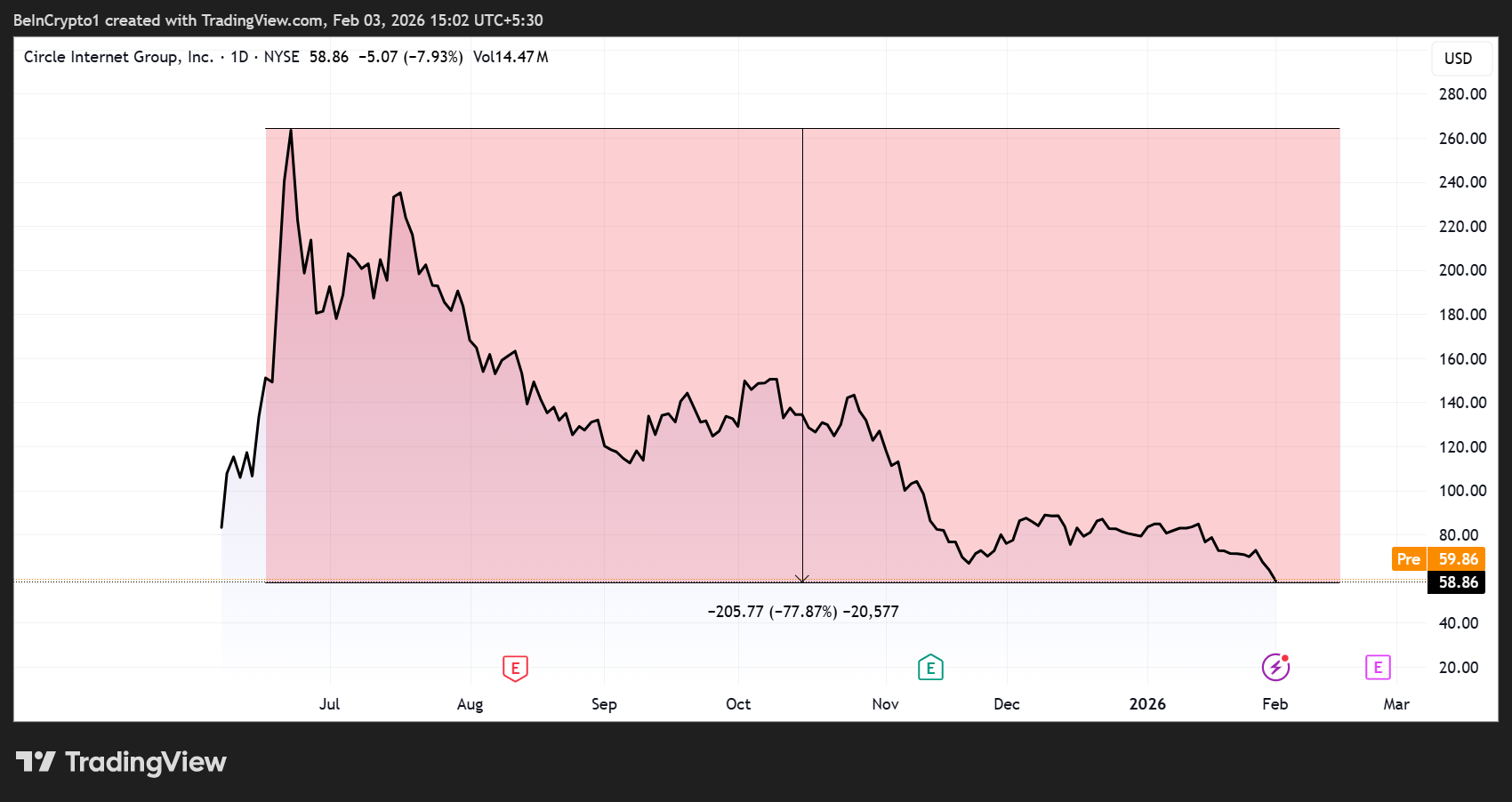
Equity fund executive Dan Tapiero pointed out that while stablecoins saw $33 trillion in total volume in 2025 and $10 trillion in January alone, Circle’s equity continues to price in failure rather than scale, a curious choice for a company that’s basically the financial equivalent of a well-oiled machine-except the machine is running on caffeine and optimism.
“USDC was $8T of that… in one month,” Tapiero said, arguing that the total addressable market (TAM) for stablecoins could exceed $1,000 trillion over time. One might say the numbers are as grand as a Wodehousian ballroom, though the investors seem to have missed the invitation.
Others echo the view that the market is misclassifying Circle’s role, arguing that investors still treat it as a fintech company rather than as core financial infrastructure, which is like calling a cathedral a shed. If this framing is true, then it understates the strategic importance of regulated digital dollars in payments, treasury operations, foreign exchange, and capital markets, which are all, of course, as thrilling as a well-timed punchline.
Regulatory Clarity Fuels USDC’s Rise as Markets Miss the Signal
Circle itself has leaned into this narrative, stating that stablecoins are now operating globally at scale following the convergence of regulatory clarity, institutional adoption, and on-chain technology, which, if you’ll pardon the metaphor, is like finding a gold brick in a haystack-only the haystack is the entire financial system.
Beyond stablecoins, a new financial system is taking shape.
What began as an innovation in digital dollars has evolved into core financial infrastructure. In just a few years, regulatory clarity, institutional adoption, and onchain technology have converged.
This report…
– Circle (@circle) January 13, 2026
The disconnect between usage and valuation mirrors a broader crypto pattern, with analysts noting that January’s $10 trillion stablecoin volume annualizes to roughly $120 trillion-nearly 40 times the entire crypto market capitalization of around $3 trillion, which is like saying a pebble is a mountain.
Product destroying it.
Stock getting destroyed.Same pattern as crypto overall:
Utility growing ✅
Price collapsing ❌$10T stablecoin volume in January.
Annualized = $120T.That’s 40X crypto’s total market cap ($3T).
Stablecoins is the real crypto product.
If regulation…
– 0xsimba ⌘ (🌸, 🌿) 🛸 (@0xbrel) February 3, 2026
In that context, stablecoins increasingly look like the most successful real-world crypto product, even as associated assets struggle to reflect that reality, which is akin to a symphony being played by a quartet of confused flutes.
Meanwhile, regulation remains a key differentiator for Circle’s stablecoin. USDC’s dominance is widely attributed to Circle’s compliance-first approach, which has helped it gain traction with institutions amid global scrutiny of digital assets, much like a well-dressed gentleman gaining favor at a society event.
Artemis data shows stablecoin usage has expanded from roughly $1 trillion in early 2023 to record levels today, with USDC widening its lead over USDT in several activity metrics, as if it’s leading a race with a head start and a well-timed nap.
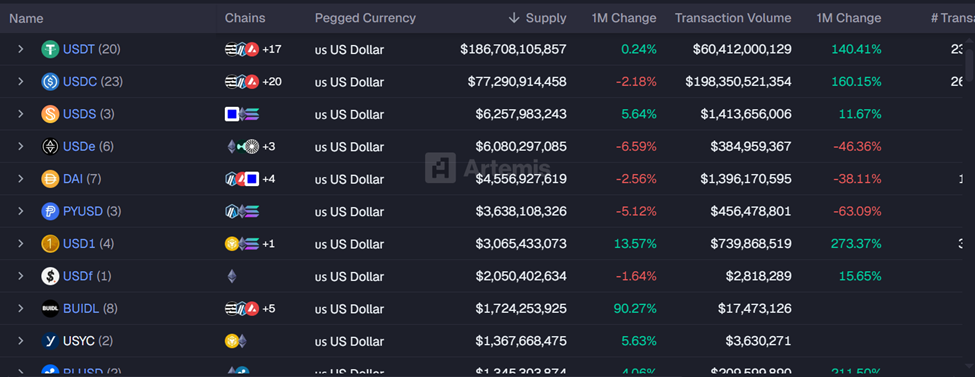
At the same time, liquidity continues to build. Total stablecoin supply is approaching an all-time high near $310 billion, leading some analysts to describe the market as sitting on more than $300 billion in deployable “dry powder,” which is a fancy way of saying “a lot of money waiting to be spent, if only the market could be convinced to stop fidgeting.”
📊 State of Stablecoins (Jan 2026):
🔹 Total Supply: $310B (Approaching ATH)
🔹 2025 Vol: $33T (> Visa)
🔹 ETH Share: 53%The liquidity gates are open.
If you’re bearish on crypto right now, you’re fighting $300B+ of dry powder waiting to buy.#DeFi #Markets #Investing
– Next 100X GEMS (@Next100XGEMS) January 21, 2026
That represents latent demand waiting for clearer macro signals and regulatory certainty, which, one suspects, will arrive just in time to confuse everyone again.
2026-02-03 14:08