On July 28, 2026, the U.S. Senate decided not to move forward with the Digital Asset Market CLARITY Act. Instead, they chose to focus on a bill imposing sanctions on Russia and confirming federal nominations. This means a vote on the crypto bill won’t happen before the Senate’s summer break on August 7th, effectively delaying any chance of officially recognizing XRP as a commodity under federal law for the time being.
This isn’t just a temporary setback. It represents a major turning point for XRP and similar digital assets. Their growth – including how institutions hold them, how banks treat them financially, and investments into XRP ETFs – relies on clear, long-term laws, which regulatory rulings alone can’t guarantee.
EXPLORE: Best Meme Coins to Buy for August
CLARITY Act News: How the Senate Calendar Closed Before a Cloture Vote Was Filed
On June 1, 2026, the CLARITY Act was scheduled for debate in the Senate. It had previously passed the Senate Banking, Housing, and Urban Affairs Committee on May 14 with a vote of 15 to 9. The vote included all 13 Republican senators, plus Democrats Ruben Gallego of Arizona and Angela Alsobrooks of Maryland, who agreed to support the bill only if it included stronger ethics rules.
Senate Majority Leader John Thune had not filed a cloture motion as of mid-July, and the bill needed 60 votes to clear that threshold, with confirmed support estimated at roughly 51 at the time of shelving.
The Senate has delayed working on the CLARITY Act. They’re currently focused on confirming nominations and a bill related to Russia sanctions, meaning crypto legislation probably won’t be debated until at least next week.
— CoinDesk (@CoinDesk) July 28, 2026
On July 21st, the Polymarket forecast for the Senate passing the bill reached a high of 43% after the White House indicated it might accept the bill’s ethics section. However, as the Senate’s recess neared, the forecast dropped to around 42%. Ultimately, disagreement over the ethics clause – specifically, whether state attorneys general could take action through the Department of Justice – prevented a deal. Both Republicans and the White House removed that section, effectively ending negotiations.
As a researcher at Galaxy Digital, my team and I are currently assessing the likelihood of the CLARITY bill becoming law in 2026. Based on our analysis of the legislative hurdles – specifically the challenges in securing enough votes to overcome procedural obstacles and the need to reconcile differing versions of the bill – we estimate the chances are roughly even or less than 50%. The process is complicated by the fact that the Senate Banking Committee’s draft needs to be combined with the Digital Commodity Intermediaries Act, which passed the Senate Agriculture Committee on January 29, 2026, with a very narrow, partisan vote. There’s also the House-passed version of the bill, which gained bipartisan support in July 2025, that needs to be considered.
XRP Price and the Standard Chartered Conditional: What Statutory Permanence Was Actually Worth
As of July 29th, XRP was trading around $1.08 on Binance, which was about 8% lower than its price a week earlier. Over the past 24 hours, it fluctuated between $1.0450 and $1.0679. While XRP reached a high of around $3.40 in mid-2025, it has been trending downwards since then. A ‘death cross’ – a key technical indicator where the 50-day moving average falls below the 200-day moving average – is still signaling a potential continued decline.
The ADX reading of 11.2 suggests a very weak trend, one of the weakest we’ve seen this summer. When the ADX is below 20, it usually means the market is moving sideways with a lot of unpredictable price swings.
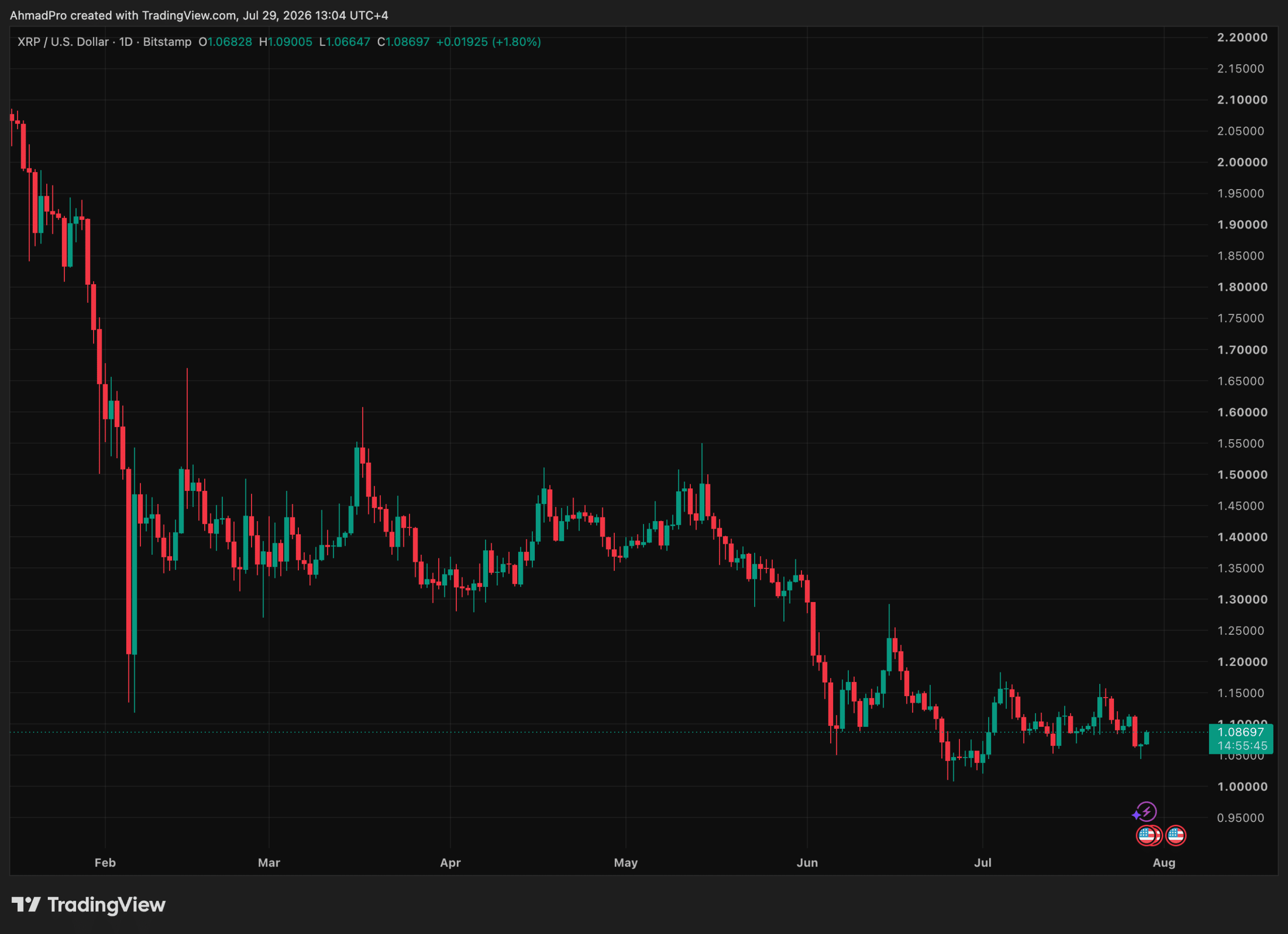
Source: XRPUSD / Tradingview
Standard Chartered predicts XRP could reach $8 if spot ETFs see a total of $10 billion in investments. Their analysts believe that the approval of CLARITY could drive $4 to $8 billion of these inflows, which would then encourage the development of new XRP-based financial products for institutions.
Because lawmakers didn’t vote on it before their break, the potential increase in funds is now delayed. The recent drop in XRP’s price, down to around $1.06–$1.08, is likely due to this legislative setback and a general move away from risk as investors await the Federal Reserve’s announcement today.
Following the resolution of the SEC lawsuit in 2025 and a combined SEC-CFTC decision in March 2026 confirming XRP isn’t a security, Ripple achieved a regulatory status for XRP similar to that given to common commodities. However, this classification depends on ongoing regulatory statements, not established laws, meaning a future presidential administration could potentially change it. The proposed CLARITY legislation would enshrine this classification into U.S. law, making it much harder to overturn and providing the long-term certainty that banks and ETF providers need before investing in XRP-based products.
Macro Overlay: The Fed Rate Decision and What a Hawkish Hold Implies
Federal Reserve Chair Kevin Warsh is leading today’s (July 29th) meeting of the Federal Open Market Committee. Most experts predict interest rates will remain steady, between 3.50% and 3.75%. There was a recent surge in expectations for a rate hike – peaking at around 38% last weekend – but those expectations have eased slightly. The price of Bitcoin, currently around $63,400 as of Tuesday, has been affected by these changing expectations, along with outflows from Bitcoin ETFs and overall selling in the crypto market.

A dovish hold with language hinting at a September cut could lift XRP toward the $1.10–$1.12 Fibonacci golden zone. A hawkish statement or dissenting vote in favor of a hike extends the sell-off toward the next support cluster at $1.0125 and $0.9711. Neither scenario substitutes for the legislative catalyst that the market has now lost until at least late 2026.
We suspect the more consequential variable for crypto regulation timelines is not the August recess itself but the midterm election calendar that follows it: a compressed fall legislative window leaves CLARITY structurally vulnerable to slipping into the next Congress, where the entire Senate coalition would need to be rebuilt from scratch.
DISCOVER: Best Meme Coins to Buy in 2026
2026-07-29 19:00