Crypto is rewriting how Wall Street traders spend their weekends
Presented by

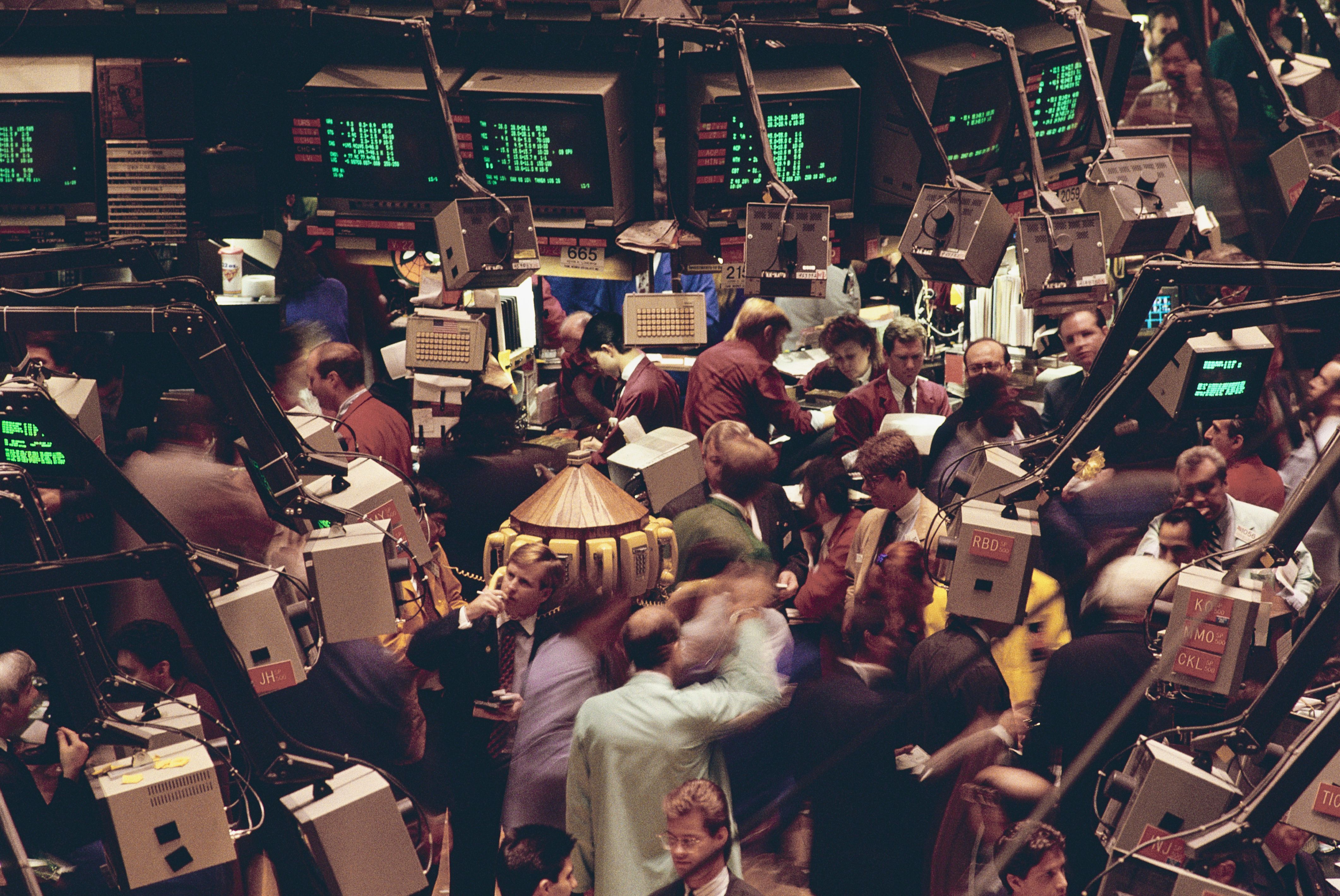
By Friday afternoon, the mood on commodity trading desks changes.
Traders spend Monday through Thursday attempting to make money with their investments. But by Friday afternoon, they’re focused on limiting potential losses before trading resumes Sunday night.
As a researcher studying market dynamics, I’ve found that the time when markets are closed can be surprisingly impactful. Significant events – like breaking news about conflicts, election outcomes, or even unexpected announcements from groups like OPEC – can occur at any time. We recently saw how a single post from the President could move markets, and it really highlighted something I’ve observed: those 48 hours when trading pauses can feel like a long time for traders who have positions open, especially in volatile markets, as they’re essentially powerless to react until trading begins again.
According to Mustafa Al Niama, who used to lead digital assets at Goldman Sachs and now works at Mysten Labs, trading activity typically slows down significantly around lunchtime. From that point on, traders focus on managing their positions for the next two days until markets reopen on Sunday evening.
All commodities options traders face the same challenge. By Friday, they’re less concerned with predicting where prices will go and more focused on how comfortable they are with their current positions, knowing they can’t make any changes if unexpected events occur over the weekend.
According to Terry Duffy, the head of CME Group, unexpected events – whether related to global politics or something else entirely – can happen at any time.
However, most markets still operate this way. For years, traders have always prepared for possible problems that could happen on weekends or outside of regular trading hours. But earlier this year, something unexpected occurred in the oil options market, disrupting this usual practice.
In March, when tensions rose between Iran and Israel, oil futures trading saw a sharp increase in activity over the weekend. Interestingly, this happened even though major commodity markets were closed. Traders didn’t wait for regular trading hours – they found other places to buy and sell.
Over the weekend, many traders used cryptocurrency exchanges to trade “perpetual futures,” which are derivative contracts that allow trading 24/7.
On March 8th, while most traditional commodity markets were closed for the weekend, the total value of open trades on the Hyperliquid decentralized exchange reached an all-time high of $1.2 billion.
Although trading volume on weekends is still lower than during the week, it’s become significant – a clear sign of a change in the market. Just a few years ago, round-the-clock oil derivative trading didn’t exist, but now it’s happening while traditional financial systems are closed.
According to Martin Lee, a market analyst at DWF Labs, oil perpetual futures on Hyperliquid have consistently seen two to three times more trading volume on weekdays compared to weekends over the past three months. However, weekend trading has increased its share of total volume by about 25% since March, although activity decreased somewhat after an initial surge following the conflict in Iran.
And this change might be quietly influencing another corner of the oil market.
The weekend problem
Energy Aspects, an energy analytics firm, believes that trading in short-term WTI crude oil options will likely evolve due to the increasing popularity of 24/7 perpetual contracts traded on cryptocurrency exchanges.
For a long time, the expected price swings for WTI crude oil contracts tended to be lower on Fridays. Traders didn’t want to pay for insurance against price changes—using options or other contracts—if they couldn’t monitor and adjust those positions over the weekend. To avoid risk over the weekend, many traders would reduce their holdings before the market closed on Friday, which consistently lowered the expected volatility, according to Energy Aspects.
That discount has begun to narrow, according to Energy Aspects.
As a researcher following options markets, I’ve been observing a significant change. Traders can now hedge their options positions over the weekend, which is particularly useful given the increasing concentration of geopolitical risks during those times. This is important because we’ve long seen a ‘weekend effect’ in short-term WTI options – implied volatility tends to drop on Fridays as traders with large options positions close them out, unable to hedge through the market’s closed hours. This new hedging capability directly addresses that structural issue.
Analysts believe that because traders can now use perpetual contracts to protect themselves from oil price changes over the weekend, they might be more likely to buy or hold options instead of selling them before the market closes on Friday.
This opens up a new possibility for traders. Instead of simply holding onto their investments during potentially volatile weekends, they could now profit from market fluctuations that occur when trading is normally closed.
As a researcher, I’ve been looking into the potential benefits of continuous futures contracts, and our estimates at Energy Aspects suggest they could increase hedging activity by around 40% over the lifespan of a standard contract. This isn’t solely about perpetual contracts either; CME recently announced plans for smaller, 24/7 contracts for WTI crude and gold. These continuous contracts would really help traders manage risk over the weekends and potentially ease the selling pressure we often see on Fridays. However, there’s a complication – the Commodity Futures Trading Commission (CFTC) has currently blocked the launch of these contracts, and CME has actually filed a lawsuit against the agency as a result.
Every trader wants to find small advantages to make a little extra profit, but for most, this remains just an idea until 24/7 trading becomes common. Even those who think this strategy could work are careful not to exaggerate how much it might help.
A trader at a market-making firm, speaking anonymously, doesn’t believe the increased availability of perpetual futures contracts (perps) is responsible for recent decreases in volatility. They explained that as someone who profits from volatility—whether it’s going up or down—they’re only concerned with the *amount* of price movement, not the direction. The trader suggested that lower volatility on the Chicago Mercantile Exchange (CME) might indicate that volatility was previously artificially high due to limited trading options.
He still agrees that it’s smart for traders to reduce risk over the weekend, even if he disagrees with a specific approach.
He believed that if a trader can reduce risk over the weekend, they might pay more for volatility on exchanges other than the CME. This is because they now have more opportunities to manage weekend risk – previously, they had none. Having these extra options makes it worthwhile to pay a premium.
Getting Wall Street’s buy-in
If traders can now protect themselves against losses in previously risky situations, why aren’t major banks actively trading perpetual futures contracts?
Bitget CEO Gracy Chen noted increasing interest from institutional investors, but believes most trading activity still comes from individual retail investors. Data from TokenInsight shows Bitget was the second-largest exchange for commodity and stock perpetual futures trading in the second quarter, after Binance.
According to Chen, the problem isn’t necessarily a lack of ability, but rather a question of whether it’s currently worth the investment for them. They might consider it in the future, but not right now.
Lack of meaningful liquidity is a major reason institutional traders are likely still staying away.
Trading of perpetual futures contracts based on things like stocks and commodities has grown noticeably in recent months. However, it’s probably not yet at a scale that would attract major investment from large Wall Street firms – but it could be soon.
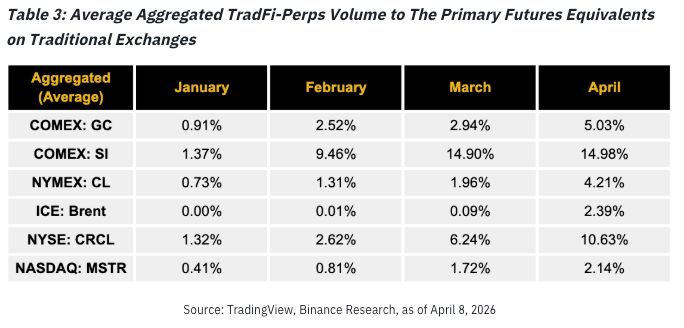
According to data from Binance Research, trading volume for crude oil perpetual contracts (perps) was relatively small in March and April, representing only around 2% and 4% respectively of the equivalent volume traded on traditional exchanges.
By 2025, trading in perpetual futures contracts (perps) on traditional cryptocurrency exchanges reached $62 trillion, significantly outpacing spot trading at around $19 trillion, according to Pantera Capital, referencing CryptoQuant data. Decentralized exchange Hyperliquid has driven a surge in perps trading, processing nearly $200 billion in monthly volume, as reported by DeFiLlama.
Although these figures seem huge in the cryptocurrency world, they’re actually quite modest compared to the scale of traditional financial markets like Wall Street.
As a researcher studying trading dynamics, I recently spoke with a trader at a market-making firm, and they highlighted a core challenge: it’s surprisingly difficult to find someone to consistently take the opposite side of a trade. They put it simply: without reliable counterparties – traditional liquidity providers – it’s hard to make trades large enough to even matter, to the point where the outcome is significant enough to be worth the risk.
In TradFi, money takes the weekend off
Then there are issues with the existing infrastructure.
Banks and other big financial institutions are already equipped to handle trading during regular market hours. However, even if weekend trading becomes popular enough for them to participate, they’ll need to set up new systems specifically for it, explains Chen from BitGet.
“Especially for those top organizations that never really had the 24/7 infrastructure,” she added.
Lee from DWF agreed, pointing out that simply offering the ability to trade wouldn’t automatically lead to increased trading activity. He explained that institutions and corporations would need to significantly increase their operational capabilities to handle a potential surge in trades.
As an analyst, I’ve been looking into some potential roadblocks for institutional involvement in perpetual futures trading, and one thing that keeps coming up is weekend operations. Basically, traditional institutions like banks aren’t open on weekends, which creates a real challenge when it comes to collecting margin. Mysten Labs’ Mustafa Al Niama pointed out that these institutions need reliable systems for actually moving funds – and right now, those systems largely operate on weekdays. This means current infrastructure isn’t really set up to support continuous, 24/7 margin calls for perps trading.
Even if trading is open on weekends, many of the essential behind-the-scenes financial systems aren’t. Banks don’t transfer assets 24/7, clearinghouses mostly operate during weekdays, and it’s difficult for firms to get extra funds quickly – like on a Saturday.
According to CME’s Duffy, that won’t be possible until the necessary systems and support are established, similar to what’s already available during the work week.
The main problem isn’t just maintaining active markets; it’s ensuring the entire financial system continues to function smoothly.
Currently, perpetual futures contracts are mostly traded by companies built around crypto, professional trading firms, and experienced individual traders.
Right now, most perpetual futures (perps) trading is done by traditional retail traders, market makers, and proprietary trading firms,” explained Al Niama. He believes they’re mainly using perps for strategies like basis trading or carry trades to profit from small price differences, rather than to reduce risk through hedging. “It’s a very profitable strategy because it doesn’t rely on predicting which way the price will move.”
End of the weekend gap
Perpetual contracts now offer traders a new benefit: they can help predict how the market will react when it opens after major news events over the weekend. This wasn’t possible before.
Previously, predicting how an asset would perform when regular markets opened was largely based on speculation. Now, with perpetual contracts (perps) trading around the clock, traders have a clearer sense of market sentiment – especially after the weekend – and can better anticipate which way prices might move.
According to Hein Tibosch, who leads digital asset trading and product development at Flow Traders, continuous or ‘perpetual’ markets are now being used to gauge market sentiment before regular stock exchanges open.
He explained that looking at the biggest market movers will give you a good sense of where things are going, essentially providing a clear direction.
The trader at the proprietary market-making firm described the same shift.
He explained that it’s now expected behavior. Traders are constantly monitoring cryptocurrency markets over the weekend to predict how traditional futures will trade when the CME opens on Sunday.
This could be an early indication that crypto perpetual futures contracts are beginning to affect traditional financial markets. They aren’t likely to replace exchanges like the CME, but they’re offering a new way to determine prices even when those other markets are closed.
So far, one of the most noticeable effects of perpetual futures contracts (perps) seems to be a change in trading behavior among certain traders.
Al Niama explained that perpetual futures contracts, or ‘perps,’ could be a turning point for the crypto industry. Historically, crypto has been learning from traditional finance, but perps might be one of the first areas where the flow of influence reverses, with crypto innovations potentially shaping traditional finance.
It’s still unclear if decentralized perpetual futures (perps) will significantly change how traditional markets operate. Trading volume, based on standard finance metrics, is currently low, and major financial institutions are taking a wait-and-see approach. Plus, the CME’s plan to offer futures contracts around the clock is still up in the air.
Traders seem to be adjusting their routines on Friday afternoons. While they’ll still keep an eye on things before the weekend, continuous trading hours mean they might not need to simply wait for Monday anymore. Instead, they can potentially profit by actively trading or monitoring contracts throughout the extended period.
According to Flow Traders’ Tibosch, many firms, like hedge funds and quantitative trading shops, could benefit from running their trading strategies continuously instead of just five days a week, potentially gaining two extra days of trading opportunities.
“So if you can have alpha, bring it on,” he added.
It increasingly looks like the old idea that trading stops on Fridays and doesn’t pick up again until Monday is becoming outdated. It used to be assumed traders just had to wait through the weekend, but that may not always be true anymore.
“I think that markets will be 24/7 down the road. All markets,” said CME’s Duffy.
Trading firms may need to begin staffing for 24/7 markets, as the idea that markets behave differently on weekends is becoming outdated.
2026-07-27 16:11