Despite recent investor caution, Wedbush, a large US investment firm, continues to recommend buying shares in three popular quantum computing companies. However, while publicly optimistic, larger institutions are actually decreasing their investments in these stocks.
These stocks have all experienced significant declines this month, falling between 24% and 36%. Despite these drops, analysts still recommend buying them, maintaining their positive ratings from earlier this year. However, trading activity suggests investors are actually selling, which contradicts the buy recommendations.
IonQ (NYSE: IONQ)
Despite falling 36% this month to $34.07 – a significant drop from its peak of $84.64 – the stock remains the largest of the three companies, with a market value of around $12.7 billion.

We’re seeing significant growth in our business right now. In the first quarter, our revenue increased by a remarkable 755% – reaching $64.7 million! Our order backlog is also expanding rapidly, up 554% to around $470 million, representing work we’ve already sold but will deliver later. We currently have about $3.1 billion in cash on hand, which puts us in a strong position for future development. I’m particularly excited that we recently delivered our first 256-qubit quantum computer to the University of Cambridge.
Despite the recent price decrease, financial analysts haven’t changed their positive outlook on the stock. Rosenblatt still rates it as a ‘buy’ with a price target of around $100, while Wedbush and Northland have targets of $75 and $70 respectively, although these estimates were made a few months ago in May and June.

Dan Ives, a well-known analyst who recently launched a popular AI investment fund exceeding $500 million, is particularly vocal about quantum computing. He views it as benefiting from the current surge in artificial intelligence and even predicts potential government investment in companies like IonQ. While these ideas aren’t brand new, recent developments actually support his perspective.
Note: Wedbush still runs and manages the IVES ETF, despite Daniel Ives’ departure.
Options traders became much more optimistic about IonQ between July 16th and July 23rd. This shift happened because the ratio of bearish put options to bullish call options dropped dramatically, from 2.69 to 0.45.

Chaikin Money Flow, which indicates institutional investment activity, was significantly negative at -0.46, suggesting strong selling pressure.

The price jump suggests traders are anticipating good news soon, but the movement of funds indicates that major investors are actually selling their shares.
I’ve never seen $IONQ Net Options Sentiment above 70 before.. something is happening!
— Cori Arnold (@iamcoriarnold) July 23, 2026
One tracked account even flagged IonQ option sentiment above 70 for the first time.
Rigetti Computing (NASDAQ: RGTI)
Rigetti has fallen 24% this month to $14.85, and it leans on government money more than sales.

Rigetti received $100 million in funding from the US Department of Commerce over three years, exchanging a small portion of company ownership for the investment. They also made their new 108-qubit quantum computer, Cepheus-1, available through major cloud services.
Despite this, analyst coverage remains limited, and positive ratings around the $40 mark from Rosenblatt and Wedbush haven’t changed even after the stock price fell – they haven’t lowered their recommendations.

We’re seeing the same pattern repeat. Rigetti’s put-call ratio dropped from 1.09 on July 16th to 0.48 on July 23rd, which suggests increased optimism in the options market.

Despite the positive price action, the Chaikin Money Flow remained negative at around -0.24, suggesting money was actually flowing out of the stock, which doesn’t support the optimistic outlook.

This trend continues to suggest that large investors aren’t currently confident in quantum computing stocks.
D-Wave Quantum (NYSE: QBTS)
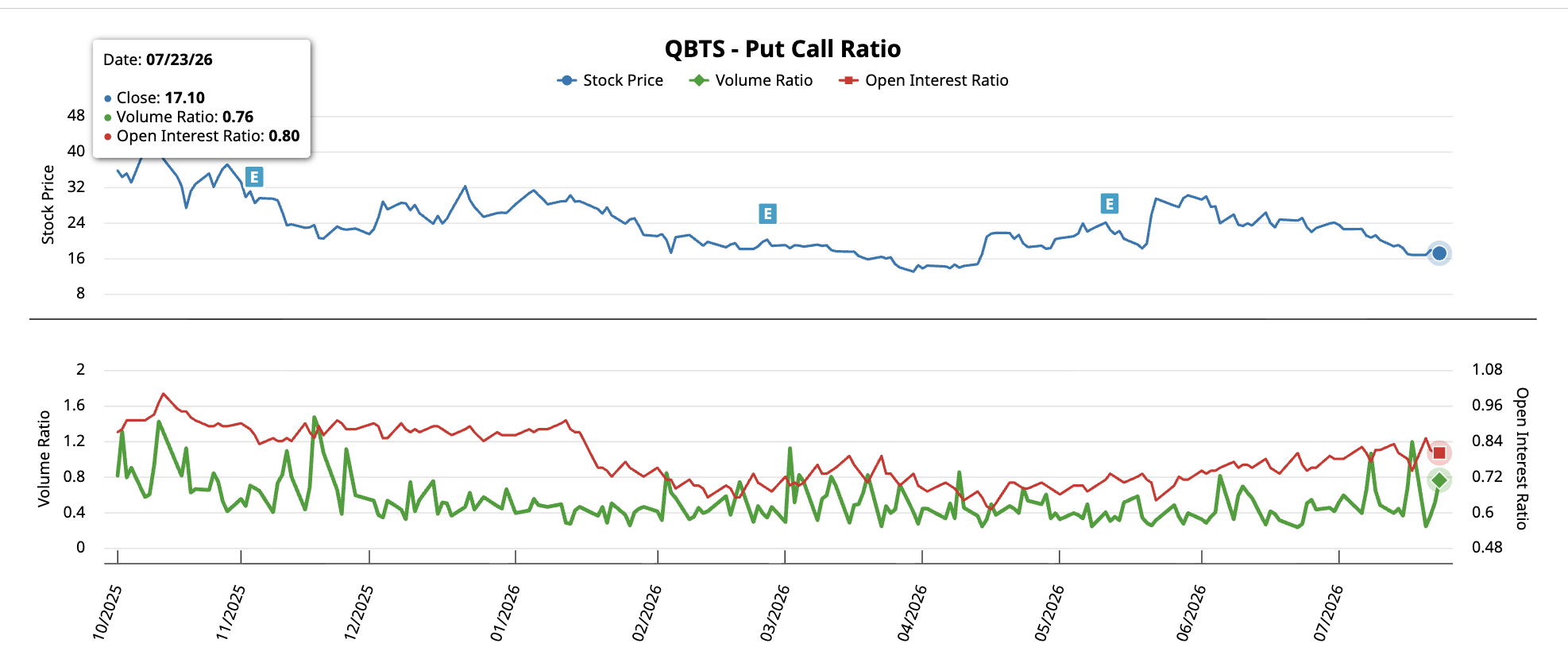
As a researcher tracking this company, I’ve observed a significant drop in their stock price this month – it’s down 26% and currently trading at $17.10. What’s interesting is that despite this decline, the company is still generating revenue from its customers; they are already profitable.

In the first quarter, the company earned $2.9 million in revenue from over 100 customers, primarily businesses. While revenue was down 81%, new orders surged by approximately 2,000%, reaching $33.4 million. The company’s technology focuses on solving optimization challenges, such as scheduling, and isn’t designed for code-breaking, suggesting the recent excitement surrounding quantum computing stocks isn’t driven by a desire to crack Bitcoin.
The conflicting opinions here are quite clear. While ten analysts still recommend buying the stock, with price targets up to $43, Barchart’s internal technical analysis strongly suggests selling it (72% confidence). Wedbush is once again among those maintaining a positive outlook.


The pessimistic outlook aligns with market activity. D-Wave’s Chaikin Money Flow is currently negative at -0.24, and while its put-call ratio improved slightly from 1.19 to 0.76 between July 17th and 23rd, this was the smallest increase in bullish sentiment compared to other indicators.

So its old buy ratings look the most stretched.
One reason experts are optimistic about quantum computing is ongoing scientific progress. Last week, researchers at Google announced they’ve made a significant improvement – a 3.5x boost – in correcting errors in quantum calculations, bringing more reliable quantum computers closer to reality.
We’re excited to share a breakthrough in controlling quantum computers! We’ve combined artificial intelligence with error-correcting techniques, allowing our computer to automatically adjust for instability and maintain accuracy during calculations. This resulted in a 3.5 times improvement in the reliability of the system. You can find more details here:…
— Google Research (@GoogleResearch) July 22, 2026
Despite different leadership, concerns remain consistent. Company insiders have been selling off approximately $988 million worth of stock since 2021, and there’s been very little purchasing from within the company, while smaller investors are starting to show more optimism.
Shares of quantum computing companies like IonQ, Rigetti, and D-Wave are causing a stir on Wall Street after a recent report highlighted potential risks totaling $988 million.
— The Right News, Right Now. (@BradPorcellato) July 22, 2026
Positive analyst recommendations and active options trading suggest potential growth for these companies, but sales from company executives and large investors create a contrasting downward pressure. Maintaining recent gains will probably require strong financial results to emerge soon, before investor optimism fades.
2026-07-24 16:03