The White House supports a new bill, called the CLARITY Act, which includes what they say are the strongest federal ethics rules ever proposed. They need support from Democrats in the Senate to get the 60 votes needed for it to pass.
Summary
- The White House accepted extensive ethics rules addressing Democratic concerns over Trump’s crypto interests.
- CLARITY still needs Democratic support to reach the Senate’s 60-vote threshold.
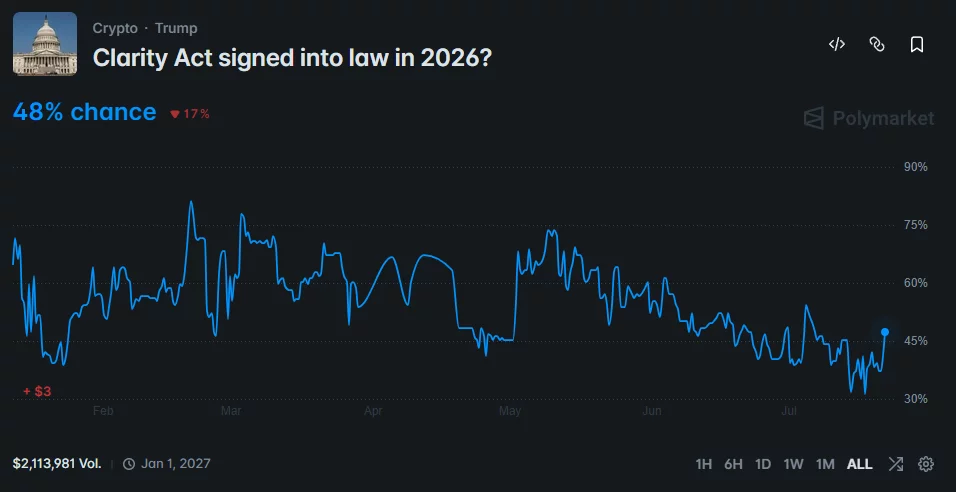
- Bitcoin topped $66,000, while Polymarket placed the bill’s 2026 passage odds at 48%.
According to Punchbowl News, White House staff have come to an understanding with Senators Cynthia Lummis and Bernie Moreno regarding ethics guidelines. This agreement could potentially affect former President Trump’s involvement with cryptocurrency, but the exact details of the provision haven’t been made public, nor has it been clarified how it would be carried out.
As a researcher following this closely, I’ve learned that a White House official recently confirmed they’ve agreed to changes regarding ethics regulations. They described these new provisions as the most extensive and far-reaching ever created in this area. The official also stated that the administration made significant efforts to incorporate feedback from Democratic lawmakers.
A key disagreement that was blocking the Digital Asset Market Clarity Act has been resolved, but it’s still unclear if enough Democrats will support the bill. The Senate hasn’t released the final version or scheduled a vote, meaning time is running out before senators leave for their state work period in August.
Ethics deal removes a key Senate obstacle
Democratic senators are demanding limits on political spending using cryptocurrency as part of their support for new legislation. Senators Elizabeth Warren, Chris Murphy, Jeff Merkley, and Chris Van Hollen have stated that a bill regulating financial markets wouldn’t be effective if it didn’t also address connections between Donald Trump and the crypto industry.
Democrats are worried about Donald Trump’s connection to a cryptocurrency named after him, as well as his family’s involvement with World Liberty Financial. They’ve asked for congressional hearings to investigate Trump’s investments and relationships with crypto businesses before the Senate votes on related matters.
It’s still not fully known what the White House agreement involves, such as who it would apply to – including the President’s family – and who would be responsible for making sure it’s followed. According to Barron’s, some Democrats worry that only the Department of Justice, which is under Trump’s control, might enforce the rules, instead of also allowing state attorneys general to take action.
Past discussions revealed that ethical considerations were a major challenge. Patrick Witt, who leads the President’s Council of Advisors for Digital Assets, explained to CoinDesk in May that the administration favored rules applying to everyone from the President to new interns on Capitol Hill. However, they were against any rules specifically targeting a particular person or their family.
While discussions on ethical guidelines went on, senators working on the bill made progress on other disagreements and even resolved some. Recently, Ryan VanGrack from Coinbase noted that Democrats successfully added stronger protections for customers, making this version of the legislation more impactful than previous drafts.
Ultimately, this legislation focuses on protecting consumers. Currently, those safeguards aren’t strong enough, but Democrats rightly stepped in with this bill to prioritize customer needs.
Negotiations have become more complex due to issues like rewards for stablecoins, rules to prevent money laundering, the use of tokenized securities, and safeguards for software developers. Earlier in May, crypto.news reported that the Senate Banking Committee moved the bill forward with a vote of 15 to 9, receiving support from all Republican members and Democratic Senators Ruben Gallego and Angela Alsobrooks.
Although Gallego and Alsobrooks supported the committee’s decision, they didn’t promise to vote for the final bill, as details were still being worked out. This meant Republicans needed to keep their support and convince more Democrats to vote in favor to reach the 60 votes needed for passage in the Senate.
In July 2025, the House of Representatives approved its version of the CLARITY Act during a week focused on cryptocurrency. The bill aims to clarify which government agencies oversee digital assets and establish clear guidelines for determining whether a token should be regulated as a security or a commodity.
Bitcoin rises while passage odds remain below 50%
Following news of an agreement with the White House, crypto markets saw gains. Bitcoin’s price surpassed $66,000 on Tuesday – its highest point in seven weeks. Shares of Coinbase increased by around 10%, and Circle rose approximately 7%.
As a researcher following this closely, I’ve been monitoring the prediction markets, and they’re still showing considerable doubt about the CLARITY Act becoming law. A contract on Polymarket currently gives it only a 48% chance of passing in 2026 – that’s a significant drop of 17 percentage points. Interestingly, this market has seen about $2.11 million traded, suggesting people are paying attention, but still aren’t confident, even with the recent news about an ethics agreement.
President Trump asked senators to pass the bill as a tribute to Senator Lindsey Graham, who strongly backed it. Leaders in the cryptocurrency industry, like those from Coinbase, have also been pushing Congress to create national standards for the market.
Because the actual legal language is still missing, it’s unclear if the ethics agreement will actually work. Until Democratic senators examine the details, state their opinions, and agree to a vote, the deal is just a possible path to the 60 votes needed for the CLARITY Act to pass – it’s not a guarantee it will happen.
2026-07-21 23:19