In the grand and eternal struggle of man against the clock, the CLARITY Act now finds itself in a most critical hour, with but eighteen legislative days remaining before the August recess-a span of time so short that even the most hopeful of souls might despair, while Russia, that vast and enigmatic land, moves to establish its own crypto framework, as if to mock the leisurely pace of American lawmakers.
Key Takeaways
- The Senate, in its infinite wisdom, has allotted only eighteen days to finalize the CLARITY Act, a period that would be laughable if it were not so absurd.
- Supporters, with the earnestness of peasants pleading for rain, say ethics provisions remain the chief obstacle, as if the moral fabric of the nation hangs on a single clause.
- Russia’s advance toward a legal crypto framework adds urgency, for what is more pressing than the fear of being outdone by a former adversary?
CLARITY Act Faces a Decisive Senate Week-Or Does It?
The CLARITY Act has entered a week of such decisive importance that one might expect the heavens to tremble, yet the Senate approaches its August recess without updated legislative text or a scheduled floor vote, as if the fate of the nation were a trifle best left to idle chatter. Negotiations continue, but the compressed calendar leaves little room for unresolved language issues, procedural delays, or the shifting whims of political priorities-a comedy of errors that would make even Gogol smile.
Stand With Crypto (SWC), a grassroots organization backed by the mighty Coinbase, which mobilizes the faithful to influence public policy, has declared that the CLARITY Act has entered a decisive stage, with only eighteen Senate days remaining. The group urges lawmakers to stay in Washington until the legislation is completed, as if the mere presence of 2.9 million advocates could compel the indifferent to action.
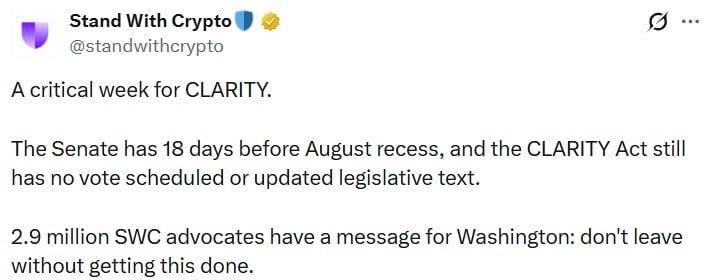
Negotiators must settle outstanding provisions, release revised text, and secure enough Senate time to move the bill before lawmakers abandon Washington for their summer retreats. Missing that window would push consideration until September, prolonging uncertainty for crypto companies-a fate that any reasonable soul would liken to a slow, bureaucratic death.
The urgency also reflects the warning of Senator Cynthia Lummis, who with the gravity of a prophet declares that Congress may not receive another opportunity to enact comprehensive digital asset legislation before 2030. She argues that election pressures and the remaining congressional calendar could reduce the likelihood of major action, leaving the United States to follow rules established elsewhere-a prospect that would be farcical if it were not so perilous.
Russia’s Crypto Bill Adds Competitive Pressure-and a Touch of Irony
Stand With Crypto intensified its call after reports that Russia, that perpetual antagonist, was preparing to finalize legislation establishing a legal framework for crypto. Responding with the urgency of a man whose house is on fire, the organization wrote:
“The U.S. cannot wait any longer. We need to pass the CLARITY Act.”
Russia’s advancing crypto legislation adds competitive pressure to the U.S. debate, reinforcing concerns that other major economies are establishing digital asset rules while Washington remains divided-like a group of boatmen arguing over oars while the current sweeps them downstream. Supporters of the CLARITY Act argue that further delays could weaken U.S. influence over global crypto policy, a notion that would be tragic if not for the delicious irony of being outpaced by a nation that still struggles with its own alphabet.
Ethics Negotiations Hold the Key to Progress-Or to Endless Laughter
Kristin Smith, president of the Solana Policy Institute and former CEO of the Blockchain Association, said talks are continuing as the recess approaches. She stressed, with the fervor of a martyr:
“It’s crunch time for Clarity. Negotiations are moving and the August recess is just weeks away.”
Smith said the bill has gained stronger illicit finance provisions, consumer protections, and oversight of spot exchanges since its passage in the House. The remaining dispute, like a stubborn stain on a fine garment, centers on ethics rules that would apply to the president and members of Congress-as if the very idea of ethics in Washington were not the punchline of a cosmic joke.
The White House, in a dramatic and unexpected twist, joined discussions over ethics language last week, raising hopes that negotiators can find common ground. Smith, with the optimism of a child awaiting a snowstorm, framed the bill as a defining opportunity:
“This is a legacy-making moment for the President, and he knows how to close a deal. Get ethics right, break the logjam, and he signs the most important crypto law in American history. Both sides of the aisle want to get this done.”
As the August recess approaches, lawmakers face increasing pressure to resolve the remaining disputes and advance the CLARITY Act. Failing to do so could significantly reduce the chances of Senate action until Congress returns in September-a delay that, in the grand Tolstoyan scheme of things, would be but a minor inconvenience in the eternal, grinding machinery of procrastination.
2026-07-21 04:28