In the vast, bewildering expanse of the crypto universe, where fortunes rise and fall with the capricious whims of the market, a curious phenomenon has emerged. While the once-mighty Bitcoin and Ethereum treasuries lie prostrate, their balance sheets bleeding paper losses, one entity stands apart, its coffers swelling with unseemly profits. Hyperliquid Strategies Inc. (NASDAQ: PURR), a name that rolls off the tongue like a cat’s purr, has achieved the unthinkable: a $152.5 million quarterly profit in a sector where failure is the norm. How, one might ask, has this feline-monikered firm defied the odds? The answer lies not in the stars, but in the mechanics of its revenue-backed HYPE token-a mechanism so ingenious, it borders on the absurd.
Consider, if you will, the folly of the digital-asset-treasury (DAT) trade. Public companies, in their infinite wisdom, have stuffed their balance sheets with single tokens, only to watch in horror as the market turns against them. Bitcoin, Ethereum, Solana-all have become albatrosses around the necks of their corporate patrons. Yet Hyperliquid’s HYPE token, with its $1.4 billion valuation and $103 million in cash, trades near parity with its net asset value. It is as if the laws of gravity have been suspended, and PURR has discovered the financial equivalent of perpetual motion.
The secret, dear reader, is not in the token itself, but in the machinery that drives it. Hyperliquid’s protocol routes a staggering 97% of its trading fees into automated buybacks of HYPE, a process so relentless that it has spent over $1.3 billion since its inception. This is not mere speculation; it is a self-sustaining ecosystem, a financial flywheel that spins faster with every trade. While Bitcoin treasuries rely on the fickle winds of market sentiment, HYPE is anchored to a cash-flowing protocol-a distinction as profound as it is profitable.
But let us not be blinded by the dazzle of numbers. Risks abound, like shadows lurking in the corners of this crypto carnival. A token unlock looms on June 6, threatening to unleash a $700 million supply wall. The buyback policy, though robust, is not set in stone; it is the plaything of governance votes. And the specter of regulation hovers like a vulture, ready to pick at the carcass of this financial innovation. Yet, for now, Hyperliquid’s HYPE remains the darling of the crypto treasury world, a beacon of hope in a sea of despair.
What, then, is the lesson of this tale? It is not that HYPE is infallible, nor that its $100 price target is assured. No, the true insight is far more profound: the corporate treasury era is evolving. The first generation, with its bets on scarcity and sentiment, is giving way to a new breed-one that ties its fortunes to productive, revenue-linked tokens. Hyperliquid has shown us the way, and the wise will follow. For in this chaotic realm of crypto, where folly and genius often walk hand in hand, it is not the asset that matters, but the engine that drives it. And Hyperliquid’s engine, my friends, is purring like a well-oiled machine.
Key Takeaways
- Hyperliquid’s HYPE token trades near $72, with analysts eyeing $100 as a milestone.
- The protocol’s 97% fee-to-buyback mechanism has spent over $1.3 billion repurchasing HYPE.
- Hyperliquid Strategies (NASDAQ: PURR) posted $152.5M in Q3 2026 profit, trading near NAV.
- Bitwise’s HYPE ETF (NYSE: BHYP) saw $19M in single-day inflows, accumulating $55M in HYPE.
- Risks include token unlocks, governance-dependent buybacks, and regulatory uncertainty.
The Flywheel of Fortune: Hyperliquid’s Buyback Mechanism
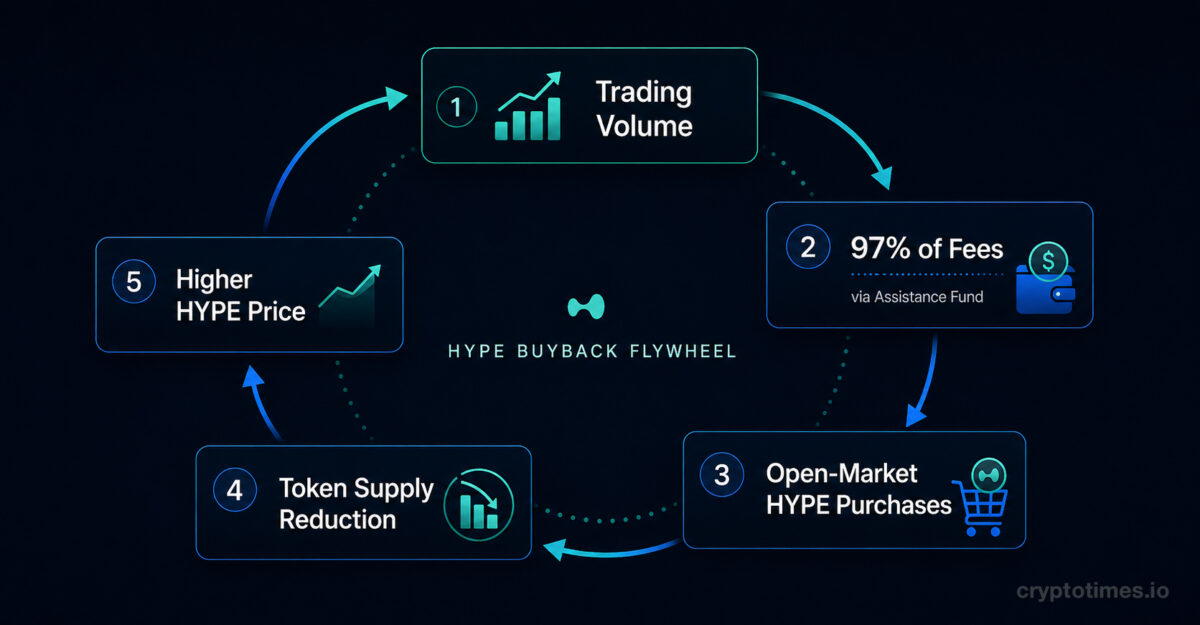
Hyperliquid is no mere sideshow in the crypto circus. It is the undisputed ringmaster of on-chain perpetual futures, clearing $180 billion in trading volume with sub-second finality. But it is the tokenomics that steal the show. Through the Assistance Fund, 97% of trading fees are funneled into automated HYPE buybacks-a process so relentless, it averages $1 million per day. This is not a policy; it is a commitment, enshrined in governance votes and enforced by the protocol itself. The result? A structural bid that turns trading volume into token value, a mechanism so elegant, it almost feels like cheating.
Why HYPE Succeeds Where BTC and ETH Fail
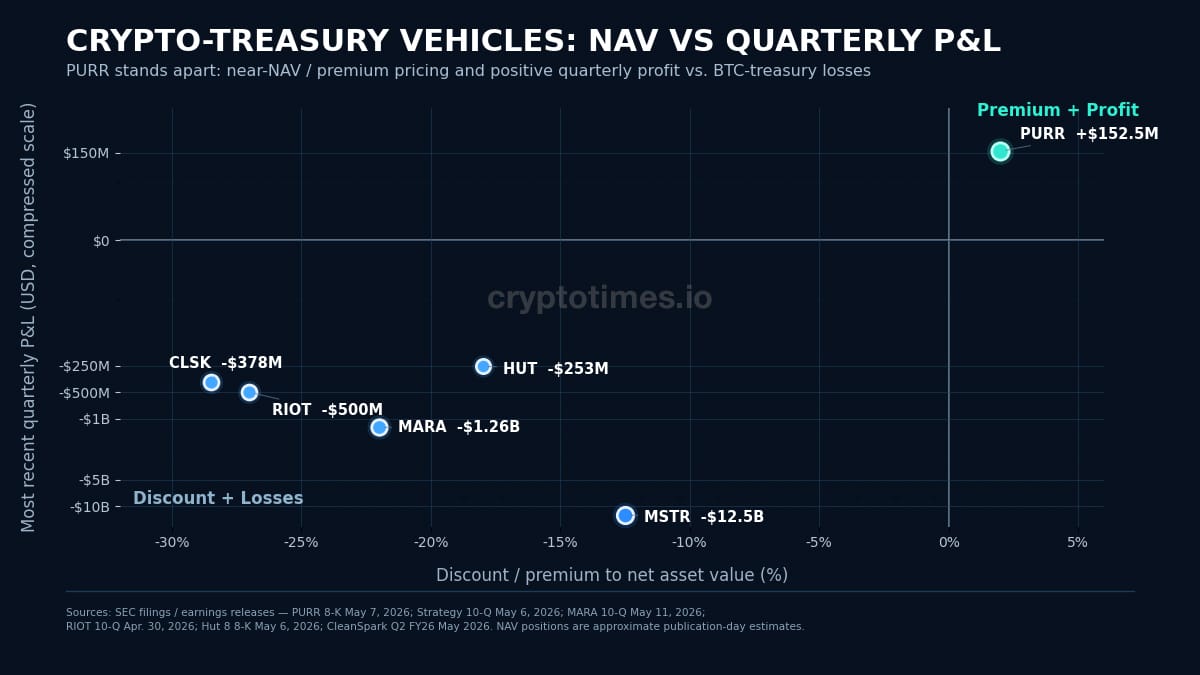
The failure of BTC, ETH, and SOL treasuries is a tale as old as time itself. Their returns depend entirely on price appreciation, a gamble as risky as it is futile. HYPE, however, is no mere bet on scarcity. It is a claim on a cash-flowing protocol, with three distinct revenue streams: buybacks, staking rewards, and stablecoin yield. This is not digital gold; it is a financial engine, humming with activity and generating value with every trade. A Bitcoin treasury is a vault; a HYPE treasury is a factory, and the difference could not be more stark.
The Bull Case: $100 and Beyond
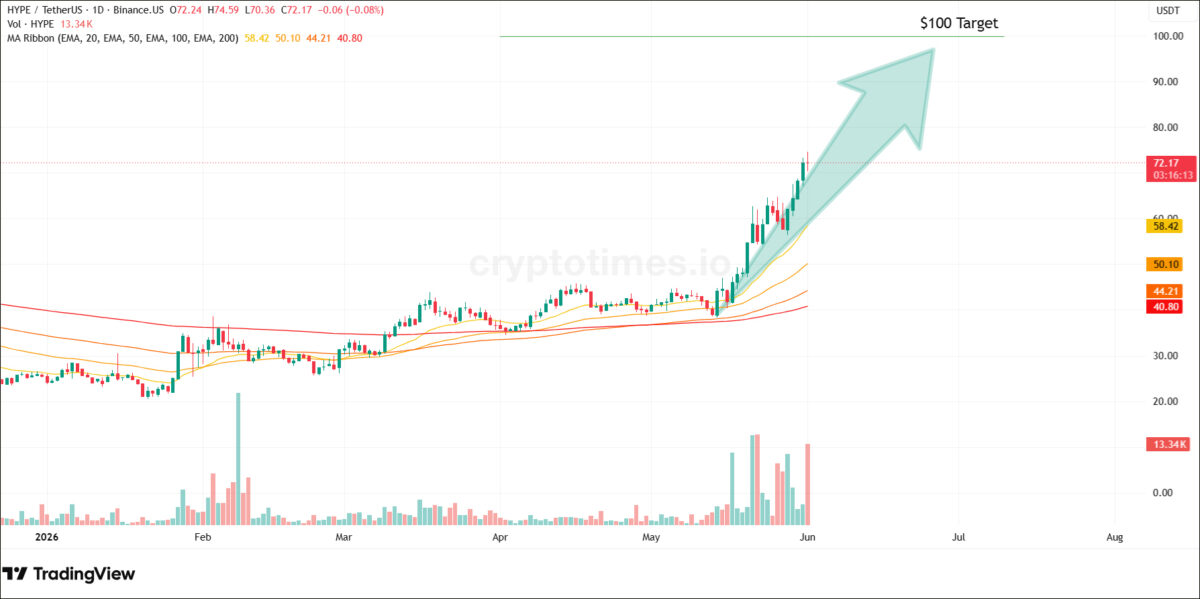
HYPE’s ascent to $72 is no accident, nor is the $100 target a mere fantasy. Analysts, from Ali Martinez to Arthur Hayes, see the potential for far greater heights. But let us be clear: this is no guaranteed windfall. The buyback intensity that drives HYPE’s valuation depends on trading volume, a variable as fickle as the market itself. Yet, with ETF inflows surging and the protocol’s growth showing no signs of slowing, $100 is not a dream-it is a possibility, however conditional.
The Risks: Five Shadows on HYPE’s Horizon
- The Supply Wall: A June 6 token unlock threatens to release $700 million in HYPE, a test of the protocol’s demand.
- The Buyback’s Fragility: A drop in trading volume could halve the buyback rate, leaving HYPE vulnerable.
- Governance’s Sword of Damocles: The 97% allocation is not immutable; it is a policy that could change.
- Regulatory Uncertainty: Fee-funded buybacks occupy a legal gray area, with CFTC and SEC scrutiny looming.
- Concentration Risk: HYPE’s single-protocol bet amplifies both gains and losses, with PURR adding its own layer of risk.
The Future of Crypto Treasuries
As we stand on the precipice of a new era, the lessons of HYPE are clear. The first generation of crypto treasuries, with their bets on scarcity and sentiment, is fading into obsolescence. The future belongs to those who tie their fortunes to productive, revenue-linked tokens. Bitwise’s fee-to-treasury structure is but the beginning; by 2026, expect a wave of issuers to follow suit. The companies that recognize the difference between holding an asset and holding a cash-flow engine will be the ones that survive the next cycle. And as for HYPE? Whether it reaches $100 or not, it has already shown us the way-a path lit not by speculation, but by the steady hum of financial innovation.
2026-06-02 15:16