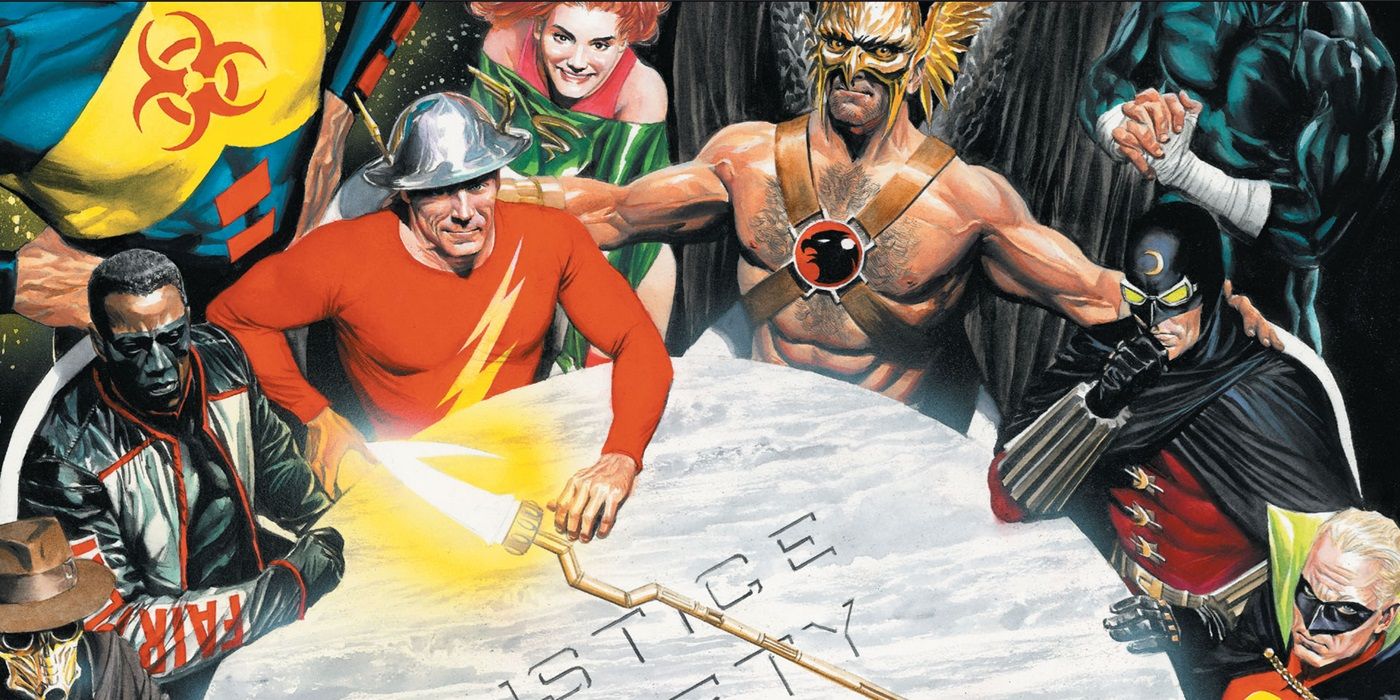
The late 1930s through the 1950s are known as the Golden Age of Comics because this was when superhero comics first became incredibly popular. As more people discovered them, titles like All-Star Comics and All showcased a new wave of heroes. The debut of Superman in Action Comics* #1 was particularly influential, inspiring the creation of many other costumed crimefighters.
During World War II, a team of heroes united to protect freedom around the world. They fought against the Nazi regime and its allies, and included original versions of characters like the Flash, Green Lantern, Hawkman, and Doctor Fate. Despite changes to their story over the years, they remained a consistent force for good.
The Golden Age Heroes on the Front Lines Of Pop Culture
Barry Allen, the Silver Age Flash, first became a hero because of Jay Garrick, the Flash from the Golden Age. The two often worked together, bridging the gap between their different eras. Their historic team-up first happened in The Flash #123 in 1962. Using their unique speed-force powers, both Flashes could travel through time, space, and even different dimensions, connecting them all.
The interactions between heroes from Earth-1, set in the present day, and those from Earth-2, still fighting in World War II, created many memorable moments. However, the yearly crossovers between these parallel worlds became overwhelming for readers to follow. Having duplicate heroes like multiple Supermen, Batmen, and Wonder Women caused confusion, which wasn’t resolved until the 1985 limited series, Crisis on Infinite Earths.
After the major events of the first crisis, the original Justice Society heroes were essentially removed from DC Comics’ main timeline just as they were beginning to be fully established. This shift was highlighted in the significant story arc, “The Last Days of the Justice Society,” created by Roy Thomas and David Ross, where the Golden Age heroes team up to battle the mythical creature Surtur.
The story shows a long-standing battle where these legendary heroes became almost like gods, earning their place in history. To stop Hitler’s last plan, the Justice Society travels to Valhalla, the afterlife for these warriors. They essentially step aside, allowing their successors in Infinity, Inc. to take over and become the new heroes. While it seemed like a noble and fitting end, the Justice Society was destined to return.
Fans Demanded The Iconic Return of the JSA
By the 1990s, a renewed interest in DC’s Golden Age of comics led to the revival of the Justice Society of America. These heroes, largely overlooked for years, played a key role in a series intended as a follow-up to the 1985 Crisis event. Written by Dan Jurgens, the series aimed to resolve continuity issues that many longtime DC fans felt were unresolved after the original multiverse was destroyed.
Throughout the series, many of the original JSA members regained their powers, and some, like Green Lantern Alan Scott, realized they were incredibly long-lived. Through magic or a natural part of their abilities, the JSA stayed together and soon returned to fighting crime.
The team officially came back together and, throughout the 2000s, became relevant again, championing a new era of heroism. While mentoring a younger group of heroes, their ranks actually grew. The JSA also renewed their classic partnership with the Justice League and rightfully reclaimed their position as the original team who inspired everything that followed.
The Justice Society of America (JSA) faced challenges through various major events, like the Infinite Crisis, which brought together heroes from different realities. They consistently showed their strength and earned their place in the DC Universe. However, things changed drastically with Flashpoint, an event that completely reset DC’s history and effectively erased the original JSA from existence. This led to a reboot of the heroes and the beginning of a new struggle.
The Clock Ticked Closer to Doomsday for the JSA
In 2014, DC Comics relaunched its entire line with a fresh start called “The New 52.” This new direction featured younger, less experienced versions of its heroes, with a few established characters remaining. As part of this change, DC eliminated its Golden Age history from its main timeline, moving those older heroes to a separate Earth-2.
On this alternate Earth, heroes battle forces from the dark world of Apokolips, where Darkseid’s minions are trying to take over. A young Jay Garrick becomes the planet’s super-speedster, possessing abilities much like the original. Together, they gather allies and form a team to protect their world, but despite their best efforts, they are ultimately defeated.
It becomes clear that a complete restart of the DC Universe is too extreme, so a softer reset, called “Rebirth,” begins. It’s soon discovered that Dr. Manhattan, a powerful character from the Watchmen series, has been altering the timeline. He’s been experimenting with the history of DC Comics, causing reboots, rewriting stories, and even erasing events, all in an attempt to understand superheroes.
Without Superman protecting Dr. Manhattan, the timeline would have remained broken. After a months-long investigation and the return of both Wally West and Barry Allen (the Flashes), the established history of the DC Universe – Prime-Earth – has been repaired. This means heroes from the Golden Age, like those in the Justice Society, now properly coexist with modern-day heroes.
A Year in the Life of the JSA
Okay, so the Justice Society of America is back in the main DC universe, and things are definitely shaking up! They’ve always been the link between the classic heroes and the newer generation, but lately, we’re getting some seriously cool backstory reveals. The biggest one? Alan Scott, the original Green Lantern and dad to Jade and Obsidian, is gay. It’s a huge development and adds a whole new layer to his character, which I’m really excited about!
Thanks to Stargirl, many of the original heroes’ sidekicks have returned to Earth after being lost in time. Meanwhile, Jay Garrick recently discovered he has a daughter, Judy, who also possesses super speed as the hero known as The Boom. The Justice Society of America is back in action too, with a team made up of both its original members and a new generation of heroes, including Jade and Obsidian fighting alongside their father.
The Justice Society of America has a long history of leading the charge against evil. Recent issues of JSA (#13-18) explored the origins of the team, showing how individual heroes came together to form a united front. This ‘Year One’ storyline highlighted that their combined strength was essential, and they understood they would face future threats as one.
This group of heroes would face many challenges, but one thing is clear: the Golden Age paved the way for all modern superheroes. It showed us that even when things are tough, we’re stronger together – we become a community. The story of the Justice Society of America (JSA) is still being told in their ongoing monthly comic book series, published by DC Comics.
2026-05-24 04:11