In the land where the Douro wine flows and the Atlantic whispers secrets to the shore, the authorities of Portugal have cast a decree upon the digital realm-ordering Polymarket, that sly purveyor of crypto-fueled speculation, to cease its operations. Yet, like a ghost at a funeral, the platform persists, defiantly accessible to those with a penchant for wagering on fate’s caprices. The regulator, SRIJ, has brandished its bureaucratic sword, yet no parchment of enforcement lies in evidence, rendering the edict a quixotic endeavor in the annals of modern governance.
This peculiar exchange unfolds as users, armed with cryptocurrency, bet on events as if divining the future through alchemical formulas. One might imagine Turgenev himself chuckling at the spectacle-modern man, ever the gambler, now armed not with cards but with tokens, and not in salons but in the ether.
The Serviço de Regulação e Inspeção de Jogos, that solemn arbiter of Portugal’s gaming laws, reportedly granted Polymarket a 48-hour reprieve from January 17 to 19. Yet, as the clock struck midnight on the latter date, the site thrived unabated, its digital doors unbarred by any geographical whim. A tale of two systems: one bound by law, the other by code, with the latter currently holding the high hand.
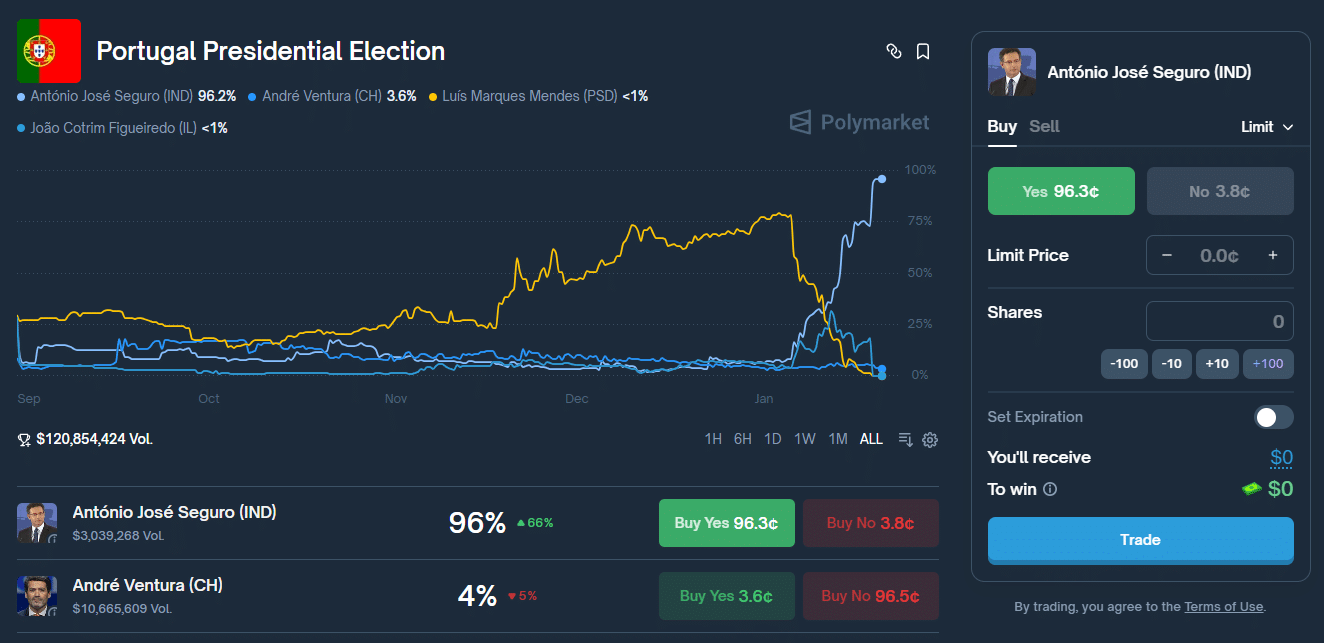
Behold, the Portugal Presidential Election market-a tempest of $120 million in bets, with António José Seguro’s name etched at 96% probability. One might say the people of Portugal bet more on their leader than on the harvest, though their wine exports remain unmentioned in this ledger of speculation. | Source: Polymarket
SRIJ, in its earnestness, affirmed to Renascença that Polymarket operates without the blessing of the state. “Illegal,” they declared, as if branding a rogue with a red-hot iron. Yet the regulator’s discovery of the platform, “very recently,” reads less like vigilance and more like the belated realization that one has been outmaneuvered by the very technology it sought to tame.
Plans to enlist internet providers in this digital crusade have yet to materialize, leaving the regulator to ponder whether its words are mere wind. Meanwhile, the law, that archaic parchment, forbids political betting-a curious omission in an age where politics itself is a casino. Decreto-Lei n.º 66/2015, with its lists of permissible wagers, might as well be written in hieroglyphs to the modern speculator.
Legal Framework Excludes Political Betting
Mr. Filipe Mayer, a jurist of no little repute at CCA Law Firm, opined that political betting is a creature unknown to Portugal’s legal bestiary. A noble sentiment, though one wonders if the lawmakers who drafted the decree ever considered that politics might be the most volatile game of all. After all, what is a presidential election but a grand, public gamble with millions of stakes?
The frenzy preceding January 18’s results was nothing short of a digital stampede-€5 million exchanged in two hours, as if Lisbon’s citizens had collectively decided to hedge their bets against the tides of democracy. One suspects the regulators, in their offices, sipped espresso and muttered, “This is not what we meant by ‘gambling.’”
Global Regulatory Pattern Continues
Portugal’s gambit mirrors a global trend, where regulators chase the tail of innovation like cats after laser dots. France, too, has taken up the mantle, investigating a trader who wagered fortunes on the 2024 US election. Polymarket, meanwhile, now finds itself barred in over 30 lands, a veritable Don Quixote tilting at windmills in the crypto sphere. Some jurisdictions allow the viewing of markets but not the betting-a curious compromise, akin to serving wine without the glass.
Yet in the United States, the platform strides boldly, having secured CFTC approval to operate under federal supervision. One might conclude that the American eagle spreads its wings while the European sparrow flutters in confusion. And let us not forget Polymarket’s alliance with Dow Jones, a union that would surely raise an eyebrow (or two) in the halls of Turgenev’s Russia.
As for Polymarket itself, it remains a silent player in this bureaucratic opera, its public statements scarce as hen’s teeth. Perhaps it waits, as all wise gamblers do, for the house to run out of cards-or perhaps it simply enjoys the game.
Read More
- Clash Royale Best Boss Bandit Champion decks
- Vampire’s Fall 2 redeem codes and how to use them (June 2025)
- Best Arena 9 Decks in Clast Royale
- Country star who vanished from the spotlight 25 years ago resurfaces with viral Jessie James Decker duet
- World Eternal Online promo codes and how to use them (September 2025)
- JJK’s Worst Character Already Created 2026’s Most Viral Anime Moment, & McDonald’s Is Cashing In
- ‘SNL’ host Finn Wolfhard has a ‘Stranger Things’ reunion and spoofs ‘Heated Rivalry’
- M7 Pass Event Guide: All you need to know
- Solo Leveling Season 3 release date and details: “It may continue or it may not. Personally, I really hope that it does.”
- Kingdoms of Desire turns the Three Kingdoms era into an idle RPG power fantasy, now globally available
2026-01-20 19:14