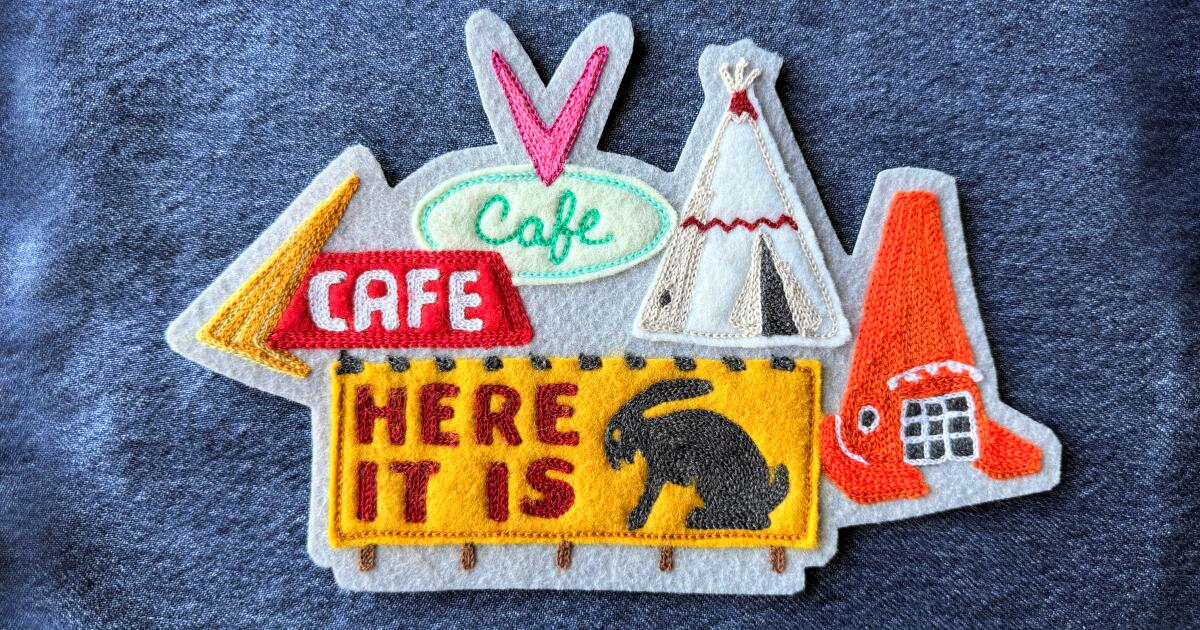
Route 66 travels extensively through Southern California, particularly around Los Angeles, passing through cities like Pasadena and West Hollywood before ending in Santa Monica. However, perhaps the most heartfelt tribute to this historic highway can be found at the Disneyland Resort, within Disney California Adventure park.
Cars Land debuted in 2012 as part of a major overhaul of the theme park, finally giving it an impressive area that could compete with – and often exceed – those next door at Disneyland. The land is beautifully designed, featuring reddish rocks reminiscent of Arizona and a mountain range backdrop subtly shaped like the tail fins of classic Cadillacs from the late 1950s and early 1960s. This is a nod to Cadillac Ranch in Amarillo, Texas, a famous art installation where ten vintage Cadillacs are buried nose-down in the ground, often compared to a 20th-century Stonehenge.
Before it became part of the 2006 movie, this area was originally planned as a theme park celebrating classic roadside attractions and journeys along Route 66, known as the ‘Mother Road.’ While Cars Land is inspired by a town created for an animated film, its inspiration comes from very real places and experiences.


Kathy Mangum, the retired Disney Imagineer who oversaw the creation of Cars Land, points out, ‘We knew from the start you’d be traveling along Route 66.’
Mangum explains that this stretch of Route 66 isn’t a typical one. You won’t find scenery like Cadillacs among red rocks anywhere else along the original road. It’s not about recreating the ‘best’ parts of Route 66, but rather capturing its overall feeling by combining unique elements. The result is something that feels authentic and true to the spirit of the road.

Even before Disney knew Pixar was making the movie “Cars,” plans were already underway to create a car-themed area for Disney California Adventure. The park, which opened in 2001, hadn’t been very successful at first. Guests felt it lacked the classic attractions and impressive scenery found at Disneyland.
To revitalize the park, Disney Imagineer Kevin Rafferty came up with the idea for “Car Land” – intentionally without the plural “s” – inspired by his family’s road trips and the quirky roadside attractions along Route 66. A key attraction, originally called Scoot 66 but later renamed Road Trip, USA, would have been a leisurely ride taking guests on a cross-country adventure through natural scenery and unusual roadside sights. The ride’s highlight would have been a miniature version of Carlsbad Caverns, a slight departure from the Route 66 theme.
Rafferty, who is now retired, explains that the ride, which was never constructed, was meant to be playful and humorous. The idea was to feature a series of quirky roadside attractions, such as enormous bunnies, to capture visitors’ attention.

Mater’s Junkyard Jamboree is a ride in Disney California Adventure’s Cars Land that brings the lovable tow truck, Mater, from the movie “Cars” to life. (Mark Boster / Los Angeles Times)

A mural in Seligman, Arizona, celebrates the town’s connection to the Disney-Pixar film “Cars,” which drew a lot of inspiration from the real place. (Mark Lipczynski / For The Times)
Rafferty thought a Cars Land-style area would be perfect for a Disney park because the setting – the late 1950s and early 1960s – evokes a shared fondness for a time when driving represented freedom and adventure. Even today, Cars Land captures that timeless feeling, with its classic rock music and a vibrant, neon-lit street that draws guests in, especially after dark.
Rafferty explained that the ‘Cars’ franchise felt like a natural fit for a Disney park, particularly Disney California Adventure, because cars are so central to California’s identity. California is where cars are designed and customized, with a strong car culture evident in its many design studios, custom shops, and car clubs. He also pointed to the numerous iconic songs about cars, like the Beach Boys’ ‘She’s so fine, my 409,’ as further proof of this connection.

The plans for Rafferty’s Car Land evolved once the Imagineers and Pixar team started working together. This change also meant the area would be more closely tied to the Route 66 culture that inspired the movie. Both the Pixar filmmakers and later, the Imagineering team, took 10-day research trips along Route 66 with historian Michael Wallis, who wrote the book “Route 66: The Mother Road.” The Pixar team loved Wallis’ tours so much they asked him to be the voice of the sheriff character in the film.
Wallis described taking his teams on trips in rented Cadillacs. He enjoyed making frequent stops – about every 300 yards – to fully experience the journey. They would rescue box turtles from the road, explore fields of winter wheat, and pick wild grapes. Wallis also made a point of introducing the team to interesting people and unique places they likely wouldn’t have encountered otherwise, showcasing both the natural beauty and hidden gems along the way.

The charming town of Radiator Springs from the movie “Cars” wasn’t based on one specific place, but it draws inspiration from several small towns along the historic Route 66 between Tulsa, Oklahoma, and Kingman, Arizona. Towns like Tucumcari, New Mexico, and Seligman and Oatman, Arizona, all influenced its look and feel. The elegant bridge featured in Radiator Springs is very similar to the Colorado Street Bridge in Pasadena, California, though the real bridge doesn’t have a waterfall nearby.


The main bridge in Cars Land’s mountain scenery was designed to look like a real landmark. (Paul Hiffmeyer / Disneyland Resort)

The Colorado Street Bridge in Pasadena served as a key inspiration for the design of Cars Land.
As a movie buff, I always notice cool set design, and the world of Cars is full of it! They really nailed the details. For example, Ramone’s body shop feels like a shout-out to some real places, and it turns out it is – it’s connected to the U-Drop Inn in Shamrock, Texas, which is this amazing old Art Deco gas station that’s now a visitor center and cafe. And the Cozy Cone Motel? That’s a clear nod to the Wigwam motels that used to be all over the place. Actually, there were seven of them stretching from Kentucky to California, but only two are still going strong on Route 66 – one in San Bernardino and another in Holbrook, Arizona. It’s details like these that make the movie so charming!
Although the Imagineers had the animated movie as a starting point, Mangum explains that the research trip was crucial for making the park feel realistic and genuine.
Mangum explains that they could find a building in Shamrock, Texas, very similar to the one in the film, and even discover the same textured terra-cotta tiles were used. He emphasizes that while it’s a movie set, it’s also based on real-world details and materials.
While Flo’s V8 Cafe isn’t based on any single real Route 66 diner, Disney’s designers were inspired by the feeling of places like the Midpoint Cafe in Adrian, Texas.

Rafferty explains they thoroughly tasted everything at the Midpoint Cafe and took detailed notes. The cafe’s owners shared their mother’s recipe for what they called ‘ugly crust pies,’ and Rafferty’s team immediately loved them. When Rafferty proposed serving these pies at Flo’s V8 Cafe in Disneyland to the head chef—who was French at the time—the chef firmly refused, stating that nothing in Disneyland could be ‘ugly.’
Abandoned buildings played a role in shaping the land’s design. Specifically, the ruins at Two Guns, Arizona, inspired the “Stanley’s Oasis” section of the Radiator Springs Racers queue. Designers used the remains of an old gas station as a starting point, adding an oil service station and a unique structure built from empty oil bottles. The backstory is that Stanley’s Oasis was a popular roadside stop that eventually led to the founding of Radiator Springs.

The Cozy Cone Motel features a row of cone-shaped booths selling tasty snacks like soft-serve ice cream cones. (Stephanie Breijo / Los Angeles Times)

The Cozy Cone is based on the real-life Wigwam Motels. (Christopher Reynolds / Los Angeles Times)
Rafferty explains that the Route 66-style story people often hear isn’t true—it wasn’t part of the original film. However, that invented history later became the basis for the 2012 short film, ‘Time Travel Mater’.
Route 66’s lasting appeal isn’t simply because of the popular cartoons and movies it’s inspired. Despite a history marked by hardship and racial injustice, the road has become a beloved symbol of American culture, offering a window into our country’s past and encouraging us to learn more.
The landscape feels untouched by time. It embodies the classic, comforting idea of a small town – the kind of place people always dream of returning to. As Mangum puts it, “It doesn’t necessarily reflect modern America, but it still captures something essential about the country.”
Read More
- Total Football free codes and how to redeem them (March 2026)
- Clash of Clans May 2026: List of Weekly Events, Challenges, and Rewards
- Farming Simulator 26 arrives May 19, 2026 with immersive farming and new challenges on mobile and Switch
- Last Furry: Survival redeem codes and how to use them (April 2026)
- Honor of Kings x Attack on Titan Collab Skins: All Skins, Price, and Availability
- NTE: Neverness to Everness Original Game Soundtracks: Your Ultimate Playlist Guide
- Gold Rate Forecast
- COD Mobile Season 4 2026 – Eternal Prison brings Rebirth Island, Mythic DP27, and Godzilla x Kong collaboration
- Zenless Zone Zero version 2.8 ‘New: Eridan Sunset’ update will release on May 6, 2026
- Top 5 Best New Mobile Games to play in May 2026
2026-05-12 13:33