I’m watching a fascinating case unfold in federal court right now. A judge seems inclined to halt the $6.2 billion merger between Nexstar Media Group and one of its competitors. The core question is whether this takeover would break antitrust laws – basically, whether it would give Nexstar too much control over the TV market. It’s a significant development that could reshape how local news is delivered, and the judge’s stance suggests he’s taking those concerns seriously.
After a two-hour hearing in Sacramento on Tuesday, the chief judge indicated he’s likely to issue a temporary order blocking Nexstar and Tegna from merging while a lawsuit against the combination continues.
Nunley said he would draft a written order, which is expected by Friday.
Previously, Nunley had issued a temporary restraining order to pause the merger.
Last month, Nexstar quickly completed its large acquisition of Tegna, even while facing a lawsuit. The lawsuit was brought by California Attorney General Rob Bonta and seven other state attorneys general, all Democrats, who argued the merger would give Nexstar excessive control over local television. They believed this would negatively impact viewers by reducing the variety and quality of local news coverage.
Laura Antonini, a Deputy Attorney General in California, explained that when fewer companies control the news, we lose access to a variety of perspectives.
“That’s extremely harmful to democracy and to the citizens of this state,” she said at the hearing.
President Trump supports the merger between Nexstar and Tegna, believing it will reduce the power of large television networks like ABC and NBC, which he frequently criticizes. Nexstar, a company headquartered in Irving, Texas, operates many local network affiliate stations.
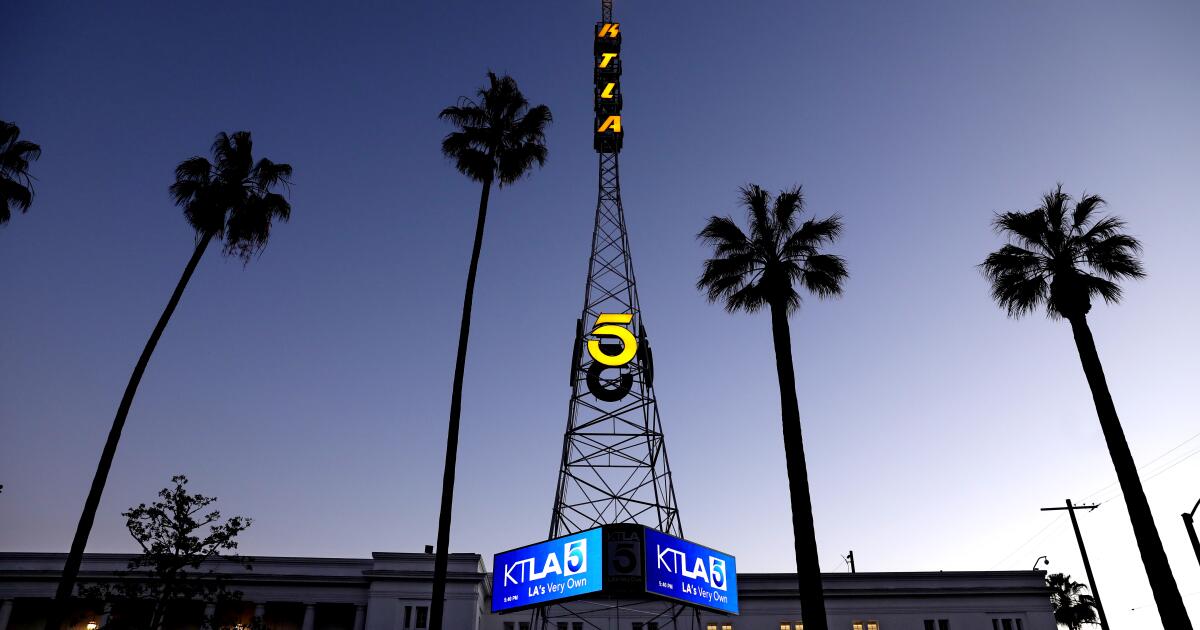
Nexstar, the current leader in local television station ownership – including KTLA 5 in Los Angeles – is getting even bigger. This deal will significantly expand their network to 265 stations, up from their existing 164, and is expected to change the landscape of local TV.
If Nexstar completes its purchase, its stations would reach 80% of American households, going over the 39% ownership limit established by Congress.
DirecTV has also filed a lawsuit, claiming that merging the two biggest television station groups would severely damage its pay-TV service by leading to higher costs and more frequent programming interruptions.
Representatives of Nexstar, DirecTV and Bonta’s office declined to comment after Tuesday’s hearing.

Hollywood Inc.
Inside the crisis facing local TV news: Layoffs, consolidation and shrinking ratings
Experienced TV journalists could lose their jobs as stations like KTLA struggle with falling viewership and the need to cut costs due to the rise of streaming services.
At the hearing, Nexstar’s lawyer, Alexander Okuliar, opposed a temporary block of the merger, stating that those challenging it hadn’t proven it would immediately harm the public. He explained that DirecTV and the state attorneys general only presented potential financial losses as evidence.
According to court filings, state attorneys general and DirecTV argued the agreement would allow Nexstar to control several TV stations across the country. This sparked worries about job losses in the TV industry, which has already seen many cuts as more people turn to streaming services and platforms like TikTok for entertainment and advertising.
DirecTV claims that Nexstar might close local news stations in many cities, which would significantly decrease the amount of reliable local news available to people about their communities.
Nexstar, for instance, owns the Fox television station in Sacramento, and Tegna, headquartered in McLean, Virginia, owns the ABC station.
Okuliar pushed back, saying there was no evidence that local newsrooms would be shuttered.
He explained to the judge that a key goal of the agreement was to support local broadcasters and local news reporting.
Nexstar argues the acquisition would improve the financial health of TV stations, enabling them to invest more in news coverage and offer more newscasts. They point to the numerous awards earned by their journalists, including recognition in Oklahoma City, as evidence of their commitment to quality news.

Hollywood Inc.
Nexstar Media Group has finalized the purchase of Tegna, even though some state attorneys general objected to the deal.
Along with Bonta, the lawsuit is also brought by the attorneys general of Colorado, Connecticut, Illinois, New York, North Carolina, Oregon, and Virginia.
I was really struck by the sheer number of legal representatives present at the hearing. It wasn’t just a few – nearly two dozen lawyers were there to speak for the plaintiffs, while Nexstar and Tegna each had a sizable team of eight lawyers defending them. It definitely felt like a high-stakes situation with both sides prepared for a fight.
Nexstar Chief Executive Perry Sook and Chief Operating officer Michael Biard also attended.
DirecTV claimed it would lose money because Nexstar, with its growing power, would likely demand much higher fees to allow DirecTV to carry its local channels. These channels provide popular content like local news, prime-time shows, and sports, including NFL games. Disputes over these fees can result in service interruptions, frustrating viewers.
Okay, so Nexstar’s legal team pushed back hard on those claims, basically telling the judge that combining with the other company would actually increase the quality of the stuff we watch. They even floated the idea that it could lead to lower bills for viewers who get their TV through companies like DirecTV – you know, the ones with around 10 million subscribers nationwide. They’re saying it could be a win-win, but honestly, I’m taking it with a grain of salt until I see it happen.
Nunley recently combined the DirecTV and state attorneys general lawsuits into one.
The judge, appointed by President Obama, had previously voiced worries about the merger.
In his March 27th ruling, Judge Nunley explained that DirecTV was likely to win its case in court, based on the strength of its arguments.
He told Nexstar to stop all work on combining their company with Tegna right away.
The judge ruled that Tegna must keep running its business separately, remaining a strong and competitive company, as it currently does.
In early February, the proposed merger between Nexstar and Tegna gained political attention when Donald Trump publicly supported it. He posted on Truth Social that he considered the deal a positive one, arguing it would offer competition to what he called the “Fake News National TV Networks.”
“GET THAT DEAL DONE!” Trump wrote.
Hollywood Inc.
The move comes after Nexstar wins FCC approval and finalizes its $6.2-billion takeover
On March 18th, the state attorneys general filed a lawsuit to stop the merger. At the time, the deal was still under review by the U.S. Justice Department, which examines potential antitrust issues, and the Federal Communications Commission, which regulates TV station licenses.
The DOJ and FCC blessed the deal the following day.
Within an hour, Nexstar completed the deal and Tegna ceased to exist as a company.
“It’s very rare to do what Nexstar did here,” DirecTV’s attorney Glenn Pomerantz said.
Nexstar requested the court to require the plaintiffs to provide a $150 million bond. This bond would cover any financial losses Nexstar might experience if the deal were to be delayed.
Read More
- Limbus Company 2026 Roadmap Revealed
- After THAT A Woman of Substance cliffhanger, here’s what will happen in a second season
- Gold Rate Forecast
- Wuthering Waves Hiyuki Build Guide: Why should you pull, pre-farm, best build, and more
- XO, Kitty season 3 soundtrack: The songs you may recognise from the Netflix show
- Guild of Monster Girls redeem codes and how to use them (April 2026)
- Total Football free codes and how to redeem them (March 2026)
- The Division Resurgence Specializations Guide: Best Specialization for Beginners
- All Mobile Games (Android and iOS) releasing in April 2026
- GearPaw Defenders redeem codes and how to use them (April 2026)
2026-04-08 06:01