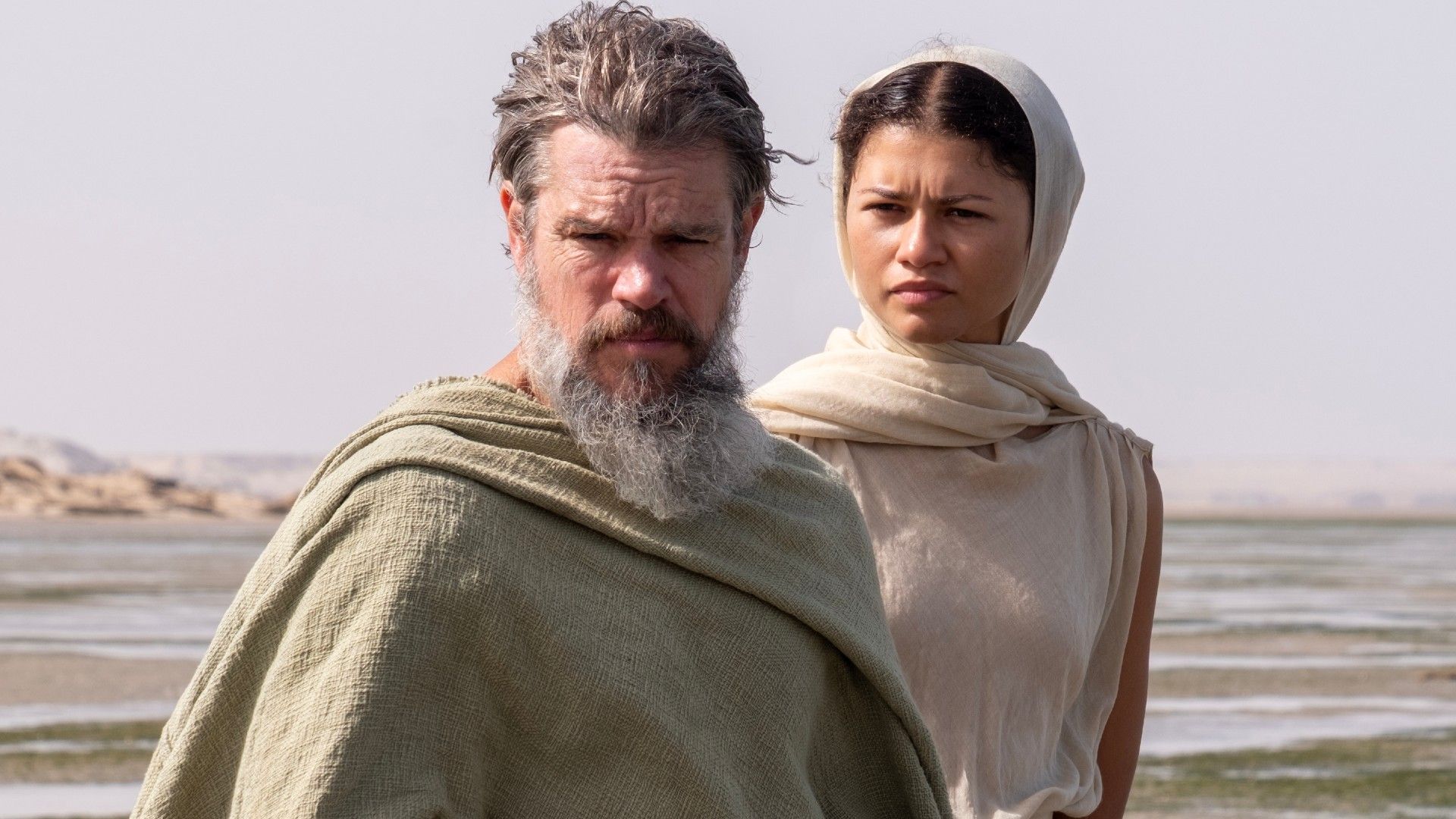
Okay, so I just read about how Christopher Nolan made his version of The Odyssey, and it’s fascinating! Apparently, he really wanted to make it feel real, so he avoided using a ton of CGI. Instead, he worked closely with the production designer, Ruth De Jong, and they basically built the entire world of the story as their actual filming locations. It sounds like an absolutely massive undertaking – a true epic in every sense!
At a presentation in April 2026, director Christopher Nolan explained that his film involved extensive global travel, stating, “This is The Odyssey, and we filmed it accordingly.” He also noted the production faced significant challenges, adding, “It was meant to be difficult – that’s inherent to the story itself.”
The actors left the Universal Studios backlot and filmed in six different countries around the world. The cast and crew traveled extensively, hiking, sailing, and filming action scenes while carrying large IMAX cameras. The result is a remarkably realistic portrayal of Homer’s The Odyssey. Christopher Nolan’s three-hour film is a stunning example of traditional, practical filmmaking.
The fantastical creatures in The Odyssey were brought to life using clever practical effects and filmmaking techniques. Instead of relying heavily on computer graphics, the production team used puppets, makeup, and careful camera work to create the monsters and magical moments. Digital effects were used subtly to enhance the visuals, but many of the most impressive scenes were achieved entirely through these real-world methods. With The Odyssey, Nolan demonstrates that even with today’s advanced CGI, nothing beats the impact of authentic action filmed in-camera.
Odysseus’s Ship and Voyage

The movie’s scenes of Greek soldiers sailing the Mediterranean weren’t filmed on a soundstage. Instead, the actors and crew actually went out on the water in real boats, bringing along the large IMAX cameras with them.
Production designer De Jong found the 115-foot Viking ship in Stavanger, Norway (according to Architectural Digest). To make it look like a genuine ancient Greek warship for the film, the team added hand-made sails and oars, along with bronze accents. The ship itself traveled from Scotland to Morocco during the shoot.
Filming out on the ocean created a sense of realism and allowed for unscripted moments. The actors experienced the waves and spray firsthand, making their reactions genuine. A lucky highlight was when dolphins swam into the shot unexpectedly – a natural event you couldn’t recreate on a soundstage.
The Cave

While sailing home, Odysseus and his crew found themselves trapped inside the cave of a monstrous, man-eating Cyclops. Interestingly, these scenes were filmed at a real location – Nestor’s Cave in Greece’s Peloponnese region – a place deeply rooted in ancient Greek stories.
The film crew remarkably turned a cave into a filming location, making use of its large, high ceiling (according to Outside magazine). Shooting inside the cave was difficult, as everyone had to carry equipment up a mountain to reach it. They also faced challenges like thousands of bees protecting the cave entrance, complete darkness inside, and the strong smell from the 40 sheep used in the scene, which added to the unsettling environment.
Nolan explained to Empire that filming in a real cave created a uniquely immersive experience. He described how, despite becoming quite damp and odorous over time, the cave’s atmosphere was far more impactful than any set he’d built before. The feeling of being sealed inside, surrounded by darkness after the entrance was blocked off, added a powerful sense of realism to the film.
The cave, with all its difficulties, created a remarkably believable and unsettling mood in the film.
The Invasion of Troy

As the final battle for Troy raged, flames engulfed the great city, bringing down its towering structures in a fiery collapse.
Even the actors were amazed by the impressive special effects used to create this scene. In an interview with Entertainment Weekly, Matt Damon and Tom Holland described being shocked by how massive everything was. Damon specifically recalled being stunned by the huge crowd of people involved – including the cast, crew, and stunt team.
Tom Holland, who plays Telemachus in the upcoming movie Troy, was amazed by how quickly and easily the fire effects could be started and stopped on set. He told Entertainment Weekly it was “literally like a tap,” describing the process as incredible.
Despite being carefully planned and controlled, the scene felt completely chaotic.
The Laestrygonians

During their journey home, Odysseus and his crew accidentally landed on an island inhabited by the Laestrygonians, a race of giant cannibals. The movie used a technique called forced perspective to make these giants appear even more enormous on screen.
On the Happy Sad Confused podcast, Matt Damon, who played Odysseus, described how the show created the visual effects for its creatures. The Laestrygonians, dressed for battle, were actually 7-foot-tall stunt performers, while the Greek soldiers were played by stunt doubles shorter than 5 feet. Damon specifically praised stuntwoman Devyn Dalton, his stand-in, for her impressive work in the battle scene.
The filmmakers used clever camera work to make the actors seem much taller than they actually were, emphasizing a two-foot height difference. This technique made the Laestrygonians look enormous on screen – at least four times bigger than Odysseus and his weary troops.
Circe’s Transformations

One of the most unsettling moments in The Odyssey depicts Greek soldiers being turned into pigs by the witch Circe. She coolly transforms them, physically reshaping their faces into snouts and reaching down their throats – a magical effect brought to life through impressive practical effects and a captivating performance by Samantha Morton.
To portray Circe’s transformation of men into pigs, the actor used clay models and special effects makeup. In an interview with SyFy, Morton explained that she became so immersed in the role during those scenes that it felt like she wasn’t working with props at all.
The actor received a spontaneous round of applause from the film crew after performing this scene. Director Christopher Nolan noted that such a reaction hadn’t happened on one of his sets since Heath Ledger’s iconic portrayal of the Joker in The Dark Knight.
The Trojan horse
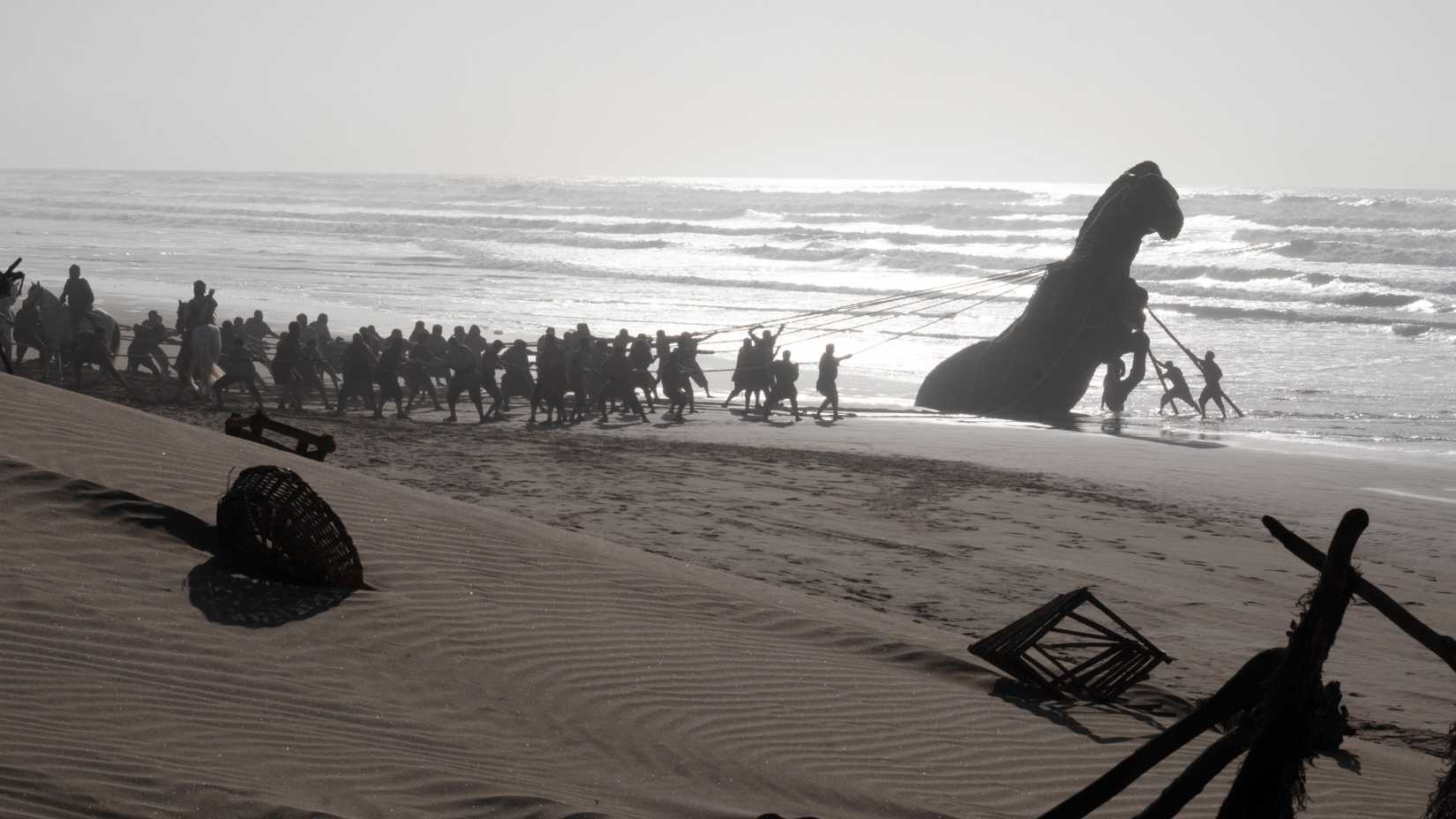
The story of the Trojan horse is perhaps the most well-known part of Homer’s Odyssey. According to the myth, Greek soldiers built a giant wooden horse, hid inside it, and presented it to the city of Troy as a gift. Once inside the city walls, the soldiers emerged from the horse and conquered Troy.
Nolan’s depiction of the Trojan horse didn’t rely much on special effects. Instead, the filmmakers actually built a massive, 35-foot-tall wooden horse. They transported it to Morocco in sections and assembled it right on the beach. Designed to be moved, hundreds of extras worked together to pull the enormous prop from the shore into the town and stand it up near the tower of Athena.
The filmmakers wanted to realistically show how much the Greek soldiers suffered inside the Trojan Horse. So, the cinematographer and actors actually went inside the prop horse and worked out how to play the scene together. Despite being very cramped and uncomfortable, they stayed in there for several hours until they got the perfect shot.
Damon explained to GamesRadar+ that the feeling of being trapped wasn’t intentionally created, but rather developed naturally as they filmed. He believes if they’d planned it specifically, it wouldn’t have felt as authentic. You can really feel the enclosed atmosphere while watching.
Polyphemus the Cyclops

Polyphemus, the enormous, man-eating Cyclops, would seem incredibly difficult to create without computer effects. He’s far bigger than any of the Laestrygonians, and no camera trick could make him appear that large realistically. But director Nolan once again showed his preference for practical effects over CGI in this inventive scene.
The stage production of The Odyssey featured a massive, 60-foot-tall puppet of the character Polyphemus. This puppet was moved to a location in the Greek hills representing Nestor’s Cave and used in sweeping shots of the Cyclops, with only a little bit of computer-generated imagery added. This technique—combining physical models with digital effects—was first popularized by the film Jurassic Park in 1993 and still creates a more realistic feel than relying solely on computer animation, even with today’s advanced technology.
For the actors in The Odyssey, a puppet served as a realistic stand-in during filming, much better than simply using a tennis ball. Close-up shots of Polyphemus were actually performed by Bill Irwin, a performer known for his vaudeville and clowning skills. Visual effects were then used to seamlessly blend Irwin’s performance with footage of the soldiers and sheep inside the cave.
2026-07-27 23:30