Author: Denis Avetisyan
A new platform harnesses the power of artificial intelligence to automate the study of microscopic plant remains, offering unprecedented insights into past environments and human-plant interactions.

This review details Sorometry, an AI-driven system for automated phytolith analysis using digital microscopy, image processing, and Bayesian modeling to enhance throughput and reproducibility.
Traditional phytolith analysis-a cornerstone of paleoecological and archaeological reconstruction-is hampered by the labour-intensive demands of manual microscopic identification. This limitation is addressed in ‘Leveraging Phytolith Research using Artificial Intelligence’, which presents Sorometry, a comprehensive artificial intelligence pipeline for high-throughput phytolith digitisation, inference, and interpretation. By fusing 2D image and 3D point cloud analysis with Bayesian modelling, Sorometry achieves up to 84.5% segmentation quality and enables assemblage-level predictions of plant contributions, significantly exceeding the capacity of conventional methods. Will this automated approach usher in a new era of “omics”-scale phytolith research, unlocking unprecedented insights into past environments and human-plant interactions?
Unveiling the Past: Phytoliths as Records of Ancient Ecosystems
Phytoliths – minute, fossilized plant silica bodies – represent a largely untapped archive of past ecosystems and the ways humans have engaged with them. These microscopic remnants, persisting in soils and sediments long after the plant matter itself has decayed, offer direct evidence of vegetation composition, agricultural practices, and even dietary habits. However, realizing this potential is significantly hampered by the traditional methods of analysis. Historically, researchers have relied on manual identification and counting of phytoliths under a microscope – a process that is not only incredibly time-consuming but also susceptible to individual interpretation and bias. This subjective element limits the reproducibility of findings and restricts the scope of questions that can be realistically addressed, hindering a comprehensive understanding of the past environments and human-plant relationships embedded within these silica records.
The traditional analysis of phytoliths, while valuable, faces significant hurdles due to the painstaking nature of manual identification and counting. Researchers historically spend countless hours meticulously examining microscopic slides, a process susceptible to human error and subjective interpretation – a single researcher’s identification can differ from another’s. This labor-intensive approach inherently restricts the scope of inquiry; large-scale studies aiming to reconstruct regional vegetation histories or comprehensively assess human-plant relationships become impractical given the time and resources required. Consequently, the potential of phytolith analysis to address broad ecological and archaeological questions remains largely untapped, necessitating more efficient and objective methodologies to unlock the full wealth of information contained within these microscopic plant archives.
The increasing resolution of microscopic imaging techniques now generates vast datasets of phytoliths – plant silica bodies – far exceeding the capacity of manual analysis. While each phytolith holds clues about past vegetation and land use, efficiently extracting meaningful information from these immense assemblages requires innovative, automated approaches. Researchers are developing computational methods, including machine learning algorithms, to identify, classify, and quantify phytoliths with greater speed and accuracy than previously possible. These tools not only alleviate the burden of tedious manual counting but also enable the analysis of larger sample sizes and more complex datasets, ultimately unlocking a more detailed and nuanced understanding of past environments and human-plant interactions. The transition toward automated analysis promises to transform phytolith research, allowing scientists to move beyond descriptive studies and towards statistically robust, predictive models of ecological and cultural change.
![Digital images showcase the diverse suite of [latex]16[/latex] phytolith types (including examples like Acute bulbosus and Decorated tabular) analyzed in the study, with red overlays indicating automatically segmented regions, and a [latex]10[/latex] µm scale bar provided for reference.](https://arxiv.org/html/2603.11476v1/5_Morphotypes.png)
Sorometry: An Automated Pipeline for Phytolith Analysis
Sorometry represents a novel approach to phytolith analysis by integrating artificial intelligence across the entire analytical workflow, from initial digitisation to final interpretation. The platform utilizes automated image acquisition and processing to convert physical slides into digital data, followed by AI-driven inference to identify potential phytolith structures. This is achieved through a multi-stage process involving image enhancement, 3D reconstruction via point clouds, and segmentation algorithms. The system’s capabilities extend beyond simple identification to include data interpretation, facilitating quantitative analysis of phytolith assemblages and enabling researchers to draw statistically supported conclusions regarding archaeological or paleoenvironmental contexts.
High-resolution images are acquired using a digital microscope as the initial step in the phytolith analysis pipeline. To overcome limitations in depth of field and ensure comprehensive visualization of three-dimensional structures, a focus stacking technique is implemented, generating an image with maximized sharpness across all planes. Subsequent image enhancement employs Bilateral Filtering, a non-linear method preserving edges while reducing noise, followed by Laplacian Edge Detection, which highlights boundaries and features within the image. These pre-processing steps are critical for accurate segmentation and subsequent automated identification of individual phytoliths.
Following high-resolution image capture, the system converts images into point cloud data to facilitate automated phytolith segmentation. This is achieved using CloudComPy, a parallel processing framework, and Octree data structures, which enable efficient spatial partitioning and analysis of the point cloud data. The implemented pipeline processed a total of 123 microscopic slides, resulting in the identification and segmentation of 3.81 million individual point clouds, each representing a potential phytolith for further analysis and classification.
Deep Learning for Phytolith Classification: Establishing Accuracy and Reliability
Sorometry utilizes the ConvNeXt architecture, a convolutional neural network recognized for its performance in image classification tasks, to identify and categorize phytolith morphotypes. This architecture achieved a global accuracy of 77.9% when applied to the dataset, indicating its effectiveness in distinguishing between different phytolith forms. ConvNeXt’s design incorporates modern convolutional neural network principles, allowing for efficient training and high accuracy in complex classification scenarios, as demonstrated by its performance in this phytolith analysis application.
During the training phase, the ConvNeXt model utilizes several data augmentation techniques to enhance its generalization ability and robustness. Standard Image Augmentation methods, including rotations, flips, and color adjustments, increase the effective size of the training dataset and expose the model to a wider range of variations. MixUp creates new training samples by linearly interpolating between pairs of images and their corresponding labels, encouraging linear behavior between classes. Label Smoothing replaces hard labels with a softened distribution, reducing overfitting and improving calibration. These combined techniques contribute to a more resilient and accurate phytolith classification system by mitigating the impact of noisy or limited training data.
Bayesian Finite Mixture Models (BFMMs) are implemented to analyze phytolith compositional data, addressing challenges inherent in characterizing complex sediment mixtures. Prior to BFMM application, Isometric Log-Ratio (ILR) transformation is used to convert compositional data-where total composition is fixed-into a coordinate system suitable for standard statistical modeling. This transformation avoids spurious correlations caused by the sum-to-one constraint. Parameter estimation within the BFMM is achieved through Hamiltonian Monte Carlo (HMC), a Markov Chain Monte Carlo method that efficiently explores the posterior distribution, enabling robust source apportionment and compositional analysis despite data complexity and potential noise. This approach allows for statistically sound inferences regarding the relative contributions of different sources to the phytolith assemblage.
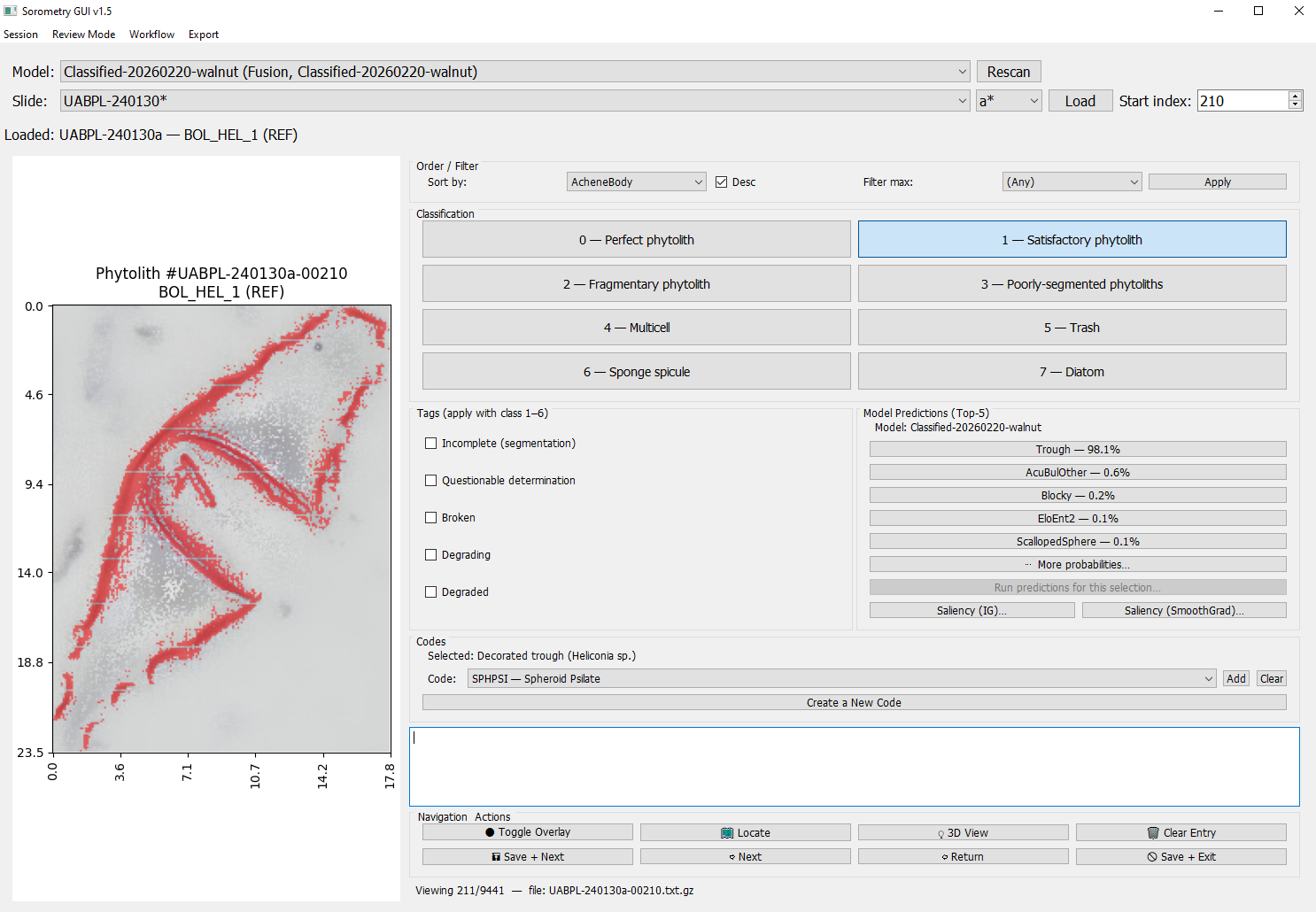
To ensure the reliability of automated phytolith classification, the system incorporates a quality control step utilizing Expert Review, where human specialists validate the AI-driven classifications. This process not only serves as a check on model accuracy but also provides data for refining model performance through iterative improvement. Quantitative evaluation demonstrates a class-adjusted accuracy of 71.4% and a Macro F1 Score of 0.71, indicating the model’s ability to correctly identify and categorize phytoliths across all represented classes while balancing precision and recall.
The system’s scalability was demonstrated through the analysis of 712 individual sediment sectors, resulting in the morphological coding of 4638 phytoliths. This substantial dataset, processed using the automated classification pipeline, confirms the system’s capacity to handle large-scale archaeological and paleoenvironmental datasets efficiently. The successful assignment of morphological codes to this quantity of phytoliths indicates the potential for broader application in regional and global studies requiring high-throughput phytolith analysis.

Expanding the Scope: Implications for Reconstructing Past Ecosystems
Sorometry’s capacity for rapid, large-scale data processing represents a significant advancement for archaeological and paleoenvironmental research. Traditional methods, often limited by the time required for manual analysis of samples like pollen cores or phytolith assemblages, now give way to automated workflows capable of handling datasets orders of magnitude larger. This acceleration allows researchers to move beyond localized studies and tackle broad-scale questions concerning vegetation dynamics, ancient agricultural practices, and the long-term impacts of climate change. The technology facilitates comparative analyses across geographically diverse regions, revealing subtle yet critical patterns previously obscured by logistical constraints, and ultimately enabling a more holistic understanding of past ecosystems and human interactions within them.
Sorometry’s automated analytical capabilities are fundamentally reshaping the scale of inquiry within archaeological and paleoenvironmental research. By swiftly processing data from numerous sites or samples, researchers can now conduct comparative studies previously hampered by logistical constraints and time limitations. This enables the identification of broad regional patterns in vegetation distribution, ancient land use practices, and the complex interplay between human populations and their environments. For instance, shifts in pollen records, charcoal deposits, and phytolith assemblages can be correlated across extensive geographical areas, revealing how environmental changes or human activities propagated across landscapes. Ultimately, this automated, large-scale analysis moves beyond isolated site-specific interpretations, fostering a more holistic understanding of past ecosystems and the long-term dynamics of human-environment interactions.
Sorometry’s capacity to ingest and analyze extensive datasets is revolutionizing paleoenvironmental reconstruction. Traditionally, establishing past environments relied on painstakingly gathered and limited proxy data – pollen counts, sediment analysis from a few core samples, or isolated faunal remains. Now, algorithms can integrate information from thousands of sources, including remote sensing data, digitized historical records, and previously inaccessible archives, creating highly detailed environmental baselines. This expanded scope allows for the identification of subtle shifts in vegetation, climate, and land use with unprecedented accuracy, moving beyond broad generalizations to reveal nuanced regional variations and localized ecological changes. The resulting reconstructions aren’t simply static snapshots of the past, but dynamic models capable of illustrating environmental processes at resolutions previously unimaginable, offering invaluable insights into long-term ecological trends and human impacts.
Sorometry’s power lies not simply in data acquisition, but in its capacity to alleviate the bottlenecks of traditional research methods. By automating previously time-consuming and repetitive tasks – such as image processing, feature extraction, and initial data categorization – the technology significantly reduces the labor required for large-scale analyses. This newfound efficiency allows researchers to shift their focus from manual data handling to more intellectually demanding endeavors – formulating complex hypotheses, interpreting nuanced patterns, and testing theoretical frameworks. Consequently, scientific discovery is accelerated, enabling a more rapid cycle of inquiry and a deeper understanding of past environments and human interactions with them. The technology thus promises a paradigm shift, moving archaeology and paleoenvironmental research beyond descriptive cataloging towards predictive modeling and robust explanatory power.
The pursuit of automated phytolith analysis, as detailed in this work, embodies a commitment to algorithmic rigor. Sorometry isn’t simply about faster processing; it’s about establishing a verifiable, repeatable process for extracting meaningful data from complex microscopic images. This echoes Andrey Kolmogorov’s sentiment: “The shortest and most effective way to master something is through systematic practice and application of fundamental principles.” The platform’s reliance on Bayesian modeling and image processing techniques aims to move beyond empirical observation toward a mathematically grounded understanding of past ecosystems – a pursuit of demonstrable truth rather than merely functional results. It’s a commitment to provable outcomes, a hallmark of elegant algorithmic design, and a departure from solutions assessed solely on performance metrics.
Beyond the Horizon
The presented work, while representing a substantial algorithmic advance in phytolith analysis, merely scratches the surface of a far deeper problem. The automation of image processing, however efficient, does not address the fundamental challenge of translating assemblage data into ecologically meaningful interpretations. A perfectly classified phytolith remains, mathematically speaking, an abstraction-a point in a multi-dimensional space awaiting rigorous contextualization. Future effort must shift from simply detecting phytoliths to understanding their relationships within complex paleoecological models, and this demands a move beyond purely descriptive statistical approaches.
A critical limitation lies in the current reliance on training datasets-finite, and therefore inherently biased representations of phytolith morphology. The elegance of Bayesian modeling is diminished if the prior probabilities themselves are based on incomplete or geographically restricted samples. True progress requires generative models capable of synthesizing novel phytolith forms, thereby testing the robustness of classification algorithms and expanding the search space for potential paleoecological signals. Such a system would not merely analyze what is, but explore what could be.
Ultimately, the value of Sorometry-or any similar platform-will be determined not by its speed or accuracy, but by its capacity to reveal previously inaccessible patterns in the archaeological record. The pursuit of automated analysis should not be an end in itself, but a means to a more profound, mathematically grounded understanding of past ecosystems and the human interactions within them. The focus must remain on the underlying logic, not the convenience of computation.
Original article: https://arxiv.org/pdf/2603.11476.pdf
Contact the author: https://www.linkedin.com/in/avetisyan/
See also:
- ‘Project Hail Mary’s Unexpected Post-Credits Scene Is Worth Sticking Around
- Beyond Accuracy: Gauging Trust in Human-AI Teams
- Gold Rate Forecast
- The most surprising Hannah Montana cameos: From John Cena to Dwayne Johnson and even a Coronation Street soap star as show celebrates its 20th anniversary
- Limbus Company 2026 Roadmap Revealed
- EMEA Masters Winter 2026 introduces official Qualifier for Esports World Cup
- Genshin Impact Version 6.5 Leaks: List of Upcoming banners, Maps, Endgame updates and more
- Brawl Stars Sands of Time Brawl Pass brings Sandstalker Lily and Sultan Cordelius sets, along with chromas and more
- Total Football free codes and how to redeem them (March 2026)
- Brawl Stars Brawl Cup Pro Pass arrives with the Dragon Crow skin and Chroma, unique cosmetics, and more rewards
2026-03-14 23:07