We continue our countdown of your picks for with #60-51!
Thanks to everyone who voted – we received over 1,100 ballots! You ranked your favorite storylines from best to worst, giving 10 points for your top choice and 1 point for your least favorite. I’ve tallied all the scores, and here are the results!
60. “The Death of Jean DeWolff” by Peter David and Rich Buckler (plus many inkers) (The Spectacular Spider-Man #107-110) – 198 points (7 first place votes)
The Death of Jean DeWolff is a compelling story that explores the challenges of consistently applying moral rules to superhero comics. It begins with the murder of Captain Jean DeWolff, a minor character in the Spider-Man universe, by a new villain known as the Sin-Eater.
The story consistently challenges Spider-Man and Daredevil, forcing them to question their abilities as the Sin-Eater relentlessly attacks them. Daredevil faces a difficult decision twice: reveal his secret identity or try to stop the Sin-Eater. Each time, he prioritizes keeping his identity hidden.
Spider-Man is even more disturbed when he discovers that Captain DeWolff harbored a secret, unreturned affection for him. When they finally capture the Sin-Eater, Spider-Man is consumed by rage and intends to kill him, but Daredevil intervenes. The two heroes clash, but ultimately reveal their secret identities to each other, forging a stronger friendship than they previously shared.
I really loved how this story cleverly laid the groundwork for the Venom saga! It introduced Eddie Brock as this promising reporter who gets his big break uncovering the Sin-Eater, only to find out he was totally tricked by a fake confessor. And it was such a fantastic way to introduce Peter David to the comics scene – seriously, what a debut! He knocked it out of the park with this arc.
59. “Secret Wars” by Jim Shooter, Mike Zeck, Bob Layton, John Beatty and a host of other inkers (Marvel Super-Heroes Secret Wars #1-12) – 201 points (1 first place vote)
Okay, so as a comic book and gaming fan, I’ve gotta say, Marvel Super Heroes Secret Wars is legendary. It basically took all the big Marvel heroes and villains from back then and threw them onto this alien planet. Then, this super powerful being just made them fight each other – it was seriously like a dream come true for any fan, especially since it was tied into the toy line. It’s probably the biggest comic event ever built around a toy line, honestly.
It seems straightforward, but writer Jim Shooter adds complexity by showcasing the clever tactics each character uses. Instead of working together, the heroes divide into two teams: the X-Men and a separate group of allies. The villains aren’t all the same either; some are eager to simply fight, while others, like Doctor Doom, try to come up with more thoughtful plans.
Following several intense battles – including a surprising clash between Spider-Man and the X-Men, and a near-disaster where a mountain almost crushed everyone (saved only by the Hulk) – Doctor Doom unexpectedly turns the tables. He seizes control of the power that brought the heroes together and proposes a truce. But can the heroes trust him and work alongside him? They must now decide.
and Doom’s response is…fiery…
Man, this series had some killer cliffhangers!
Mike Zeck and John Beatty were both at the peak of their careers when this series was created. Bob Layton also contributed excellent work as a temporary artist.
58. “Runaways Volume 1” by Brian K. Vaughan, Adrian Alphona, Craig Yeung, Takeshi Miyazawa, David Nebold and Christina Strain (Runaways #1-18) – 203 points (4 first place votes)
Brian K. Vaughan, along with artists Adrian Alphona, David Newbold, Craig Yeung, and Christina Strain, created the Runaways, a compelling team of young heroes. These heroes are the children of Los Angeles’s most powerful supervillains – a group known as the Pride – though they’re unaware of their parents’ true identities. The Pride holds a yearly charity event, and their kids are forced to spend awkward time together. This year, however, the kids witness their parents committing a shocking murder as part of a ritual sacrifice. Realizing the truth, they flee and become the Runaways, each inheriting a piece of their parents’ power – from advanced technology and alien abilities to mutant powers, magic, and strategic genius. They unite to stop their parents and, hopefully, make a positive difference in the world. And now, they’re choosing their heroic identities…
Vaughan excels at creating compelling characters right away, and by the end of the series, you really feel like you’ve gotten to know them. However, the final plot twist reveals that one of the Runaways isn’t quite what they seem, challenging everything you thought you knew about them and their motivations.
The final conflict is brutally bittersweet.
The artwork, as you can see, is gorgeous.
57. “Grand Guignol” by James Robinson and Peter Snejbjerg (with Paul Smith) (Starman #62-73) – 205 points (4 first place votes)
The final issue of James Robinson’s Starman finds Jack Knight returning from space to a shocking sight: his hometown of Opal City is under attack by his enemies, apparently led by the Shade. While the Shade was often portrayed as a villain, this attack felt different and out of character. Starman wasn’t a lighthearted comic, but it also avoided the overly dark and violent tone common in comics at the time. The story always showed real emotional weight when bad things happened – destruction wasn’t treated casually. So, seeing such widespread devastation in Opal City was a powerful shock, and writer James Robinson and artist Snejbjerg portrayed it exceptionally well.
The story unfolded with a series of exciting battles. Because the villain, Shade, had isolated Opal City, the city’s defenders were limited to those who happened to be there – including Jack, Elongated Man, Black Condor, and Jack’s father, the original Starman. The narrative also included flashbacks, and featured several surprising twists, culminating in the reveal of the true mastermind.
The story concluded with a poignant and impactful sacrifice. It was a masterful blend of exciting action and compelling character development, which is what made the Starman comic so beloved. Notably, Paul Smith, a frequent collaborator of the writer, returned to contribute a flashback sequence focusing on the wives of the Justice Society of America, offering a fitting farewell to that period of the comic’s history.
56. “Confession” by Kurt Busiek, Brent Anderson and Will Blyberg (Kurt Busiek’s Astro City #4-9) – 209 points (4 first place votes)
The storyline ‘Confession’ marked a significant change for Kurt Busiek’s Astro City. Previously, the series focused on generally optimistic superhero stories – not comedies, but tales featuring classic, straightforward heroes like Superman or the Fantastic Four – the kind who are beacons of hope.
In ‘Confession,’ Kurt Busiek and artist Brent Anderson explore the shadowy underbelly of Astro City, focusing on its hidden corners and the individuals who live within them.
We first encounter Brian Kinney, a young man with dreams of becoming a superhero. He doesn’t have to wait long before becoming the sidekick to The Confessor, a hero similar to Batman, and begins training under him.
known as Altar Boy…
As the story continues, Brian develops into a stronger hero, but we also learn that there’s a dark secret behind The Confessor’s past – and uncovering that secret is the story’s biggest surprise.
Despite all this, the story is full of other developments – like a debate over whether superheroes should register with the government, and heroes behaving like villains. It’s a complex plot, but, as with all of Kurt Busiek’s Astro City stories, it’s driven by the intricate personalities of the characters.
55. “Planet Hulk” by Greg Pak, Gary Frank, Aaron Lopresti and Carlo Pagulayan (Incredible Hulk Vol. 2 #92-105) – 213 points (3 first place votes)
Okay, so the Planet Hulk storyline was actually pretty cool because it finally tackled the whole thing about Hulk just wanting to be left alone. Basically, the Illuminati – Reed Richards, Tony Stark, Doctor Strange, the whole crew – decided the best way to handle Hulk was to actually send him somewhere he could chill without bothering anyone. They totally tricked him onto a spaceship headed for this empty planet, thinking it would solve everything.
As you’d expect in a comic book, something goes wrong and Hulk’s spaceship is damaged, causing him to crash-land on a planet dominated by gladiatorial combat. Because Earth’s heroes were busy fighting amongst themselves during the Civil War, no one realized what had happened to Hulk’s ship. He was left stranded, and surprisingly, wasn’t the strongest being on this new world.
Hulk ultimately lived up to his reputation as the strongest there is, finding camaraderie with a group of gladiators who became like family. This was especially true after the Red King betrayed his people by bombing them, even causing the death of his own son.
Greg Pak crafted a compelling and expansive storyline, taking his time to build it up effectively. He particularly excelled at developing the characters who fought alongside Hulk as the “Warbound.” The artwork throughout the story was consistently strong, featuring contributions from several different artists. The story concludes with a dramatic cliffhanger that sets the stage for the next big event, World War Hulk, where Hulk finally gets his revenge.
54. “Welcome Back, Frank” by Garth Ennis, Steve Dillon and Jimmy Palmiotti (Marvel Knights: Punisher #1-12) – 217 points (4 first place votes)
Joe Quesada and Jimmy Palmiotti’s Event Comics had a lot of success revitalizing Marvel heroes, notably Daredevil. However, their idea of turning the Punisher into a heavenly avenger didn’t quite work. That’s why the follow-up series by Garth Ennis and Steve Dillon, titled “Welcome Back, Frank,” was so welcome.
Starting with the first issue, Ennis drops the angel storyline and dives straight into classic Punisher violence! What sets this apart from previous Punisher comics is Ennis’s choice to use a style similar to his Hitman series – blending dark humor with a diverse group of both heroes and villains.
The book was a genuinely enjoyable and visually striking read, though it definitely wasn’t afraid to get violent. More importantly, it successfully revitalized the Punisher character, and it’s probably no surprise that a new Punisher movie was approved shortly after this fresh take on the character emerged.
Ennis continued this approach with a regular Marvel Knights series, but the initial humor eventually lost its impact. This first large-format story, however, was incredibly well-done and original. Later, Ennis shifted the Punisher to the darker Marvel MAX line, removing the humor entirely. And if you’re familiar with Garth Ennis’s dislike of traditional superheroes, you’ll appreciate how he portrays Daredevil in an early guest spot.
The Netflix Daredevil series later notably adapted that story.
53. “The Court of Owls” by Scott Snyder, Greg Capullo and Jonathan Glapion (Batman #1-11) – 220 points (3 first place votes)
The story centers around a hidden group secretly running Gotham City. They recruit and train assassins called “Talons” to carry out their plans. When Bruce Wayne becomes too powerful a force in the city, they target him for elimination. This, of course, draws Batman into a conflict with the organization as he fights to dismantle their operation.
As a huge Batman fan, I have to say Greg Capullo is just incredible when it comes to drawing action scenes. And Scott Snyder is a genius at balancing that with the overall mystery of the Court of Owls. Seriously, Capullo’s artwork practically jumps off the page during the fight scenes – like when Batman stumbles upon one of the Court’s hidden lairs and they immediately try to take him out… it’s amazing!
such action!
That’s a really impressive scene. I particularly appreciate how Snyder captures Batman’s personality – he’s logical, remains calm even when things are tough, and confidently takes charge, essentially saying, ‘This is a bad situation, but I’m Batman, and I know how to handle it.’
Following a brutal encounter where the Court of Owls’ leader, William Cobb, nearly killed Batman – and revealed the Court’s history to him – Batman unexpectedly turned the tables, defeating Cobb himself. This demonstrated to the Court that Batman was a much greater threat than they’d anticipated. Previously concerned with simply controlling Bruce Wayne, they now focused on eliminating Batman entirely and asserting their dominance over Gotham City. This escalation triggered the ‘Night of the Owls,’ a coordinated attack where the Court unleashed all of its deadly assassins, the Talons, to target key figures throughout the city. Batman was forced to rally all of his allies and resources to prevent a catastrophic outcome.
Batman temporarily defeated the Court of Owls, and surprisingly learned that one of its members could be a relative!
This story marked Batman’s fresh start in the New 52 universe, and writer Scott Snyder’s complex storylines and interesting new characters quickly established it as the most important Batman title.
52. “Kree/Skrull War” by Roy Thomas, Neal Adams, Sal Buscema and John Buscema (Avengers #89-97) – 223 points (1 first place vote)
What really stands out about the Kree/Skrull War is how Roy Thomas packed it with so many different concepts and plotlines. The story moves at a breakneck pace, constantly surprising you – just when you think you know where it’s going, it takes an unexpected turn.
The story centers around a decades-long conflict between the Kree and Skrulls, and how Earth’s heroes, especially the Avengers, become involved.
The story features shape-shifting aliens called Skrulls creating chaos on Earth, mirroring the paranoia of McCarthyism – the idea that anyone could be a hidden enemy. A senator, secretly a Skrull, stirs up anti-alien sentiment, which puts Captain Marvel, who is actually from an alien race himself, in a difficult position. The storyline heavily emphasizes the “enemies within” theme, even featuring a cover with the slogan “The only good alien is a dead alien!” – a direct echo of anti-communist language from that era.
This plotline is central to Vision’s development, especially his connection with the Scarlet Witch. And regarding unexpected ideas, writer Thomas and artist Neal Adams brilliantly mirrored the plot of Fantastic Voyage by having Ant-Man shrink down to revive Vision when he fell into a coma.
Vision later reflects on the absurdity of McCarthyism, and this is when he starts to connect with the Scarlet Witch. She understands prejudice firsthand, being both a Romani person and a mutant.
I love how Thomas just keeps the story moving, jumping from place to place! It really kicks into high gear with some amazing space adventures – honestly, it’s non-stop action and so exciting!
The art in these early 1970s Marvel comics is fantastic, especially the issues drawn by Neal Adams. The work by the Buscema brothers is also excellent – it’s really as good as you could ask for from that era!
The concepts Thomas developed for the Kree/Skrull War proved incredibly influential, and writers have continued to draw from them for decades, even up to the present day, establishing it as a truly significant story in comic book history.
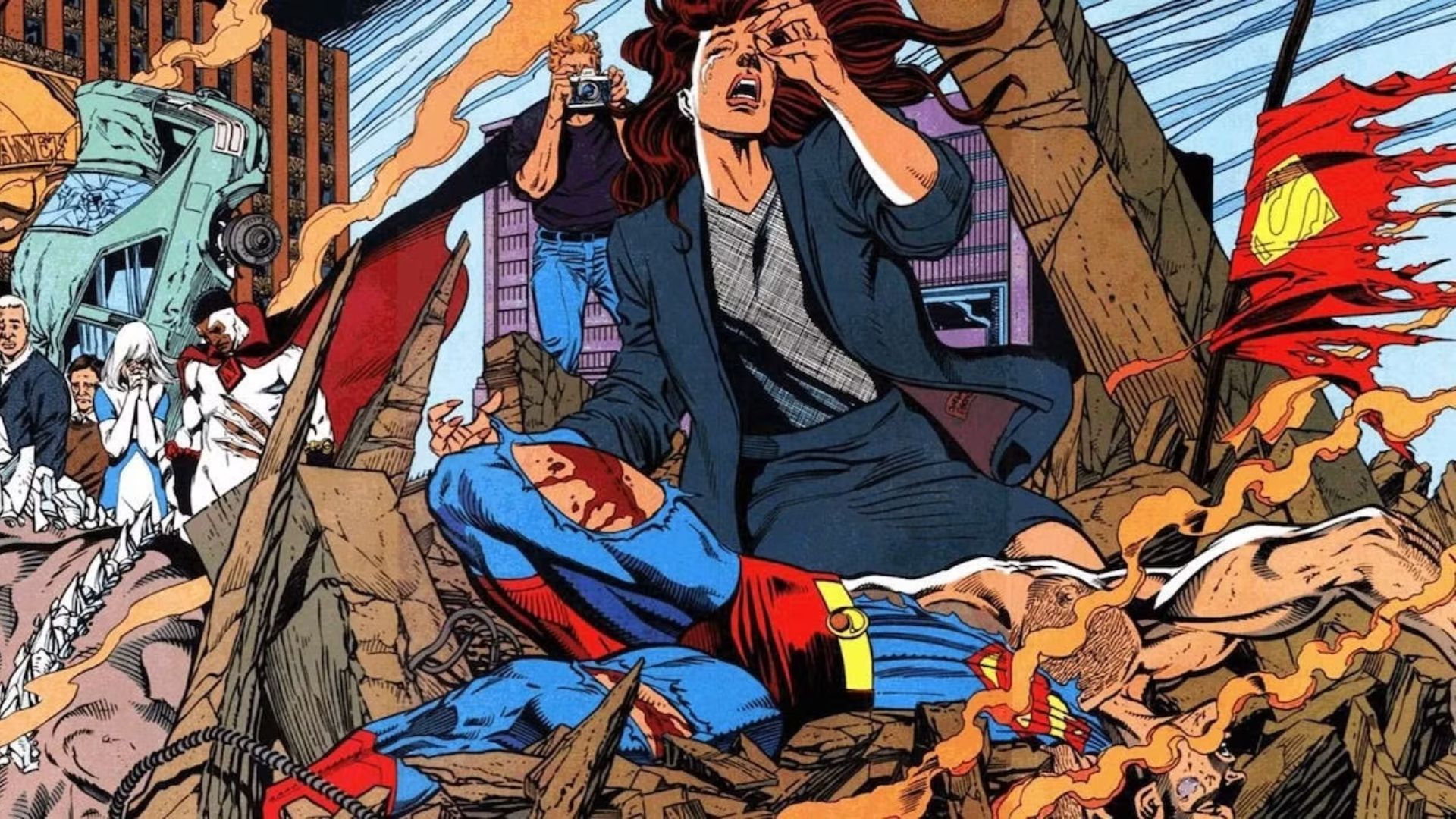
51. “The Death of Superman” by Dan Jurgens, Jerry Ordway, Louise Simonson and Roger Stern (writers), Dan Jurgens, Tom Grummett, Jon Bogdanove and Jackson Guice (pencilers) and Brett Breeding, Doug Hazlewood, Dennis Janke, Denis Rodier and Rich Burchett (inkers) (Superman #74-75, Adventures of Superman #497, Superman: Man of Steel #18-19, Action Comics #684, Justice League America #69) – 226 points (1 first place vote)
We took inspiration from a concept by Walter Simonson, Louise Simonson’s husband. For several weeks before revealing a massive creature in Man of Steel #18, we subtly included the sound effect “Doom doom doom” in the background of all four Superman comic books. This sound effect represented the creature breaking free from its prison.
It then caused destruction across the country, and unexpectedly ended up heading towards Metropolis.
The Justice League tried to intervene, but the creature quickly defeated them all. Booster Gold was the one who gave it the name “Doomsday”.
The conflict ultimately came down to Superman attempting to prevent a creature from reaching Metropolis, but they ended up fighting within the city itself. The story was told with a unique visual style: the number of panels per page gradually decreased from five to four to three to two, and finally, the last issue consisted entirely of full-page illustrations. This created a powerful feeling of increasing speed and intensity as the story reached its climax.
In the final issue, both Doomsday and Superman ultimately perished in a last, mutual attack.
This comic book was incredibly impactful and memorable. After all, it featured the death of Superman – a truly shocking moment!
Read More
- Clash Royale Best Boss Bandit Champion decks
- Vampire’s Fall 2 redeem codes and how to use them (June 2025)
- World Eternal Online promo codes and how to use them (September 2025)
- Best Arena 9 Decks in Clast Royale
- Country star who vanished from the spotlight 25 years ago resurfaces with viral Jessie James Decker duet
- M7 Pass Event Guide: All you need to know
- ‘SNL’ host Finn Wolfhard has a ‘Stranger Things’ reunion and spoofs ‘Heated Rivalry’
- Mobile Legends January 2026 Leaks: Upcoming new skins, heroes, events and more
- JJK’s Worst Character Already Created 2026’s Most Viral Anime Moment, & McDonald’s Is Cashing In
- Kingdoms of Desire turns the Three Kingdoms era into an idle RPG power fantasy, now globally available
2025-12-29 15:43