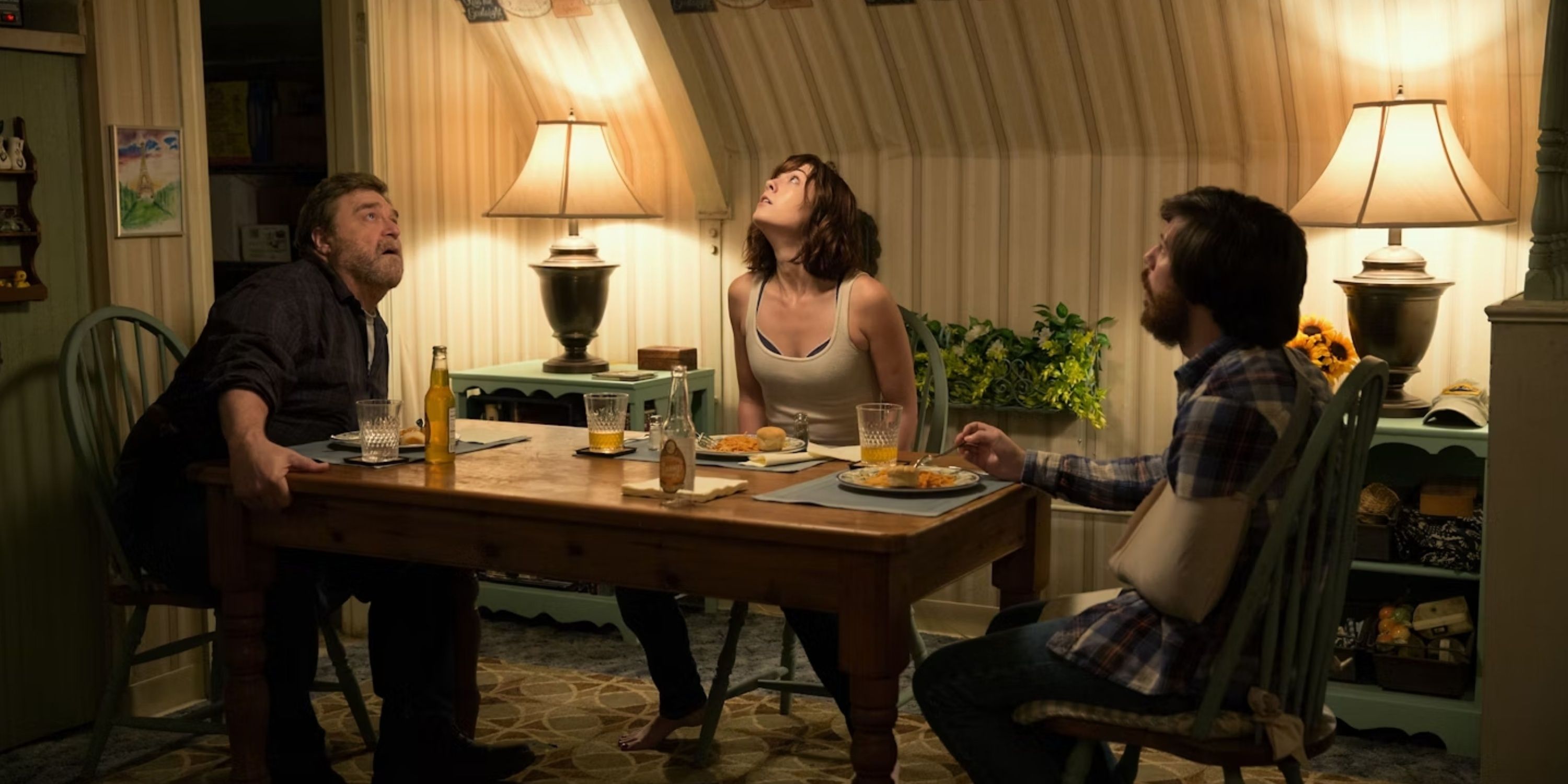
The movie 10 Cloverfield Lane constantly shifts between genres during its runtime of an hour and 45 minutes, making it a fascinating study in itself. It starts as a survival thriller, becomes a psychological exploration, briefly touches on horror, then returns to suspense, ultimately landing as a science fiction story. The ending was particularly shocking, and its bold twist has become a memorable moment in sci-fi, sharply dividing opinions among fans.
When 10 Cloverfield Lane surprised audiences in 2016 with its sudden trailer and release, no one anticipated the divisive reaction it would provoke. The film didn’t simply split viewers; it actively challenged them, fostering a sense of unease and making them share in the protagonist’s paranoia. Even now, years later, Dan Trachtenberg’s first feature film remains memorable not for its suspenseful core, but for the fifteen minutes following a key reveal.
10 Cloverfield Lane is A Thriller Built on Uncertainty
The ending of this film is often shocking for viewers, but it’s easy to miss how carefully the first two acts build up to it. What seems like a straightforward story at first quickly becomes a mind-bending experience, constantly challenging the audience and keeping them guessing.
Mary Elizabeth Winstead plays Michelle, who comes to after a bad car crash to find herself chained up in a concrete cell. Her captor, Howard Stambler (played by John Goodman), is a complex character – at times frightening, controlling, obsessed with conspiracies, and ultimately just a lonely man. Howard insists he rescued her, claiming a devastating attack has occurred – possibly even from Martians – and that the world outside is now unsafe.
The brilliance of this approach lies in its ability to disorient the viewer, removing any sense of a stable reality. This creates a strong connection between Michelle and the audience; we experience her anxieties, doubts, and thoughts as if they were our own, because we’re only privy to the information she receives. By placing us directly into her perspective, the film cleverly subverts typical thriller conventions, leaving both Michelle and the audience equally confused and unsettled.
Movie fans generally understand the setup: the person who imprisons someone is the villain, and the world outside is safe. However, 10 Cloverfield Lane twists this familiar formula. Howard is definitely erratic and obsessed with conspiracy theories, having prepared for every possible disaster—except losing control. But the film subtly hints that he might actually be telling the truth.
Viewers are confronted with the sight of dead pigs showing signs of illness just outside the airlock. A deep rumbling sound suggests the presence of vehicles far too large to be ordinary trucks. Trachtenberg deliberately puts the audience in the same state of uncertainty as the character Michelle, making them constantly question whether Howard is a socially awkward hero or a dangerous predator hiding behind the disaster.
The confusing atmosphere is heightened by the cramped and unsettling set design. The bunker itself is deceptive, further adding to the sense of mystery. While it includes a basement, it also strangely resembles a distorted version of a typical home – with a comfortable living room, a jukebox, and a fully equipped kitchen – but it feels oppressive due to the complete lack of sunlight and any sense of openness.
Jeff Cutter, the film’s cinematographer, uses everyday lighting – like cozy table lamps and stark fluorescent lights – to make the settings feel incredibly real. This realism actually heightens the feeling of being trapped. It’s important because it focuses the story on the characters themselves, rather than the science fiction elements. Before we even think about spaceships, we’re concerned with the strange rules Howard imposes and his unsettling way of treating Michelle.
The film builds a unique kind of suspense that’s uncommon in science fiction or post-apocalyptic movies. Typically, these films hint at an alien presence or some other mysterious force. But here, the audience is kept guessing, waiting for the explanation to emerge. The film cleverly uses our familiarity with the genre against us: if this were a movie like Saw, Howard would be untruthful. Conversely, if it isn’t, Howard is being honest.
The first ninety minutes of the film brilliantly interweaves two perspectives. Michelle embodies the audience’s disbelief and resistance, actively preparing to fight against her confinement. In contrast, Emmett, who readily sought shelter, represents the audience’s fear, choosing to accept their situation rather than face the terrifying unknown.
Howard presents himself as someone who always knows best, expecting thanks for a security that often feels like confinement. He craves control and wants others to accept his often outlandish beliefs. Though he’s usually unpleasant and even hateful, he’s skilled at appearing sympathetic the instant anyone starts to truly judge him, much like Michelle.
An Ending Torn Between Standalone Film and Franchise Identity
When Michelle escapes through the air duct, improvising a protective suit from a shower curtain and tape, the movie takes a dramatic turn. This is where the biggest debate starts, as the film moves from a simple genre shift to a complete clash of styles. For most of its length, 10 Cloverfield Lane is a tense psychological thriller focused on manipulation and abuse. However, in the final scenes, it transforms into a full-fledged action film.
Michelle expected to see a ruined world, but instead, she finds a strange, mechanical alien ship above her farmhouse. This launches her into a desperate fight for survival filled with homemade bombs, alien creatures, and huge blasts. Many viewers felt this change was jarring, and some critics believe it ruined the intense, confined atmosphere of the earlier scenes, replacing suspense with over-the-top action.
As a big fan of the series, it feels like they really shoehorned a sci-fi ending into what started as a much more grounded story. Apparently, the original script, called The Cellar, didn’t have any aliens at all! It was supposed to end with Michelle escaping Howard, taking him out, and heading to Chicago, only to find the city completely destroyed – proving Howard was right about some kind of attack, but with no actual monsters to battle. It was a really dark, hopeless ending, and honestly, it made a lot of sense given the situation. They were clearly forced to add the alien stuff to fit the franchise’s requirements, and it kind of feels tacked on.
Calling the movie’s ending a “branding mistake” overlooks the interesting tension it actually creates. How viewers react depends on their expectations going in. Those hoping for a straightforward sequel might have been let down by changes to the monster, but pleased that the film still delivered on its science fiction elements.
For viewers going in with no prior knowledge, the abrupt shift to an alien invasion completely changes how they understand everything that happened before. The disagreement comes from differing expectations: those hoping for a character-focused story felt let down by the special effects, while those expecting a big action movie thought the first part of the film was too slow before getting to the exciting parts.
This ending has a clever, hidden meaning. By adding a real, defeatable alien enemy, the movie shifts from simply showing destruction to testing what the main character is made of. The surprise isn’t just the aliens themselves—it’s that the story’s rules have changed, and the hero needs to react immediately.
The movie shifts from showing Michelle as a victim to portraying her as someone who fights back. If she had just driven off into the dangerous outside world, the film would have supported the idea that staying hidden in the bunker was the only way to survive. Instead, by giving her a monster to overcome, the movie shows that her decision to escape was the right one. It suggests that taking the risk of freedom is better than being safely trapped.
For me, what really sticks with this movie is how deliberately unsettling it is. The ending definitely throws you, but that’s kind of the whole idea. It feels like being suddenly dropped into a completely unpredictable situation, mirroring what Michelle goes through. Honestly, whether you connect with it probably depends on if you’re open to a film taking a big swing and being different right up to the very end.
More Than Anything, 10 Cloverfield Lane Is About Survival
Although the story could have concluded in several ways without causing debate, the ending of 10 Cloverfield Lane isn’t focused on the change in genre or impressive special effects. Instead, it’s a final test of Michelle’s character and resilience.
For the first ninety minutes of the film, the main character is established as someone who avoids problems by simply leaving them. Whenever things get difficult, she runs away – first from her fiancé, then from any kind of confrontation. While hiding in the bunker, she just tries to survive by following orders and making deals. But when she finally ventures out, she’s forced to make a crucial decision that reveals her true character.
Having defeated the alien scout, Michelle grabs a bottle of J&B Scotch – first seen at the beginning of the story – and gets in her car, turning on the radio. She picks up two different broadcasts: one tells survivors to head to Baton Rouge for safety, while the other calls for people with military or medical skills to travel to Houston and help fight. This decision is incredibly important, overshadowing everything else.
Baton Rouge embodies the earlier version of Michelle, someone who prioritizes escape and finding a safe haven. Houston, on the other hand, showcases a transformed Michelle – one who confronts danger head-on, takes control of her own life, and channels her past trauma into fighting back. Her decision to drive towards Houston ultimately brings the film’s intricate exploration of Howard Stambler to a satisfying conclusion.
In a strange way, Howard had been correct all along. Aliens, monsters, and a world after the apocalypse did exist. However, being right didn’t excuse his actions. Howard believed the only way to survive was through control and ownership, wanting to isolate and possess Michelle, keeping her safe but completely trapped, like an animal in a cage.
Michelle’s brave choice demonstrates that truly living isn’t just about physical survival – it’s about freedom. By willingly facing danger instead of seeking safety, she confirms her deep need to break free. She shows us that even the risks of the unknown are better than being trapped, even if that trap feels safe.
No matter how you feel about the ending – whether it’s brilliant or a misstep by the studio – it’s clear that 10 Cloverfield Lane made the audience decide for themselves, just like the main character, Michelle. In a genre that usually delivers predictable or neatly wrapped-up conclusions, a film that asks viewers to choose a side is unusual and memorable. So, the ambiguous ending isn’t a weakness; it’s what makes the movie stick with you.
Read More
- Clash Royale Best Boss Bandit Champion decks
- Vampire’s Fall 2 redeem codes and how to use them (June 2025)
- Mobile Legends January 2026 Leaks: Upcoming new skins, heroes, events and more
- World Eternal Online promo codes and how to use them (September 2025)
- Clash Royale Season 79 “Fire and Ice” January 2026 Update and Balance Changes
- Best Arena 9 Decks in Clast Royale
- M7 Pass Event Guide: All you need to know
- Clash Royale Furnace Evolution best decks guide
- Best Hero Card Decks in Clash Royale
- How to find the Roaming Oak Tree in Heartopia
2025-12-20 02:42