
“What if I died right here in front of you?” Davey Havok says, his eyes shining with a playful, innocent happiness. “Wouldn’t that be good? It would make the writing even stronger. Let me experiment and see what happens. I’ll give it a try.”
A conversation about the potential sudden death of the AFI singer has caught the attention of people at Sightglass Coffee in Hollywood, where they were sitting at a small table. Even though the 49-year-old songwriter joked that his passing would make this article better, the real reason for the talk was something he’s eager to experience: the release of AFI’s 12th studio album, “Silver Bleeds the Black Sun,” which comes out Friday on Run for Cover Records.
After 35 years with AFI, and with other musical ventures like the electronic project Blaqk Audio and the pop-oriented Dreamcar, Havok feels he’s created an album he’d be proud to represent his life’s work – which explains the focus on themes of mortality. However, Havok (born David Passaro) also feels a little uneasy about how strongly he connects with “Silver Bleeds the Black Sun”. The last time he felt this passionate about an album was with 2009’s “Crash Love”, which followed the success of two albums that would later go platinum: 2003’s breakthrough “Sing the Sorrow” and 2006’s chart-topping “Decemberunderground”.
Havok explains that with each album they’ve released since [1997’s] ‘Shut Your Mouth and Open Your Eyes,’ they’ve seen a shift in their fanbase – losing some and gaining others. However, with ‘Crash Love,’ the loss was significant – around 900,000 fans. He notes, while wearing a sleeveless black shirt, that these fans were likely drawn in during the band’s time on MTV and on magazine covers, and their reasons for being fans were different. He describes the experience as “really brutal.” ‘Crash Love’ was a particularly enjoyable album to create, unlike ‘Decemberunderground.’ He felt strongly about ‘Crash Love,’ comparing it to his feelings about ‘Silver Bleeds the Black Sun,’ believing it truly represented the band. While they didn’t expect to sell a million copies given changing music consumption habits, he hoped for a gold record. Unfortunately, the album largely went unnoticed – people didn’t even realize it had been released. They were on tour and fans wearing band merchandise were asking why they were touring. He admits it was disappointing, especially since he loves the record, but it did prepare him for the potential reception of their current work. He says he loves this new record more than any other they’ve made, but acknowledges there’s a strong possibility it will be overlooked, just like ‘Crash Love.’
I’ve been following AFI for years, and it’s interesting to hear drummer Adam Carson talk about how people already have their opinions formed. He was saying in a Zoom interview that a lot of those opinions were made way back with ‘Sing the Sorrow’ in 2003, or even earlier in ’97 at a hardcore show! But what’s really cool is he’s noticing a lot of people who weren’t really paying attention before are discovering their new songs and being surprised. He really hopes that with ‘Silver Bleeds the Black Sun’, people will rethink what AFI has been doing for the past few presidential terms, and maybe even elevate their perception of the band. It’s exciting to think they might be winning over some new fans and changing some old minds!
Even from the start, with AFI’s 1995 debut as a teenage hardcore band (“Answer That and Stay Fashionable”), the band has never made two albums that sound alike. They consistently change direction every few releases, exploring new and unexpected sounds. With “Silver Bleeds the Black Sun,” that change is a collection of songs strongly inspired by their favorite post-punk bands – so much so that Bauhaus’ “Bela Lugosi’s Dead” would feel right at home on the album.
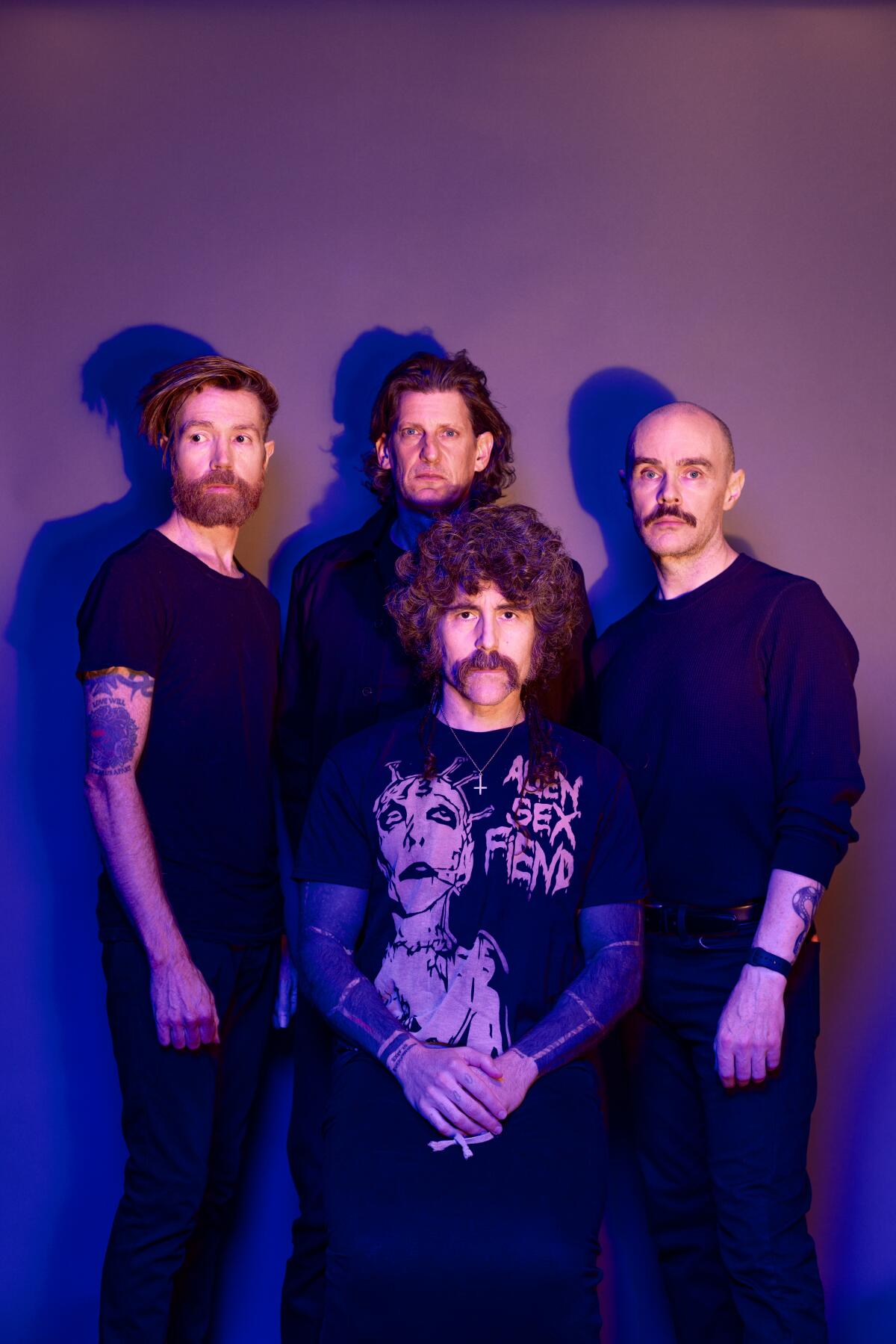
The band understands that their newest sound might not appeal to all AFI fans, but it *is* attracting a new audience. They’ve intentionally moved in a surprising direction – something all four members enjoy – and feel they’ve earned the right to take this somewhat calculated risk after so many years. It’s a necessary step to reignite their creativity while remaining true to who they are as artists.
As a longtime fan, I’ve always admired how AFI, no matter the genre they tackle, manages to keep that signature sound and vibe we all know and love. Davey Havok, Adam Carson, guitarist Jade Puget, and bassist Hunter Burgan – who joined in the late ’90s – have been experimenting with different sounds and ideas for almost three decades. Each album feels unique and has its own style, but it *always* fits comfortably within their overall work. This dive into post-punk feels like a natural progression – no bigger a leap, really, than when Havok and Puget slowed things down with “God Called in Sick Today” on 1999’s “Black Sails in the Sunset.” And honestly, I think all these years of making music together is what makes these kinds of transitions so seamless.

When you look at bands that have been together for a long time, you often see them as these frustrated, resentful older musicians who are constantly arguing and can’t stand each other,” Puget explains over Zoom. “They typically keep to themselves in separate dressing rooms and travel on different buses, and they’re really just doing it for the money. We’ve been very fortunate to maintain a good relationship with each other and be genuine friends. Davey and I, as the team who write the songs, have never disagreed. In nearly 30 years, we haven’t even had a single argument because we work so well together. It’s common for bands to start with everyone seeing eye-to-eye, but then people grow in different ways and start to clash. We haven’t experienced that at all, so we feel incredibly lucky in that regard.”
Havok explains that the band members have such a strong connection that they instinctively know each other’s positions on stage without needing to look. He adds that they can sense when something feels off or if there’s potential danger. This deep understanding also influences their creative process; Havok notes that he and Jade often collaborate seamlessly. Regarding ‘Silver Bleeds the Black Sun,’ he recalls instances where Jade had already composed entire pieces of music before he even arrived.
After his favorite coffee shop closed for the night, the conversation with Havok continued on a bench nearby. The chatty singer talked about a lot of things, including his fondness for Lana Del Rey, the Ramones (he even sings in a local cover band called Ramones X!), Coachella fashion, how he takes care of his voice while touring, and his frustrations with technology. He feels that new fans often discover artists only through their most-streamed songs, which doesn’t give a true sense of a band like AFI.
 ×
× It’s hard to pinpoint one song (or even an album) that truly captures the essence of AFI’s sound. Their music has evolved significantly, moving from aggressive hardcore to mainstream pop-rock and now exploring post-punk. They’ve gone through numerous musical phases – perhaps even more than Taylor Swift – yet have maintained a consistent core identity. The band members themselves credit their sobriety, diverse personalities, and unwavering dedication to making music as the key factors that have kept them grounded throughout the years. And it’s this internal stability, combined with a loyal and receptive fanbase, that gives them the freedom to experiment and venture into new sonic territories with each new release.
As a long-time fan, what I’ve always loved about AFI is how many different sounds they blend together, and it’s so cool how those influences always shine through in their music. Carson explained that with their previous albums, the songwriting was really a mix of everything they were into, which resulted in a diverse collection of songs. But somehow, when it all came together, it still *sounded* like AFI – they had a way of making it cohesive. This time, though, it was different. They really focused on a smaller set of influences. Instead of throwing *everything* at the album, they wanted to create a collection of songs that truly felt connected and stayed true to those specific sounds. It’s like they intentionally narrowed their focus to make something really unified and special. It’s a really interesting approach, and I can’t wait to hear how it all comes across!
We’ve made so many records responding to different circumstances and ideas, and we felt it was time to create something truly for ourselves,” Burgan explained to me over Zoom from a coffee shop patio. “The sound we’ve developed over the years is a result of four people bringing completely different tastes together – there’s always been that creative tension. Even when we were starting out playing punk, I was always trying to sneak some jazz influences in there. This new record, ‘[Silver Bleeds the Black Sun],’ really reflects the music *I* love, so it felt less like I was battling the creative process and more like everything just naturally aligned.”

As a long-time fan, we were all buzzing about the upcoming release of “Silver Bleeds the Black Sun,” but honestly, I was still surprised by the reaction to Havok’s new look. After his interview with “Alternative Press” in August, pictures of him – sporting a thick mustache with a cool mix of mid-length curls and long braids – just *exploded* online. It’s not like he’s a stranger to attention; with his modeling work, magazine covers, and even being named “World’s Sexiest Vegetarian” back in 2007, he’s used to his style choices getting noticed. But even he was shocked by the flood of memes his friends started sending him! It just went totally viral in a way most of us middle-aged guys don’t experience, and it was hilarious to see.
I don’t actively participate [in social media], but friends would send me memes they found,” Havok explains, chuckling. “One friend showed me a meme where a metal band was using pictures of my exaggerated facial expressions-because I apparently look a bit crazy-to promote a T-shirt. Then, a couple of days later, someone pointed out that my image was on a promotional flier for a show that AFI wasn’t involved with at all. I was really surprised and taken aback by how widespread it was becoming. It’s quite strange.”
We’ve been around for a while now, and Havok’s appearance has changed quite a bit over the years. So, it’s actually really interesting to me that people still discuss our singer’s facial hair – whether they like it or dislike it,” Puget says with a smile, stroking his own beard. “I think that’s a positive thing, really. If nobody cared about us, it wouldn’t be a topic of conversation. The fact that something so simple can cause such strong reactions makes me wonder how people will react to our new album.”
Read More
- Clash Royale Best Boss Bandit Champion decks
- Vampire’s Fall 2 redeem codes and how to use them (June 2025)
- Mobile Legends January 2026 Leaks: Upcoming new skins, heroes, events and more
- World Eternal Online promo codes and how to use them (September 2025)
- Clash Royale Season 79 “Fire and Ice” January 2026 Update and Balance Changes
- Best Arena 9 Decks in Clast Royale
- M7 Pass Event Guide: All you need to know
- Clash Royale Furnace Evolution best decks guide
- Best Hero Card Decks in Clash Royale
- Clash of Clans January 2026: List of Weekly Events, Challenges, and Rewards
2025-10-03 22:35