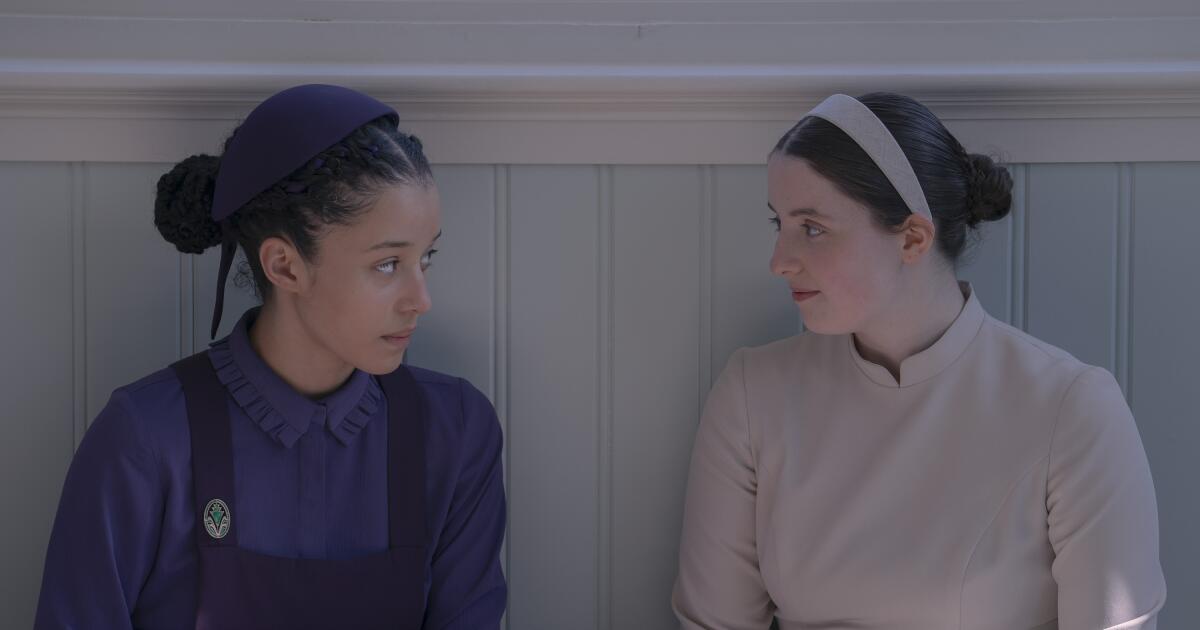
When Hulu released its adaptation of Margaret Atwood’s “The Handmaid’s Tale” shortly after Donald Trump became president, many viewers felt it eerily predicted the future. The show’s iconic red robes and white head coverings quickly became a symbol of resistance, particularly because the new president, while not overtly religious, supported policies favored by conservative Christians – especially those that limited women’s reproductive and civil rights.
Originally, this story didn’t involve Donald Trump – the book was written in 1985 and the show was approved for production before he became president. This just highlights how disturbingly relevant Atwood’s ideas still are. So it’s not shocking that the new series, “The Testaments,” also connects to current events. While presented as a young adult drama – think “Pretty Little Liars” or “Gossip Girl” – “The Testaments” explores themes reminiscent of the Epstein case.
Based on Margaret Atwood’s award-winning novel, “The Testaments” is set after the events of “The Handmaid’s Tale.” The story centers on Ardua Hall, where Aunt Lydia, once again in a position of power, trains young women to become dutiful wives and mothers in the Republic of Gilead.
The story begins with Agnes, who tells us what life is like for her. While she senses things are about to change, she’s mostly focused on everyday problems – like dealing with her unkind stepmother and waiting for her first period. Agnes and her friends, Becka, Shunammite, and Hulda, have all moved into the next stage of growing up, symbolized by becoming “Plums” instead of “Pinks.” However, only Becka has started menstruating, which means she’s now eligible to be chosen as a wife by a Commander or another unmarried man.

Television
Ann Dowd’s compelling performance as the original villain in ‘The Handmaid’s Tale’ has evolved her character into a symbol of change and a connection to a new series.
As a film lover, one scene really struck me as disturbing. It takes place at a seasonal dance where young women are essentially ‘chosen’ by eligible bachelors. But it’s not a fair process – the older, more influential men get first pick. Seeing them casually joke around while deciding who they want… it unfortunately brought to mind the horrific stories surrounding Jeffrey Epstein and how he treated young women, though obviously in a different context – this isn’t about marriage, it’s about control and power dynamics.
While hinted at in “The Handmaid’s Tale,” the disturbing link between social status and the organized exploitation of women is the true, driving force behind the events in “The Testaments.” Though a worldwide infertility problem helped Gilead come to power, the regime’s power isn’t really about having babies. Agnes and the Plums are simply victims of extreme sexual abuse and manipulation.
Becka is the only one who isn’t excited about the idea of getting married. Everyone else, including Agnes, is eager to wed and hopes to become pregnant soon—though they lack any real understanding of intimacy, whether through choice or state control.
Growing up, I had everything – a comfortable life where I never wanted for anything. But Agnes? Her world was… different. She was sheltered, really. Like a lot of women in Gilead, she wasn’t taught to read or write. It’s hard to explain, but they just… accepted the brutality around them. Public executions, beatings – they saw it all as what happened when you broke the rules, and there were so many rules. It was twisted, but they’d been taught to believe their own bodies were somehow evil, that they tempted men, and it was their job to stop that temptation. It’s a really disturbing concept, and it just felt so ingrained in their lives.
Despite the watchful eyes of Aunt Vidala (Mabel Li), who is strict, and the gentler Aunt Estee (Eva Foote), the girls remain playful and mischievous. They joke with each other, compare looks, and secretly make fun of their aunts, all while hoping for a joyful future.
That’s actually more disturbing and impactful than the frightening scenarios in “The Handmaid’s Tale.” While slavery always involves force, force often leads to resistance. The most effective way to control people is to convince them that their lack of freedom, rights, and options is either unavoidable or acceptable – that’s the only way a truly oppressive society can last.
Let’s be honest, watching “The Testaments” isn’t as viscerally thrilling as seeing the horrors faced by the women in “The Handmaid’s Tale” – though it does have some truly unsettling flashbacks. What really stuck with me, though, was the disturbing idea of young women, so relatable to today’s teens, willingly accepting their own oppression. It starts with a lack of awareness, but quickly spirals into a terrifying realization of what freedom – and the truth – could cost them. It’s a powerful, and frankly chilling, social commentary.
The fate of Gilead, and the events in “The Testaments,” depend on whether the people of Plum remain unaware and obedient. Agnes, though initially different from Becka in her views on marriage, quickly faces new challenges. She finds herself attracted to one of the Eyes—the secret police who watch over her—and is asked to train one of the new “Pearl Girls.” These young women, dressed in white, are missionaries sent to Canada to encourage girls to support Gilead. One of these recruits, Daisy (played by Lucy Halliday), is placed under Agnes’ guidance by Aunt Lydia.
Agnes’ friend Shunammite is quick to judge, and believes Daisy is a spy. Daisy, who had a fleeting connection to the character June from another show in the very first episode, consistently disrupts the status quo, mainly by responding to Gilead’s cruel public acts with normal, human reactions – the way someone not accustomed to such horrors would.

Television
As a huge fan of ‘The Handmaid’s Tale,’ I was really fascinated to hear Eric Tuchman and Yahlin Chang, the showrunners, discuss how they approached the finale. They talked a lot about how the show’s dark, fictional world unfortunately reflects things happening in the real world, which is something I’ve always noticed while watching it.
Throughout the season, Agnes and Daisy develop a close relationship that challenges Agnes’s beliefs and her friendships. “The Testaments” is a significantly longer and more intricate novel than “The Handmaid’s Tale.” Both books are presented as historical documents from a defunct government, but adapting “The Testaments” offered Bruce Miller more source material than he had with the shorter, more ambiguous story of “The Handmaid’s Tale.”
He approaches this task with care, though sometimes at a deliberate pace. The first season largely focuses on introducing the characters, particularly Agnes, whose life before Gilead is clear to those familiar with “The Handmaid’s Tale.” Following her acclaimed performance in “One Battle After Another,” Infiniti skillfully portrays a young woman who is so used to suppressing her emotions that she struggles to distinguish between her outward composure and her true feelings.
Though her friends share similar disabilities, the extent varies. As they develop their individual personalities – Conforti, Blanchard, and Ardies – they each create distinct characters, playing roles within roles, all while remaining relatable and genuinely human.
Halliday’s portrayal of Daisy is particularly striking, but all the characters—including the Aunts—feel constrained by the roles they’re forced to play. Despite being subjected to indoctrination and limited knowledge, their intelligence consistently emerges, showing both how they cope with and are unsettled by the beginnings of doubt.
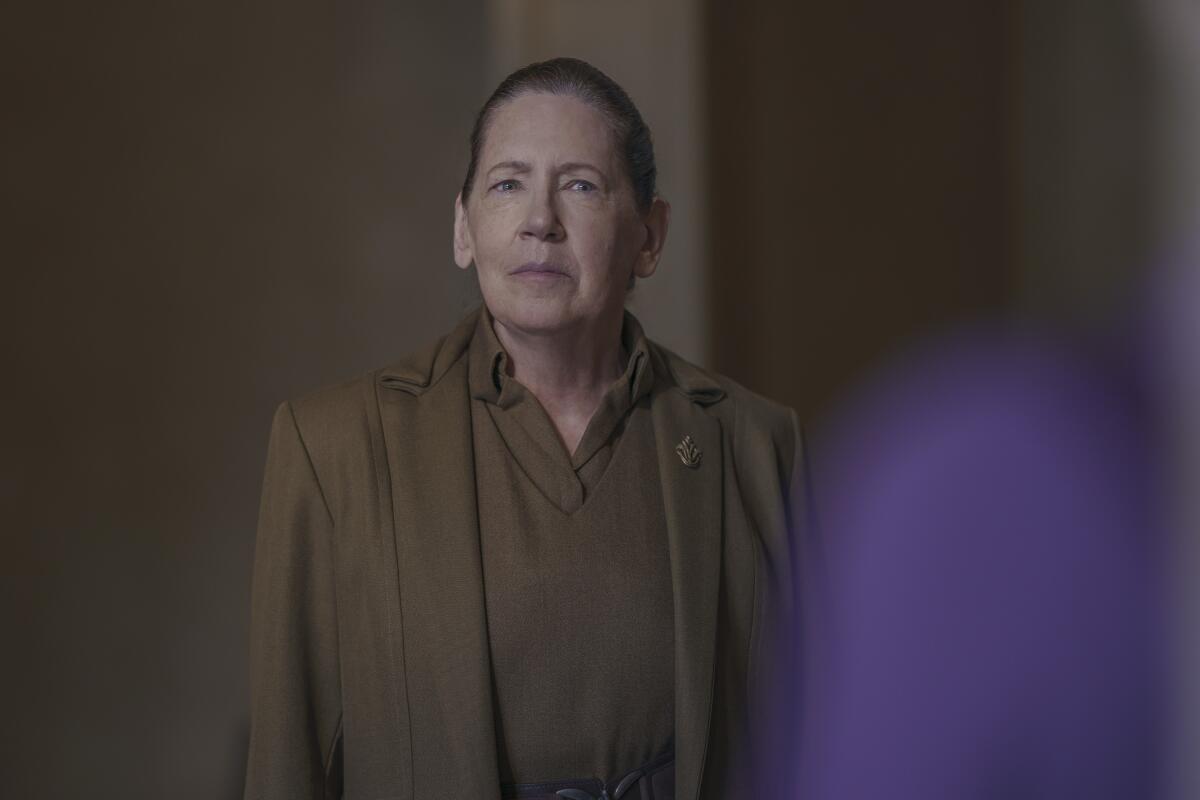
Ann Dowd’s performance is exceptional. She brilliantly captures the weight of her character’s past, both from “The Handmaid’s Tale” and before, creating an Aunt Lydia who embodies both the outward appearance and the hidden truths of Dorian Gray and his portrait. While it’s not explicitly shown, Aunt Lydia’s decision to place Daisy with Agnes is clearly a calculated move with a specific purpose.
Both “The Handmaid’s Tale” and “The Testaments” are presented as historical records recovered after the collapse of Gilead’s government. It’s already known that Gilead will eventually fall, and the question is whether the events in “The Testaments” will be the start of that downfall, or happen during it.
But we all know what happened to Epstein in the end.
Read More
- Gold Rate Forecast
- Limbus Company 2026 Roadmap Revealed
- After THAT A Woman of Substance cliffhanger, here’s what will happen in a second season
- Last Furry: Survival redeem codes and how to use them (April 2026)
- GearPaw Defenders redeem codes and how to use them (April 2026)
- Genshin Impact Version 6.5 Leaks: List of Upcoming banners, Maps, Endgame updates and more
- Wuthering Waves Hiyuki Build Guide: Why should you pull, pre-farm, best build, and more
- XO, Kitty season 3 soundtrack: The songs you may recognise from the Netflix show
- Guild of Monster Girls redeem codes and how to use them (April 2026)
- The Division Resurgence Best Weapon Guide: Tier List, Gear Breakdown, and Farming Guide
2026-04-08 10:32