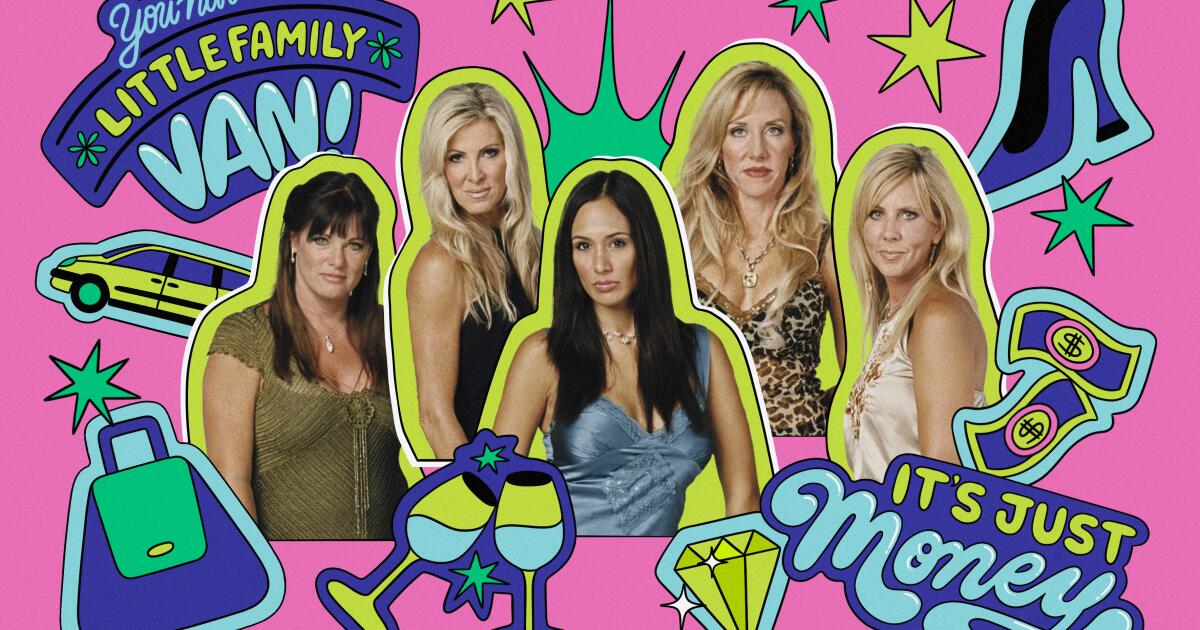
About 13.8 billion years ago, the universe started from an incredibly hot, dense point and rapidly expanded – an event called the Big Bang. Similarly, twenty years ago, a different kind of explosive event happened in Orange County, California. Five women in the affluent community of Coto de Caza created a whirlwind of ambition and drama that eventually grew into the entire “Real Housewives” reality TV franchise.
“The Real Housewives of Orange County” first aired on Bravo on March 21, 2006, introducing viewers to Jeana Keough, Vicki Gunvalson, Lauri Peterson, Kimberly Bryant, and Jo De La Rosa. Though the initial season was only eight episodes long, the show quickly grew into a major franchise, expanding to 12 other cities across the United States, with the newest version debuting next month. It has also spawned over 30 international versions in 20 countries and a dozen spin-off shows (some more successful than others). The series set a new standard for reality TV by offering a candid look at the lives and viewpoints of wealthy women, a format that other networks, like Hulu with “The Secret Lives of Mormon Wives,” have tried to copy.
To celebrate the 20th anniversary of the original “Orange County” series, The Times interviewed the show’s original cast and the people who helped create it, to tell the story of how Bravo’s popular franchise began.

‘A not great version of “Curb Your Enthusiasm”’
Scott Dunlop balanced a sales job with performing improv at the Groundlings while living in Los Angeles. He also worked on various film projects, including the low-budget feature “Tag: The Assassination Game,” which starred Linda Hamilton and Robert Carradine. After getting married in the late 1980s, he moved to Coto de Caza, an exclusive, upscale community in the foothills of the Santa Ana Mountains, and quickly became intrigued by the people who lived there.

I met Jeana, who used to be Playboy’s Playmate of the Year, when I first arrived in Coto. It was a really hot day, and I was moving in. She walked up and immediately asked what I was doing and who I was – it felt like a full interrogation, but in a funny way. I quickly got to know Jeana, her late husband Matt (a former baseball player), and their three children very well.
Once Dunlop became comfortable in his surroundings, he began developing an idea for a television show. He noticed distinct character types – what he called the “tennis wives,” wealthy men with free time, and young adults moving back home. He originally envisioned a short film, but as reality television became popular in the early 2000s, he considered that format instead.
I was observing the scene in Coto, noticing how the women stayed while the men left what we jokingly called ‘the ranch.’ My initial idea was to create a satirical look at life in wealthy suburbs, but one that also felt grounded in real experiences.
Whenever Scott visited, he’d always ask about the person in the living room. I’d explain it was David Goodman, a director from New York, who was escaping the cold and working on a new screenplay. My house was always full of interesting people – it felt like a neighborhood hangout, similar to the show ‘Cheers’. Scott then proposed a reality show about my family, inspired by ‘The Osbournes’ and ‘Curb Your Enthusiasm’. He filmed a short preview with us, and also with another up-and-coming actor, Ryan Eggold, who went on to star in several TV series.
Ryan and I knew each other from when he was studying acting at USC – he lived nearby with his parents. He asked if he could be on my show, and I came up with a quick idea for him. I said, ‘For a short preview, let’s make you the son of doctors – a ‘boomerang kid’ who’s moved back home.’ We planned to film a scene of him just being himself – hanging out in a robe, having a beer, and relaxing outside.
Scott, a neighbor, overheard me joking about my breast implants at the gym. He then asked a friend of mine if he thought I’d be open to being on TV. I wasn’t particularly interested – I’m a stay-at-home mom and my life is already full. Ultimately, the whole family agreed it would be okay to do it. I figured with so many channels available, it wasn’t a huge risk if nobody even watched.

John Dunlop developed a one-page outline for a show called “Behind the Gates” and, by 2004, was creating a preview reel to pitch to television networks. Around this time, Bravo was establishing itself as a leader in reality TV after previously being a smaller cable channel known for sophisticated programming like art films, opera, and ballet. The network had already found success with shows like “Queer Eye for the Straight Guy,” “Project Runway,” “Battle of the Network Reality Stars,” and “Kathy Griffin: My Life on the D-List.”
Frances Berwick, who was Bravo’s head of programming and production at the time, described a pitch someone made to her. The idea was to film the lives of people in a specific community – neighbors who all socialized at the country club. The person pitching highlighted interesting dynamics, like attractive young men working at the pool and a teenage boy who was interested in another woman, a friend’s mother. They really conveyed what that community was all about.
I remember when Amy Introcaso-Davis brought a VHS tape to my desk – I was Vice President of Original Programming at Bravo at the time – and said we should take a look. I wish I’d kept it! It was a really strange tape, with some narration, but what really grabbed me was that all the people in it lived in a gated community. It just felt so dramatic and perfect for a soap opera.
The show almost didn’t get made. When we started seeing early edits, we realized the producers were shifting its direction. Our original idea was to create a realistic, observational look at people’s lives, but they were trying to force jokes into it. This was a problem because the cast wasn’t skilled at improvisation, and it was starting to feel like a poor imitation of “Curb Your Enthusiasm.”

‘We were interested in the women’
Bravo gave Dunlop some notes.
Cohen: We were interested in the women. We were not interested in the husbands.
Shari Levine, who was an executive at Bravo at the time, recalls that openly discussing breast enhancement surgery was unusual back then. Kimberly’s candidness about the procedure stood out to Shari, leading her to believe the show’s cast would be willing to discuss normally private topics on camera, which she found very interesting.
Dunlop put out local newspaper ads to look for more subjects.
Tamra said her son Michael, who was a teenager at the time, had received a letter from Scott. Michael went to school and didn’t hear anything back, but mentioned a possible phone call. Tamra was busy and didn’t understand what he was talking about. Soon after, Scott called and asked if he could come over. He suggested they film a reality show in Coto, comparing Tamra to the characters in “Desperate Housewives.” Tamra immediately said she wasn’t interested and shut the door on him. She told him she was working and didn’t want to be bothered, but he knocked again. And that’s how it all started.
I have two children from a previous relationship. My then-husband, Don, expressed his reluctance, but I insisted on moving forward. We’re just a regular family from Chicago. At the time, our daughter Brianna was involved in cheerleading, and our son Michael had just started college. Don was still working at Home Depot – he hadn’t retired yet. I was running my insurance business from home, and Lauri was working with me.
1

2

Vicki Gunvalson first became involved with the show when her son, Michael, spotted a newspaper advertisement. Lauri Peterson, who was then known as Lauri Waring and worked at Vicki’s insurance company, was a single mother of three at the time she joined the cast. (Chris McPherson/Bravo)
I was going through a really tough time – I’d recently gotten divorced and was trying to raise my three kids and support them financially, all by myself. I’d spent most of my adult life in a marriage, and this was actually my second marriage that hadn’t worked out. I hadn’t really lived independently before, and I felt like I needed something new and stimulating. It was a positive change for me then.
When the chance to be on the show came up, I was finishing my English and comparative literature degree at UC Irvine. I was planning to go to Harvard Law, maybe even specialize in entertainment law. Then my boyfriend, Slade, came home from a charity event and told me they were looking for another couple to be on the show. They were interested in our age difference – he was fifteen years older than me – and the fact that I came from a modest background while living in a wealthy area. He was excited about doing it, so I agreed to give it a try.

‘It was going to be $400,000 to kill it’
Shooting began in 2005, but the initial footage did not thrill executives.
I’ll always remember that meeting. I can even picture exactly where I was sitting. Shari and I were actually hoping they’d decide to cancel the show. Looking back, it turned out to be the most important meeting of my life, because it would have only cost about $400,000 to do so.
So, after the initial cut, Shari Levine really took charge and completely re-edited the film. Honestly, it was a pretty big expense for us at the time – a lot of extra money we hadn’t planned for. We actually had a serious discussion about whether it was worth the cost, or if we should just scrap the whole thing and cut our losses. Thankfully, we decided to stick with it, and, well, look how it turned out!
The first season was a real challenge. We didn’t have any existing examples to follow, and we had a lot of footage of these women’s lives. Figuring out how to combine it all into a cohesive story wasn’t easy, and the initial cuts weren’t working. Because of my background in news magazines and documentaries, I’m used to shaping stories with editors, so I naturally wanted to get involved in the editing process. I went to L.A. and spent several days reviewing the footage, discussing what we had, and rethinking our approach. It took time, but we eventually developed a new plan that worked.

‘We didn’t even have a pool, so why was I sitting in a bikini?’
The show needed a memorable name, and Bravo didn’t think “Behind the Gates” quite captured the right feel. Because the show was inspired by the popular series “Desperate Housewives” and set in the same world as the teen drama “The O.C.,” they ultimately decided on the title “The Real Housewives of Orange County.”
The episode begins with quick cuts showing off luxurious homes, tennis courts, fancy cars, and expensive jewelry. A voice-over immediately establishes the setting, highlighting the exclusive lifestyle within the gated community: “Life is different here”; “The land is worth $1 million an acre”; “You don’t realize what you’re missing until you’re inside.” The episode, titled “Meet the Women,” then introduces the main characters and their worlds.
I don’t live a lavish lifestyle. I don’t have staff like butlers, and I definitely don’t have a private jet. I’m just a girl from the Midwest who moved to California. I only have a gardener come once a week, and I handle everyday tasks like laundry myself. I’m very hands-on with my kids, and I think viewers can connect with the challenges of being a working mother. I value being financially independent and making my own choices.
De La Rosa explained that without a clear idea of what the project would be, she felt unsure of how to present herself and ended up being overly dramatic. She specifically questioned a suggestion involving a bikini and a dog, pointing out they didn’t even have a pool, making the idea seem illogical.
I was really drawn into Jeana Keough’s storyline in the first episode, especially through her son Shane. He’s dealing with all the typical senior year stress – he actually skipped his graduation because Jeana was at a charity event – and the added pressure of trying to follow in his dad’s footsteps with the baseball draft. It was a lot to watch, seeing him navigate all of that!
I didn’t attend my graduation because I’d had a disagreement with my baseball coach at Tesoro High School, so I transferred my son, Shane, to a different school. He didn’t know many people there and was feeling lonely, so he preferred to just have friends over at our house instead of going to school events. That wasn’t an embarrassing moment for me, though. What was embarrassing – and Vicki and I used to laugh about it – was the fashion choices. We honestly had no idea how bad some of our outfits looked! I was starting menopause around the first or second season of the show, and I gained weight. I didn’t feel my best, especially compared to the other women who were all so fit and worked out constantly.
Right from the start, Vicki Gunvalson is shown working hard in her home office, taking calls. This dedication to work would become a defining characteristic of her personality on the show.
In the early days of filming, everything was much simpler. There weren’t fancy lights or editing tricks. It was just a small camera crew – usually two or three people – and they were constantly underfoot. It was mostly frustrating because I didn’t understand what they needed from me. I just wanted to be myself while getting things done – cooking dinner, taking work calls, and running my business.
For Peterson, a mother of three, a particularly impactful moment was revisiting her former home – a much grander place she’d lived in before her divorce.
I hadn’t revisited that neighborhood since moving away, but it used to be a wonderful place to live. It felt very safe and protected. Seeing the house again was difficult; it had changed a lot, and it made me feel sad. I remembered painting it bright white with black trim and filling the yard with hydrangeas. There was even a portable toilet on the lawn, likely because they were doing renovations, which somehow felt like a reflection of my own feelings at the time.


In the premiere episode of “The Real Housewives of Orange County,” Kimberly Bryant and Jo De La Rosa are shown talking about the challenges of being a cast member on the show. (Photo: Jamie Trueblood/Bravo)
The first interaction we see between two of the Housewives happens at a restaurant, where De La Rosa shyly approaches Bryant, who is with her friends. De La Rosa, who is still enjoying her youth while her partner wants her to settle down, is hoping to get some advice.
I always looked up to Kimberly as a mentor, like Yoda. She perfectly embodied the traditional housewife – everything from her appearance to how she managed her home and family. Growing up, I immigrated to America from Peru at a young age, and I never saw a stay-at-home mom living such a comfortable life. I had this idea that being a housewife meant shopping and having tea, so I was focused on things like fluffing pillows and making the bed. Kimberly noticed and offered to teach me what being a true housewife really meant. She really showed me the ropes and became my guide.
I recall feeling a bit awkward about how she initially approached our group, but once she joined us, conversation flowed easily. Those women were friends I had invited, and Jo was just stunning and so young. I immediately thought about how strange it was for her to be in the suburbs – when I was her age, I was living in New York City. I couldn’t picture being stuck in the suburbs, unsure about even wanting children with someone… well, someone like me. So I decided to go along with it, because we were supposed to be welcoming her. But honestly, I kept thinking she should be out experiencing life, these were important years for her.
The episode ends with De La Rosa, following Bryant’s suggestion, performing a lap dance for Smiley while playfully using a bright pink feather boa.
I try to explain it away by saying I had too much wine – it lowered my inhibitions. Looking back, I’m embarrassed by how I acted in those episodes. I think I felt pressure to be interesting, and that’s the best excuse I can offer. Also, I was young and figuring out my sexuality and identity, and all of that was happening publicly on camera.
I received around $1,200 to $1,500 for the whole season, which wasn’t much money. And since I hadn’t earned anything similar before, it was hard to gauge whether it was a good amount or not.
‘They were the uniform of these women’
As the show gained popularity, a distinctive fashion item—the Sky top—became well-known. It was as bold and dramatic as the show’s glamorous female characters.
I was fascinated by the Sky tops these women wore. It was incredible – they seemed to all have them! I think a single designer made them for all of them, and they had so many. These blouses really showed off their implants, drawing attention to the middle with a decorative jewel. They might not have been trendy everywhere else, but they were definitely the style at that place.
They were a lot of fun to wear! We even wore them on the “Today” show, and Al Roker was really curious about them. They’re these large chest plates meant to represent strength and power – we thought of them as shields for strong, working women.
Read More
- Invincible Season 4 Episode 4 Release Date, Time, Where to Watch
- Physics Proved by AI: A New Era for Automated Reasoning
- American Idol vet Caleb Flynn in solitary confinement after being charged for allegedly murdering wife
- Gold Rate Forecast
- “Wild, brilliant, emotional”: 10 best dynasty drama series to watch on BBC, ITV, Netflix and more
- Seeing in the Dark: Event Cameras Guide Robots Through Low-Light Spaces
- Magicmon: World redeem codes and how to use them (March 2026)
- Total Football free codes and how to redeem them (March 2026)
- eFootball 2026 is bringing the v5.3.1 update: What to expect and what’s coming
- Simulating Humans to Build Better Robots
2026-03-24 13:35