Author: Denis Avetisyan
New research reveals that unlocking creative potential with artificial intelligence requires more than just assembling a team of agents – it demands human guidance and critical judgment.
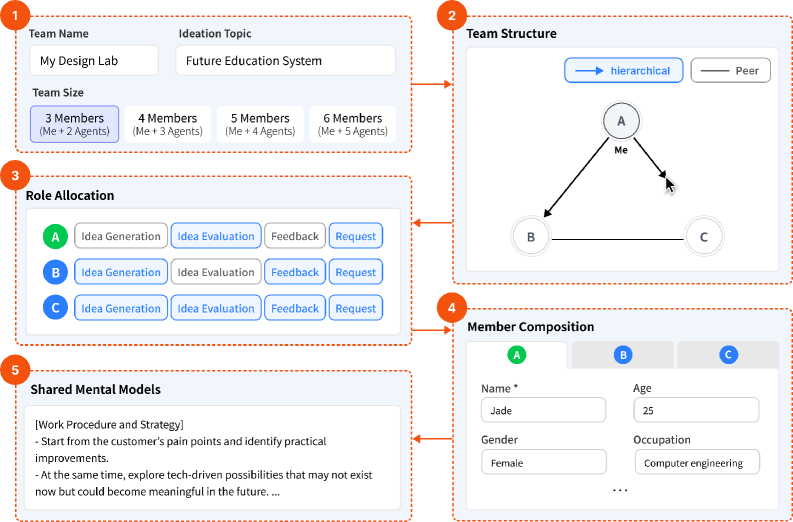
Effective Human-Multi-Agent Teams rely on human orchestration to direct AI contributions and ensure valuable outcomes in creative tasks.
While contemporary creative workflows increasingly leverage artificial intelligence, realizing the full potential of human-AI collaboration requires careful consideration of team dynamics. This research, ‘Understanding Human-Multi-Agent Team Formation for Creative Work’, explores the formation and operation of Human-Multi-Agent Teams (HMATs) for creative ideation. Findings from a study with design practitioners reveal that effective HMATs are not characterized by autonomous agent interaction, but instead rely on direct human orchestration to guide the process and make critical value judgements. How can we best design interfaces and workflows to empower humans to effectively lead and leverage the unique capabilities of multi-agent AI systems?
The Fragility of Conventional Collaboration
Conventional team structures, frequently built on hierarchical models and predefined roles, can falter when confronted with problems demanding agility and innovation. These static frameworks often prioritize established processes over responsive adaptation, hindering a team’s capacity to incorporate new information or shift strategies mid-project. Research indicates that such rigidity stems from communication bottlenecks and a reluctance to deviate from assigned tasks, ultimately slowing down problem-solving and diminishing the potential for creative solutions. This inflexibility becomes particularly pronounced in dynamic environments where challenges are ill-defined and require constant reassessment, demonstrating a clear need for more fluid and adaptable collaborative approaches.
The generation of truly novel ideas hinges on a dynamic interplay of perspectives, demanding more than simply aggregating individual thoughts. Research indicates that effective ideation isn’t a linear process, but rather a cyclical one of proposal, critique, and refinement – a process hindered by rigid, static methodologies. Traditional brainstorming sessions, for example, often suffer from production blocking, where only one person can speak at a time, or evaluation apprehension, stifling the contribution of potentially valuable ideas. Successful innovation, therefore, necessitates communication channels that facilitate rapid iteration and the seamless building upon each other’s concepts, allowing teams to collectively explore a problem space with fluidity and responsiveness, rather than being constrained by pre-defined structures.
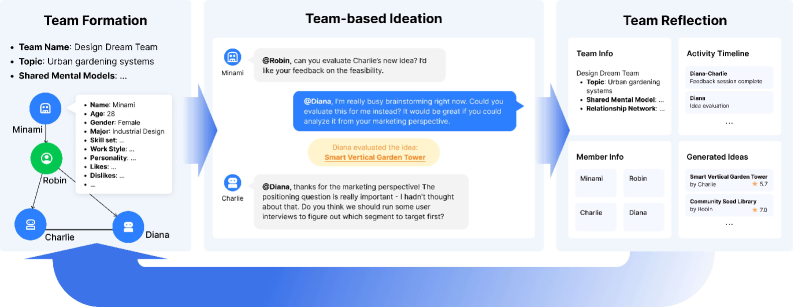
Architecting for Emergence: Introducing CrafTeam
CrafTeam utilizes AI Agents as the core mechanism for facilitating collaborative ideation. These agents are defined as autonomous entities, meaning they operate independently to achieve designated objectives within the system. Each agent is assigned specific tasks, such as brainstorming, critique, or research, contributing to the overall collaborative process without requiring constant human direction. This autonomy allows for parallel processing of ideas and enables the system to explore a wider range of possibilities than traditional linear brainstorming methods. The agents function as individual contributors, interacting with each other and with human users to refine and develop concepts within the collaborative environment.
CrafTeam agents utilize the GPT-4o-2024-08-06 large language model to facilitate complex ideation tasks. This model enables a high degree of contextual understanding, allowing agents to interpret prompts with subtlety and generate responses that are relevant and detailed. Specifically, GPT-4o-2024-08-06’s capabilities extend to discerning nuanced requests, identifying implicit assumptions within discussions, and formulating novel ideas based on the collective input of other agents or human users. The model’s architecture supports the generation of diverse outputs, ranging from concise suggestions to elaborate proposals, contributing to a more comprehensive and productive collaborative process.
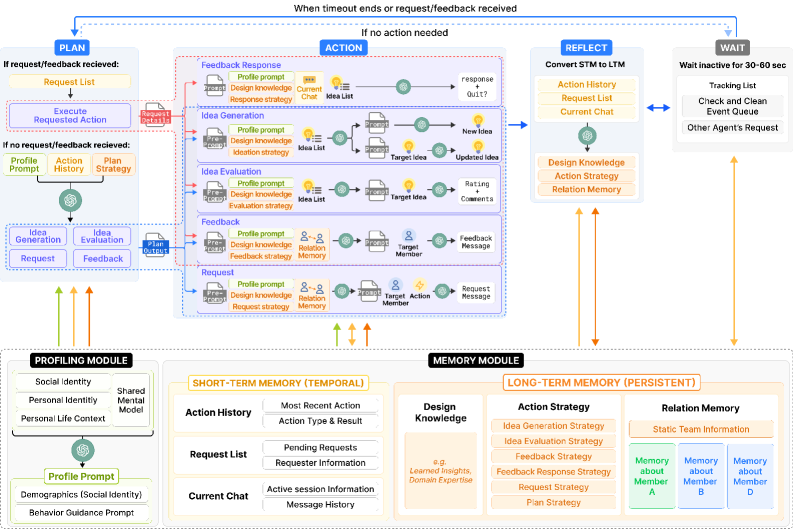
CrafTeam’s architecture is based on a Generative Agent framework, enabling autonomous agent behavior through a cyclical process of cognitive functions. Agents don’t simply react to stimuli; they utilize planning to establish goals and sub-tasks, act to execute those tasks within the CrafTeam environment, reflect on outcomes to assess progress and adjust strategies, and wait, allowing for asynchronous collaboration and efficient resource utilization. This deliberate sequencing of plan, act, reflect, and wait aims to simulate human-like deliberation and problem-solving within the collaborative ideation process, resulting in more nuanced and considered outputs.
The Memory of the Collective: Enabling Agent Cognition
Effective collaborative performance within multi-agent systems relies on the capacity of individual agents to retain and utilize information across varying timescales. Short-term memory functions allow agents to process and respond to immediate inputs and interactions, enabling dynamic adjustments within a current task. Complementing this, long-term memory provides a persistent store of learned experiences, strategies, and contextual knowledge. This enables agents to leverage past interactions to improve future performance, adapt to novel situations, and maintain consistent behavior over extended periods, ultimately facilitating more robust and effective collaboration.
Agent short-term memory functions as a buffer for recent interactions and observations, enabling the agent to maintain context within a current task or dialogue. This is distinct from long-term memory, which serves as a persistent store for learned information, including successful strategies, problem-solving techniques, and accumulated knowledge about the environment and other agents. The combination of these memory systems allows agents to respond dynamically to immediate stimuli while leveraging past experiences to inform future actions and improve overall performance; short-term memory provides the “what happened now?” context, while long-term memory supplies the “what happened before and what should I do about it?” knowledge base.
Multi-Agent Communication (MAC) enables agents within a system to exchange data regarding their internal states, perceptions of the environment, and planned actions. This information sharing is crucial for coordinating activities and avoiding redundant effort. MAC protocols can vary in complexity, ranging from simple broadcast mechanisms to sophisticated message passing interfaces that support content-based routing and selective addressing. Effective MAC directly contributes to a synergistic workflow by allowing agents to build upon each other’s knowledge, dynamically adjust strategies based on collective information, and ultimately achieve outcomes that would be impossible for isolated agents to accomplish. The capacity for reliable and efficient communication is therefore a foundational requirement for robust multi-agent systems.
Research conducted during this study indicates that Human-Multi-Agent Teams (HMATs), where a human operator guides and coordinates the activities of multiple AI agents, yield demonstrably superior results in creative ideation tasks when compared to teams of agents operating autonomously. Specifically, the HMAT configuration consistently generated a higher volume of novel ideas, as assessed by human evaluators, and these ideas were also rated as significantly more feasible and original. The observed performance difference suggests that human oversight provides critical direction, filters irrelevant outputs, and facilitates the synergistic combination of agent-generated concepts, ultimately enhancing the creative problem-solving process.
Beyond the Code: CrafTeam’s Foundation and Scaling Potential
CrafTeam leverages the capabilities of Next.js for both its front and back-end development, establishing a foundation characterized by flexibility and efficiency. This modern React framework enables rapid iteration and deployment through features like server-side rendering, static site generation, and API routes-all crucial for a dynamic, collaborative platform. By adopting Next.js, the development team benefits from built-in optimizations, enhanced performance, and a streamlined workflow, allowing them to focus on innovation and user experience rather than infrastructure concerns. The framework’s component-based architecture further promotes code reusability and maintainability, contributing to a scalable and robust system capable of accommodating future growth and feature additions.
The architecture of CrafTeam relies on Upstash Redis as its central data repository, a crucial component for maintaining the application’s functionality and user experience. This in-memory data store efficiently manages both user profiles and the configurations of individual teams, guaranteeing that information persists across sessions and updates. By leveraging Redis’ speed and reliability, CrafTeam ensures a responsive and consistent platform, enabling seamless collaboration and preventing data loss even during peak usage. This persistent state management is fundamental to the platform’s ability to track progress, personalize experiences, and maintain the integrity of team-based projects.
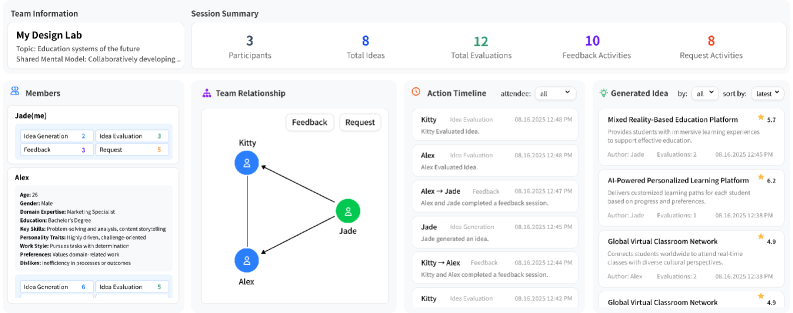
A core component of CrafTeam’s architecture is a robust Team Status Monitoring system, designed to deliver granular, real-time data on agent activity and the overall health of the platform. This monitoring extends beyond simple uptime checks, tracking key performance indicators for each AI agent – including task completion rates, error occurrences, and resource utilization. The resulting insights allow for proactive identification of potential bottlenecks or failures, enabling immediate intervention and optimization. Consequently, the system doesn’t merely report problems; it facilitates a dynamic, self-healing environment where performance is continuously refined and maintained, ensuring consistent reliability and scalability as the team and its tasks evolve.
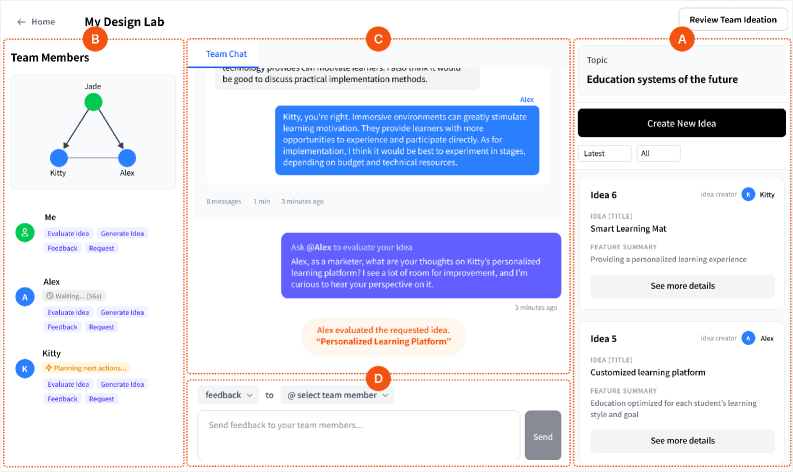
Initial experimentation with fully autonomous team structures quickly gave way to a more directed approach, as participants found greater success with single-tier hierarchies featuring human leadership. This transition indicates a move away from simply delegating tasks to AI agents and towards actively directing their efforts. Observations suggest that while AI proved capable of generating a substantial volume of ideas, humans excelled at evaluating and prioritizing them, ultimately assuming a supervisory role to guide the team towards optimal outcomes. This pattern highlights the continued importance of human oversight and strategic decision-making, even within systems designed for increased automation, and implies that effective collaboration necessitates a balance between AI generation and human orchestration.
The study revealed a dynamic interplay between artificial and human intelligence in team innovation, with AI agents consistently generating the larger volume of initial concepts. However, the research demonstrated that human participants didn’t simply delegate to these agents; instead, they assumed a crucial directing role, curating, refining, and prioritizing the AI-generated ideas. This shift highlights the effectiveness of human orchestration in maximizing the potential of AI, suggesting that the true power lies not in complete automation, but in a collaborative system where humans leverage AI’s expansive ideation capabilities with their own critical judgment and strategic direction. The findings underscore that human oversight is not a limitation, but rather a key component in fostering truly impactful innovation within these hybrid teams.
Evaluations conducted during the study consistently revealed a significant divergence in idea assessment between human participants and the AI agents themselves. While the artificial intelligence generated a substantial volume of concepts, human reviewers consistently assigned higher ratings to those same ideas, indicating a critical role for subjective judgment in the creative process. This preference wasn’t simply a matter of bias; human participants demonstrated an ability to discern nuances, assess feasibility, and recognize originality in ways that the AI, despite its generative capacity, could not replicate. The findings suggest that effective innovation isn’t solely about the quantity of ideas produced, but also the quality as determined by distinctly human criteria, highlighting the enduring importance of human oversight and curation even within AI-driven creative workflows.
The study of Human-Multi-Agent Teams reveals a cyclical truth about complex systems. While generative AI offers a proliferation of ideas, the research underscores that true creative output isn’t born of pure autonomy, but of careful human direction. It recalls Donald Davies’ observation that, “everything built will one day start fixing itself.” The ‘fixing’ here isn’t mechanical, but conceptual – the human orchestrator constantly refines, judges, and steers the AI’s output. This isn’t control, of course; the system remains an ecosystem, but one where mindful guidance shapes its evolution. Each dependency on an AI agent is, in essence, a promise made to the past, requiring present orchestration to realize its potential.
What Lies Ahead?
The pursuit of automated creative collaboration reveals, predictably, the limits of automation. This work demonstrates not a failure of agency in artificial systems, but a confirmation of the inherent need for situated judgment. To speak of ‘forming’ a team implies a destination, an optimized configuration. Yet the observed benefit of human orchestration suggests that effective Human-Multi-Agent Teams are less about building and more about tending – cultivating a dynamic where value isn’t a calculable output, but an emergent property.
Monitoring, in this context, is the art of fearing consciously. The true challenge isn’t maximizing agent interaction, but anticipating the inevitable moments where autonomous processes drift from meaningful exploration. These aren’t bugs, but revelations – opportunities to recalibrate, to redefine ‘creative’ itself. The focus should shift from designing for peak performance to designing for graceful degradation, for systems that admit their own limitations.
True resilience begins where certainty ends. The next iteration of this research must embrace the messy, unpredictable nature of creative work. The question isn’t whether agents can generate ideas, but whether these systems can support a human’s capacity to discern – and to accept that the most valuable outcomes often lie beyond the scope of pre-defined metrics.
Original article: https://arxiv.org/pdf/2601.13865.pdf
Contact the author: https://www.linkedin.com/in/avetisyan/
See also:
- Invincible Season 4 Episode 4 Release Date, Time, Where to Watch
- Physics Proved by AI: A New Era for Automated Reasoning
- American Idol vet Caleb Flynn in solitary confinement after being charged for allegedly murdering wife
- Magicmon: World redeem codes and how to use them (March 2026)
- Gold Rate Forecast
- “Wild, brilliant, emotional”: 10 best dynasty drama series to watch on BBC, ITV, Netflix and more
- Total Football free codes and how to redeem them (March 2026)
- Goddess of Victory: NIKKE 2×2 LOVE Mini Game: How to Play, Rewards, and other details
- Seeing in the Dark: Event Cameras Guide Robots Through Low-Light Spaces
- Mobile Legends Advanced ServerPatch 2.1.66 Update: Hero Adjustments, Battlefield Changes and more
2026-01-22 04:49