
On November 26, 1983, six men stole from a warehouse near London’s Heathrow Airport. They were expecting to find £1 million in foreign money, but instead discovered 6,800 gold bars, valued at £26 million in 1983 – making it the largest robbery ever recorded at that time. The gold was temporarily held under the care of Brink’s-Mat, a combination of an American security company and a British transport firm. This incident is now the subject of
I found the actual robbery itself was surprisingly quick on screen. What really captivated me was the puzzle on both sides: for the robbers, figuring out how to convert three tons of gold into usable money, and for the police, the challenge of recovering it and catching those responsible. It’s clever how the film shows the cops and criminals occasionally crossing paths – the screenwriter, Neil Forsyth, really wants us to notice that. This is especially true for Detective Chief Superintendent Brian Boyce (Hugh Bonneville), who’s a very reserved but outspoken man. And, interestingly, he gets really annoyed by people’s misconceptions about jazz – he actually compares understanding jazz to understanding police work! It’s a quirky detail that adds a lot to his character.
Detectives Tony Brightwell (Emun Elliott), a history buff, and Nicki Jennings (a charismatic Charlotte Spencer), who built her career from the ground up, are brought onto a special task force by Boyce. They make for good viewing and generally get along, though spending long hours together in cars while on stakeouts inevitably leads to some humorous friction. As a fictional character, Jennings-a woman who had to overcome significant challenges to reach her position-provides opportunities for deeper emotional exploration, especially in scenes (both tender and tense) with her father, Billy (Danny Webb), whom she jokingly calls “by a country mile the worst villain in England,” due to his health-limited criminal activity.
While Micky McAvoy (Adam Nagaitis), one of the robbers, receives significant focus, most of the series centers on three criminals handling the gold and washing the money afterward. Kenneth Noye (Jack Lowden) is described as “a fence with protection,” benefiting from his connections with police officers through his membership in the Masons. (When Boyce assembles his team with Jennings and Brightwell, he establishes rules: “no overtime, no drinking at lunchtime, no freemasonry.”) John Palmer (Tom Cullen), a gold and jewelry dealer with dyslexia, conveniently has a portable smelter on his property. And the fictional character Edwyn Cooper (Dominic Cooper), a self-made solicitor who tries to appear upper-class and is married to a wealthy woman whose snobbish parents barely hide their disapproval, ends up working for “a group of businessmen who have a lot of money that needs to be made respectable,” as explained by Gordon Parry (Sean Harris, sinister).
Spanning six episodes, this isn’t a fast-paced story, and a second series exploring the consequences has already been released in the U.K. Besides some surveillance, following suspects, one deadly confrontation, and the occasional pursuit, there isn’t much in the way of dramatic Action– it’s mostly a lot of conversation- questioning, explaining, intimidating, rambling, personal, or lecturing. While the show feels realistic- reminiscent of classic British productions- the dialogue can sound quite polished. Characters frequently deliver short speeches, often detailing their backstory and how they became who they are, feeling like something you’d hear near the end of a play. For example, Jennings found the sound of sirens soothing, which inspired her to join the police, “so that kids like me will be safe”; Boyce had a pivotal moment involving a pair of red leather shoes while serving in the so-called Cypriot Emergency. Some of the dialogue feels like it could have been taken directly from a 1930s gangster movie. The show clearly highlights issues with the British class system and problematic individuals within the police force.
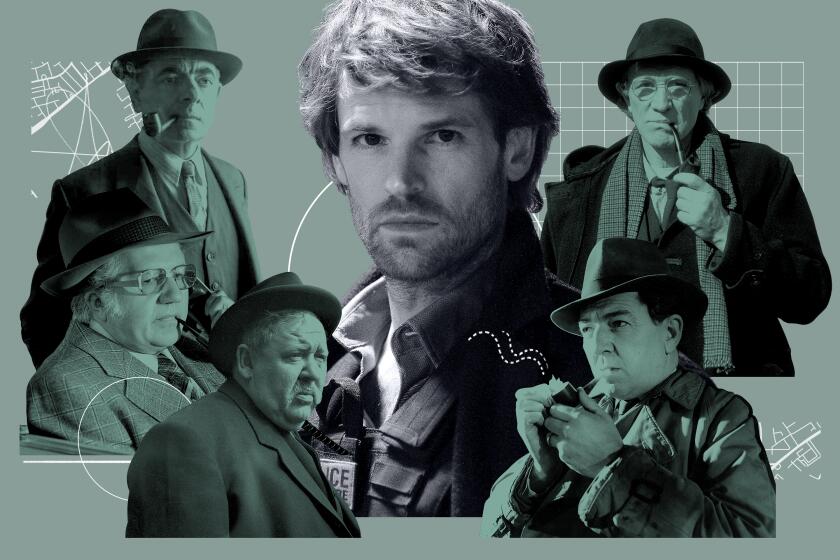
Commentary: ‘Maigret’ on PBS is the latest version of Simenon’s sleuth. Here are 6 more to watch
As a big mystery fan, I’ve always loved the character of Maigret, the Parisian detective created by Georges Simenon. PBS’ ‘Maigret’ is just the latest take on him, and it got me thinking about all the other fantastic versions out there. So, I put together a little guide to some of the best Maigret adaptations you should definitely check out. It’s a great character to explore through different actors and approaches!
“The Gold” has many characters and jumps between scenes quickly, so it might take some time to understand everything – who the criminals are, their relationships, and their roles in the heist. While Noye comes across as unlikeable, Forsyth aims to show the human side of his villains, portraying them as people who, due to limited opportunities or a particular talent, decided that stealing was the easiest way to improve their lives. As Boyce points out regarding his country’s social inequalities, “If people didn’t try to escape the lives they were born into, the police wouldn’t have a job.” This might downplay the severity of events – historical records may tell a different story – but it works well as a dramatic approach and makes for compelling viewing.
As a show set in the past, it doesn’t try too hard to emphasize the time period. You’ll see classic cars, and plenty of mustaches – more than we’re used to today. But aside from the modern pop songs played during the credits, it doesn’t shout, “This is the 1980s!” (Think about the sequel to “Life on Mars,” called “Ashes to Ashes,” for comparison.) What’s *not* included is actually more noticeable. The detectives do have a computer, but only Brightwell understands its purpose or how to operate it. There are no cellphones, but they use walkie-talkies. A tracking device – seemingly the only one in all of British law enforcement – has to be secretly imported from Belfast. It’s refreshing to see a lack of guns – there aren’t any armored teams rushing in with pistols drawn. (They only use truncheons.) And the transformation of East London into a modern, glass-filled area, which is a small part of the story, is just starting to happen.
It’s like a vacation from now, and who can’t use one of those?
Read More
- Clash Royale Best Boss Bandit Champion decks
- Vampire’s Fall 2 redeem codes and how to use them (June 2025)
- Mobile Legends January 2026 Leaks: Upcoming new skins, heroes, events and more
- World Eternal Online promo codes and how to use them (September 2025)
- Clash Royale Season 79 “Fire and Ice” January 2026 Update and Balance Changes
- Best Arena 9 Decks in Clast Royale
- Best Hero Card Decks in Clash Royale
- Clash Royale Furnace Evolution best decks guide
- FC Mobile 26: EA opens voting for its official Team of the Year (TOTY)
- Clash Royale Witch Evolution best decks guide
2025-10-05 13:35