When a filmmaking legend like Stanley Kubrick praises a movie, it’s usually worth paying attention to. is a prime example – directed by Francis Ford Coppola and based on Mario Puzo’s novel, it’s considered a landmark film. Its compelling story, perfect casting, and incredible acting have stood the test of time. While the story continued in two sequels, the original film remains a favorite, largely due to its unforgettable final scene, a creation of Coppola himself.
The Godfather essentially created the modern mob movie, adding themes of family, emotion, and a timeless story to the genre of organized crime. Initially, Michael Corleone strongly opposed his father Vito’s lifestyle, but by the film’s end, he had completely changed. The iconic scene where Michael becomes the new Don is famous for being a powerful cinematic conclusion, but a different ending was actually filmed and later cut from the final version.
The Godfather Had One Of The Most Brutal Endings
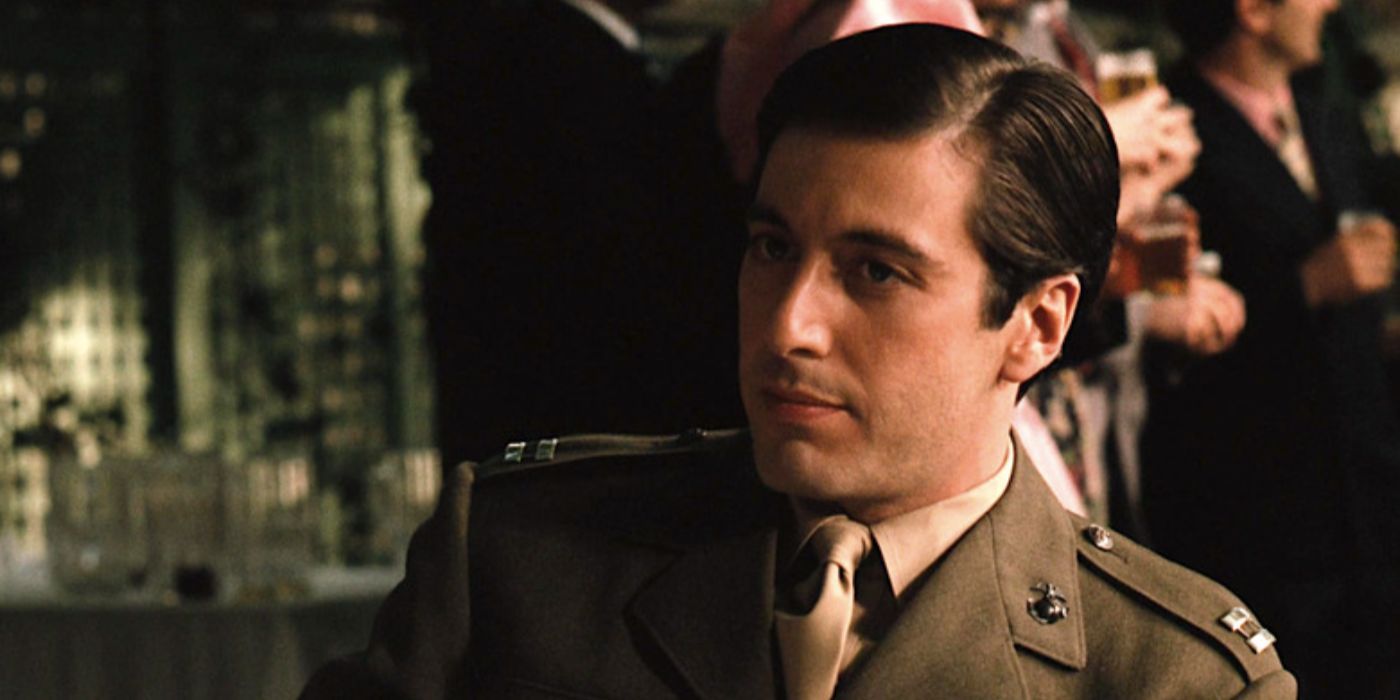
From the very beginning of The Godfather, with Don Corleone handling requests at Connie’s wedding, I thought the movie would be all about him. And it is about him, to a degree, but what really grabbed me was watching Michael Corleone change. Seeing him go from a war hero to this incredibly dangerous mob boss was intense. There were so many turning points – the attempts on his father’s life, the tragic loss of Apollonia – but it all felt like it built to that shocking ending, the moment he truly became the new Don. That’s what really stuck with me.
Following Vito’s natural death, Michael is summoned by Tessio to meet with Barzini. Recalling his father’s advice, Michael orders Tessio’s murder. Simultaneously, Michael orchestrates a massive power grab, a sequence famously depicted in The Godfather. While attending his niece’s baptism and taking on the role of godfather, Michael arranges the ruthless killings of all the other Mafia bosses and Moe Greene, a prominent Jewish gangster. However, this is not the end of his actions.
Michael’s capacity for cruelty becomes clear when he lures Carlo into a false sense of security, promising him banishment only to have him killed by Clemenza moments later. This act creates a deep rift between Michael and his wife, Kay. While not physically abusive, Michael is emotionally brutal towards her. Kay directly asks Michael if he ordered Carlo’s murder, and he denies it, his lie sounding unconvincing even to his own wife.
Kay briefly feels relieved, but the feeling quickly fades. Watching other gang leaders pay their respects to Michael in his study, she realizes her husband has changed completely. He’s now fully taken over as the Don, and the violent acts she just witnessed have cemented his power.
Adding to the tension, Al Neri shuts Kay out of the den, a powerful image of how isolated Michael has become since taking over from his father. The scene is brilliantly acted by Diane Keaton, who subtly conveys Kay’s dawning realization of how much Michael has changed, and Al Pacino, who portrays a chilling emptiness as Michael spirals further into darkness.
The ending of The Godfather is considered one of the most memorable in film history. Despite a lack of dramatic action, director Francis Ford Coppola powerfully communicated the story’s themes through symbolism, establishing Michael as the head of the family. Interestingly, the final scene Coppola initially filmed was quite different from the one audiences know today.
Francis Ford Coppola Had Shot A Different Ending, Originally
The original ending of The Godfather was quite different from what made it into the film. It closely followed Mario Puzo’s novel and heavily featured religious symbolism. Like the movie’s final scenes, Michael ordered hits during a baptism, but in the book, it culminated with Kay becoming part of the traditional family structure of wives and mothers within the Corleone crime family.
I always felt a certain alternate ending to The Godfather was incredibly compelling. Apparently, Mario Puzo himself favored a scene where Kay Adams is shown attending church with Michael’s mother, Carmella. She’s there, lighting a candle – a plea for forgiveness for all the Corleone men and their… questionable actions. It would have dramatically shifted Kay’s character. Instead of the woman who ultimately distances herself, she’d have embraced a more traditional Sicilian role: quietly accepting, even enabling, the men’s behavior. Honestly, narratively, it makes a lot of sense. It would have shown her adapting to the family’s ways, turning a blind eye to their crimes, and ultimately becoming a part of that world, rather than fighting against it. It’s a fascinating ‘what if’ that really changes how you see the whole story.
I always found it so striking how women like Apollonia were brought up in Sicily. They seemed to accept a lot, turning a blind eye to their husbands’ flaws as long as they were provided for, and then quietly seeking solace and hoping for redemption through prayer. It felt like fate when Kay finally stepped into that role, becoming the wife Michael always envisioned – the one Apollonia, in a way, foreshadowed.
The original ending was drastically different from what made it into the movie, and many people still debate which ending would have been better for the first film in the series. Here’s a comparison of the two.
Which The Godfather Ending Was Better?
As a huge fan of The Godfather, I’ve always been fascinated by the different endings. Both finales center around Kay and Michael, but they really paint two different pictures. The original, cut ending – the one Mario Puzo preferred – would have left us without that incredibly powerful scene of Michael truly becoming Don. It was the final step in his transformation, and Al Pacino played it perfectly. You could feel he wasn’t going to be the same kind of leader as his father, Vito. It was a clear signal that things were changing, and honestly, that moment felt essential to understanding Michael’s journey.
The ending of The Godfather was deeply pessimistic, offering little hope for Kay and Michael’s future together. The film clearly showed a complete breakdown in their relationship, marked by Michael’s deceit and the emotional and physical distance between them. Despite promising a new, honest life, Michael never planned to share that with Kay.
The original, but ultimately removed, ending offered a more optimistic outlook, hinting at future developments. It showed Kay letting go of her attempts to control the situation and embracing a life rooted in Sicilian traditions, both for herself and her children. Filming the final scene in a church further emphasized the strong connection between Italian-American culture, faith, and family, aligning with the story’s overall themes.
The problems between Kay and Michael were a major theme in The Godfather: Part II, so the original ending could have worked perfectly well without emphasizing the breakdown of their marriage at the end of The Godfather.
It would have been more impactful if, rather than Kay abandoning him, we’d seen his wife, left with no other choice, seek solace in faith to try and heal his hardened heart. This would have mirrored Michael’s own journey, where he uses the Church for practical gain and inner peace, ultimately seeking confession to cope with the guilt of his brother’s death.
Mario Puzo’s original ending was as powerful as the one Francis Ford Coppola created, both highlighting Michael’s descent into evil. Puzo’s version was particularly moving because it showed Kay’s desperate attempt to save her husband, symbolized by her conversion to Catholicism and joining Carmella in prayer. Given the strong family bonds and the ruthless nature of the mafia in The Godfather, this ending felt especially fitting and realistic.
Both endings were deeply upsetting, but they achieved this in different ways. One was brutally direct, while the other was more subtle but ultimately more powerful. Both showed Michael Corleone losing his way – abandoning his values, hurting his family, and turning away from his faith – and made it clear he wouldn’t be saved from the consequences.
Read More
- Clash Royale Best Boss Bandit Champion decks
- Vampire’s Fall 2 redeem codes and how to use them (June 2025)
- Mobile Legends January 2026 Leaks: Upcoming new skins, heroes, events and more
- World Eternal Online promo codes and how to use them (September 2025)
- Clash Royale Season 79 “Fire and Ice” January 2026 Update and Balance Changes
- Best Arena 9 Decks in Clast Royale
- Best Hero Card Decks in Clash Royale
- Clash Royale Furnace Evolution best decks guide
- Clash Royale Witch Evolution best decks guide
- How to find the Roaming Oak Tree in Heartopia
2025-12-20 03:41