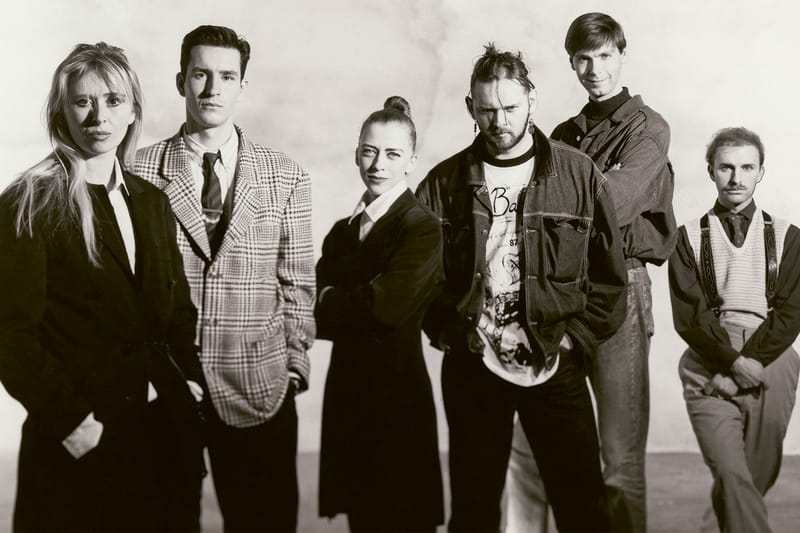
The thing about the Antwerp Six is that they were never really meant to be the “Antwerp Six”.
The story goes that in 1986, six young Belgian designers – Ann Demeulemeester, Dries Van Noten, Walter Van Beirendonck, Dirk Bikkembergs, Dirk Van Saene, and Marina Yee – packed their designs into a van and drove to London.
Okay, so we showed up at this British Designer Show, and honestly, the location was…interesting. We were stuck on the second floor, right between wedding dresses and, uh, latex. Not exactly the vibe! We decided to hustle, made our own flyers, and started handing them out. Then, things really took off when Barneys New York placed a huge order with us. We basically changed the game in contemporary fashion – it was awesome! But looking back, that story feels a little too clean, you know? It leaves out a lot of the messy stuff that really happened.
 The Antwerp Six, 1986
MoMu’s latest exhibition, celebrating the 40th anniversary of the Antwerp Six’s success in London, doesn’t just showcase their work. It also explores what the group truly represented and challenges the idea of a fixed definition for them.
According to curator Romy Cockx, the idea of the ‘Antwerp Six’ as a unified group is somewhat of a misconception. While they all met at the Academy, they only actively collaborated and presented work together for about three years in London. The notion of them as a collective has become more of a lasting legend than an accurate reflection of their history.
It’s interesting because what’s happened isn’t so much a change to what actually happened, but more how we think about it. You see, this term has become a quick way to describe a certain style, but the designers who created it never intended to create a whole ‘thing’ or label, you know? It just sort of evolved that way.
You know, the name ‘Bloomsbury Group’ wasn’t something they chose for themselves! It was actually given to them by the British press, and honestly, I think it was partly because reporters kept messing up how to spell everyone’s names! But it also stuck because, while they were all very different artists and writers with their own styles, they were a close-knit group of friends who lived near each other and were all trying to make a name for themselves. It was that shared experience and being in the same circles that really connected them.
Practicality was the main reason for showcasing their work in London, according to Cockx. It wasn’t a deliberate statement, but a sensible solution – they could save money by sharing transportation and increase their overall impact. As Cockx explains, they strengthened each other’s efforts, even while pursuing distinct artistic styles.
 Ann Demeulemeester, SS90
 Dirk Bikkembergs, SS07
 Dries Van Noten, SS20
 Walter Van Beirendonck, SS93
 Dirk van Saene, AW89
 Marina Yee, SS88
The exhibition implies the Antwerp Six weren‘t so much a lasting trend as a fleeting convergence of six distinct designers, each pursuing their own unique path and vision.
To truly understand this period, the show explores the broader cultural and economic context of the late 1970s and early 1980s. Fashion was changing quickly, with traditional Parisian styles being disrupted by a new wave of designers. These innovators, like Jean Paul Gaultier and Thierry Mugler, brought a dramatic flair, while Rei Kawakubo and Yohji Yamamoto took a more experimental and unconventional approach.
Antwerp was also changing during this period. Though known for its textile production, the city lacked a strong presence in international fashion. However, it unexpectedly became a hotbed for a fresh wave of creativity, fueled by art, a vibrant nightlife, and a unique, independent design philosophy.
The exhibition doesn’t tell one single story, but instead reveals how these six designers influenced each other. Their time at the Royal Academy of Fine Arts, where they were taught by Mary Prijot, encouraged them to develop their own unique styles. This focus on individuality is reflected in how the exhibition is designed. Each designer has their own dedicated space, showcasing their personal approach. The overall effect is intentionally fragmented, avoiding any attempt to force a unified look or ignore differences.
 Dirk Bikkembergs
 Walter Van Beirendonck
 Dirk Van Saene
 Dries Van Noten
 Marina Yee
 Ann Demeulemeester
The way the exhibition was put together also reflects this broken or incomplete feeling. When the curators spoke with the designers, they found that memories of events differed – small details weren’t consistent, and people remembered things in different ways. After forty years, there isn’t one single, unified story, but many different perspectives.
The exhibition was put together like a collection of pieces. We combined interviews with historical items like photos, invitations, and official documents. These materials came from both forgotten attics and well-maintained archives.
Rather than presenting a definitive answer, the exhibition embraces open interpretation, suggesting the ‘Antwerp Six’ isn’t a static group, but a concept that continues to change and develop.
The show doesn’t downplay how significant the Antwerp Six were. While not a formal movement, they were a major catalyst for change. They put Belgium back on the world fashion stage, turning Antwerp into a renowned center for design education and drawing students from across the globe.
 Runway invitations on show
 Runway invitations on show
 Runway invitations on show
 Runway invitations on show
Their lasting impact isn’t about a specific style or look. Instead, it’s found in the foundations they laid – the cultural and systemic changes they helped create – rather than just the things they designed.
Maybe this exhibition feels so impactful right now because it’s a welcome change of pace. In a world of fashion that often favors simple stories and easily defined brands, this exhibition presents a more complex narrative. The designers known as the ‘Antwerp Six’ weren’t intentionally created as a group; they were simply six designers working in the same place, and together, they helped establish Belgium as a hub for up-and-coming talent.
The mystery surrounding the events still lingers – the van, the posters, the small stand on the second floor. However, this new exhibition presents these details alongside a deeper understanding, exploring not only what occurred, but also how and why it’s been remembered over time.
Read More
- The Division Resurgence Best Weapon Guide: Tier List, Gear Breakdown, and Farming Guide
- Last Furry: Survival redeem codes and how to use them (April 2026)
- Clash of Clans Sound of Clash Event for April 2026: Details, How to Progress, Rewards and more
- Guild of Monster Girls redeem codes and how to use them (April 2026)
- GearPaw Defenders redeem codes and how to use them (April 2026)
- Gold Rate Forecast
- After THAT A Woman of Substance cliffhanger, here’s what will happen in a second season
- Wuthering Waves Hiyuki Build Guide: Why should you pull, pre-farm, best build, and more
- eFootball 2026 “Countdown to 1 Billion Downloads” Campaign arrives with new Epics and player packs
- Genshin Impact Version 6.5 Leaks: List of Upcoming banners, Maps, Endgame updates and more
2026-04-09 22:27