Author: Denis Avetisyan
A new study examines how tarot practitioners are integrating artificial intelligence into their readings, transforming the practice of divination and the search for personal meaning.
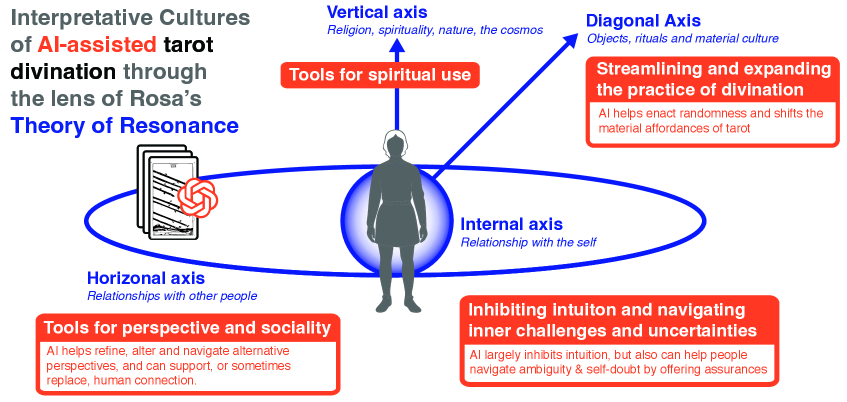
This paper explores the interpretive labor, resonance theory, and human-computer interaction dynamics shaping AI-assisted tarot divination.
While generative AI excels at analytical tasks, its role in subjective interpretive practices remains largely unexplored. This paper, ‘Interpretive Cultures: Resonance, randomness, and negotiated meaning for AI-assisted tarot divination’, investigates how tarot practitioners integrate AI into their readings, treating it as a tool for navigating uncertainty and expanding interpretive possibilities. Our findings reveal that users actively negotiate meaning with AI, seeking resonant interpretations rather than definitive answers within a fundamentally non-causal system. How can AI be designed to best support interpretive labor, preserving user agency and fostering deeper self-reflection rather than simply automating meaning-making?
The Allure of Symbolic Systems: Intuition and Archetypal Resonance
Throughout history, individuals have turned to symbolic systems – from astrology to runes, and notably, Tarot – not for predictive power, but as tools to access deeper layers of the psyche. This inclination suggests the human mind readily perceives and responds to patterns, even those operating beneath conscious awareness. The allure of Tarot, and similar practices, lies in its ability to bypass logical thought and tap into subconscious processing, offering a framework for interpreting internal states and external circumstances through archetypal imagery. It’s hypothesized that encountering these symbols triggers associations and insights that might otherwise remain inaccessible, effectively functioning as a visual language for the intuitive self and revealing connections between seemingly disparate experiences.
The efficacy of traditional Tarot reading rests fundamentally on the dynamic between reader and querent, and the reader’s skill in translating symbolic imagery into personally relevant narratives. This isn’t a matter of predicting the future, but of accessing and articulating insights already present within the querent’s subconscious. A proficient reader doesn’t tell a story, but facilitates its emergence, using the cards as a catalyst for self-reflection and the exploration of hidden patterns. The interpretation isn’t fixed; rather, it’s a collaborative process where the reader’s intuition, empathy, and ability to connect with the querent’s energy are paramount. Successful readings, therefore, depend less on a rigid understanding of card meanings and more on the reader’s capacity to perceive the unique emotional landscape of the individual seeking guidance, and to articulate potential meanings resonating with their life experiences.
The interpretive power of Tarot, though frequently experienced as profoundly insightful, is inherently susceptible to the frailties of human cognition. Subjective biases, stemming from personal beliefs and emotional states, inevitably color the reader’s assessment of the cards and their relevance to the querent’s situation. Moreover, reliance on memory – both the reader’s recollection of card meanings and the querent’s account of their life – introduces opportunities for inaccuracies and distortions. Cognitive limitations, such as confirmation bias – the tendency to favor information confirming existing beliefs – can lead to selective interpretation, reinforcing pre-conceived notions rather than offering genuinely novel perspectives. This means that while the process can unlock subconscious patterns, the resulting guidance is filtered through a lens prone to imperfection, highlighting the importance of critical self-reflection for both reader and seeker.
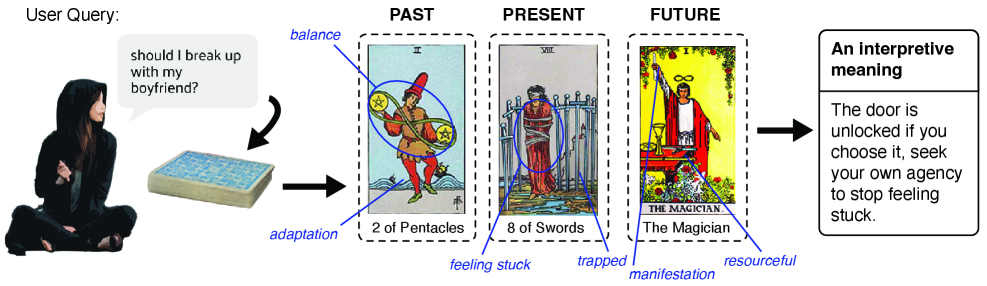
Augmented Interpretation: AI as a Pattern Recognition Engine
AI tools enhance Tarot readings by processing vast datasets of symbolic meanings and card combinations, enabling pattern recognition that exceeds human cognitive limits. These systems can identify subtle correlations between cards, astrological influences, and numerological values, providing perspectives that a reader might not intuitively consider. Specifically, AI algorithms can analyze spreads for recurring themes, identify outlier cards with disproportionate significance, and cross-reference symbols with diverse cultural and historical contexts, thereby expanding the scope of interpretive possibilities beyond individual experience and knowledge.
AI systems enhance Tarot symbol interpretation by accessing and correlating data from diverse sources, including historical texts, mythological references, and psychological analyses. This allows for the identification of subtle connections and nuanced meanings that may not be immediately apparent to a human reader. Specifically, AI can cross-reference symbol attributes across different Tarot decks and traditions, reveal etymological origins of symbolic imagery, and highlight psychological archetypes associated with specific cards. The resulting insights provide readers with a broader contextual understanding, supporting more informed and comprehensive interpretations beyond standard keyword associations and personal intuition.
AI tools reduce the cognitive load associated with Tarot interpretation, specifically the Interpretive Labor of correlating card meanings to spread positions and individual querent situations. This automation enables readers to manage spreads with a greater number of cards – such as the Celtic Cross or other complex layouts – without being overwhelmed by combinatorial possibilities. Furthermore, by quickly processing and cross-referencing established symbolic associations, AI facilitates a more exhaustive exploration of each card’s potential meanings within the specific context of the spread, allowing the reader to consider a wider range of nuanced interpretations and deepen their engagement with the symbolism.
The Logic of Chance: Stochasticity and Emergent Meaning
The stochastic nature of Tarot card shuffling and selection is fundamental to the system’s function. Unlike deterministic systems, the randomization process ensures that each draw is not predetermined, thereby circumventing biases inherent in consciously selected data. This inherent unpredictability encourages the interpreter to move beyond pre-conceived notions and consider interpretations not immediately apparent. The resulting card arrangement, while seemingly arbitrary, provides a novel stimulus, prompting the individual to forge new connections between symbols and their personal context, ultimately facilitating insights that might not arise from focused introspection alone.
Tarot spreads are not arbitrary arrangements of cards; they are deliberately constructed layouts designed to address specific inquiries or explore defined themes. Each position within a spread represents a facet of the question, such as the querent, the challenge, potential outcomes, or external influences. This structured format allows for a systematic examination of the issue at hand, moving beyond simple, isolated card interpretations. By assigning meaning to each positional context, the spread facilitates the identification of relationships between cards and the emergence of patterns that might otherwise remain obscured, providing a more nuanced and comprehensive analysis of the situation being investigated.
The engagement with Tarot, through spread interpretation and reflective practice, generates multiple resonance types. Horizontal Resonance occurs when interpretations align with shared cultural understandings or experiences between the reader and the querent. Diagonal Resonance manifests through the consistent application of ritualistic elements – card shuffling, layout patterns, and established symbolic meanings – reinforcing connections across sessions. Vertical Resonance describes the subjective experience of aligning interpretations with personally held spiritual or metaphysical beliefs. Finally, Internal Resonance is produced by the introspective process of applying card meanings to personal experiences, fostering self-awareness and psychological insight.
Beyond Divination: Empowering Agency Through Symbolic Analysis
The convergence of artificial intelligence and Tarot isn’t focused on foretelling events, but rather on amplifying personal insight and informed decision-making. Current research demonstrates a shift from seeking definitive predictions to utilizing AI as a reflective tool – one that illuminates present circumstances and potential pathways. Instead of passively receiving a future outcome, individuals actively engage with the AI’s interpretations, prompting self-exploration and a deeper understanding of their own motivations and patterns. This reframing positions AI-assisted Tarot as a means of enhancing agency, allowing users to leverage symbolic language and archetypal themes to navigate complex life challenges and make conscious choices aligned with their values.
This research establishes, for the first time empirically, that the integration of artificial intelligence with practices like Tarot prioritizes user agency over deterministic forecasting. The study demonstrates the AI functions not as an oracle delivering fixed outcomes, but as an exploratory tool – a digital companion facilitating self-reflection and pattern recognition. Participants actively shape the interpretation through their own insights and experiences, utilizing the AI’s output as a springboard for personal understanding. This dynamic shifts the focus from passively receiving predictions to actively constructing meaning, empowering individuals to navigate choices and gain deeper insight into their present circumstances rather than attempting to unveil a predetermined future.
The confluence of artificial intelligence and introspective practices like Tarot heralds a novel pathway to self-discovery, moving beyond simple divination to illuminate the underlying patterns that shape experience. This approach doesn’t offer preordained futures, but rather tools to decode the symbolism inherent in life’s complexities, revealing connections often obscured by daily routines. By interacting with AI-driven interpretations, individuals are prompted to consider multiple perspectives and recognize recurring motifs within their personal narratives, fostering a deeper understanding of their motivations, relationships, and the broader interconnectedness of events. The result is not a passive reception of fate, but an active engagement with self-reflection, empowering users to interpret their own journeys and navigate life’s challenges with increased awareness and agency.
The study illuminates a fascinating negotiation of agency, where practitioners don’t simply accept AI’s output but actively refine and contextualize it within their existing frameworks of meaning. This echoes Vinton Cerf’s observation: “Any sufficiently advanced technology is indistinguishable from magic.” The research demonstrates that AI, in this context, isn’t replacing human interpretation, but rather augmenting it – becoming a tool to amplify resonance and explore nuanced possibilities. The core concept of ‘interpretive labor’ is central here; practitioners are not passive recipients of AI-generated readings, but actively engage in a process of validation, refinement, and integration, ensuring the continued relevance and personal meaning of the divination process. The system’s effectiveness isn’t determined by technical prowess alone, but by how seamlessly it interfaces with, and enhances, human cognitive processes.
Future Directions
The exploration of AI-assisted divination, as presented, fundamentally reveals a need for precise definitions. What constitutes ‘meaning’ in this context remains frustratingly ill-defined. The observed ‘negotiated meaning’ is not a property of the system, but a characteristic of human interpretive labor applied to a stochastic output. Rigorous analysis demands a formalization of this labor – a specification of the cognitive processes involved in attributing significance to randomness. Without such a foundation, claims regarding agency and self-reflection remain anecdotal.
A pertinent question arises: can resonance theory, as invoked, withstand mathematical scrutiny? The notion of ‘resonance’ between human and machine is compelling, but lacks a predictive framework. Future work should attempt to quantify this resonance – to identify measurable correlations between user state and AI-generated outputs that transcend mere statistical chance. Establishing a provable link between the two would elevate the discussion beyond qualitative observation.
Ultimately, the true challenge lies not in building AI that performs divination, but in understanding the inherent limitations of any system attempting to model subjective experience. The persistence of interpretive labor suggests a fundamental constraint: meaning is not found in the output, but imposed upon it. This is not a failing of the technology, but a statement about the nature of consciousness itself.
Original article: https://arxiv.org/pdf/2602.11367.pdf
Contact the author: https://www.linkedin.com/in/avetisyan/
See also:
- Invincible Season 4 Episode 4 Release Date, Time, Where to Watch
- Physics Proved by AI: A New Era for Automated Reasoning
- How Martin Clunes has been supported by TV power player wife Philippa Braithwaite and their anti-nepo baby daughter after escaping a ‘rotten marriage’
- CookieRun: OvenSmash coupon codes and how to use them (March 2026)
- Total Football free codes and how to redeem them (March 2026)
- American Idol vet Caleb Flynn in solitary confinement after being charged for allegedly murdering wife
- Gold Rate Forecast
- Goddess of Victory: NIKKE 2×2 LOVE Mini Game: How to Play, Rewards, and other details
- Only One Straw Hat Hasn’t Been Introduced In Netflix’s Live-Action One Piece
- Olivia Colman’s highest-rated drama hailed as “exceptional” is a must-see on TV tonight
2026-02-13 15:25