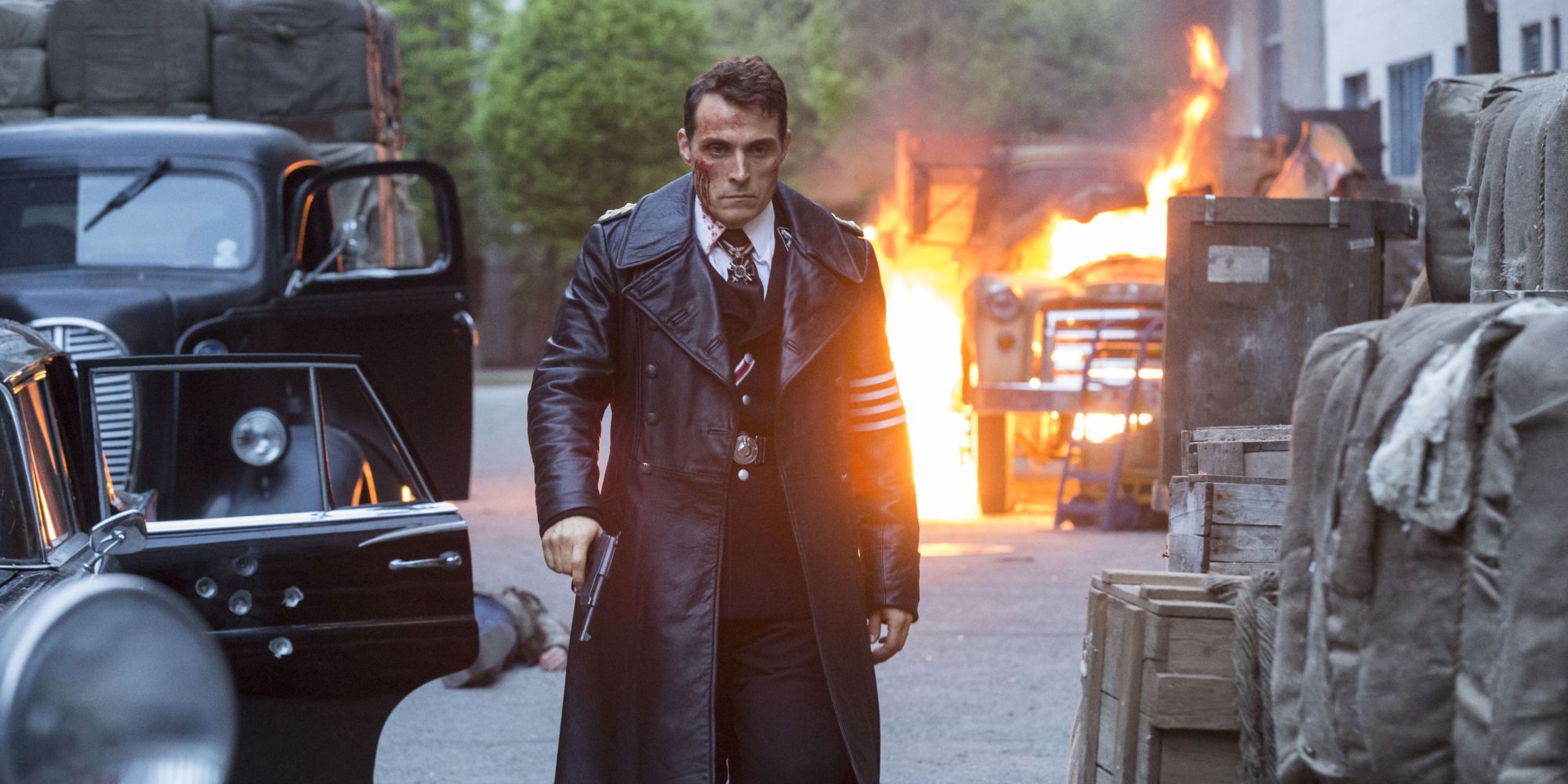
He loves sharing his favorite things online, especially movies and TV shows. Because Stephen King is such a famous and frequently adapted author, people often pay attention when he recommends something.
Stephen King is a fan of the show The Man in the High Castle, calling it amazing, unsettling, and incredibly impressive. The series, which first aired in 2015, imagines an alternate history where the Axis powers won World War II and remains highly recommended even years later. In 2018, King shared his praise for the show on Twitter.
Stephen King Praised The Man in the High Castle
The series The Man in the High Castle premiered on Prime Video on January 15, 2015, and continued for four seasons, with ten episodes each, totaling 40 episodes. It’s set in an alternate reality where Germany and Japan won World War II and took over the world. The show is based on a novel of the same name and has generally been well-received by both critics and audiences.
Shortly after the third season of the show launched on Prime Video in December 2018, Stephen King shared his enthusiastic reaction on X (formerly Twitter). In a single post, he called the series amazing, impactful, and unsettling. He also strongly recommended that new viewers watch it from the very first episode to fully appreciate its depth and emotional power.
Stephen King highly recommends the Amazon Prime series The Man in the High Castle. He describes it as wonderful, and particularly praises some of its striking, though unsettling, imagery – like American children performing the Nazi salute and a Nazi soldier standing in place of the Statue of Liberty. He suggests watching it from the very first episode.
Stephen King is famous for his scary novels like It, Carrie, Pet Sematary, Salem’s Lot, The Shining, and Misery. But he doesn’t limit himself to horror. He’s also written in other genres, and one of his science fiction fantasy stories, which explores the meaning of life, was made into a movie in 2025. Books like The Shawshank Redemption, The Green Mile, Under the Dome, and 11/22/63 show his ability to write beyond the horror genre.
The series leans into science fiction and often mixes fantasy with real-world themes. It’s fitting, then, that the story is set in an alternate universe built upon a particularly dark period of history. Given the positive reception, fans of Stephen King are likely to enjoy it.
Although it was posted a while ago, King’s tweet remains true: The Man in the High Castle is a fantastic show that feels especially important given the current, often divisive, political climate.
The Man in the High Castle Is an Uncomfortably Realistic Take on What Would Happen if the Allied Powers Lost WWII
In this alternate history, the Axis Powers emerged victorious in 1946. Key events leading to their win included the assassination of President-elect Franklin D. Roosevelt by Giuseppe Zangara, a successful German nuclear attack on Washington D.C., and a Japanese invasion of the U.S. West Coast. These events forced the United States to surrender, effectively ending its role in the Allied Powers – previously known as the “Big Four.”
I remember when the Allies seemed so strong. Besides the U.S., the main players were the United Kingdom, the Soviet Union, and China. France was with us too, even though they’d initially fallen to Germany. But everything changed when the U.S. was defeated. Once our government surrendered to the Axis powers, and Germany invaded, the whole alliance just crumbled.
Concentration camps were initially created to imprison and murder Jewish people and African Americans, but eventually held many other groups who were targeted and mistreated. Additionally, major cities like Cincinnati experienced significant violence, resulting in numerous deaths among Americans.
After the war ended, Nazi Germany and Japan expanded their control to cover much of the world. Germany, led by dictator Adolf Hitler, now rules most of Europe and Africa, while Japan dominates Asia and Oceania.
The story takes place in 1962, in a world dramatically different from our own. Adolf Hitler’s German Reich rules over half of America, Europe, and Africa, while the Japanese Emperor controls most of the rest of the globe. The series primarily centers on what remains of the United States and Germany, though parts of the American West are occupied by Japan following their invasion.
The show highlights a fascination with America before the war, though very little of that era still exists. In this alternate reality, a ‘Neutral Zone’ around the Rocky Mountains divides America between Japanese and Nazi control. Any hope for a different outcome in this Axis-dominated world has faded.
As King observed, the films show unsettling images, like American children giving Nazi salutes and the Statue of Liberty being replaced by a Nazi figure. They portray an America that is the opposite of its ideals, a far cry from the free nation it once was before the war. These films present an alternate reality where the Axis powers won, offering a distorted view of the world.
The first episode centers around Trudy sending a package of film reels to her sister, Juliana Crain. Shortly after, Trudy is shot by Japanese police, suggesting she shouldn’t have sent the package in the first place. Juliana later discovers the films reveal the Allies actually won the war in 1945.
This video is impossible – it shows a reality where the Allies didn’t win the war. Its very existence proves there’s a world where the Axis powers were defeated, a world different from the one we know. This discovery inspires both hope and a desire for change.
The first season received excellent reviews and was one of Prime Video’s most popular pilots ever. Rotten Tomatoes calls The Man in the High Castle “unlike anything else on television,” praising its unique combination of historical drama and science fiction, specifically the idea of alternate realities. Critics often describe the show as thought-provoking, captivating, and immersive.
The series has been widely praised for its sensitive treatment of a difficult subject and its faithful adaptation of the original story. Many critics consider it essential viewing, comparing it to the work of Stephen King himself. While the show’s themes might resonate strongly given current events and political tensions, it remains a beautifully crafted and worthwhile watch.
Found an error? Send it so it can be corrected.
Read More
- ‘Project Hail Mary’s Unexpected Post-Credits Scene Is Worth Sticking Around
- Beyond Accuracy: Gauging Trust in Human-AI Teams
- Gold Rate Forecast
- Clash Royale Balance Changes March 2026 — All Buffs, Nerfs & Reworks
- The most surprising Hannah Montana cameos: From John Cena to Dwayne Johnson and even a Coronation Street soap star as show celebrates its 20th anniversary
- eFootball 2026 is bringing the v5.3.1 update: What to expect and what’s coming
- Genshin Impact Version 6.5 Leaks: List of Upcoming banners, Maps, Endgame updates and more
- Total Football free codes and how to redeem them (March 2026)
- Brawl Stars Brawl Cup Pro Pass arrives with the Dragon Crow skin and Chroma, unique cosmetics, and more rewards
- We talked to ‘Bachelorette’ Taylor Frankie Paul. Then reality hit pause on her TV career
2026-04-02 07:08