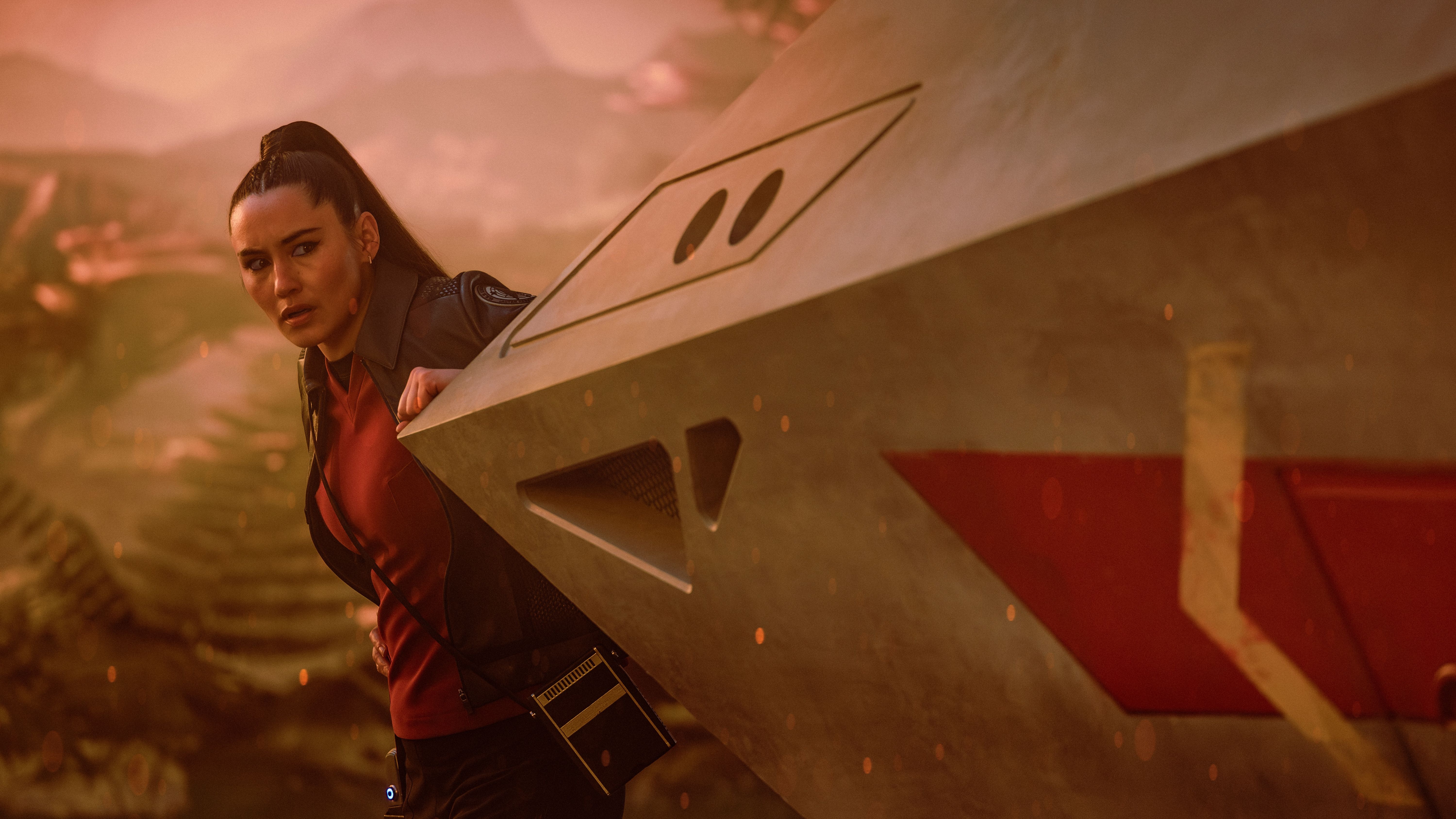
Before the new season of Strange New Worlds began, the creators announced they’d be introducing things never before seen in Star Trek, including puppets! One surprising element – dinosaurs – felt like something the show should have explored decades ago. The premiere also revisits an old scientific idea about a lost planet that once existed between Mars and Jupiter.
Gene Roddenberry’s vision for Star Trek was to use science fiction as a way to subtly address social and political issues, bypassing strict television censorship. While the show was largely fantastical – humans hadn’t even reached the moon yet – Roddenberry aimed to ground it in genuine scientific principles. The episode “Valles Marineris” successfully achieves both of these goals, blending imaginative storytelling with realistic science, even while including elements like dinosaurs and Martians.
In Star Trek, Real Scientific Theories Come Second to Its Characters and Allegorical Storytelling
This season marks a strong addition to the larger Star Trek universe. The episode opens mid-adventure, with Captain Pike and his crew bending the rules to protect an alien civilization. We learn that since the death of his partner, Captain Marie Batel, at the end of Season 3, Pike has been pushing everyone relentlessly – much like he urged his horse forward in a previous scene. So, their current mission to study a dangerous cosmic storm was supposed to be a welcome break.
A typical accident on Star Trek sends the USS Enterprise back in time 65 million years, leaving it damaged and stranded. When a team goes down to the planet to find iridium – a substance they need to fix their ship – they discover that dinosaurs aren’t even the most surprising thing about ancient Earth.
The story centers around finding an advanced civilization on Mars – one that has spaceships capable of interplanetary travel, but not yet warp speed. They’re locked in a long-running war with the Dol’drm, a species of intelligent insects. Captain Pike attempts to negotiate with a Martian leader, offering assistance in establishing communication with the Dol’drm and bringing their conflict to an end.
Similar to rescuing the civilization before warp travel – which would also break the rules against interfering with the past – helping these people carries a huge risk. Any change to the past could prevent humanity from ever developing. Although he’s a highly respected Starfleet officer, choosing to save lives despite the potential consequences…
Acting on a sudden feeling, he surprisingly decides against intervening when the Martian leader utilizes the Enterprise’s antimatter capabilities to obliterate the planet of the Dol’drm.
Captain Pike’s attempt to negotiate peace with the Martian commander embodies the core principles of Star Trek. He insists that despite the Martians’ fear and hostility towards the Dol’drm, embracing diversity leads to strength and peace is always achievable. Like the Cheronians, Ferengi, and many other alien species encountered in the show, the Martians offer a warning about the consequences of poor decisions.
The Martian leader made a terrible choice: she ordered the destruction of another species hoping to protect her own civilization, but it ultimately caused their downfall. This act of genocide resulted in Mars itself becoming the barren, desolate planet we know today.
Strange New Worlds’ Lost Fifth Planet Calls Back to the Flawed Titius-Bode Law
Back in the 18th century, astronomers Johann Titius and Johann Bode proposed a pattern: each planet’s distance from the Sun would be double that of the planet before it. Surprisingly, this formula accurately predicted the distances of all known planets at the time – Mercury, Venus, Earth, Mars, Jupiter, and Saturn. However, the formula also suggested a missing planet should exist between Mars and Jupiter, creating a noticeable gap.
Almost two centuries before, the astronomer Johannes Kepler predicted a planet likely existed in that location. Titius and Bode believed their calculations would guide others to find this planet – and other undiscovered ones – which ultimately happened.
Not long after, William Herschel actually found Uranus exactly where those mathematical predictions said a planet should be beyond Saturn! He initially thought it was a comet, and others had even mistaken it for just another star. But this discovery gave everyone a real boost of confidence, and a team of astronomers – they jokingly called themselves ‘the Celestial Police’ – really ramped up their hunt for that fifth planet.
Around 1801, roughly three decades after Johann Bode published his ideas, astronomer Giuseppe Piazzi found Ceres, a dwarf planet in the area where a planet called Phaeton was thought to exist. Shortly after that, other similar objects were discovered – astronomers like Herschel referred to them as “asteroids,” including Pallas, Juno, and Vesta.
I remember when people still believed in the Titius-Bode law! The idea was that the asteroids were actually pieces of a planet called Phaeton, which supposedly exploded. It was a really cool theory! But honestly, when Neptune was discovered in 1846, it became pretty clear the law was just a lucky accident. It was a bit sad for Titius and Bode, but science moves on, you know?
More research into the asteroid belt proved that Phaeton—or the Dol’drm homeworld as depicted in Strange New Worlds—wasn’t real. Despite being wrong, Titius and Bode’s initial ideas sparked interest in the stars, ultimately leading to the discovery of gas giants, dwarf planets, and other fascinating objects in our solar system.
In ‘Valles Marineris,’ Strange New Worlds Draws on Many Ancient Solar System Theories
The Titius-Bode law isn’t remembered for being correct, but for how it motivated early astronomers to study space with the tools they had available. Later, while observing ‘Valles Marineris’ on Mars, Spock details the consequences of a devastating attack by a Martian commander on the planet Dol’drm, explaining that four percent of the planet’s remains ended up forming the asteroid belt.
This idea connects to the Phaeton hypothesis and research showing asteroids aren’t made of leftover planet material. He also proposes that debris from a shattered planet created the Chicxulub impact crater.
I remember being absolutely fascinated when I first learned about Luis and Walter Alvarez’s idea – that an asteroid actually wiped out the dinosaurs! It all came down to this element called iridium. They noticed a surprisingly large amount of it in rock layers from around the time the dinosaurs disappeared, and because iridium is pretty rare on Earth but common in asteroids, they proposed this incredible impact theory. It just made so much sense!
A 2021 study found traces of iridium, a material often associated with asteroids, within the crater. Researchers considered this finding highly significant, stating it was unlikely to occur by chance. A separate study that year traced the origin of this material to the outer edge of the asteroid belt – the likely location of the Dol’drm homeworld.
The possibility of life on Mars has fascinated people for centuries, ever since we began to learn about the planet. Early Mars was surprisingly similar to Earth, possessing features like oceans, rivers, changing seasons, volcanic activity, and an atmosphere. Recently, NASA found compelling evidence – in fossil records – suggesting that microscopic life once existed there.
Most scientists agree that Mars never developed life beyond a very basic level. Studies of gases in space show that Mars lost most of its atmosphere around four billion years ago, making it uninhabitable long before the dinosaurs even existed.
Even if the timing isn’t quite right, the ideas presented in Strange New Worlds aren’t entirely far-fetched. There are theories suggesting Earth has hosted advanced civilizations in the past. Ultimately, anything built by any civilization would eventually disappear completely over millions or billions of years.
As Pike pointed out to the Martian leader, intelligent life doesn’t necessarily resemble humans. It’s possible that advanced life once existed on Mars but disappeared over time.
Star Trek: Strange New Worlds debuts new episodes Thursdays on Paramount+.
2026-07-24 16:07