Author: Denis Avetisyan
New research shows that giving artificial intelligence distinct personalities dramatically improves the realism of social media simulations.
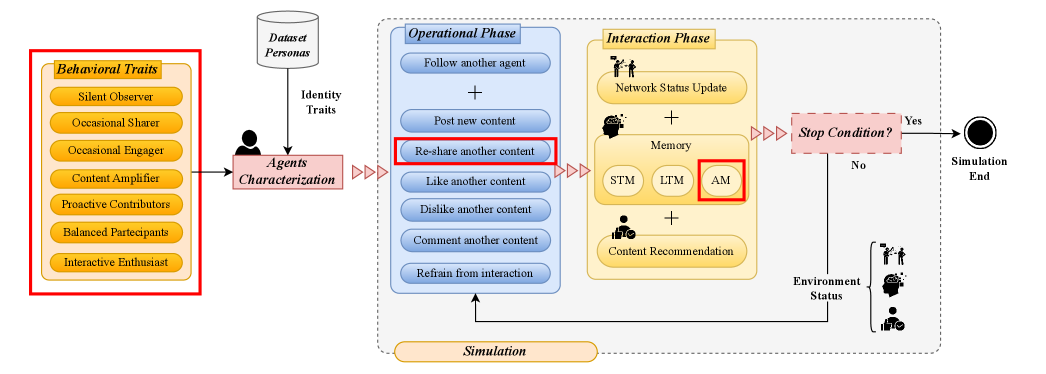
Explicitly modeling behavioral traits in generative agent-based models enhances the accuracy of reproducing user behaviors and network structures on social media platforms.
While generative agent-based models increasingly simulate social systems, they often struggle to replicate the nuanced behavioral diversity observed in real-world online platforms. This work, ‘From Who They Are to How They Act: Behavioral Traits in Generative Agent-Based Models of Social Media’, introduces a novel approach to agent characterization by explicitly modeling behavioral traits that govern propensities toward specific platform actions. Through large-scale simulations, we demonstrate that incorporating these traits is essential for generating heterogeneous participation patterns and realistic content propagation dynamics. Could a more nuanced understanding of how agents act-not just who they are-unlock new possibilities for modeling and understanding complex social phenomena online?
Beyond Simplification: Modeling Social Dynamics with Agent-Based Simulation
Historically, social scientists have relied on methods like statistical analysis and large-scale surveys to discern patterns in human behavior. However, these approaches often falter when attempting to model emergent behavior – phenomena arising from the complex interplay of individual actions, rather than being directly dictated by overarching rules. The inherent limitations stem from an inability to fully account for the non-linear dynamics and feedback loops present in social systems; averaging individual data points can obscure crucial variations and interactions. Consequently, traditional methods frequently struggle to predict how localized changes can cascade into system-wide effects, or how simple individual rules can give rise to surprisingly complex collective outcomes. This inability to capture these intricacies motivates the search for computational approaches, like agent-based modeling, which explicitly simulate these interactions to better understand the genesis of social patterns.
Agent-based modeling represents a significant shift in how complex social systems are investigated, moving beyond traditional top-down approaches that often rely on aggregated data and statistical analysis. Instead, ABM constructs simulations populated by autonomous ‘agents’ – computational entities programmed with behaviors and decision-making rules – and then observes how their interactions give rise to emergent, system-level patterns. This bottom-up methodology allows researchers to explore how local interactions can scale to produce global phenomena, such as the spread of innovations, the formation of social norms, or even market fluctuations. By manipulating agent characteristics and environmental conditions within the simulation, researchers can test hypotheses about the underlying mechanisms driving these complex behaviors, offering insights that are often difficult or impossible to obtain through conventional empirical methods. The power of ABM lies in its ability to recreate the dynamics of a system from the ground up, revealing how simple individual behaviors can collectively produce remarkably complex outcomes.
The fidelity of agent-based models hinges on the internal complexity of the simulated agents themselves; simply defining rules for interaction isn’t enough to replicate realistic social dynamics. Current research emphasizes the need for sophisticated architectures that move beyond basic rule-following to incorporate elements of cognition – the ability to process information, learn, and adapt – and memory, allowing agents to retain past experiences and adjust future behavior accordingly. These internal mechanisms, often inspired by cognitive science and neuroscience, allow for emergent behaviors that are far more nuanced and unpredictable than those arising from purely reactive agents. For example, agents equipped with memory can exhibit phenomena like habit formation or the development of biases, while cognitive architectures enable them to evaluate situations, weigh options, and make decisions based on internal goals and beliefs, ultimately leading to simulations that more accurately reflect the complexity of human social systems.
Intelligent Agents: The Foundation with Large Language Models
Large Language Models (LLMs) function as the primary reasoning engine for the simulated agents, providing the capacity for natural language understanding and generation. Models such as Llama 3 and Gemma are utilized due to their demonstrated proficiency in processing and responding to complex prompts. These models are transformer-based neural networks trained on massive datasets of text and code, enabling them to perform tasks including text completion, question answering, and code generation. The agents leverage the LLM’s ability to predict the next token in a sequence, which translates to coherent and contextually relevant responses within the simulation. Importantly, the LLM itself does not retain state; it operates on a per-turn basis, requiring external memory systems to maintain consistency and context across interactions.
PyAutogen is a Python framework designed to facilitate the development of multi-agent conversational systems. It enables the creation of complex interactions by allowing developers to define multiple agents, each with specific roles and capabilities, and then orchestrate their conversations through a programmatic interface. The framework handles message passing, turn management, and agent coordination, abstracting away much of the underlying complexity of building distributed conversational AI. PyAutogen supports various LLMs and allows for customization of agent behavior through prompt engineering and the implementation of custom functions, enabling the creation of agents that can collaborate to solve tasks requiring complex reasoning and information exchange.
Agent behavior is not solely determined by the Large Language Model (LLM); a tiered memory system provides crucial contextual awareness and behavioral consistency. This system comprises Short-Term Memory (STM), which stores recent interactions for immediate recall, enabling agents to respond directly to the current conversation; Long-Term Memory (LTM), a persistent store for facts, knowledge, and experiences accumulated over time, facilitating learning and informed decision-making; and Activity Memory, which tracks ongoing tasks, goals, and the current state of execution, ensuring agents maintain focus and progress towards objectives. The interplay between these memory types allows agents to exhibit more complex and coherent behavior than would be possible with LLM prompting alone, by providing a dynamic and evolving internal state.
Defining Social Roles: A Spectrum of Agent Behavior
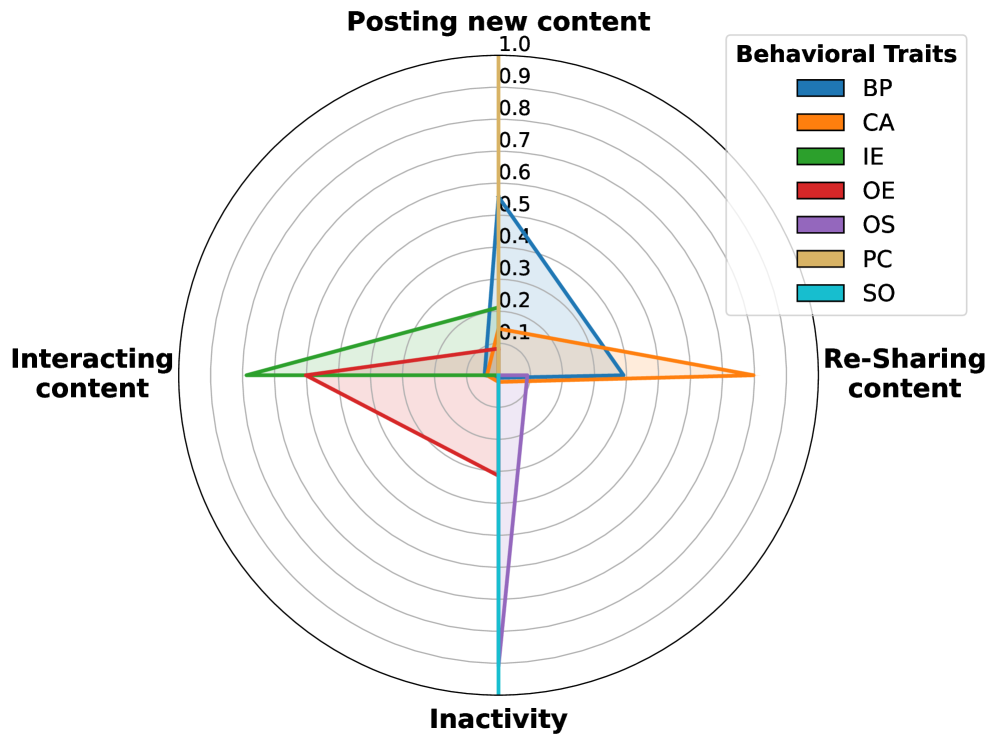
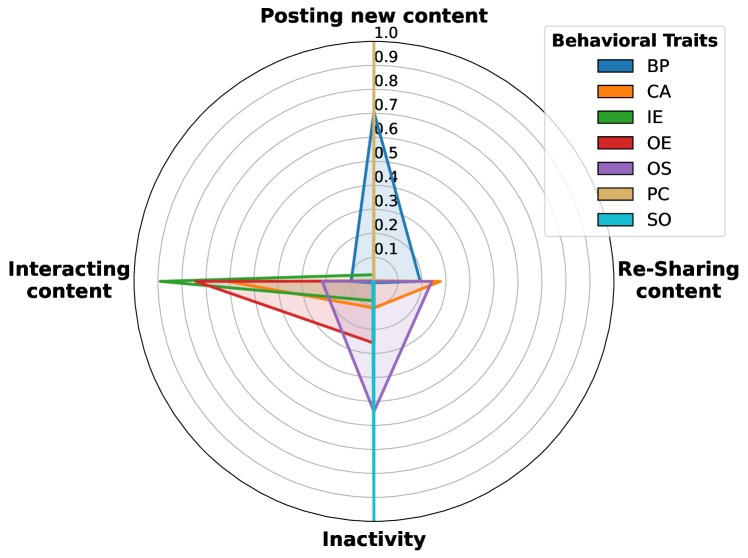
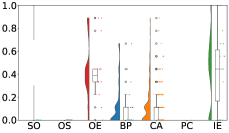
Agent behavioral traits within the simulation are defined along a spectrum of participation, ranging from complete passivity to active content creation. The ‘Silent Observer’ represents one extreme, characterized by no content generation or re-sharing. Conversely, the ‘Proactive Contributor’ is defined by a prioritization of original content creation. Intermediate traits exist to model varied levels of engagement, acknowledging that agents do not uniformly participate. These traits are not assigned randomly; their distribution is calibrated to create a realistic simulation of online social dynamics, influencing the overall content lifecycle and network propagation patterns.
Beyond passive observation and proactive content creation, agent archetypes include the ‘Content Amplifier’, characterized by a high ratio of re-shared content to original posts; the ‘Interactive Enthusiast’, which prioritizes direct engagement with other agents through comments and reactions; and the ‘Balanced Participant’, exhibiting a near-equal distribution between content creation and re-sharing activities. These archetypes are defined by specific behavioral weighting parameters within the simulation, influencing their propensity for different action types and contributing to the overall diversity of interaction patterns observed. The prevalence of each archetype is adjustable, allowing researchers to model varying social network dynamics and analyze the impact of different participation styles on information dissemination.
Agents designated as ‘Occasional Sharers’ and ‘Occasional Engagers’ represent a critical component of simulation realism by introducing stochasticity into content propagation. While not consistently active, these agents contribute to a more natural distribution of information and prevent the formation of overly-structured or predictable interaction patterns. Data indicates that approximately 18% of agents fall into these categories, and their intermittent activity extends the average content propagation chain length beyond what would be achieved by consistently active agents alone. Their contributions, though infrequent, are statistically significant in increasing the overall complexity and believability of the simulated social environment.
Emergent Networks: The Dynamics of Re-sharing and Interaction
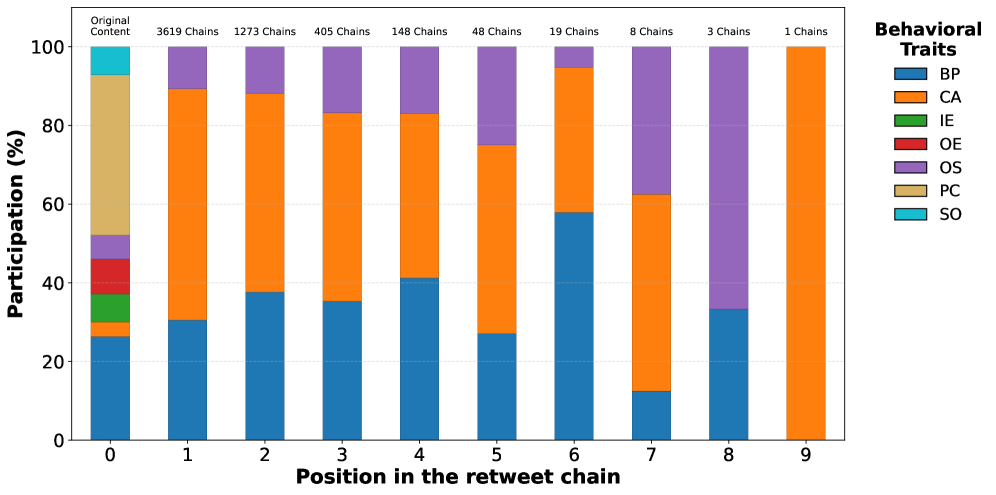
Agent-based interactions within the simulated environment give rise to two distinct, yet interconnected, networks that illuminate the dynamics of social information flow. The Re-sharing Network visualizes how content propagates as agents redistribute information, effectively mapping the pathways of influence and highlighting key disseminators. Complementing this, the Interaction Network captures direct engagement – comments, reactions, and other forms of immediate response – between individual agents. This network reveals patterns of social connection and provides insights into which agents are most actively involved in shaping conversations. Together, these networks offer a comprehensive picture of the social landscape, illustrating not just what information is spreading, but how and between whom, ultimately revealing the underlying mechanisms of social influence and community formation.
The social connections within these simulated environments are far from fixed; instead, they represent a constantly shifting terrain molded by agent actions. As individuals share content, offer commentary, and respond to one another, the pathways of information flow and direct engagement are continually redrawn. This creates a dynamic social landscape where relationships aren’t predetermined but emerge through interaction, leading to fluctuations in network density, the formation of temporary clusters, and the ongoing reshaping of influence pathways. The evolving structure isn’t simply a record of past exchanges, but a key determinant of future interactions, impacting how readily new information disseminates and how quickly communities coalesce or fragment within the system.
The architecture of social networks-specifically, how information travels and individuals connect-offers a powerful lens for understanding complex social phenomena. Analyzing the evolving structure of these networks reveals patterns in information diffusion, demonstrating not just how content spreads, but also who influences its propagation and where key bottlenecks or amplifying nodes exist. This dynamic network perspective extends beyond simple information flow, providing insights into the formation of communities as agents cluster around shared interests or influential individuals. Furthermore, observing how interactions change over time allows researchers to model the mechanisms of social influence, revealing how opinions are shaped, behaviors are adopted, and collective action emerges from individual interactions within these constantly shifting digital landscapes.
Simulations of agent interactions reveal a robust cycle of content dissemination, characterized by a near-equal distribution between initial content creation and subsequent re-sharing – a ratio of 59.17% for first-order actions versus 40.83% for second-order amplification. This balance suggests a self-sustaining dynamic where content not only originates but is actively propagated throughout the network. Further analysis indicates an average propagation chain length of 2.79 when recommendations are generated randomly; notably, this figure significantly exceeds the chain length observed with preference-based recommendations (p<0.05). This finding implies that while personalized recommendations can efficiently target existing interests, random exposure plays a crucial role in extending the reach of information and fostering broader engagement across the social landscape.
The pursuit of realistic simulation, as demonstrated in this study of generative agent-based models, echoes a fundamental principle of elegant design. The paper highlights how explicitly modeling behavioral traits enhances the accuracy of social media simulations, moving beyond mere structural reproduction to capture the nuances of user action. This focus on distilling complex behaviors into essential components aligns with John McCarthy’s observation: “It is often easier to say what something is not than what it is.” The researchers, in essence, define user behavior not by attempting to encompass all possibilities, but by carefully delineating key traits, mirroring the power of subtraction in achieving clarity and a more truthful representation of the simulated social network.
Further Lines
The pursuit of verisimilitude in simulation often resembles an asymptotic approach. This work clarifies that behavioral traits, when explicitly modeled, demonstrably refine the fidelity of generative agent-based models. However, refinement is not resolution. Current implementations still rely on simplified representations of human motivation – traits are assigned, not emerged. The next challenge lies in endowing agents with internal states that dynamically modulate these traits based on simulated experience.
Network centrality metrics, while useful for broad comparisons, offer limited insight into the qualitative differences in content propagation. A deeper understanding requires not merely that information spreads, but how it alters agent beliefs and behaviors. The incorporation of cognitive biases – and their attendant irrationalities – represents a necessary, if uncomfortable, progression.
Ultimately, the value of these models rests not in their predictive power, but in their capacity to reveal the unexpected consequences of simple rules. To chase perfect prediction is to mistake the map for the territory. The true utility lies in identifying the points where simulation diverges from observation – these discrepancies are not errors, but opportunities for genuine insight.
Original article: https://arxiv.org/pdf/2601.15114.pdf
Contact the author: https://www.linkedin.com/in/avetisyan/
See also:
- Invincible Season 4 Episode 4 Release Date, Time, Where to Watch
- Physics Proved by AI: A New Era for Automated Reasoning
- Gold Rate Forecast
- American Idol vet Caleb Flynn in solitary confinement after being charged for allegedly murdering wife
- Total Football free codes and how to redeem them (March 2026)
- Olivia Colman’s highest-rated drama hailed as “exceptional” is a must-see on TV tonight
- “Wild, brilliant, emotional”: 10 best dynasty drama series to watch on BBC, ITV, Netflix and more
- Goddess of Victory: NIKKE 2×2 LOVE Mini Game: How to Play, Rewards, and other details
- Nicole Kidman and Jamie Lee Curtis elevate new crime drama Scarpetta, which is streaming now
- Country star Maren Morris blasts Trump supporters for backing ‘cornball’ president in fiery rant
2026-01-23 00:59