Author: Denis Avetisyan
Researchers are using artificial intelligence to create realistic simulations of couples therapy sessions, offering new avenues for training and understanding relationship dynamics.
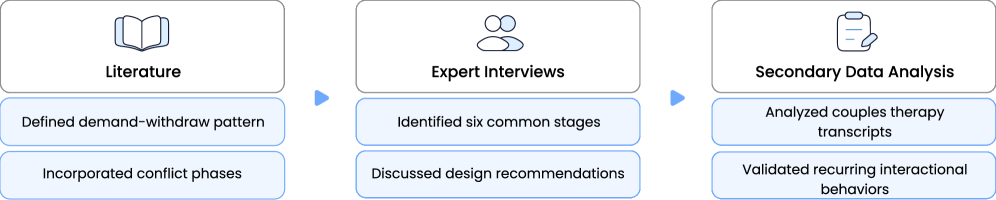
This study details a multi-agent system, driven by large language models, designed to realistically model interactions and the demand-withdraw cycle in couples therapy.
Despite the established benefits of couples therapy, training therapists to navigate complex relational dynamics remains challenging due to the difficulty of replicating real-world nuance. This paper presents ‘Modeling Multi-Party Interaction in Couples Therapy: A Multi-Agent Simulation Approach’, detailing a novel multi-agent system-informed by research on the demand-withdraw cycle-designed to provide a low-stakes training environment for aspiring therapists. Evaluation with licensed clinicians demonstrated that the simulation achieved higher ratings for realism and agent responsiveness compared to a baseline system, effectively identifying engineered interaction stages. Could such a framework, fusing human-computer interaction with therapeutic practice, fundamentally reshape the future of couples therapy training and beyond?
The Evolving Landscape of Connection: Recognizing Relational Patterns
Many couples fall into predictable, yet damaging, interaction patterns, and the Demand-Withdraw Cycle is particularly prevalent. This dynamic arises when one partner expresses needs or complaints – the ‘demand’ – while the other responds by shutting down, becoming defensive, or physically withdrawing – the ‘withdraw’. This isn’t necessarily a conscious choice; often, it’s an unconscious reaction rooted in attachment styles and past experiences. The demanding partner may escalate their efforts, perceiving the withdrawal as rejection or disinterest, which then reinforces the withdrawing partner’s need to disengage. This creates a negative feedback loop where both individuals feel unheard and misunderstood, ultimately eroding the emotional connection. Recognizing this cycle is a crucial first step in couples therapy, as it reframes conflict not as a personal failing, but as a maladaptive pattern that can be addressed with targeted interventions.
Couple therapies aren’t monolithic; rather, distinct approaches offer varied pathways to improved relational health. Behavioral Couple Therapy (BCT) focuses on identifying and modifying specific problematic behaviors within the relationship, often utilizing skills training and contingency management to foster positive interactions. In contrast, Emotionally Focused Couple Therapy (EFT) delves into the underlying emotional needs of each partner, seeking to reconstruct attachment bonds and create a more secure emotional connection. While BCT aims to change what couples do, EFT concentrates on why they do it, exploring the emotional landscape driving negative cycles. Both methodologies acknowledge recurring interaction patterns, such as the demand-withdraw cycle, but diverge in their strategies for intervention – BCT through behavioral change and EFT through emotional responsiveness and attachment repair.
While effective couples therapies – like Emotionally Focused Therapy and Behavioral Couple Therapy – possess well-defined techniques, translating these approaches into consistent clinical practice presents a considerable hurdle. Research indicates a significant gap between theoretical knowledge and actual application among therapists, even those with years of experience. This inconsistency isn’t necessarily due to a lack of skill, but rather the complexities inherent in applying nuanced therapeutic models to the unique dynamics of each couple. Standard training often relies heavily on simulated scenarios and observational learning, methods that, while valuable, may not fully prepare therapists for the unpredictable nature of real-world interactions. Consequently, ensuring that therapists consistently and accurately implement these evidence-based techniques remains a primary focus for ongoing professional development and a crucial area for improving outcomes in couples therapy.
The preparation of couples therapists frequently centers on role-playing exercises and observational learning, techniques that, while valuable, present inherent limitations. These methods often struggle to fully replicate the complexities of authentic couple interactions, potentially leading to a narrowed understanding of nuanced behavioral patterns. Furthermore, the subjective nature of observation can introduce inconsistency in skill development, as interpretations of therapeutic techniques may vary significantly between trainees and supervisors. This reliance on simulated scenarios and individual assessments raises concerns about the transferability of learned skills to real-world clinical settings, where unpredictable dynamics and deeply entrenched emotional patterns demand adaptable and consistently applied therapeutic interventions. Consequently, there’s a growing need for more robust and standardized training protocols to ensure therapists are equipped to effectively address the multifaceted challenges inherent in couples therapy.
Constructing a Practice Environment: Simulation as a Catalyst for Growth
Simulation-based training provides a standardized and repeatable practice environment for couples therapists, overcoming limitations inherent in traditional training methods such as reliance on role-play with peers or limited access to direct observation of experienced clinicians. This approach allows therapists to encounter a wider range of presenting problems and patient behaviors than typically available in live supervision, and facilitates focused practice on specific therapeutic skills. The controlled environment enables objective measurement of therapist performance through pre-defined metrics, providing targeted feedback and supporting skill refinement. Furthermore, simulation mitigates potential ethical concerns associated with practicing on real clients, offering a safe space to experiment with different interventions and build confidence.
The Couples Therapy Simulator utilizes Virtual Patient Agents (VPAs) to generate dynamic and responsive simulated clients. These VPAs are driven by Large Language Models (LLMs), specifically fine-tuned on extensive datasets of couples therapy transcripts and psychological profiles. This allows the VPAs to exhibit realistic conversational patterns, emotional expression, and consistent personality traits relevant to common presenting problems in couples therapy. The LLM architecture enables the VPAs to respond to therapist interventions in a contextually appropriate manner, creating a highly interactive and believable therapeutic environment. Furthermore, the system allows for the configuration of VPA characteristics, such as attachment style and communication patterns, to generate a wide range of scenarios and client presentations.
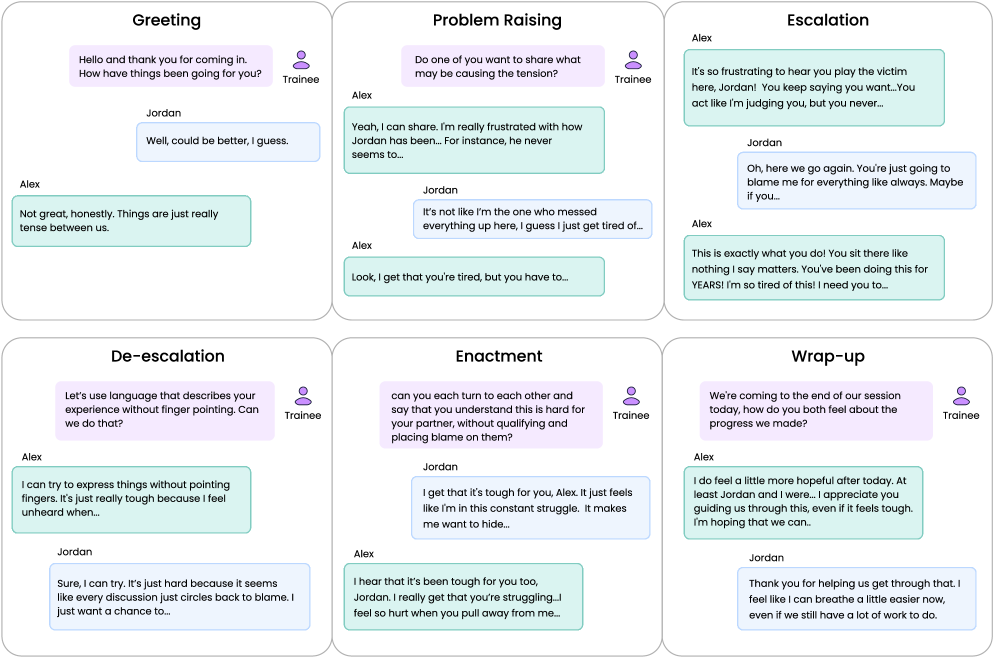
The Couples Therapy Simulator employs a structured approach to training, organizing each session into Six Interaction Stages. These stages – Initial Contact, Collaborative Assessment, Goal Setting, Interventional Techniques, Relapse Prevention, and Termination – are designed to replicate the typical progression of couples therapy. A Stage-Based Interaction Controller manages the flow of dialogue and prompts, ensuring the simulation adheres to the defined stage and presents relevant conversational cues. This controller dynamically adjusts the Virtual Patient Agent’s responses based on therapist input and the current stage, facilitating a realistic and focused training experience. Progression between stages is governed by pre-defined criteria related to therapeutic progress, allowing for consistent and repeatable scenario delivery.
The simulation environment enables the creation of standardized clinical scenarios that can be repeated multiple times with different therapists, controlling for variables present in live training or actual clinical practice. This repeatability facilitates the objective assessment of therapist performance through pre-defined metrics, such as adherence to therapeutic techniques, quality of empathic responses, and effectiveness in addressing specific client issues. Data collected during simulated sessions-including dialogue, response times, and chosen interventions-can be quantified and analyzed to provide therapists with targeted feedback and identify areas for improvement, moving beyond subjective evaluations common in traditional supervision models.
Mirroring Reality: Validating the Simulator’s Authenticity
Simulator fidelity was assessed by comparing its outputs to the Alexander Street Counseling Transcripts, a publicly available database comprised of audio and transcripts from actual therapy sessions. This corpus provides a benchmark of realistic language use, interaction patterns, and therapeutic dialogue. Validation involved analyzing simulated sessions and statistically comparing key characteristics – such as utterance length, topic shifts, and emotional tone – to those observed within the Alexander Street data. This approach ensured the simulator’s behavior aligned with established patterns of authentic therapeutic interactions, establishing a foundation for ecologically valid training scenarios.
Hierarchical Generalized Least Squares (GLS) was utilized to quantify the similarity between language features and interaction dynamics within the simulated therapy sessions and those documented in the Alexander Street Counseling Transcripts. GLS is a regression technique appropriate for analyzing nested or hierarchical data, accounting for potential correlations within the transcripts and simulator outputs. This statistical approach enabled a comparison of multiple linguistic variables – including utterance length, lexical diversity, and sentiment analysis scores – as well as interaction characteristics such as turn-taking frequency and response latency. By modeling the covariance structure of these variables, GLS provided robust estimates of the differences between the simulator and the real-world transcripts, facilitating a statistically rigorous validation process.
The simulation utilizes a Text-to-Speech (TTS) model to synthesize vocalizations for the Virtual Patient Agents (VPAs). This integration moves beyond text-based interactions, introducing auditory cues designed to enhance the realism of the simulated therapeutic environment. The TTS model is parameterized to produce speech with variations in prosody, intonation, and emotional tone, reflecting the simulated patient’s current emotional state and conversational context. This auditory component is intended to improve the trainee’s ability to interpret non-verbal communication and build rapport, thereby increasing the effectiveness of the training experience.
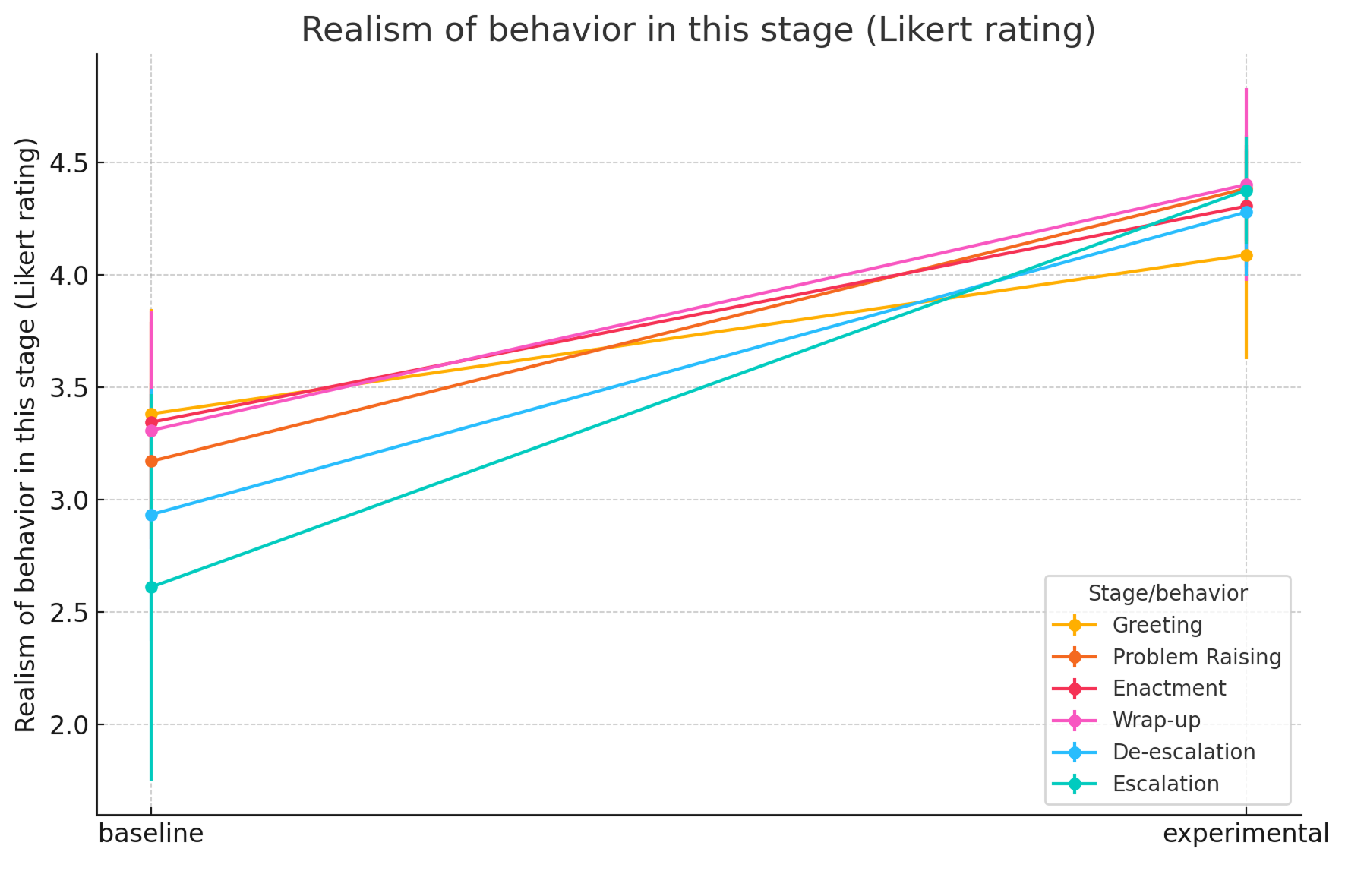
Validation against licensed therapists revealed statistically significant improvements in both perceived realism and training effectiveness. Therapists demonstrated greater accuracy in identifying interaction stages, as indicated by a Beta coefficient of 0.082 with a p-value less than 0.05. Furthermore, recognition of the Demand-Withdraw cycle was significantly enhanced, with a Beta coefficient of 1.841 and a p-value less than 0.001. These results, derived from comparative analysis, suggest the simulator effectively improves a therapist’s ability to discern key relational dynamics within a counseling session.
Statistical analysis demonstrated a significant improvement in the overall realism of the simulation, as indicated by a Beta coefficient of 1.451 with a p-value less than 0.001. This improvement was particularly pronounced in the realism of virtual patient responses, which exhibited a Beta coefficient of 1.254 (p < 0.001). These values, derived from comparative analysis against the Alexander Street Counseling Transcripts using Hierarchical Generalized Least Squares, suggest a strong positive correlation between the simulated interactions and authentic therapeutic dialogues, specifically regarding the perceived naturalness and appropriateness of the virtual patient’s communication.
Expanding the Horizon: Implications for the Future of Relational Therapy
The creation of a functional Couples Therapy Simulator signifies a pivotal advancement in the application of simulated environments to mental healthcare training. This achievement extends beyond simply replicating therapeutic dialogue; it establishes a proof-of-concept for immersive, repeatable practice across a spectrum of therapeutic approaches. By providing a safe and controlled setting for trainees to hone their skills – managing challenging patient dynamics, applying specific techniques, and receiving immediate feedback – simulation offers a valuable complement to traditional methods like live supervision and role-playing. The demonstrated efficacy in couples therapy suggests a broader potential for developing similar simulators for individual psychotherapy, trauma counseling, and even psychiatric interviewing, ultimately promising to enhance therapist competence and improve patient outcomes across diverse clinical settings.
Building on the architecture of the Couples Therapy Simulator, systems like Roleplay-doh represent a significant step towards democratizing access to high-quality counselor training. These platforms leverage virtual reality and artificial intelligence to create repeatable, customizable training scenarios, removing geographical and logistical barriers that often limit professional development opportunities. Importantly, the scalable nature of these simulations allows training programs to accommodate a larger number of trainees simultaneously, and at a reduced cost compared to traditional methods like live role-playing with experienced supervisors. By providing a safe and controlled environment for practicing difficult conversations and refining therapeutic techniques, Roleplay-doh and similar systems empower counselors to hone their skills and ultimately deliver more effective care to clients, regardless of location or institutional resources.
Ongoing development centers on tailoring the therapeutic simulation to both the trainee’s expertise and the nuanced characteristics of virtual patients. Researchers aim to implement adaptive algorithms that assess a therapist’s performance – identifying strengths and areas needing improvement – and dynamically adjust the simulation’s complexity and challenges. Simultaneously, patient profiles will evolve beyond basic demographics to encompass detailed psychological histories, attachment styles, and communication patterns, creating uniquely responsive virtual clients. This personalization intends to move beyond generalized training exercises, offering highly specific practice opportunities that mirror the unpredictable nature of real-world clinical encounters and maximize skill development for individual counselors.
The potential impact of this simulated therapeutic environment extends beyond simply providing practice scenarios; it offers a pathway to demonstrably improve the efficacy of couples therapy itself. By allowing therapists to refine their skills in a controlled, repeatable setting – receiving immediate feedback on communication patterns and intervention strategies – the technology fosters a level of competence difficult to achieve through traditional supervision alone. Furthermore, the ability to tailor simulations to specific therapist skill gaps and patient presentations promises a more personalized and effective training experience, ultimately leading to better outcomes for couples seeking help and a stronger, more confident cohort of licensed counselors entering the field. This isn’t merely about practicing techniques, but about cultivating a deeper understanding of relational dynamics and honing the nuanced skills required to navigate complex emotional landscapes.
The pursuit of realistic modeling, as demonstrated by this multi-agent simulation of couples therapy, inherently acknowledges the inevitable entropy of any complex system. Each iteration of the simulation, refining the LLM’s responses and agent interactions, represents an attempt to delay the decay towards unrealistic behavior. As Claude Shannon observed, “The most important thing in communication is to convey the meaning without distortion.” This principle applies equally to simulating human interaction; the system strives to preserve the nuanced communication patterns of couples, even as it operates within the constraints of algorithmic representation. The fidelity of the Demand-Withdraw cycle modeled speaks to the effort of minimizing that distortion, acknowledging that perfect replication is an asymptotic goal, not a fixed destination.
What Lies Ahead?
This work, in its attempt to model the intricate dance of couples therapy, reveals not so much a destination achieved, but a deepening awareness of the territory. The simulation, while demonstrably improved, remains an echo of lived experience-a sophisticated mimicry, not a replication. Each successful iteration, each nuanced response from the virtual patients, merely highlights the chasm between algorithmic understanding and the chaotic beauty of human interaction. Every bug is a moment of truth in the timeline, a stark reminder that the system’s fragility mirrors its subjects.
The pursuit of realism, however, feels increasingly like chasing a receding horizon. The true challenge lies not in perfecting the simulation of demand-withdraw cycles, but in acknowledging the inherent limitations of such models. The value, perhaps, resides in exploring what cannot be simulated – the subtle shifts in affect, the unspoken histories, the unpredictable emergence of genuine connection. These are not flaws in the system; they are the very essence of the lived experience, and therefore beyond the reach of even the most advanced LLMs.
Technical debt is the past’s mortgage paid by the present, and the accumulation of increasingly complex models will demand ever-greater resources. The field must confront the question of diminishing returns. Will further refinement yield proportionate gains in therapeutic insight, or will it simply create a more convincing illusion? The future likely rests not in building ever-more-detailed simulations, but in thoughtfully integrating these tools with human expertise, recognizing that the most effective therapy will always be a collaboration, not a replacement.
Original article: https://arxiv.org/pdf/2601.10970.pdf
Contact the author: https://www.linkedin.com/in/avetisyan/
See also:
- Clash Royale Best Boss Bandit Champion decks
- Vampire’s Fall 2 redeem codes and how to use them (June 2025)
- Best Arena 9 Decks in Clast Royale
- Country star who vanished from the spotlight 25 years ago resurfaces with viral Jessie James Decker duet
- World Eternal Online promo codes and how to use them (September 2025)
- JJK’s Worst Character Already Created 2026’s Most Viral Anime Moment, & McDonald’s Is Cashing In
- ‘SNL’ host Finn Wolfhard has a ‘Stranger Things’ reunion and spoofs ‘Heated Rivalry’
- Solo Leveling Season 3 release date and details: “It may continue or it may not. Personally, I really hope that it does.”
- M7 Pass Event Guide: All you need to know
- Kingdoms of Desire turns the Three Kingdoms era into an idle RPG power fantasy, now globally available
2026-01-20 18:57