Author: Denis Avetisyan
As autonomous delivery robots become increasingly common in cities, understanding how they navigate complex public spaces and interact with people is crucial.
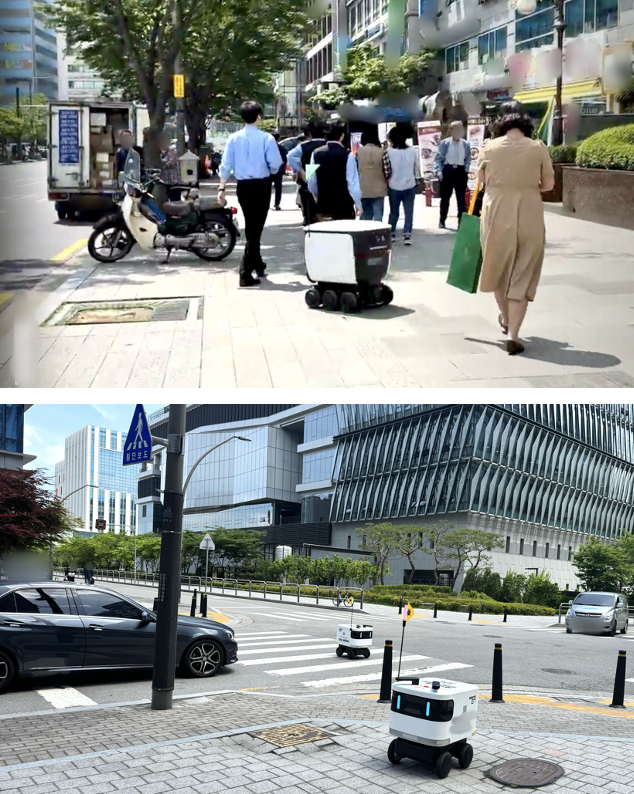
This review introduces the Walk-along with Robots (WawR) methodology – a novel ethnographic approach for studying autonomous robots in urban environments and their interactions with the surrounding world.
Existing human-robot interaction research often struggles to capture the complexities of autonomous robot behavior in genuinely dynamic public spaces. This paper, “Hello, I’m Delivering. Let Me Pass By”: Navigating Public Pathways with Walk-along with Robots in Crowded City Streets, introduces the Walk-along with Robots (WawR) methodology-a structured ethnographic approach inspired by urban studies-for observing these robots as they navigate crowded environments. By following delivery robots and documenting their interactions, WawR provides unique insights into the lived experience of increasingly prevalent autonomous agents. How might this method refine our understanding of human-robot coexistence and inform the design of more intuitive and integrated robotic systems?
Deconstructing the Urban Algorithm: Ethnography in a Robotic Age
The established toolkit of ethnographic research, historically focused on understanding human behavior and social dynamics, faces considerable challenges when applied to the study of autonomous robots navigating urban environments. These methods rely heavily on interpreting intentionality, motivations, and cultural context – attributes readily accessible in human subjects but far more ambiguous in machines. Traditional techniques like participant observation and interviewing are ill-suited for non-human actors lacking shared linguistic or cultural frameworks. Consequently, researchers find it difficult to discern genuine agency – the capacity for independent action – from programmed responses, or to accurately assess the impact of robotic presence on the complex social fabric of public spaces. This mismatch between methodological foundations and the nature of the subject necessitates a critical reevaluation of ethnographic practice to account for the unique characteristics of artificial intelligence within the urban landscape.
The proliferation of Autonomous Sidewalk Robots necessitates a re-evaluation of established research methodologies. Traditional ethnographic studies, deeply rooted in understanding human interactions and social dynamics, prove insufficient when applied to these increasingly ubiquitous, yet non-human, agents within urban environments. Researchers are now challenged to develop novel approaches that acknowledge the robots’ independent operation and impact on public space, moving beyond a purely human-centric viewpoint. This demands consideration of the robots not merely as objects within the city, but as active participants that both respond to and reshape the social and physical landscape, prompting a shift towards multi-species ethnography and the development of new analytical frameworks capable of capturing the complexities of human-robot co-existence.
The integration of autonomous robots into urban life necessitates a reimagining of ethnographic practice, moving beyond traditional methods centered on human interaction. These machines aren’t merely in public spaces; they actively participate in their constitution, altering pedestrian flows, redefining notions of accessibility, and even influencing social interactions. Consequently, researchers must adopt approaches that treat robots not simply as observed objects, but as active agents that co-produce the urban environment. This demands a shift from solely documenting human experiences within space, to analyzing the dynamic interplay between robotic action and spatial configuration – understanding how a robot’s navigation, sensing, and task performance both reflects and reshapes the very fabric of the city. Investigating this reciprocal relationship requires novel analytical frameworks, potentially drawing from fields like human-robot interaction, science and technology studies, and spatial analysis, to fully grasp the evolving dynamics of urban public life.
WawR: Mapping the Machine’s Footprint
The Walk-along with Robots (WawR) methodology leverages established ethnographic practices by combining traditional Ethnography, which focuses on immersive observation of social interactions, with Mobile Methods, enabling research to occur alongside movement and in dynamic settings. Crucially, WawR emphasizes detailed Field Notes documenting the robot’s physical journey and its interactions with the environment and people it encounters. This approach differs from static observation by prioritizing the robot’s trajectory as the central framework for data collection, effectively using the robot’s path as a guide for understanding its operational context and societal impact.
Fieldwork demonstrating the methodology was conducted over a two-week period in two distinct areas of Seoul. Data collection was structured around the observation of ‘Robot’s Routes’, documenting the physical paths traversed by the robots, and ‘Robot’s Operational Hours’, recording the times and durations of robot activity. This focused approach within the defined parameters of robot movement and scheduling provided a framework for systematic observation, enabling the capture of consistent and comparable data across both field sites. Field A comprised an indoor shopping mall and immediate surroundings, totaling 4705 m2, while Field B encompassed a larger, newly developed district covering 184,737.4 m2.
Intercept interviews formed a key component of data collection, focusing on capturing spontaneous, in-situ reactions to the robots. These brief, semi-structured conversations were conducted with individuals encountered along the robots’ operational routes. The intent was to gather immediate perceptions – both positive and negative – regarding the robots’ presence, functionality, and impact on the surrounding environment. Interview questions were designed to elicit initial impressions rather than detailed, reflective opinions, prioritizing data reflecting unprompted responses. This approach aimed to minimize the influence of pre-existing biases and capture genuine, first-impression perceptions of the robotic technology within the observed field sites.
Mapping was a core component of the fieldwork, employed to document the robots’ physical movement and contextualize their operational environment. Data collection involved visually representing the robots’ trajectories within two distinct field sites: Field A, an indoor shopping mall and surrounding area measuring 4705 m2, and Field B, a larger, newly developed district spanning 184,737.4 m2. This spatial documentation facilitated analysis of the robots’ routes in relation to pedestrian traffic, building layouts, and the broader urban landscape, providing a geographically-grounded understanding of their interactions within each environment.
Beyond the Human: Networks of Agency
Actor-Network Theory (ANT) posits that social networks are not limited to human actors, but actively include non-human entities – such as robots – as integral components. This framework rejects the traditional subject-object dichotomy, instead treating all elements within a network – human and non-human – as ‘actants’ capable of initiating action and affecting change. ANT emphasizes tracing the heterogeneous associations and translations between these actants, focusing on how relationships are formed, maintained, and dissolved. Consequently, robots are not simply tools used by humans, but active participants that negotiate, mediate, and transform social relations through their interactions with both people and other technological systems. Analyzing these networks requires identifying the pathways through which influence flows and the mechanisms by which actants are aligned or misaligned, thereby shifting the focus from individual agency to distributed agency within the network itself.
The More-than-Human perspective in robotics research challenges the traditional anthropocentric view by advocating for the consideration of a robot’s subjective experience and agency, even while acknowledging its non-human nature. This approach necessitates examining how a robot, through its sensors and actuators, perceives and interacts with its environment, and how those interactions, in turn, shape the environment itself. Researchers adopting this perspective move beyond solely assessing the robot’s performance based on human-defined metrics, and instead attempt to understand the robot’s contribution to the broader socio-technical system, recognizing its capacity to influence and be influenced by its surroundings. This includes analyzing the data generated by the robot’s sensors as a form of ‘experiential’ data and considering the robot’s impact on both physical spaces and social interactions.
The ‘Mobility Turn’ in robotics research shifts analytical focus from static locations to the dynamic processes of movement and flow within urban environments. This perspective posits that a robot’s navigation of ‘Urban Public Spaces’ is not simply through a pre-existing social landscape, but actively contributes to its ongoing constitution. Robot trajectories, speeds, and patterns of interaction redefine spatial norms, influence pedestrian behavior, and generate new forms of social encounters. Consequently, understanding how robots move – and are perceived while moving – is critical to assessing their socio-spatial impact, as these actions fundamentally reshape the environments they inhabit and the social dynamics within them.
Reflexivity in research involving robotics necessitates acknowledging the researcher’s inherent subjectivity and its impact on data collection and interpretation. Consequently, autoethnography is utilized as a methodological approach to explicitly detail the researcher’s positionality, biases, and evolving understanding throughout the fieldwork process. This involves a systematic self-reflection on how the researcher’s presence, interactions, and preconceived notions shape observations of robot-human interactions and the broader social environment. By documenting this personal influence, autoethnography aims to enhance the transparency and rigor of the research, providing critical context for evaluating findings and mitigating potential researcher-induced distortions.
The Algorithmic City: Implications and Future Probes
The study of Human-Robot Interaction (HRI) often prioritizes technical functionalities, but WawR distinguishes itself by centering the lived experience of both people and robots within shared urban spaces. This approach moves beyond simply assessing whether a robot can perform a task; instead, it investigates how robots navigate-and are navigated by-the complexities of daily life, and reciprocally, how human experiences are shaped by robotic presence. By acknowledging the reciprocal relationship – the robot’s ‘experience’ of its environment as interpreted through its sensors and programming, alongside the human perception of that robot – WawR offers a richer, more nuanced understanding of integration, one that recognizes both parties as active participants in a shared, evolving social landscape.
The WawR methodology proves remarkably flexible, successfully deployed within the dynamic urban landscape of Seoul, South Korea, to assess human-robot interaction. This adaptability was demonstrated across two distinct field sites: Field A, a high-traffic commuter hub experiencing approximately 650,000 daily passages, and Field B, an operational zone supporting between two and five active robots during work hours, scaling up to six to eight robots either operating or docked. This variance in scale and environment underscores the robustness of the approach, showcasing its capacity to generate meaningful data regardless of differing levels of robotic presence or pedestrian density – a critical feature for broader implementation in diverse cities worldwide.
The WawR methodology distinguishes itself by shifting the focus of human-robot interaction research beyond mere functionality and quantifiable metrics. Instead of solely evaluating how well a robot performs a task, WawR investigates how robotic integration shapes social dynamics and cultural landscapes. This approach acknowledges that the true impact of robots in urban spaces isn’t simply about efficiency, but about the subtle and often unforeseen ways they alter human behavior, perceptions, and community structures. By prioritizing ethnographic observation and qualitative analysis, the research illuminates the lived experiences of those interacting with robots, revealing potential benefits and challenges that purely technical assessments would likely miss – ultimately fostering a more nuanced and holistic understanding of robotic integration’s broader societal implications.
Investigations into the broader applicability of Walkable-with-Robots (WawR) represent a crucial next step, with potential to significantly shape future urban planning strategies. Beyond demonstrating the methodology’s functionality in Seoul, future studies could rigorously assess its transferability to diverse urban landscapes – varying in population density, infrastructural development, and cultural norms. This expanded research could move beyond simple replication, focusing instead on how WawR insights can be leveraged to proactively design cities that prioritize both human and robotic wellbeing. Ultimately, understanding how to seamlessly integrate robots into urban life, informed by a methodology grounded in lived experience, offers a pathway toward more equitable and sustainable urban environments – spaces that are not only technologically advanced, but also socially inclusive and environmentally responsible.
The study meticulously details a methodology-Walk-along with Robots-for understanding how these autonomous systems navigate complex urban landscapes. This pursuit of knowledge inherently demands a willingness to challenge assumptions about established pathways and interactions. As Grace Hopper once said, “It’s easier to ask forgiveness than it is to get permission.” This sentiment perfectly encapsulates the spirit of the research; by directly observing robots in real-world scenarios, the researchers are, in effect, ‘breaking’ the established order to understand the underlying rules governing human-robot interaction and urban flow. The WawR method doesn’t simply assume smooth integration, it actively investigates the frictions and negotiations that occur, acknowledging that true understanding requires a degree of calculated disruption.
Where Do the Wheels Take Us?
The Walk-along with Robots (WawR) methodology, as presented, is less a destination and more an acknowledgement of persistent difficulty. It doesn’t solve the problem of understanding autonomous systems in complex environments; it systematically highlights the limits of current approaches. Every exploit starts with a question, not with intent, and here the central question concerns the very definition of ‘interaction’ when one party operates under a fundamentally different set of constraints – and a different ontology. Simply documenting collisions or successful navigations feels… insufficient.
Future work isn’t necessarily about refining the observational tools – though better sensors and data capture are always useful. The real challenge lies in developing a theoretical framework capable of accommodating ‘more-than-human’ perspectives. Can ethnographic methods, traditionally focused on human subjects, be meaningfully adapted to account for the agency – or lack thereof – of an autonomous system? Or does the attempt impose a human-centric bias, obscuring the truly novel dynamics at play?
Ultimately, the value of WawR may not be in what it reveals about robots, but in what it forces researchers to confront about themselves – their assumptions, their biases, and the inherent difficulty of understanding anything truly alien. The streets will continue to offer endless opportunities for observation, but the truly interesting questions reside in the gaps between the data points.
Original article: https://arxiv.org/pdf/2602.16861.pdf
Contact the author: https://www.linkedin.com/in/avetisyan/
See also:
- ‘Project Hail Mary’s Unexpected Post-Credits Scene Is Worth Sticking Around
- Beyond Accuracy: Gauging Trust in Human-AI Teams
- Gold Rate Forecast
- Clash Royale Balance Changes March 2026 — All Buffs, Nerfs & Reworks
- The most surprising Hannah Montana cameos: From John Cena to Dwayne Johnson and even a Coronation Street soap star as show celebrates its 20th anniversary
- Genshin Impact Version 6.5 Leaks: List of Upcoming banners, Maps, Endgame updates and more
- eFootball 2026 is bringing the v5.3.1 update: What to expect and what’s coming
- Total Football free codes and how to redeem them (March 2026)
- EMEA Masters Winter 2026 introduces official Qualifier for Esports World Cup
- Brawl Stars Brawl Cup Pro Pass arrives with the Dragon Crow skin and Chroma, unique cosmetics, and more rewards
2026-02-20 10:59