Author: Denis Avetisyan
A new approach leverages generative AI and environmental semantics to create a more realistic and intelligent model for integrated sensing and communication systems.
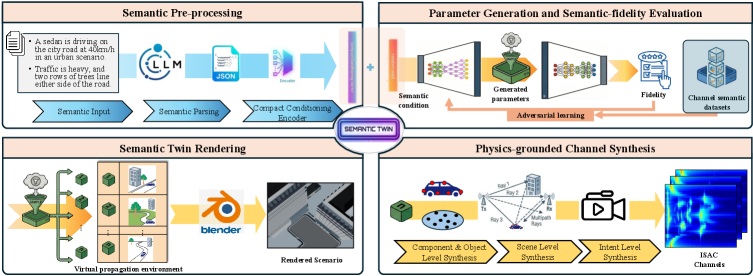
This paper introduces a Semantic Twin Channel Model (STCM) for ISAC, using physics-grounded synthesis and hierarchical mapping to improve the accuracy of wireless propagation prediction.
Current ISAC channel models struggle to reconcile the detailed multipath information crucial for sensing with the computational efficiency required for broad communication system evaluation. This challenge motivates the work presented in ‘Generative AI-Empowered Semantic Twin Channel Model for ISAC’, which proposes a novel approach leveraging environmental semantics and generative AI. The core innovation is a ‘Semantic Twin Channel Model’ (STCM) capable of generating physically plausible channel realizations representative of specific environmental conditions, bridging the gap between semantic understanding and observable channel characteristics. Will this paradigm shift enable truly reproducible ISAC benchmarking and facilitate the design of next-generation integrated sensing and communication systems?
Beyond Statistical Echoes: Embracing Semantic Awareness in Wireless Channels
Statistical channel models have long served as the foundation for wireless communication system design, prized for their mathematical tractability and ease of implementation. These models typically characterize the wireless channel using a limited set of statistical parameters, such as path loss, fading, and noise. However, as integrated sensing and communication (ISAC) gains prominence, the limitations of these simplified approaches become increasingly apparent. Complex environments – including indoor spaces, urban canyons, and dynamic scenarios with moving objects – introduce rich spatial and temporal variations that statistical models struggle to represent accurately. This deficiency hinders the performance of ISAC systems, which rely on precise channel state information not just for reliable communication, but also for accurate target localization and sensing. The inherent abstraction within statistical models, while beneficial for certain applications, proves insufficient when detailed environmental understanding is paramount, creating a need for channel representations that move beyond mere statistical characterization.
The convergence of sensing and communication, driving the field of integrated sensing and communication (ISAC), demands a fundamental shift in how wireless channels are modeled. Traditional approaches, heavily reliant on statistical characterization, prove inadequate for ISAC’s complex requirements because they treat the channel as a mere conduit for signals, ignoring its potential as a source of environmental information. Modern applications-from autonomous navigation and industrial automation to precise localization-require channel models that move beyond simply predicting signal strength and phase; they necessitate models that actively understand the surrounding environment, interpreting reflections, scattering, and interference not as noise, but as data revealing the location, material, and movement of objects. This transition compels researchers to integrate semantic awareness-the ability to ascribe meaning to channel characteristics-into future channel models, enabling ISAC systems to simultaneously communicate and perceive the world around them with unprecedented accuracy and detail.
Contemporary methods for environmental representation, like Digital Twin technologies, frequently prioritize exhaustive replication of physical spaces. While aiming for fidelity, this complete mirroring often results in computationally expensive and inefficient models. The pursuit of perfect realism neglects the potential benefits of abstraction – representing only the essential features relevant to signal propagation. This overemphasis on detail creates significant overhead in data storage, processing, and real-time updates, hindering the scalability and responsiveness crucial for integrated sensing and communication (ISAC) applications. A shift towards strategically simplified representations, focusing on semantic understanding rather than pixel-perfect accuracy, promises a more practical and effective approach to channel modeling.
Existing channel modeling techniques, while foundational, are increasingly inadequate for the demands of integrated sensing and communication (ISAC) systems. Current strategies often prioritize either statistical representation of the wireless environment or complete environmental replication – such as through Digital Twins – but both approaches present limitations. Statistical models lack the granularity to support advanced sensing applications, while comprehensive digital replicas are computationally expensive and often redundant. This gap highlights a pressing need for a new paradigm – one that moves beyond simply characterizing how signals propagate and instead focuses on understanding what the signals are interacting with. A successful advancement will require abstraction, efficiency, and, crucially, the incorporation of semantic awareness – a channel model that doesn’t just predict signal behavior, but ‘understands’ the environment itself, paving the way for more intelligent and adaptable ISAC systems.

Introducing the Semantic Twin Channel Model: A Generative Approach to Environmental Understanding
The Semantic Twin Channel Model (STCM) represents a shift in channel modeling by employing a generative approach focused on Environmental Semantics. This paradigm moves beyond traditional statistical or deterministic methods by explicitly incorporating contextual understanding of the wireless environment. Rather than solely relying on measured data or predefined physical parameters, STCM generates channel realizations based on semantic descriptions of the surroundings – including elements like building types, surface materials, and object locations. This allows for the creation of a wider range of plausible channel conditions, including scenarios not directly represented in training datasets, and facilitates the modeling of complex, realistic wireless propagation environments.
The Semantic Twin Channel Model (STCM) employs Generative AI techniques, specifically deep learning architectures, to establish a functional mapping between semantic data and resultant channel characteristics. This process ingests detailed semantic information, encompassing scene geometry – including layouts and spatial relationships – and object properties such as material composition, size, and reflectivity. The Generative AI then predicts corresponding channel impulse responses, path loss exponents, and delay spreads. This mapping is not a simple lookup; the AI learns the complex, non-linear relationships between semantic features and channel behavior from training data, enabling the generation of diverse and realistic channel realizations given a specific semantic scene description. The system outputs channel characteristics that statistically correlate with the input semantic information, allowing for the creation of channels tailored to specific environments.
Physics-Grounded Channel Synthesis within the Semantic Twin Channel Model (STCM) combines data-driven generative approaches with established physical principles governing electromagnetic wave propagation. This methodology ensures generated channel realizations are not only statistically diverse but also adhere to fundamental physics, such as the laws of reflection, diffraction, and absorption. Specifically, the process incorporates physical constraints – including material properties, antenna characteristics, and geometric configurations – into the generative model, preventing the creation of physically implausible channel responses. By grounding the data-driven generation in physics, the STCM achieves a higher degree of realism and accuracy compared to purely data-driven or purely physics-based channel modeling techniques.
The Semantic Twin Channel Model (STCM) establishes a correlation between environmental semantics and resulting channel behavior through Hierarchical Semantics-to-Channel Mapping. This mapping operates on multiple levels, beginning with broad scene layouts and progressing to specific object characteristics and material properties. Each semantic level informs corresponding channel parameters – for example, room dimensions influence multipath delay spread, while object material dictates reflection and absorption coefficients. This hierarchical approach enables the STCM to model complex propagation effects, accounting for interactions between various elements within a scene and their impact on wireless signal transmission. By linking semantic descriptions directly to quantifiable channel characteristics, the model facilitates the generation of realistic and diverse channel realizations representative of specific environments.
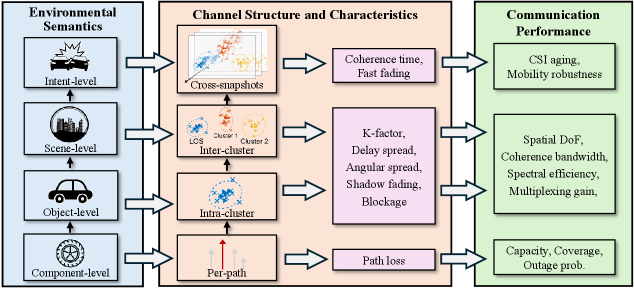
Validating Semantic Fidelity and Adaptability: Demonstrating Real-World Performance
Semantic fidelity, in the context of generated channel realizations, quantifies the degree to which the model accurately reflects the underlying environmental characteristics used as conditioning data. This metric is critical because successful wireless communication and sensing rely on the channel model’s ability to represent the physical world-specifically, how signals propagate and interact with objects within the environment. A high degree of semantic fidelity indicates that the generated channel models are not merely statistically similar to real-world channels, but also preserve the key relationships between environmental features and signal behavior, which is essential for reliable performance evaluation and algorithm development. Accurate representation of these semantic relationships enables the assessment of how well a system will function in a given, realistically modeled environment.
The Statistical Twin Channel Model (STCM) performance was evaluated using target identification as a representative sensing task to demonstrate its ability to accurately perceive the environment. Collaborative target identification achieved a p-value of 95.03%, indicating a statistically significant correlation between the generated channel realizations and the underlying environmental semantics. This result confirms the model’s capacity to faithfully reproduce semantic information relevant to environmental perception, and establishes a quantitative metric for validating the STCM’s performance in realistic sensing applications.
The Spatio-Temporal Channel Model (STCM) incorporates an Online Adaptation capability to maintain performance reliability in non-static environments. This functionality enables continuous model updates based on real-time sensing data, allowing the STCM to dynamically adjust to alterations in the propagation channel. This adaptive process mitigates performance degradation caused by environmental dynamics, such as moving objects or changing weather conditions, and ensures sustained accuracy in tasks like target identification. The system’s ability to recalibrate in response to these changes is critical for deployment in real-world scenarios where environmental conditions are rarely constant.
Model training and validation utilize full-wave electromagnetic (EM) simulations to generate high-fidelity ground truth data, enabling accurate model calibration. Performance in single-observation target identification demonstrates an exceedance probability of 94.24%. This result represents a substantial improvement over the 5.56% exceedance probability achieved by statistical baseline methods, indicating the effectiveness of the simulation-driven training process and the model’s capacity for reliable environmental perception based on limited observations.
Future Implications: Towards Intelligent Networks That Understand Their Surroundings
The advent of Semantic Transmission Channel Modeling (STCM) represents a paradigm shift in wireless network design, moving beyond traditional signal-focused approaches to embrace an understanding of the environment’s meaning. This semantic awareness allows networks to adapt not just to signal strength, but to the context of the communication – discerning, for example, whether a signal obstruction represents a temporary pedestrian or a permanent building. Consequently, networks equipped with STCM can proactively optimize resource allocation, enhance reliability in challenging conditions, and support more sophisticated sensing applications. By interpreting the wireless environment as a carrier of semantic information, these intelligent networks promise improved performance, increased capacity, and the foundation for truly adaptive and context-aware communication systems.
The integration of multi-modal sensing with the Semantic Transmission Channel Model (STCM) dramatically enhances a network’s ability to interpret its surroundings. This approach moves beyond traditional signal-based communication by incorporating data from diverse sources – such as cameras, microphones, and specialized environmental sensors – to create a comprehensive understanding of the wireless environment. By fusing these data streams, the STCM can discern not just the presence of obstacles or interference, but their nature, allowing for proactive adaptation of transmission parameters. This richer environmental awareness translates directly into improved performance, particularly in complex scenarios like crowded urban spaces or dynamic industrial settings, where intelligent resource allocation and interference mitigation are crucial for reliable communication. The system essentially ‘learns’ the environment, enabling it to anticipate challenges and optimize connectivity with a level of sophistication previously unattainable.
The Semantic Transmission and Channel Model (STCM) isn’t merely a theoretical advancement; its design explicitly incorporates adherence to 3GPP standards, a crucial factor for practical implementation. This commitment ensures interoperability with existing and future cellular infrastructure, facilitating a smoother transition towards intelligent networks. By aligning with these widely adopted protocols, the STCM avoids the common pitfall of innovative technologies remaining confined to laboratory settings. Instead, it positions itself as a viable component for integration into real-world 5G and beyond networks, potentially unlocking enhanced performance and novel applications across a broad range of wireless communication systems. This standardization isn’t simply about compatibility; it’s a deliberate strategy to accelerate the deployment and widespread adoption of semantic communication principles.
Conventional wireless communication treats the radio spectrum as a mere conduit for signals, focusing on predicting how those signals will travel and fade. This emerging approach, however, fundamentally shifts that perspective, instead prioritizing an understanding of the meaning embedded within the wireless environment itself. By analyzing subtle changes in signal reflections – not just as impediments to clear transmission, but as indicators of movement, material composition, or even human activity – networks can become truly aware of their surroundings. This semantic understanding allows for adaptive communication strategies, optimized resource allocation, and ultimately, a new level of intelligent connectivity where networks don’t just transmit data, but actively interpret and respond to the world around them, paving the way for applications ranging from proactive safety systems to context-aware smart spaces.
The pursuit of accurate channel modeling, as demonstrated in this work concerning the Semantic Twin Channel Model, inevitably reveals the complexities inherent in representing real-world environments. Systems, even those meticulously constructed with generative AI and physics-grounded synthesis, are not static entities; they evolve and degrade over time. Linus Torvalds observed, “Talk is cheap. Show me the code.” This sentiment applies perfectly to the field – elegant theory must translate into demonstrable, functional models. The STCM, by embracing environmental semantics and hierarchical mapping, attempts to move beyond mere approximation, but acknowledges that even the most sophisticated model is a snapshot, a temporary representation of a continually shifting reality. Observing the nuances of this process, and refining the model iteratively, proves more valuable than pursuing a flawless, unattainable perfection.
What’s Next?
The pursuit of a ‘Semantic Twin Channel Model’ – a faithful echo of propagation environments – inevitably encounters the limitations inherent in any representation. This work establishes a promising avenue, yet the fidelity of physics-grounded synthesis will always be a negotiation with computational cost. The current model, while leveraging generative AI, still relies on initial environmental mappings – a process prone to entropy. Future iterations must address the decay of these mappings over time, and the challenge of maintaining accuracy as environments subtly, then drastically, reconfigure.
Uptime for any predictive model is temporary. The true metric isn’t static accuracy, but rather the speed with which the model adapts to inevitable deviation. A critical direction lies in exploring self-correcting mechanisms – allowing the Semantic Twin to learn and refine its representation through continuous sensing, effectively mitigating the latency inherent in every request for environmental information. The ideal isn’t perfect knowledge, but graceful degradation.
Ultimately, the field will confront a fundamental truth: stability is an illusion cached by time. The long-term viability of ISAC depends not on building an immutable digital twin, but on creating systems that acknowledge and embrace environmental flux. The question isn’t whether the model will fail, but when, and how elegantly it will adapt to its own obsolescence.
Original article: https://arxiv.org/pdf/2601.15642.pdf
Contact the author: https://www.linkedin.com/in/avetisyan/
See also:
- Invincible Season 4 Episode 4 Release Date, Time, Where to Watch
- Physics Proved by AI: A New Era for Automated Reasoning
- How Martin Clunes has been supported by TV power player wife Philippa Braithwaite and their anti-nepo baby daughter after escaping a ‘rotten marriage’
- Total Football free codes and how to redeem them (March 2026)
- CookieRun: OvenSmash coupon codes and how to use them (March 2026)
- Goddess of Victory: NIKKE 2×2 LOVE Mini Game: How to Play, Rewards, and other details
- Gold Rate Forecast
- American Idol vet Caleb Flynn in solitary confinement after being charged for allegedly murdering wife
- “Wild, brilliant, emotional”: 10 best dynasty drama series to watch on BBC, ITV, Netflix and more
- Only One Straw Hat Hasn’t Been Introduced In Netflix’s Live-Action One Piece
2026-01-25 00:01