
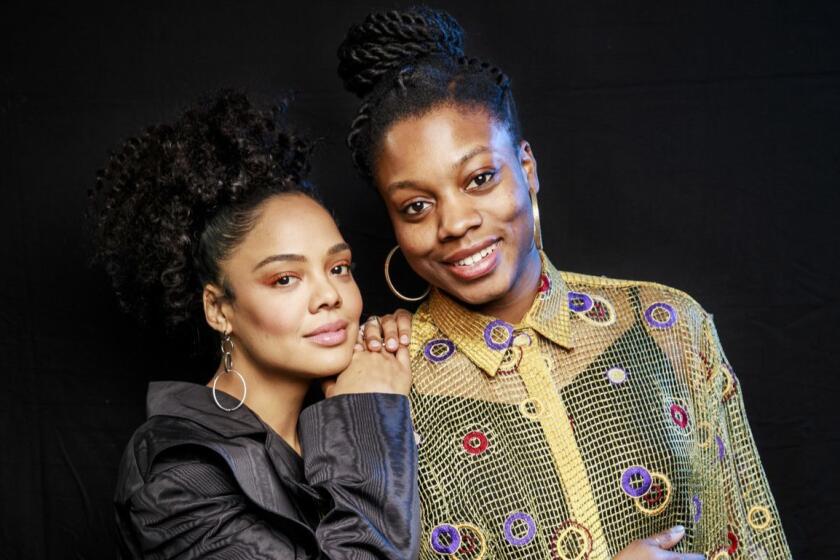
Everyone deserves a friend who looks at them with the same warmth and admiration Nia DaCosta and Tessa Thompson share.
After knowing each other for about ten years, DaCosta describes Thompson simply as “my best friend.”
DaCosta says it’s wonderful to work with someone you truly trust, someone you can be yourself around without worrying about looking silly. She smiles, adding, “It’s freeing to be able to let your guard down like that.”
The film “Hedda” debuted at the Toronto International Film Festival in September. The following day, director DaCosta, 35, and actress Thompson, 42, relaxed in a hotel suite between television interviews, surrounded by lights and cameras.
DaCosta and Thompson first connected at the 2015 Sundance Labs while DaCosta was working on what would become her first film, the 2018 crime drama “Little Woods.” There, DaCosta asked Thompson to be in the movie, confidently stating it was a matter of when she’d make it, not if. Since then, they’ve remained close friends and have supported each other professionally.
In the play “Hedda,” Thompson stars as Hedda Tesman, who was once Gabler. She’s recently married to George (Tom Bateman), a university professor trying to get a better job. They’ve taken out a loan to buy and fix up a large house, and they host a party hoping to impress George’s potential employers. However, the arrival of Eileen Lövborg (Nina Hoss)—a past love of Hedda’s, a talented academic herself, and now a competitor for the job—throws everything off. As the party becomes wilder and more excessive, Hedda begins to manipulate both Eileen and Thea (Imogen Poots), Eileen’s assistant and current partner, to sabotage George’s chances. Hedda appears to be the vibrant center of the party, but she’s also a complex and troubled character at its core.
DaCosta’s adaptation of Ibsen’s play includes significant changes, most notably reimagining the character of Eilert as a woman named Eileen. By also setting the story in 1950s England and through her casting choices, DaCosta brings issues of gender, race, and sexual identity to the forefront, greatly enhancing the play’s central themes.
Thompson’s acting is captivating, combining intelligence, glamour, a sense of unpredictability, and even a hint of danger. Amy Nicholson, a film critic from The Times, praised the movie as a lively and exciting reimagining of the original play, noting that director DaCosta stayed true to the story’s heart while adding new layers of meaning.

Tessa Thompson is the ultimate restless housewife in a viciously updated ‘Hedda’
I have to say, Nia DaCosta, the director behind ‘Candyman,’ has really knocked it out of the park with this new period drama! She and her lead actress breathe incredible life into what could have been a stuffy adaptation of Ibsen’s notorious character. It’s a wonderfully energetic film, and the supporting performances from Imogen Poots and Nina Hoss are fantastic too.
Hedda Gabler is a famously challenging and important role for actresses, often compared to the role of Hamlet for men. Many celebrated performers, including Jane Fonda, Cate Blanchett, and Ingrid Bergman, have taken on the part, as has a member of the current “Hedda” cast, Hoss. Despite its significance, Thompson admits she’s always been more interested in playing Nora from Ibsen’s “A Doll’s House.”
Thompson says she’s relieved she never felt a strong need to play the role of Hedda. However, she knew the play very well and, while preparing for her work on it – possibly to the annoyance of director Nia – she watched as many productions of it as she could find.
Since they first met, DaCosta and Thompson have followed similar career trajectories as women of color in Hollywood. Thompson has been in three “Creed” films, and she’s also known for playing Valkyrie in several Marvel movies like “Thor: Ragnarok” and “Avengers: Endgame.” Beyond blockbusters, she’s also starred in independent films like “Sorry to Bother You” and “Passing,” and appeared on the HBO series “Westworld.”

DaCosta jokingly describes watching her friend Tessa Thompson become famous, saying, “It’s amazing to see Tessa Thompson – the real Tessa Thompson!”
Nia DaCosta has built a unique career in filmmaking. After directing “Little Woods,” she made history with her remake of “Candyman,” becoming the first Black woman to direct a film that debuted at number one in the U.S. She then directed “The Marvels,” making her the youngest director to work on a Marvel movie. Currently, she’s already completed “28 Years Later: The Bone Temple,” a sequel to “28 Days Later,” which is scheduled for release next year.
I was really struck by what Thompson said about DaCosta. Even though she doesn’t know her well personally, she clearly sees DaCosta as a hugely talented filmmaker with a bright future – someone to keep a close eye on. It’s a strong endorsement, and I completely agree!
It’s amazing to be able to grow and learn alongside her,” Thompson says. “She also introduces me to worlds and experiences I probably wouldn’t have discovered on my own.
Movies
While studying in London for her master’s degree, Nia DaCosta, a promising new director, started developing the idea for her first film, “Little Woods,” as she dealt with the difficult emotions of being away from home.
In “Little Woods,” director DaCosta gave Tessa Thompson a role reminiscent of Jennifer Lawrence’s early success in “Winter’s Bone” – a realistic and compelling part she likely wouldn’t have been considered for otherwise. DaCosta continues this trend by casting Thompson in a landmark role for actresses, a role that is rarely given to women of color.
Thompson was struck by the fact that while many talented actresses have played ‘Hedda Gabler,’ few share her background. She’s grateful to have found a friend and creative partner who wanted to include her in the production, as it aligns with the type of stories they want to tell.
DaCosta explains that her diverse career path reflects the kinds of films she aspires to create.
DaCosta explains she wanted the freedom to direct all types of movies, from small, intimate projects to larger-scale dramas and ambitious science fiction films like those by Christopher Nolan. Her work on ‘Candyman’ and the Marvel film were steps toward achieving that goal – gaining the trust and resources to tell her own original stories with varying budgets and in established creative environments.
When preparing to play Hedda, Thompson intentionally waited to reread the original play until after she’d studied Lisa DaCosta’s adaptation, wanting the adaptation to be her main source of understanding. Only then did she explore other translations of the play and watch various productions. This research ultimately deepened her appreciation for how daring and perceptive DaCosta’s version was.
Thompson explains that the original play carries a strong sense of worry about public scandal. When reimagining the character of Hedda, they chose to portray her as someone comfortable with a non-traditional lifestyle – someone confident, sexually liberated, and unafraid of what others might think. This led them to realize they weren’t simply updating the story’s setting, but fundamentally changing it. Unlike many adaptations that just make superficial changes, they were essentially doing a complete overhaul – a ‘gut renovation’ of the original work.
“We’re flipping the house,” interjects DaCosta.

As I was digging into the script, director Destin Daniel Cretton and I realized we wanted to really focus the story on three key characters: Hedda, Thea, and a fascinating reimagining of Lövborg as a woman. It felt like honing in on them would give the story the emotional weight it deserved.
DaCosta explains her vision for the play, set in the 1950s, features a Black, mixed-race woman in the role of Hedda. She’s also reimagining the character of Lövborg as a woman. DaCosta is drawn to telling intricate, layered stories, reflecting the complexity she observes in people every day. She’s fascinated by the contrast between how people present themselves and what lies beneath the surface, and whether they’re aware of being seen so completely.
Playing Hedda was a fantastic challenge because she’s a character who hides her true self behind so many layers. But ultimately, everything falls apart – she’s completely vulnerable and drags everyone around her down with her. It’s a complicated role, but I think we should be more willing to explore how things like sexuality, race, and gender really impact the stories we tell.
A noticeable creative energy sparked between Thompson and DaCosta, as if their exchange of ideas was creating a visible connection.
According to Thompson, when adapting a classic story, you need to be truly invested in the process. He praises Nia’s bold choices in her adaptation, even the parts she removed, which he previously considered essential to the original’s structure. He believes their version embraces a degree of open interpretation, and that willingness to be ambiguous is a brave move in itself.
Thompson explains that Nia is grappling with how to gain control over her life, especially as a woman, when she’s limited both by what society expects and by her own self-imposed restrictions. She also found it interesting to reimagine the character of Lövborg as a woman, as it allowed her to personally connect with and influence the story.
“Yeah, I’m most Lövborg,” agrees DaCosta. “For sure, absolutely.”

The movie builds to a finale that differs from the original play, cleverly using Thompson’s captivating presence on screen. This is just one example of how the director, DaCosta, highlights Thompson’s remarkable talent, almost as if capturing a private, special quality about her.
Thompson recently shared an interesting thought: if you constantly try to please others, how many people are actually satisfied with you? The reality is, you can’t please everyone – it’s simply impossible. Our character, Hedda, exemplifies this struggle. While Nia mentions Hedda acts on impulsive thoughts, at her core, she embodies a desire to live authentically, doing exactly what she wants in each moment. However, the tragedy is that Hedda lacks the courage to fully embrace this freedom and live the life she truly desires.
Similar to the successful creative partnerships of Ryan Coogler and Michael B. Jordan, or Martin Scorsese and Leonardo DiCaprio, Nia DaCosta and Terence Thompson are confident they’ll collaborate again soon. Thompson is currently working on a TV series based on a book for DaCosta, but he’s keeping the title under wraps until the rights are fully secured, not wanting to risk speaking too soon.
DaCosta views her continued partnership with Thompson as a positive, simplifying one aspect of the complex process of filmmaking.
DaCosta is happy to have found someone she really trusts and relies on. She describes this person as a key collaborator, someone she can turn to when working on a story. Even knowing this person is busy, DaCosta feels confident having her review the work, viewing her input as a guiding principle.
Read More
- Clash Royale Best Boss Bandit Champion decks
- Vampire’s Fall 2 redeem codes and how to use them (June 2025)
- World Eternal Online promo codes and how to use them (September 2025)
- Best Arena 9 Decks in Clast Royale
- Country star who vanished from the spotlight 25 years ago resurfaces with viral Jessie James Decker duet
- ‘SNL’ host Finn Wolfhard has a ‘Stranger Things’ reunion and spoofs ‘Heated Rivalry’
- Solo Leveling Season 3 release date and details: “It may continue or it may not. Personally, I really hope that it does.”
- JJK’s Worst Character Already Created 2026’s Most Viral Anime Moment, & McDonald’s Is Cashing In
- M7 Pass Event Guide: All you need to know
- Kingdoms of Desire turns the Three Kingdoms era into an idle RPG power fantasy, now globally available
2025-10-23 13:34