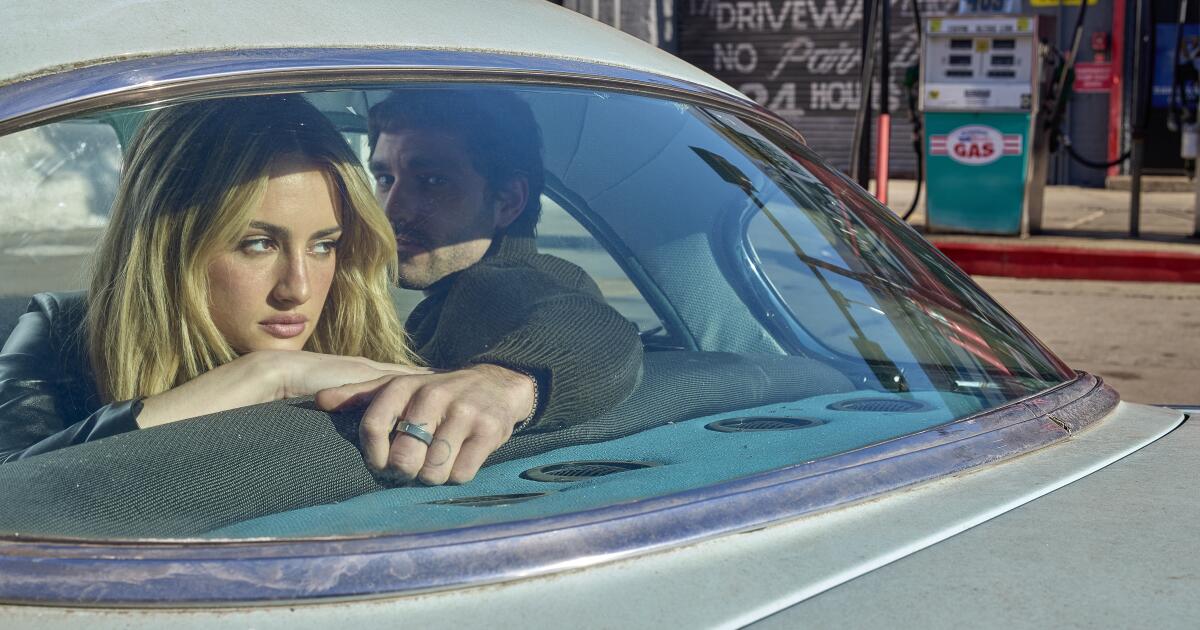
This article contains spoilers from the Season 3 finale of “Tell Me Lies.”
“Tell Me Lies” ended with the hard truth.
The Hulu series, inspired by Carola Lovering’s book, follows the turbulent and controlling relationship between college students Lucy Albright and Stephen DeMarco, played by Grace Van Patten and Jackson White, who are also a couple in real life. Their troubled connection creates drama and upheaval for their friends over an eight-year period.
The third season ended with a dramatic finale on Tuesday, revealing shocking secrets, revisiting familiar patterns, and ultimately breaking apart the core group of friends. However, the biggest question remains: what will happen to the show’s main couple?
Okay, so “Daisy Jones & The Six” really delivered in its finale. We watched Stephen face some serious consequences – Yale rescinded his acceptance, and his engagement imploded. But honestly, after seeing the extent of the emotional damage he caused, does that really feel like enough? The show brilliantly contrasted that with Lucy’s journey; getting kicked out of school was devastating, but years later, and after one more bad decision, she finally broke free from his control – truly, finally. It’s a satisfying ending, especially knowing creator Meaghan Oppenheimer has confirmed this is where the story ends; no second season, which feels right. It wraps things up definitively, and I think that’s a good call.
The New York Times spoke with the three stars of the show – Oppenheimer from her home, and Van Patten and White together from a hotel – to discuss wrapping up the series, Stephen’s relatively light punishment, and the relationship between Bree and Wrigley. The following is an edited and condensed version of their conversation.

Before we get to the final episode, we have some other news: the show won’t be back for another season. Were you hoping for more, or do you think three seasons was the right amount?
I made a collaborative decision with Hulu and 20th Television to end ‘The Patient’ after three seasons. I initially approached this season wanting it to feel conclusive. I always believed three seasons was the right length for a show of this scale, and I had a clear vision for Lucy and Stephen’s story, including their difficult breakup and the events leading up to the wedding. We started the season unsure if it would be renewed, but the positive fan reaction and strong viewership led us to consider continuing. Ultimately, I wanted Lucy and Stephen’s ending to be definitive – that Stephen was destined to hurt her, and that choosing him would mean losing her friends. Continuing the story beyond that and forcing them back together would have weakened the impact of everything we’d built.
Does it feel like the right time to be done with these characters?
It is, though it’s a little sad to see it go. But from a storytelling perspective, it feels like the perfect place to wrap things up. We’ve had a clear start, middle, and end.
White: I like the way that goes out.
Will you be glad to not be the most hated fictional man on TV?
Honestly, I’m just thrilled. It feels really good to finally be able to create something without constantly worrying about upsetting people. It’s been a weird pressure, this feeling like I’m walking on eggshells, almost like a strange social obligation. I’m genuinely excited to be free of that.
Van Patten: Because it’s out of love, but what they’re saying is so negative.
It’s a backhanded compliment – nice on the surface, but actually a little rude. It reminds me of the way Stephen interacts with the other people in the story.


A scene from the series finale of “Tell Me Lies” featuring Grace Van Patten as Lucy Albright. (Photo by Ian Watson/Disney)
Season finales are always tough because fans have high hopes. Knowing there was a chance the show might not continue, how did that uncertainty influence how you concluded the third season?
Oppenheimer explained that while working on the show, he focused on the present and avoided dwelling on future consequences. When the writers finally landed on the Season 3 finale, they realized it wasn’t just a season ender – it was the conclusion of the entire story.
I’m often surprised by some fan theories – it feels like people are watching a completely different show than I am. For example, those expecting Stephen Macy to be arrested… that really stood out to me. It’s something we intentionally kept from the book: he doesn’t face consequences for his actions. The show aims to reflect a difficult truth – that bad people often get away with things in real life.
Can you talk about how you and the writing team landed on the series’ final scene? Specifically, Lucy choosing to leave with Stephen after the wedding falls apart, and then him leaving her at a gas station – what led to that decision?
As a critic, I kept wondering how ‘Oppenheimer’ would resolve its central relationship – would they reconcile, would one walk away, or would they find a way to be together? Honestly, I felt strongly that a happy ending just wouldn’t fit. This isn’t a romance, it’s a story dealing with difficult themes, and specifically, abuse. To me, giving them a feel-good conclusion would have undermined the show’s power and its very serious message. It needed a more honest, and frankly, less optimistic ending to truly resonate.
We’ve discovered Stephen will only let someone go if he’s the one ending things. For Lucy to truly be free, he had to be the one to leave, because that’s the only way she’d realize the situation for what it was.
I often find images for scenes even before I fully understand what they’ll be about. These images are usually symbolic or inspired by stories I’ve heard. I told the writers I wanted the storyline to focus on her finally making a choice – between a life with Bree or with him, friendship or romance – and ultimately choosing him. I envisioned a scene where he simply drives away, leaving her stranded. The writers agreed that was a strong possibility. The goal was to emphasize her isolation on the island and the sense that this outcome was unavoidable, which is why we developed the subsequent storyline.

Allusion in the previous episode to the scorpion and frog fable?
Oppenheimer acknowledged that Stephen was bound to cause pain, explaining it’s simply part of his personality. He wasn’t leaving happily; in fact, he felt he’d ruined his own life by hurting someone. He recognized that causing pain to others also hurt himself. Oppenheimer believed Stephen would be happier if he could just be kind and focus on his relationship with Lucy, but he seemed unable to change his inherent competitive and somewhat destructive nature – his need to win, even if it meant hurting others, and to have the final word.
White: That character is all about himself, and this is one final way to leave on the last laugh.
I actually think the ending is kind of positive. There’s a sense of freedom and relief when she finally understands he’s gone.
She has a slightly sad expression when she’s buying coffee at the gas station. Then, when she finds herself unexpectedly stuck, she just bursts out laughing. It’s a remarkable shift in mood.
According to Van Patten, Lucy keeps returning to Stephen despite repeatedly being hurt. Each time, she convinces herself things will be different, especially after he caused so much drama at the wedding, leaving them isolated together. She hopes they can finally be honest and rebuild their relationship, free from past issues, now that the friend group has fractured. However, when Stephen repeats his harmful behavior, Lucy realizes how foolish she’s been. Instead of getting upset, she laughs, finally accepting that this pattern is predictable and conclusive.

We were asked about the decision to have Evan and Bree invite Stephen to their wedding, considering their complicated history from college. We explored the reasons behind that choice with the writers, focusing on what would motivate them to include him despite everything that had happened.
What really stood out to me in the book, and frankly worries me about young men, is how easily they excuse each other’s behavior towards women. In the story, even though Evan knows Bree is aware of the truth about Lucy, and despite their complicated history, he wants to stay close to Stephen as a kind of self-protection. Bree even pleads with Evan not to invite Stephen, but her concerns are dismissed. It’s a common dynamic – someone accepts a partner’s friend they dislike, just to keep the peace.
Some fans online are strongly hoping for a tragic ending where Stephen dies, and there was a popular idea that other characters were planning to get revenge on him during the wedding. What are your thoughts on that possibility? Why not have the show go in that direction?
As a critic, I’ve always believed that pandering to audience expectations or forcing a neatly wrapped-up happy ending ultimately harms a story’s integrity. Every writer has their own approach, of course, but I personally feel a responsibility to stay true to my own artistic vision. I understand wanting that satisfying resolution, truly I do, but I think the best way to handle complex, difficult narratives is often with a touch of dark humor – a laugh to acknowledge the messiness of it all.
I considered a different approach, but it didn’t feel believable. I’ve become pretty cynical, and looking at the world – especially after the #MeToo movement – it’s clear that not everyone who was accused faced consequences. That’s just the reality, and it’s even more apparent now with the revelations surrounding the Epstein case – it’s truly shocking. It feels dismissive to abuse survivors to suggest everything will simply work out okay. However, I do know Stephen won’t be pleased with any outcome, as he’s already deeply unhappy.
The character of White was intentionally created to be unlikeable, almost programmed to hate. He begins as an enigma, but it becomes clear he’s deeply flawed and immoral. It’s understandable why viewers might want to see him punished, especially if they see parts of themselves reflected in him. However, the ending avoids that simple satisfaction, reflecting reality. You don’t always get closure. Instead, the story suggests that these kinds of problems will continue endlessly unless you address them yourself – no one else can fix them for you, and you have to work to heal yourself.
The college timeline culminates in Yale rescinding Stephen’s law school acceptance after learning about inappropriate behavior – specifically, the distribution of pornography – which turns out to have been orchestrated by Wrigley. This is a significant setback for Stephen. What aspects of this situation did you find most interesting, and did you anticipate Wrigley being responsible all along?
We didn’t expect the situation to become public at first. Someone pointed out that it seemed unfair for Diana to be denied a place at Yale, considering all her hard work and the challenges she’d overcome. When we decided who should reveal the information, Wrigley was the obvious choice because it was the last person Stephen would suspect. It was important to me to show how men sometimes prioritize their friendships with other men, even when it hurts their female friends, and I hoped to see at least one boy stand up to the others’ unkind behavior.
I believe Yale revoking his admission really affected him deeply. He’s a resilient person, a real fighter. A lot of people never have to deal with the consequences of their actions, but I think eventually they will. What goes around comes around, and those who try to harm others will ultimately face repercussions. We might not see it happen, but I think it will happen during his lifetime.

Now let’s talk about Lucy. We discover the events during college that caused her to drift apart from her friends. Grace, what was it like portraying Lucy as she dealt with everything falling apart, feeling so numb?
For the past two seasons, the show has hinted at a deeply traumatic event that happened to Lucy during college, but we didn’t learn what it was until the latest episode. This revelation completes the picture of what caused the struggles in her life. It was incredibly sad to watch because she completely shut down, essentially reverting to a childlike state. She’s unable to process what’s happening and is completely disconnecting from reality. I think if she allowed herself to feel the full weight of it, she wouldn’t be able to cope. This is her way of protecting herself – a complete denial of the trauma.

When did you both find out that Bree was the one who released the tape? The tape contained Lucy admitting she lied about being sexually assaulted by Chris – a lie she created to shield Pippa, who was actually the victim.
I can’t recall whether I learned it from reading the script or from Meaghan telling us beforehand, but I was surprised by the storyline. The first few episodes really highlight the close bond between Lucy and Bree, building up their relationship to make the eventual betrayal feel more impactful. Ultimately, though, I see Bree’s actions as simply getting revenge.
White: I really did like that. I liked playing that I genuinely didn’t do it.
Tell me more.
Van Patten: His first time!
It was fun to play a character everyone automatically assumes is guilty. We’ve spent three years building up the idea that he’s capable of something like this, so it’s surprising – and enjoyable – to reveal he didn’t do it. It’s a classic ‘it wasn’t me’ moment – he’s done bad things before, just not this particular bad thing.
I really love how you say that line, especially when you realize it was Bree who said it— “Oh my God, you released the tape, didn’t you?”
When my character was figuring things out, it felt natural for me to do the same as an actor. That wedding scene, and really the whole sequence, flowed easily because the writing was so good. Everyone involved was fully engaged and understood how crucial those moments were.
The cake got demolished.
White: Branden Cook [Evan] is amazing in that sequence.
Van Patten: He insisted that he do that stunt. He was like stretching beforehand.
White: He was chomping at the bit. Oh, he was ready.
Was the end goal to find a way to use ‘Toxic” by Britney Spears to score the climax?
I absolutely love how the scene turned out! I’d been wanting to use Britney Spears’ ‘Toxic’ since the first season because it felt like a perfect fit for the show’s vibe. We were experimenting with music during editing, and we even tried ‘I Gotta Feeling’ by the Black Eyed Peas, which actually worked pretty well. But then I wondered if we should just try ‘Toxic.’ Luckily, my editor, Jen, pointed out it was the right moment. The song lined up perfectly with Evan falling into the cake – the timing was just incredible.

While taking a break from the engagement party, Wrigley and Bree share a private conversation that leads to them becoming intimate.

On the night of his wedding, Evan (played by Branden Cook) discovers his bride, Bree (Danielle Blancher), has been having an affair with Wrigley, as shown in a Disney production.
Can you talk about how you developed key storylines, like Bree and Wrigley’s? She does marry, but their secret comes out – what happens then? Also, were you exploring whether their connection was based on shared trauma, or something else?
I don’t believe their connection is simply trauma bonding; I genuinely think they’re soul mates. While trauma bonding exists, there’s something incredibly powerful about meeting someone while you’re vulnerable and stripped of your defenses, revealing your true self. That’s what’s happening at the start of Season 3 – they’re seeing each other’s authentic selves. It was important to me that Evan couldn’t get away with his actions and couldn’t have a happy marriage with Bree. Lucy knowingly made a choice, but Bree was completely unaware of everything Evan did to sabotage her relationship with her mother. It would have felt unjust if they had succeeded. I always envisioned that situation escalating and being revealed. The smile they share at the wedding signifies they’ll find a way to make things work, and I specifically wrote that moment into the script, noting their eye contact and smile, suggesting that despite everything, they’d find a path forward.
I enjoy stories with happy endings, like everyone else. It’s satisfying to see good things happen to characters who haven’t done anything wrong. I especially love the relationship between Wrigley and Bree – it’s really great.
I really like how those two characters connect. They seem genuinely good people who deserve to be together. It just feels right when they’re together. The same goes for Pippa and Diana – they’re the only ones who leave feeling good about things. They realize this place isn’t for them and simply walk away, managing to avoid all the drama while everyone else is caught in the chaos.

Do you wish, especially as a real-life couple, that’s what you could have played?
Van Patten believes the show’s ending was fitting for the characters. He feels a happy resolution where they ended up together wouldn’t have been believable, considering the difficult and often hurtful things they’d done to each other over the three seasons. He doesn’t think they could have realistically found happiness together.
I’m talking about the entire experience – portraying a really unhealthy couple on screen while you’re also beginning a romantic relationship yourself. It’s a lot to handle.
White: Yeah, not a lot of blending between work and real life.
You know, after watching this, I just felt relieved that the people making it are so different from the characters they’re playing. It’s clear they had a blast working together, throwing themselves into all sorts of wild scenarios and delivering some truly outlandish dialogue. There’s a real distance between the actors and the craziness on screen, which I think is a good thing – it allows them to fully commit to the absurdity without getting lost in it.
What do you hope for your characters?
I don’t have high hopes for that person. I’m trying to think if I know anyone with similar traits, and I do. I know people like that, and I pray for them, hoping they succeed. But honestly, I also hope they face the consequences of their actions. Actually, if someone just wronged me personally, I’d wish them well. But this person is different, isn’t he? It’s hard to say what I even want for him; I really don’t know.
I’m hoping that the events of the final episode will lead the character to really examine her patterns in relationships and understand why she’s been attracted to unhealthy dynamics. Hopefully, this will be a turning point where she starts to work on herself and prioritize the relationships that are truly important and deserving of her attention. It would be great to see this as a fresh start for her.
On a final note, I will say, I was relieved to see Stephen at least left behind Lucy’s purse.
White: That’s pretty funny.
I’d love to have seen video of him actually putting it there – like, getting out of the car and setting it down carefully. I’ve often wondered if he parked where he could watch Lucy, just to see how she’d react.
Read More
- Invincible Season 4 Episode 4 Release Date, Time, Where to Watch
- How Martin Clunes has been supported by TV power player wife Philippa Braithwaite and their anti-nepo baby daughter after escaping a ‘rotten marriage’
- Beyond Accuracy: Gauging Trust in Human-AI Teams
- Gold Rate Forecast
- Clash Royale Balance Changes March 2026 — All Buffs, Nerfs & Reworks
- ‘Project Hail Mary’s Unexpected Post-Credits Scene Is Worth Sticking Around
- CookieRun: OvenSmash coupon codes and how to use them (March 2026)
- eFootball 2026 is bringing the v5.3.1 update: What to expect and what’s coming
- We talked to ‘Bachelorette’ Taylor Frankie Paul. Then reality hit pause on her TV career
- Only One Straw Hat Hasn’t Been Introduced In Netflix’s Live-Action One Piece
2026-02-17 19:33