
This article contains spoilers for Part 1 of Season 4 of “Bridgerton.”
Luke Thompson and Yerin Ha are relaxing on a blue velvet couch in a luxurious waiting room at Netflix headquarters in New York, preparing for the sudden fame that usually comes with being the main romantic pairing in a season of the hit show “Bridgerton.” They’re both still getting used to their new roles as the show’s central couple.
“It’s still hard to believe,” Ha admitted during their first press event in early December. “For a long time, I didn’t think I could achieve this—I guess I should have had more confidence in my dreams. It’s really strange to keep reminding myself that I’m the main character this season.”
Thompson suggests that avoiding thinking about the show’s popularity might be a way to deal with the pressure. She recalls a moment during the first season when she realized just how many viewers there were – millions, in fact – and decided she couldn’t dwell on that thought again.
Ha said, a little worried, ‘You’ve just done exactly what I didn’t need!’ and they both started laughing. ‘That doesn’t make things any easier,’ she added.
Despite the expectations and online buzz, Thompson isn’t stressed about maintaining the romantic storyline or making it a viral moment as she steps into this classic, fairytale-like role.

Television
Jess Brownell, the creator of “Bridgerton,” is talking about what’s coming in Season 3, including a discussion she had with Shonda Rhimes about Colin’s inexperience, what happens to Julie Andrews as the show’s narrator, and how the show will look different in Season 4.
He explains the show consistently demonstrates a strong public interest in romantic stories. While the romance genre wasn’t always considered important, it’s rewarding to offer people an escape, especially during the often-dreary months of January and February, and provide a bit of joy during those times.
Luke Thompson and Claudia Jessie play Benedict and Sophie, known by fans as #Benophie, a couple whose romance is a steamy take on the classic Cinderella story. Their story is based on Julia Quinn’s novel “An Offer From a Gentleman,” which inspired this season of Bridgerton. Benedict, the artistic and pansexual second son of the Bridgerton family, has always resisted settling down and following traditional rules. However, in the first part of Season 4, released on Thursday, he meets Sophie Baek, a maid working for her cruel stepmother, at a masquerade ball. Viewers later discover Sophie is actually the illegitimate daughter of an earl, explaining why she’s forced to work as a servant.

This season, the show’s creator, Jess Brownell, wanted to explore the idea of wishes coming true – something many of us dreamed about as children.
We’re often introduced to these kinds of stories as kids through movies like Disney films. But when we approached this familiar idea, we wanted to really examine it closely. What we discovered, we hope, is that it’s often the prince – or the man with more privilege – who needs to change and become more grounded in reality before he can truly deserve someone like Cinderella. That’s not to say Sophie doesn’t also grow and change – she definitely needs to open up and allow herself to believe in love – but the story suggests the prince often has more work to do.
I recently chatted with Luke Thompson and Claudia Jessie – the stars who play Colin and Penelope in the latest season of “Bridgerton.” We talked about what it’s like suddenly being in the spotlight, and how tricky it was to play a romance where things aren’t traditionally swoony. They also described the challenges of filming those first, crucial meet-cute scenes when so much of their faces were hidden behind masks! It was fascinating to hear how they approached building chemistry under those circumstances.
Everyone’s already getting hyped for the new season! What do you think of the couple name ‘Benophie’? And am I saying it correctly?
Thompson: I don’t know!
I believe you’re right. I first pronounced it ‘Ben-off-ee,’ thinking of Banoffee pie, but then I realized that didn’t fit. It’s actually pronounced So-fee, so ‘Ben-o-fee’ would be a more logical pronunciation.
Thompson: There’s been a couple of fun AI pictures.
My mom actually sent me something yesterday about our future children! [Thompson laughs.] I asked her why she was even looking at that online. It’s everywhere, and honestly, I’m seeking it out too. It’s amazing how excited people already are and how they’re imagining all the possibilities. The fans are just wonderful.
You know, as a fan, I really think one of the coolest things about social media is how people get to express themselves – whether they’re sharing what they dream of, creating art, or just putting their own spin on things. It’s amazing to actually see how much effort and creativity people pour into it, because we just didn’t have that kind of insight before.
It’s amazing to see how creative our fans are! So many people are drawing and sketching, and the talent they share with us is truly beautiful.
1
2

3

4

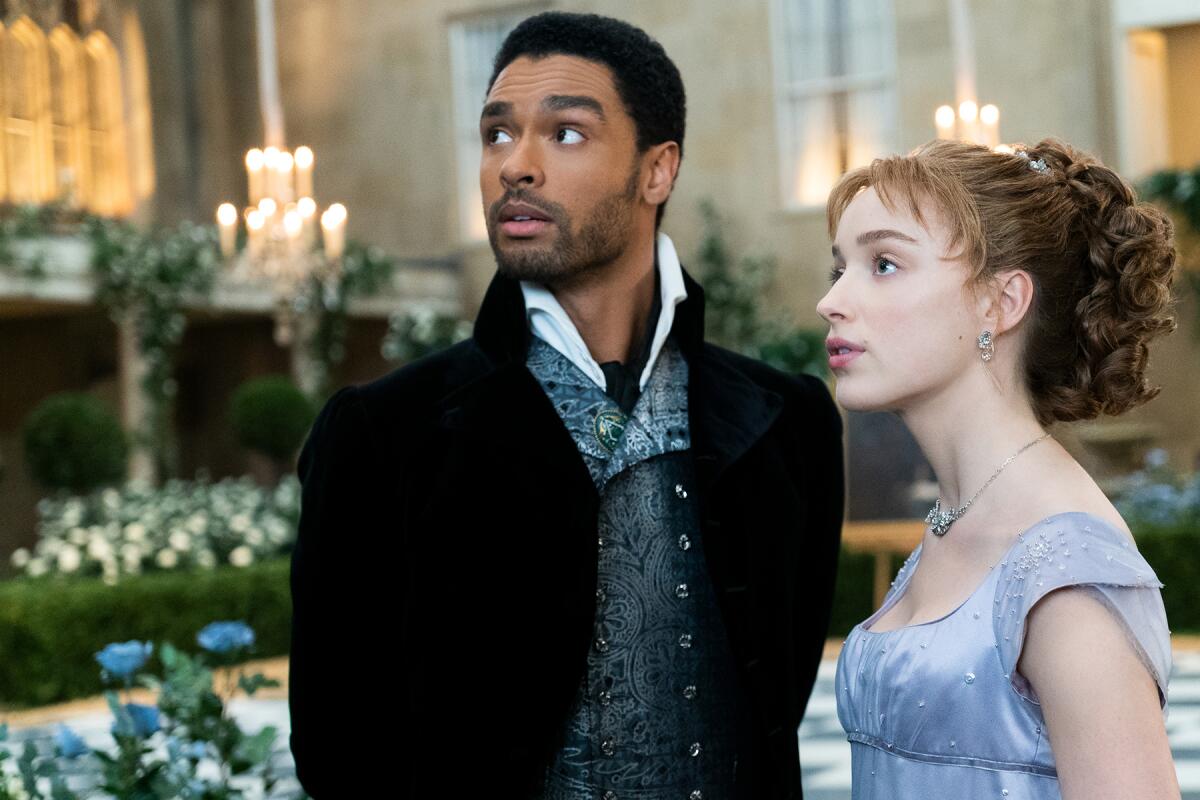
Here’s a look at the main couples featured in each season of “Bridgerton”: Season 1 followed Simon Basset and Daphne Bridgerton. Season 2 centered on Kate Sharma and Anthony Bridgerton. Colin Bridgerton and Penelope Featherington were the focus of Season 3, and Season 4 will highlight Benedict Bridgerton and Sophie Baek. (Liam Daniel / Netflix)
You’ve had three seasons to watch how Jonathan and Luke handled being the lead. Did either of them offer advice as you took on that role? And what did you learn from watching them deal with the pressure and attention that came with it?
The leading men – Regé-Jean Page, Jonathan Bailey, and Luke Newton – were always willing to share advice, which was incredibly helpful. I felt fortunate to be able to learn from them by watching how they worked. Regé took the show very seriously, which was admirable considering its potentially lighter tone. Jonathan has a fantastic energy that really lifted everyone on set. Luke is very perceptive and thoughtful about how he expresses himself. I was lucky to observe all of them, learn from their approaches, and consider how I could apply those lessons to my own work.

Television
This season of ‘Bridgerton’ focuses on Nicola Coughlan’s character, Penelope Featherington, and she says this shift in the story mirrors her own journey as an actress.
Yerin, you’re new to this world of make-believe and quickly found yourself in a challenging situation. Did Nicola Coughlan or Simone Ashley offer any helpful advice to you?
I hadn’t gone through the experience of filming like the other leads had. Luckily, Nicola and Simone were immediately supportive when I joined the cast, offering help whenever I needed it. But everyone faces different challenges, so I wasn’t always sure what to ask them about. Still, it was comforting to know they were there. I also relied on Luke, who I worked with closely, as he had a lot of experience from being on “Bridgerton.” Plus, the rest of the cast was always there to offer support when I felt unsure or needed guidance.

Since this is “Bridgerton,” the connection between Benedict and Sophie is really important to making their story work and unfold naturally. Can you describe the chemistry test? What are your memories of first meeting each other?
Thompson: It was like this.
Ha: You’re third wheeling with us.
Thompson: It was on Zoom.
I was in Korea, and it was late – around 11 p.m. I’d been really stressed all day. When I finally logged on, you, Thompson, were there. I specifically remember you wearing a striped shirt. I commented that you looked tired, but I think that was probably just me assuming you were exhausted from doing a lot of auditions and readings with other people.
We didn’t audition a lot of people for the role because it required a very specific type of actor. It was a challenging part, and we had a very clear idea of what we were looking for. We also wondered how we could get a feel for the chemistry between actors through Zoom, which is naturally awkward – pretending there’s a backdrop or acting in front of the camera felt silly. But despite all that, I immediately felt comfortable reading scenes with you. It’s just obvious when there’s a connection. As soon as the Zoom call finished, I told Tom Verica, one of our producers and directors, that it was clear you were the right person – he was even a little emotional!
I was definitely feeling a lot of pressure because he was already cast in the show. I really wanted to stay focused and let things happen naturally, because forcing it just feels awkward. I remember making eye contact with you on screen, and Luke is so open and easy to work with, which made the scene surprisingly easy, even though we had a lot of interruptions and adjustments during the audition. We just kept going and managed to get through it.
What were the scenes that you had to do together that day? The lake scene —
Thompson: The lake scene and the tea scene. Just two.

In a romance story, the initial meeting between characters is crucial, often just as important as their eventual relationship. The masquerade ball scene is particularly anticipated by readers. What was it like writing that scene? Did using masks for the characters help you feel more comfortable or less pressured while writing it?
It was a little harder for me because my mask is so large – it makes it difficult to show a lot of expression, especially with my cheekbones covered. I remember Tom telling me I needed to focus on using my eyes and mouth more to convey emotion.
Thompson: It’s basically like you were wearing a paper bag.
I think what’s so interesting about the masks in the story is how they really change Sophie. While it seems like a challenge to wear one, it actually gave her a sense of power, almost like she could do anything. Especially that night, the mask made her feel brave. It’s ironic, though – when she finally takes off the actual mask, that’s when she starts hiding her true self, putting up a different kind of barrier.
Thompson points out that the idea of masking – hiding true feelings – is central to how the two characters connect. They discuss this directly in a scene on the terrace, focusing on questions rather than answers. With Sophie, Benedict is constantly questioning her sincerity – is she genuinely naive, pretending not to know how to dance, or simply playing a role? This ambiguity, Thompson believes, is what makes their connection so romantic and relatable, as it mirrors the experience of love at first sight. It’s not about instant, complete understanding, but rather a playful dance of revelation and concealment. They carefully control what they show each other, and there are moments where they misread each other’s signals. A perfect example is when Sophie spies on Benedict through a door, and he happens to look up just as she leaves – a pattern that establishes the foundation of their relationship, starting with a dreamy, uncertain beginning.
Television
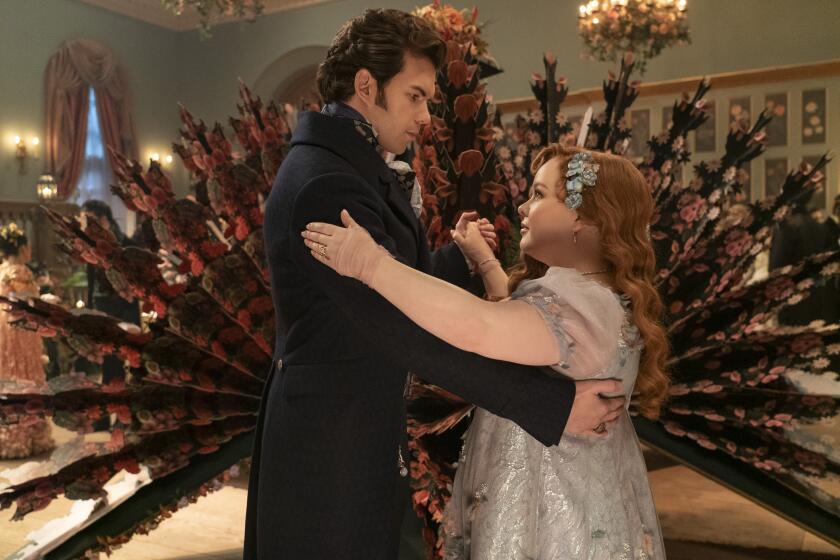
We visited the set of ‘Bridgerton’ in London and saw how the team brought the show’s lavish ball scenes to life in Season 3, including a beautifully decorated botanical ball.
I imagine there was there a lot of discussions on what these masks should look like?
Absolutely. The costume department was amazing – they created about five different versions of the costume. At one point, they even considered completely covering my face, but decided against it. They had to be careful because Benedict’s character sees me later as Sophie, and it wouldn’t make sense if he didn’t recognize me. They were incredibly creative and able to quickly change and refine the designs, and the final result was really stunning.
I was worried while reading the book that it might seem unbelievable Benedict wouldn’t recognize her. But the elaborate mask and the overall situation actually make it work. When I watched the episodes, I realized it’s plausible he senses something familiar, he just can’t quite figure out what it is.

We first see you as Sophie putting on a mask, which immediately creates a sense of mystery for both Benedict and the audience. Her story unfolds and has similarities to Cinderella. What initially drew you to the role of Sophie?
What really stands out to me about Sophie is her strong character and values. Even when facing difficulties, she remains a kind and inspiring leader, and she still has a great sense of humor. But honestly, I especially connected with her journey of learning to love herself and realizing she deserves it. It’s something I often discuss with my friends – what self-love actually means and feels like. I felt like I learned a lot from watching Sophie, particularly that love isn’t just about a romantic partner; it’s also about the supportive community you build around yourself.
The show’s writers have been developing Benedict’s character by exploring his openness to different relationships. As he and Sophie grow closer, the question is how this aspect of his personality will be shown or talked about.
It’s complicated, isn’t it? Benedict is a compelling character, and I can see why people project different identities onto him, especially when thinking about modern ideas of sexuality. Often, male sexuality is presented in a very limited way – either someone is straight, gay, or fits into another neat category. But what’s great about a fictional character is that they’re unique. Benedict isn’t meant to represent any specific experience. For him, his sexuality isn’t the defining part of who he is; it’s more about his desire to explore and his open-mindedness. Essentially, being truly open means you can connect with anyone. You could even say that this openness has driven his constant search for freedom and his avoidance of falling in love, and that’s what I find most interesting to explore.
Let’s talk about his awkward love confession at the end of the first part. Readers of the books knew it was coming, and it felt like the show was building to that moment—until he unexpectedly asked her to become his mistress. Can you tell me about your approach to playing that scene?
The situation is complicated, especially considering the history of the characters. There’s a scene in the Gentleman’s Club that shows some people in similar arrangements genuinely finding love. However, I think using that as an explanation is a bit of an easy way out. It might be trying to excuse Benedict’s core problem: he struggles with genuine connection. We’ve seen he’s capable of caring, but if you’re friendly with everyone, it’s hard to build something special with one person. His charming exterior makes it difficult for him to truly fall for someone and fully commit. Essentially, his attempt to justify the situation feels like he wants it both ways – to combine his ideal fantasy with reality and expect it to work.
He’s somewhat oblivious – both to her feelings and to the impracticality of his idea. He doesn’t realize how pursuing this wouldn’t be a good solution, and he doesn’t fully consider how Sophie might feel. Contributing to this is his lack of information about her past – specifically, her identity as the ‘lady in silver,’ which creates a lot of tension. It’s surprising because he usually makes smart decisions, but actually, it makes sense given his history. His father died when he was young, so he associates loving relationships with fear, and he’s trying to avoid real commitment while still wanting the benefits of a connection.
Yerin, how did you feel about it?
I was really disappointed with how that scene played out. When we filmed it, I genuinely felt angry. Benedict’s character is more lost in fantasy, while Sophie is very grounded in reality, but in that moment, she’s almost swept away by his words. She briefly allows herself to imagine a proposal, even though she knows it wouldn’t have been possible back then. She’s hoping for something, but as soon as he says a certain thing, she snaps back to reality and puts up her defenses. It takes her back to a painful part of her childhood and resurfaces a lot of trauma. I remember wanting to slap Benedict while we were filming it – I felt that strongly.
Thompson: We should have tried it. One take. I think people would have loved that.

Was an intimacy coordinator involved when filming that scene? What was it like to film the characters’ first intimate moment?
It was incredibly hot while filming—both because of the set itself and the intense emotions. The set was small and filled with candles, making the heat really noticeable. Thankfully, our intimacy coordinator, Lizzie, was fantastic. She didn’t give us strict instructions, but instead helped us explore the scenes and find our way naturally. She’s amazing at creating a comfortable and supportive environment, really listening to what each of us needed to feel safe and portray the scene authentically. I relied on her a lot, and she made those vulnerable and exposing scenes feel much safer.
It was a real comfort to have someone overseeing those intimate scenes, wasn’t it? It’s good not to be left alone with just the other actor, or the director – because, in my experience, directors often feel awkward about filming them, which frustrates me. They aren’t the ones performing! It all comes down to trust. Having someone there to help and offer an objective perspective is crucial, because what feels right for the actors doesn’t always translate well on screen. These scenes need to be carefully planned, as actors can only focus on their own experience and can’t see how the scene is being perceived by the audience.
There’s a bit of a “Cinderella” vibe to this season’s storyline. When you were preparing, did you draw inspiration from any traditional romantic characters or tales?
The masquerade ball reminded me a lot of Romeo and Juliet. The way the characters met and quickly went off alone felt very similar to that story. I didn’t intentionally think about it beforehand, but while we were filming the scene, the connection became really clear in my mind.
I think the story leans heavily on the classic “Cinderella” tale, probably because it was my favorite growing up. While it takes inspiration from “Cinderella,” it definitely doesn’t follow the same plot. I see it more as a jumping-off point. I even had a Cinderella dress I wore all the time – practically every other day!
Thompson: That’s so sweet.
Ha: I just wanted to meet my prince.
The first half ends with Benedict and Sophie at a crossroads, an impasse.
According to Thompson, Benedict and Sophie initially connect through shared dreams, first at a masquerade ball that Sophie imagines, and then at Benedict’s cozy cottage, which feels like a reflection of his inner world. In Episode 4, they’re forced to confront reality and navigate the challenges of a real relationship – the shift from initial infatuation to dealing with everyday frustrations and potential conflict. It will be compelling to watch them reconnect and see if they can overcome these hurdles.
Even while reading the script, I wondered how they’d pull off the story, particularly the relationship between a noble character and a servant. Fans are going to be really invested in seeing how their connection develops. The core question is: when society tries to keep people apart, do they give up, or do they fight for what they want? That’s what the second part of the story will explore.
It’s common for fans to develop strong connections within any fandom, often becoming invested in the relationships between fictional characters. Sometimes, however, these feelings can extend to the actors who play those characters. How can fans manage those feelings and maintain healthy boundaries?
I think we’re just being ourselves. What’s great about Luke is that I genuinely care for him as a person, but I can’t manage how others interpret our relationship or create stories about it. I know what’s true for me, and that is I have a lot of respect for Luke – as a person, as an actor, as someone I work with, and as a friend. We maintain a professional working relationship, but we’re also close friends.
As an actor, it’s wonderful when people react to and interpret your work – that’s part of the appeal. I believe in embracing those interpretations without feeling the need to correct anyone. It’s their experience, their show. When I meet fans, I don’t see it as a confrontation, but as them connecting with the character or story. It’s about understanding where you end and the character begins. If you can establish that mental boundary, you can genuinely enjoy the positive attention from fans, rather than feeling defensive or scrutinized.
Read More
- ‘Project Hail Mary’s Unexpected Post-Credits Scene Is Worth Sticking Around
- Beyond Accuracy: Gauging Trust in Human-AI Teams
- How Martin Clunes has been supported by TV power player wife Philippa Braithwaite and their anti-nepo baby daughter after escaping a ‘rotten marriage’
- Clash Royale Balance Changes March 2026 — All Buffs, Nerfs & Reworks
- Gold Rate Forecast
- CookieRun: OvenSmash coupon codes and how to use them (March 2026)
- The most surprising Hannah Montana cameos: From John Cena to Dwayne Johnson and even a Coronation Street soap star as show celebrates its 20th anniversary
- eFootball 2026 is bringing the v5.3.1 update: What to expect and what’s coming
- Genshin Impact Version 6.5 Leaks: List of Upcoming banners, Maps, Endgame updates and more
- Total Football free codes and how to redeem them (March 2026)
2026-01-29 14:33