Author: Denis Avetisyan
Researchers are drawing inspiration from the intricate wiring of the mouse visual cortex to build more efficient and robust deep learning models for facial emotion recognition.
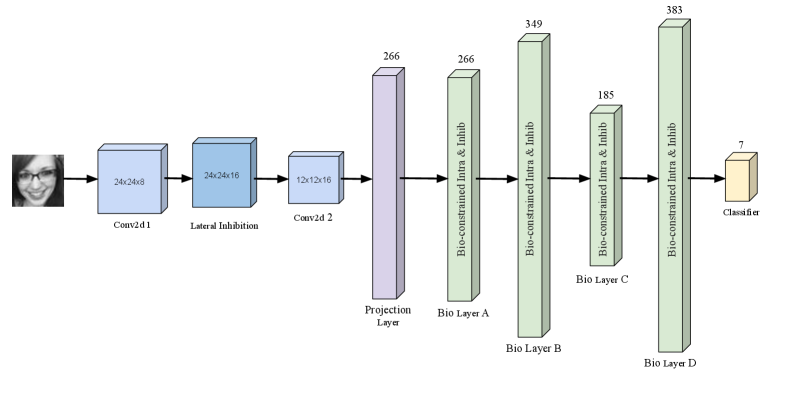
This review explores the BioNIC architecture, a biologically-inspired neural network leveraging connectomics principles to improve performance and understand the impact of structural and functional constraints.
Despite advances in deep learning, artificial neural networks often lack the architectural and functional principles observed in biological brains. This limitation motivates the development of more biologically plausible models, as explored in ‘BioNIC: Biologically Inspired Neural Network for Image Classification Using Connectomics Principles’, which introduces a novel network incorporating connectivity and learning rules derived from the mouse visual cortex. BioNIC achieves competitive performance on facial emotion recognition-reaching 59.77% accuracy on the FER-2013 dataset-while demonstrating the potential of connectomics-driven constraints and biologically inspired mechanisms like Hebbian plasticity and data augmentation. Could leveraging detailed neuroanatomical data unlock a new generation of artificial intelligence systems that are both powerful and more aligned with the efficiency of the brain?
The Fragile Facade: Decoding Emotion Beyond Pixel Patterns
Contemporary facial emotion recognition (FER) systems predominantly utilize conventional deep learning architectures, yet often fall short in replicating the intricate biological foundations of emotional displays. These models typically analyze facial muscle movements as pixel patterns, neglecting the complex interplay of physiological processes – hormonal influences, neurological pathways, and individual variations – that genuinely shape emotional expression. Consequently, current FER technology frequently misinterprets subtle cues or fails to generalize effectively across diverse populations and lighting conditions. The reliance on static image analysis also limits the ability to discern emotions from dynamic changes in facial expression, a critical aspect of human emotional communication and a key function of the mammalian brain’s visual processing centers.
Current facial emotion recognition systems, despite achieving impressive accuracy on carefully curated datasets, frequently falter when presented with real-world variability. This limitation stems from a reliance on statistical correlations within training data, rather than an understanding of the underlying biological principles of facial expression. Unlike the mammalian visual cortex – a remarkably efficient system capable of rapidly and accurately interpreting emotional cues across diverse individuals and lighting conditions – artificial neural networks require vast amounts of labeled data and struggle to generalize to unseen scenarios. The biological system achieves this efficiency through sparse coding and hierarchical processing, extracting key features with minimal computational resources, a feat that remains elusive for most contemporary AI approaches. Consequently, these models are often brittle, exhibiting significant performance drops when faced with variations in pose, illumination, or even subtle differences in individual facial features.
The pursuit of more resilient and understandable artificial emotional intelligence may benefit from designs mirroring the mammalian visual system. Current facial emotion recognition systems, while achieving notable accuracy on controlled datasets, often falter when confronted with real-world variability in lighting, pose, and individual expression. A biologically plausible architecture, inspired by the hierarchical processing and feedback loops of the brain, promises to address these limitations. Such systems could prioritize efficiency by focusing on key facial action units – the fundamental movements underlying expressions – rather than processing every pixel. Furthermore, incorporating principles of sparse coding and predictive processing could yield models that are not only more robust to noise and occlusion, but also offer greater interpretability, allowing researchers to understand why a particular emotion was recognized, rather than simply that it was recognized. This shift towards brain-inspired designs represents a crucial step towards creating emotion AI that is genuinely intelligent and reliable.
BioNIC: An Echo of Cortical Architecture
BioNIC is a feedforward artificial neural network constructed to replicate the hierarchical organization and processing characteristics of the mouse visual cortex. This includes layers representing the retina, lateral geniculate nucleus (LGN), and primary visual cortex (V1), with connectivity patterns and neuron types informed by anatomical studies of the murine visual system. The network utilizes a layered structure where information flows unidirectionally, progressing from input to successive processing stages. Specifically, BioNIC aims to model the receptive field properties and feature extraction mechanisms observed in biological neurons within the mouse visual pathway, offering a computational platform to investigate visual processing principles and potentially improve machine vision algorithms.
Lateral and graded inhibition are key mechanisms employed within BioNIC to refine feature detection. Lateral inhibition ensures that strongly activated neurons suppress the activity of their neighbors, sharpening the representation of features by enhancing contrast. Graded inhibition, conversely, modulates the degree of suppression based on proximity and connection strength; neurons closer to the strongly activated cell experience greater inhibition than those further away. This combination allows BioNIC to not only identify features but also to discriminate between similar inputs and reduce the impact of noise, improving overall accuracy in emotion detection tasks by emphasizing salient features and suppressing irrelevant background activity.
BioNIC’s neural connectivity is directly informed by data from the Mouse Brain Connectivity (MICrONS) project, a large-scale effort to map the complete connectome of the mouse visual cortex. This involves utilizing detailed anatomical tracing data to constrain the network’s architecture, specifically the probabilities and strengths of connections between neurons. Rather than random or purely learned connections, BioNIC incorporates biologically plausible connectivity patterns derived from the MICrONS dataset, ensuring the network’s structure reflects the known organization of the mouse visual system. This approach moves beyond abstract network design by grounding the model in empirically observed neural wiring, enabling a more realistic simulation of cortical processing.
BioNIC differentiates itself from conventional convolutional neural networks (CNNs) through the incorporation of biologically plausible connectivity patterns. While CNNs typically employ uniform, layered connections, BioNIC implements connections derived from the detailed anatomical data of the mouse visual cortex, specifically utilizing principles of lateral and graded inhibition. This means neurons are not solely connected to those in adjacent layers, but also exhibit connections to neurons within the same layer and to those further afield, mirroring the complex network observed in biological systems. These biologically-inspired connections aim to improve the network’s ability to extract and discriminate features by promoting sparse representations and enhancing robustness to noise, potentially surpassing the performance limitations of purely artificial architectures.
Performance as a Measure of Biological Fidelity
BioNIC achieved a test accuracy of 59.77% ± 0.27% on the FER-2013 dataset, indicating its competitive performance in facial expression recognition. This metric represents the percentage of correctly classified facial expressions within the held-out test set, with the ± value denoting the standard deviation across multiple training runs. The reported accuracy demonstrates the model’s ability to generalize to unseen data within the FER-2013 benchmark, which comprises 35887 grayscale images representing seven basic facial expressions: angry, disgust, fearful, happy, sad, surprise, and neutral.
Data augmentation techniques were employed to artificially expand the training dataset by applying transformations to existing samples, thereby improving the model’s ability to generalize to unseen data. Layer normalization was implemented to stabilize learning by reducing internal covariate shift, leading to faster convergence and improved performance. Weight decay, a regularization technique, was incorporated to prevent overfitting by penalizing large weights, promoting a simpler model and enhancing generalization capability. These combined techniques collectively contribute to both improved stability during training and enhanced performance on unseen data, mitigating the risk of overfitting and promoting robust model behavior.
Implementation of a learning rate scheduler during training allows for dynamic adjustment of the learning rate, optimizing the convergence speed and final performance of the BioNIC model. This adaptive optimization technique begins with an initial learning rate and subsequently modifies it based on observed validation performance; specifically, the scheduler reduces the learning rate when validation loss plateaus or increases, preventing overfitting and enabling finer adjustments to network weights during later training epochs. This process refines the training trajectory, facilitating more effective exploration of the parameter space and ultimately contributing to improved generalization capabilities on benchmark datasets like FER-2013.
Ablation studies demonstrate the significant impact of biological connectivity masks on BioNIC’s performance. Removal of these masks, effectively disconnecting biologically-inspired connections within the network, results in a reduction of only 1.01% in test accuracy. This indicates that while the biologically-informed connectivity is not strictly essential for achieving high performance, it contributes meaningfully to the model’s overall efficacy and robustness, suggesting a beneficial regularization effect or improved feature representation derived from the imposed structural constraints.
BioNIC achieved a macro-averaged F1-score of 0.5652, with a standard deviation of ± 0.0015, on the FER-2013 dataset. This metric provides a balanced measure of precision and recall across all seven emotion classes, indicating consistent performance rather than bias towards frequently occurring expressions. The low standard deviation suggests training stability and reproducibility of results. Macro-averaging ensures that each emotion class contributes equally to the final score, regardless of its prevalence in the dataset, thus providing a comprehensive assessment of the model’s ability to generalize across the entire spectrum of facial expressions.
BioNIC demonstrated a measurable improvement in recall performance for emotion classes that were initially underrepresented in the training data. Specifically, recall for the ‘disgust’ emotion class increased from 0.26 to 0.40, representing a 53.8% relative improvement. Similarly, recall for the ‘fearful’ emotion class increased from 0.33 to 0.38, a relative improvement of 15.2%. These gains indicate the model effectively learned to identify subtle features associated with these less frequent emotions, contributing to a more balanced and robust emotion recognition system.

Towards Sustainable Intelligence: The Future of Emotion AI
Emotion AI systems are increasingly reliant on complex deep learning models, often demanding substantial computational resources and proving vulnerable to subtle, intentionally crafted distortions. BioNIC presents an alternative, drawing inspiration from the efficiency and robustness of the biological neural networks underlying emotional processing in living organisms. This architecture prioritizes sparse connectivity and event-driven computation, mirroring how the brain conserves energy while maintaining remarkable adaptability. By shifting away from the dense, continuous activation patterns of traditional artificial neural networks, BioNIC demonstrably reduces computational demands and exhibits greater resilience to noise and adversarial attacks – potentially paving the way for emotion AI that is both powerful and deployable on resource-constrained platforms, such as edge devices and mobile applications. The framework’s biologically plausible design suggests a path toward artificial intelligence that isn’t just intelligent, but also inherently more sustainable and reliable.
Resilience to adversarial attacks represents a significant challenge for artificial intelligence, and BioNIC addresses this through a novel incorporation of synaptic noise. Inspired by the inherent stochasticity of biological neural networks, this deliberate introduction of random variation within the synaptic connections effectively disrupts the precision of malicious inputs designed to fool the system. By mimicking the ‘noisy’ communication found in the brain, BioNIC becomes less susceptible to subtle, carefully crafted perturbations that can mislead conventional AI models. This approach doesn’t rely on detecting adversarial examples – a computationally expensive process – but instead inherently diminishes their impact, offering a more robust and efficient defense mechanism. The system’s ability to maintain accuracy even when presented with intentionally deceptive data suggests a pathway toward building emotion AI systems that are not only perceptive but also demonstrably trustworthy in real-world applications.
Beyond discerning facial expressions, the BioNIC framework presents a versatile foundation for a broader spectrum of cognitive applications. Researchers envision adapting the biologically-inspired architecture to tackle challenges in areas like auditory scene analysis, where distinguishing sounds within a complex environment requires similar principles of noisy signal processing, or even natural language processing, by modeling the synaptic dynamics of semantic understanding. This adaptability stems from BioNIC’s core design – a focus on replicating the brain’s inherent robustness to incomplete or ambiguous data – a trait valuable across diverse cognitive tasks. Consequently, this opens promising avenues for investigating how principles derived from biological neural networks can enhance artificial intelligence beyond the realm of emotion recognition, potentially leading to more generalized and efficient AI systems capable of handling real-world complexity.
Continued development of BioNIC and similar emotion AI frameworks anticipates a significant refinement through the incorporation of attention mechanisms, allowing the network to dynamically focus on the most salient features within facial expressions and contextual cues. Researchers also intend to deepen the biological realism of the architecture, moving beyond simplified neuronal models to explore more intricate constraints derived from neuroanatomy and physiology – such as dendritic computations and synaptic plasticity rules. These advancements promise not only improved accuracy and robustness in emotion recognition, but also a more nuanced understanding of the computational principles underlying affective processing within the brain, potentially leading to artificial intelligence systems that exhibit a greater degree of cognitive flexibility and adaptability.
The pursuit of biologically plausible neural networks, as demonstrated in this study of connectomics-inspired architectures, inevitably reveals the transient nature of even the most carefully constructed systems. Every connection, every layer, is subject to the subtle erosions of time and data. As Paul Erdős observed, “A mathematician knows a lot of things, but he doesn’t know everything.” This sentiment echoes the findings presented; while the BioNIC model demonstrates promising results in emotion classification, the ablation study underscores that performance isn’t absolute, but rather a delicate balance of functional components. The network’s efficacy isn’t inherent, but emerges from a specific configuration, a snapshot in time, susceptible to change and refinement. Refactoring, in this context, isn’t merely optimization; it’s a dialogue with the past, acknowledging the impermanence of any design.
What Lies Ahead?
The pursuit of biologically plausible neural networks often resembles an archeological dig – each layer of abstraction reveals more questions than answers. This work, while demonstrating the utility of connectomics-derived constraints, implicitly acknowledges a fundamental tension: the mouse visual cortex, however elegantly structured, is not a human face. The efficacy of this BioNIC architecture hinges, in part, on data augmentation – a necessary palliative, but one that subtly shifts the goalposts. Every commit is a record in the annals, and every version a chapter, yet the shadow of domain gap persists.
Future iterations must grapple with the inherent limitations of translating structural principles across species. The ablation studies, while informative, only illuminate the immediate consequences of disruption; they offer little insight into the emergent properties lost during simplification. A more ambitious undertaking would involve modeling the dynamic plasticity of the cortex, acknowledging that the brain isn’t static, but a self-modifying system. Delaying fixes is a tax on ambition, and the field risks entrenching static approximations at the cost of genuine understanding.
Ultimately, the true test won’t be achieving higher accuracy on benchmark datasets, but the ability to extrapolate beyond them. The real challenge lies not in replicating function, but in understanding the principles that allow function to emerge-and those principles, one suspects, are less about specific connections and more about the rules governing their evolution.
Original article: https://arxiv.org/pdf/2601.20876.pdf
Contact the author: https://www.linkedin.com/in/avetisyan/
See also:
- ‘Project Hail Mary’s Unexpected Post-Credits Scene Is Worth Sticking Around
- Beyond Accuracy: Gauging Trust in Human-AI Teams
- Gold Rate Forecast
- Clash Royale Balance Changes March 2026 — All Buffs, Nerfs & Reworks
- The most surprising Hannah Montana cameos: From John Cena to Dwayne Johnson and even a Coronation Street soap star as show celebrates its 20th anniversary
- eFootball 2026 is bringing the v5.3.1 update: What to expect and what’s coming
- EMEA Masters Winter 2026 introduces official Qualifier for Esports World Cup
- Genshin Impact Version 6.5 Leaks: List of Upcoming banners, Maps, Endgame updates and more
- Brawl Stars Sands of Time Brawl Pass brings Sandstalker Lily and Sultan Cordelius sets, along with chromas and more
- Total Football free codes and how to redeem them (March 2026)
2026-01-31 05:57