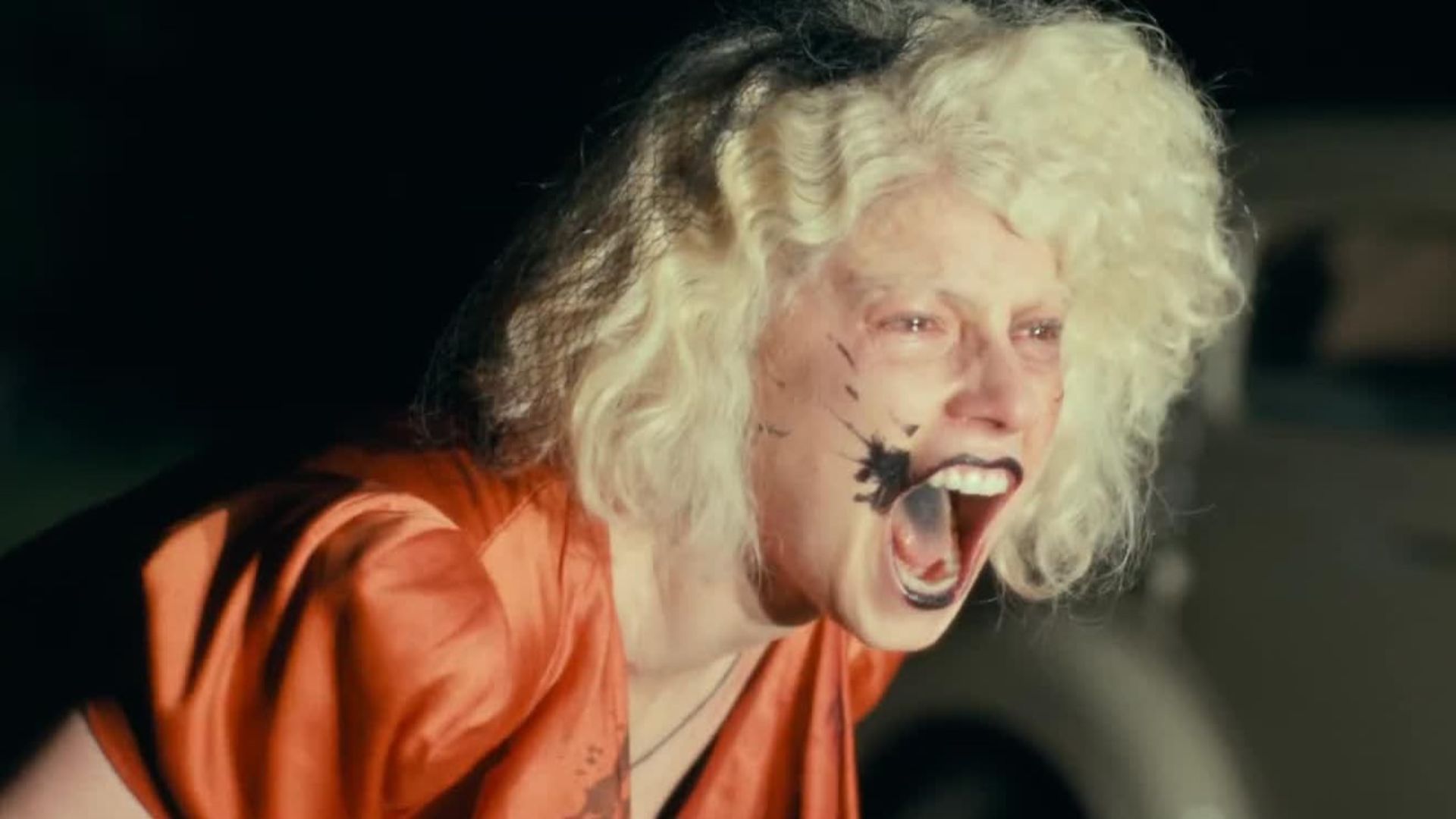
The film opens unexpectedly, much like Shakespeare’s Hamlet, with a playful knock-knock joke. Soon after, a ghost appears, revealing she’s been haunted for centuries by a story that’s grown like a dangerous growth in her mind. This ghost is Mary Shelley (played by Jessie Buckley), presented as raw and direct, yet powerful and brooding, and she addresses the audience directly. She’s about to take over the body of Ida (a mobster’s mistress, played by John Magaro), who is on the verge of death. Set in a 1930s Chicago bar, Ida is shown drinking martini after martini when she suddenly begins to convulse, switching between British and American accents, and passionately accuses someone of murder and abuse. She turns to another woman at the table and quotes Herman Melville’s Bartleby, telling her it’s acceptable to say “I prefer not to” – a message about resisting the demands of controlling men. Shortly after, she is killed for speaking this truth to someone in power.
Maggie Gyllenhaal’s second film is a powerful and unsettling look at a society in turmoil. The Bride! is a passionate and urgent movie, drawing inspiration from classic stories like Hamlet, Romeo & Juliet, and Bonnie & Clyde to condemn the excesses of the wealthy, police inaction, violence against women, and the systems that allow them to continue. It delivers its message with both fierce anger and dark humor, but at its heart, The Bride! is a deeply romantic story about choosing life, even when facing inevitable death. It suggests that a life filled with love, however brief, is more meaningful than a lonely existence. This choice, the film argues, is one we all face today, almost a century after the events depicted in Gyllenhaal’s bold, beautiful, and exciting romance.
The Bride Repurposes Mary Shelley’s Novel As a Feminist Clarion Call
Jessie Buckley is perfectly cast in this role, building on the emotionally resonant performance she gave in Hamnet which established her as a rising star. She brilliantly embodies the complex character, seamlessly shifting between the personas of Shelley, Ida, and a haunting figure caught between them. Buckley uses her physicality – sometimes contorting, sometimes softening – to portray a woman dramatically altered by Dr. Euphronius (Annette Bening), whose treatment has left her skin marked with dark, ink-like patterns. Simply by existing, this transformed woman, known as The Bride, disrupts everything around her.
Frankenstein’s monster, known as Frank, isn’t exactly a soulmate to the Bride, but a lonely man whose sadness is consuming him. He rescues her body from an unmarked grave. At 111 years old, Frank desperately wants a companion, and though she initially resists, the Bride soon helps him in his quest to create one. Sadly, like many women throughout history, the Bride’s life – and even her existence – is determined by the desires of the men around her.
When she wakes up, The Bride has almost no memory of who she is or how she ended up where she is, though fragments of a voice she recognizes as Mary Shelley echo in her mind. Frank and Euphronius tell her they were engaged before an accident, and they successfully convince her this is true. Accepting this new reality, and excited to experience life, she dives into the vibrant, underground nightlife of 1920s Chicago. The scenes, filmed with dramatic lighting by Lawrence Sher, evoke classic film noir. We see her dancing freely at a unique club, while Frank observes from a distance, seemingly pleased as she discovers what her reanimated body can do in the smoky, secretive atmosphere.
Things quickly spiral out of control, and Frank’s long-held frustration finally explodes. The film’s heroes find themselves on the run from the police, pursued by a unique pair of detectives, John and Myrna (played by Peter Sarsgaard and Penélope Cruz), who offer a contrasting view of relationships during a very traditional era. We also see another couple on screen – Frank’s idol, the charismatic Ronnie Reed (Jake Gyllenhaal) and his dance partner (Julianne Hough), reminiscent of Fred Astaire and Ginger Rogers.
Gyllenhaal’s film delves into how the stories we take in shape not only our view of others, but also our self-perception. Characters like Frank learn about love and being a man from movies, while Ida’s ideas about power come from what she’s read. The film also shows how easily people become trapped by their own biases, like a police force stuck in outdated ideas about women. Ultimately, the characters are all struggling to understand their role – or lack of one – in a deeply flawed and dishonest world.
This adaptation of The Bride of Frankenstein tries to do a lot, and it sometimes feels stretched between exploring its ideas and simply moving the story forward. There are many characters and themes to juggle. However, this isn’t necessarily a flaw – the film powerfully expresses anger towards a society that criticizes those who are different, while simultaneously upholding conventional norms.
By skillfully using her source material, the filmmaker challenges a society that avoids facing its own mortality and instead seeks someone to blame for its frustrations. The film’s most striking scene, a clear nod to Mel Brooks’ Young Frankenstein, features Frank and Ida dramatically interrupting a party of the newly wealthy, forcefully shattering their illusion of perfection. It’s a truly rebellious moment.
Interestingly, Herman Melville’s story Bartleby feels more relevant today than even Frankenstein. Bartleby centers on a Wall Street worker who unexpectedly stops doing his job, repeatedly stating, “I would prefer not to.” This simple refusal to comply is a powerful act of defiance. Ultimately, the most significant change can start with choosing not to participate. It’s about discovering your own path, defining what it means to be human for yourself, and recognizing your own unique struggles.
The Bride! releases theatrically on March 6th, 2026.
Read More
- Invincible Season 4 Episode 4 Release Date, Time, Where to Watch
- Physics Proved by AI: A New Era for Automated Reasoning
- Gold Rate Forecast
- American Idol vet Caleb Flynn in solitary confinement after being charged for allegedly murdering wife
- Magicmon: World redeem codes and how to use them (March 2026)
- “Wild, brilliant, emotional”: 10 best dynasty drama series to watch on BBC, ITV, Netflix and more
- Total Football free codes and how to redeem them (March 2026)
- Goddess of Victory: NIKKE 2×2 LOVE Mini Game: How to Play, Rewards, and other details
- Seeing in the Dark: Event Cameras Guide Robots Through Low-Light Spaces
- Simulating Humans to Build Better Robots
2026-03-04 23:31