
It seems like many filmmakers eventually want to create their own “Dracula” movie, and it’s easy to do since Bram Stoker’s original 1897 novel is free for anyone to adapt. Now, French director Luc Besson, known for past controversies, presents his version, featuring actor Caleb Landry Jones, who recently starred in Besson’s 2023 film, “Dogman.”
Luc Besson’s “Dracula” is exactly what you’d anticipate from the director known for visually striking films like “Léon: The Professional” and “The Fifth Element.” It’s an extravagant, highly stylized movie filled with bizarre creatures, impressive effects, and a somewhat unusual plot linking Dracula to the 200th anniversary of the French Revolution. As with most Dracula stories, there’s also a strong element of sexual desire.
While loosely based on Bram Stoker’s novel, Besson’s “Dracula: A Love Tale” reimagines the story as a centuries-spanning romance. The film portrays Vlad II, the historical figure behind Dracula (played by Jones), as a heartbroken warrior searching for his lost love, Elisabeta (Zoë Bleu). He finds a woman who resembles her in Mina Murray (also Bleu), a young Parisian socialite and friend to Dracula’s companion, Maria (Matilda De Angelis). Mina is engaged to Jonathan Harker (Ewens Abid), a lawyer who travels to Dracula’s castle in Romania for a business transaction. Simultaneously, a priest (Christoph Waltz) relentlessly pursues Dracula, determined to end his reign of vampirism and lift the curse he’s inflicted on others.
We’re all familiar with the Dracula story – from the original novel, films like Francis Ford Coppola’s 1992 version, and recently, Robert Eggers’ “Nosferatu,” among countless other adaptations. This new take adds a unique twist: Dracula delves into the art of perfume, creating a captivating scent in Florence with French lavender. He tests this fragrance on the fashionable, high-society women of pre-Revolutionary France, known for their elaborate white wigs.
Movies
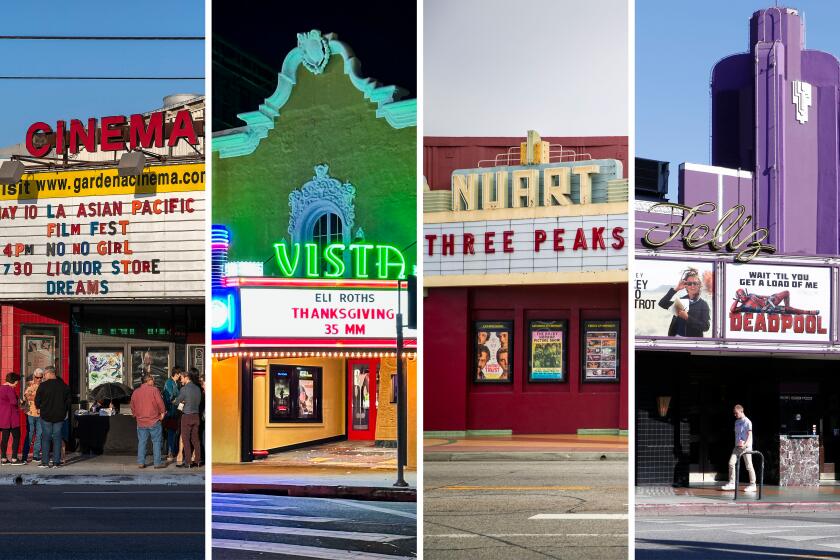
The 27 best movie theaters in Los Angeles
We’ve created a guide to 27 fantastic movie theaters in Los Angeles, including iconic spots like the TCL Chinese and New Beverly, popular chains like Alamo Drafthouse, and the best AMC location in Burbank.
Besson’s take on the story falls between Coppola’s lavish style and Eggers’ more subtle, eerie approach. However, Besson injects a strange element of his own, like an army of computer-generated gargoyles serving the villain. The movie feels a bit artificial whenever it relies heavily on special effects, but it’s much more engaging when focused on its beautifully crafted sets and interiors.
Besson consistently directs his actors to fit his unique vision, and both Jones and Bleu perfectly capture the director’s over-the-top, dramatic style. De Angelis and Waltz are also delightfully entertaining as a wildly expressive vampire bride who can’t stop licking her lips and a stoic, focused vampire hunter determined to solve the case.
Luc Besson’s “Dracula” is bogged down by frequent flashbacks. The movie begins with a lengthy 15-minute opening showing Vlad’s battles, and then jumps between past events whenever he tells his story to Harker. These flashbacks cover periods from the Middle Ages to the Renaissance. Unfortunately, the most engaging character, the priest played by Waltz, vanishes for long stretches of the film after being introduced.
The movie builds to a dramatic final battle, reminiscent of “Scarface,” where the vampire fights to the very end with his sword. In this showdown, director Besson changes the original story’s ending, focusing on the hero’s obsessive love to better fit his interpretation.
When judging a film, it’s best to focus on the movie itself, not off-screen issues. However, it’s hard to ignore the serious accusations against director Luc Besson – including allegations of sexual assault and misconduct, and his past relationship with a teenager – especially considering how he portrays the character of Vlad/Dracul. The film depicts Vlad as an ancient, monstrous figure who survives by feeding on young women, yet Besson presents him as a tragic romantic hero.
Maybe every filmmaker should make their own “Dracula.” It’s a text that can be quite illuminating.
Read More
- The Division Resurgence Best Weapon Guide: Tier List, Gear Breakdown, and Farming Guide
- Last Furry: Survival redeem codes and how to use them (April 2026)
- Clash of Clans Sound of Clash Event for April 2026: Details, How to Progress, Rewards and more
- Guild of Monster Girls redeem codes and how to use them (April 2026)
- GearPaw Defenders redeem codes and how to use them (April 2026)
- After THAT A Woman of Substance cliffhanger, here’s what will happen in a second season
- Gold Rate Forecast
- Wuthering Waves Hiyuki Build Guide: Why should you pull, pre-farm, best build, and more
- eFootball 2026 “Countdown to 1 Billion Downloads” Campaign arrives with new Epics and player packs
- Genshin Impact Version 6.5 Leaks: List of Upcoming banners, Maps, Endgame updates and more
2026-02-06 21:32