
In the expansive, deserted part of Venice Beach during the year 1980, seven architects from Los Angeles – Frank Gehry, Thom Mayne, Eric Owen Moss, Coy Howard, Craig Hodgetts, Robert Mangurian, and Frederick Fisher – were photographed together by Ave Pildas. Dressed in an assortment of clothes and posing relaxed on the beach sand, they appeared less like a professional group of architects and more like a disheveled rock band that was poised to shape the future of American architecture.
The image, featured in Interiors magazine, encapsulated a significant shift in Los Angeles’ creative landscape. The seven individuals portrayed, each lost in their own thought yet united by a playful defiance and self-confident energy, symbolized a new wave of creators. This generation was introducing an unrefined, bold approach to their projects, gradually separating themselves from the traditional, formal conventions of the architectural community.
Every one of them carved out a prosperous professional path, ranging from recipients of the Pritzker Architecture Prize to leaders of architecture institutions. For a significant period, they and their peers contributed substantially to positioning Los Angeles, undergoing rapid change, as a pivotal hub in architectural culture.
Filmmaker Russell Brown, who recently completed a 12-episode documentary on the architectural landscape of Venice, remarks that “a single image encompasses an entire universe.” He observed that there was an element of danger, yet creativity thrived in this context; it was primarily about brainstorming and innovation.
According to architectural journalist Frances Anderton, host of the series, it has turned into a sort of benchmark. It consistently resurfaces in discussions relating to that specific era.
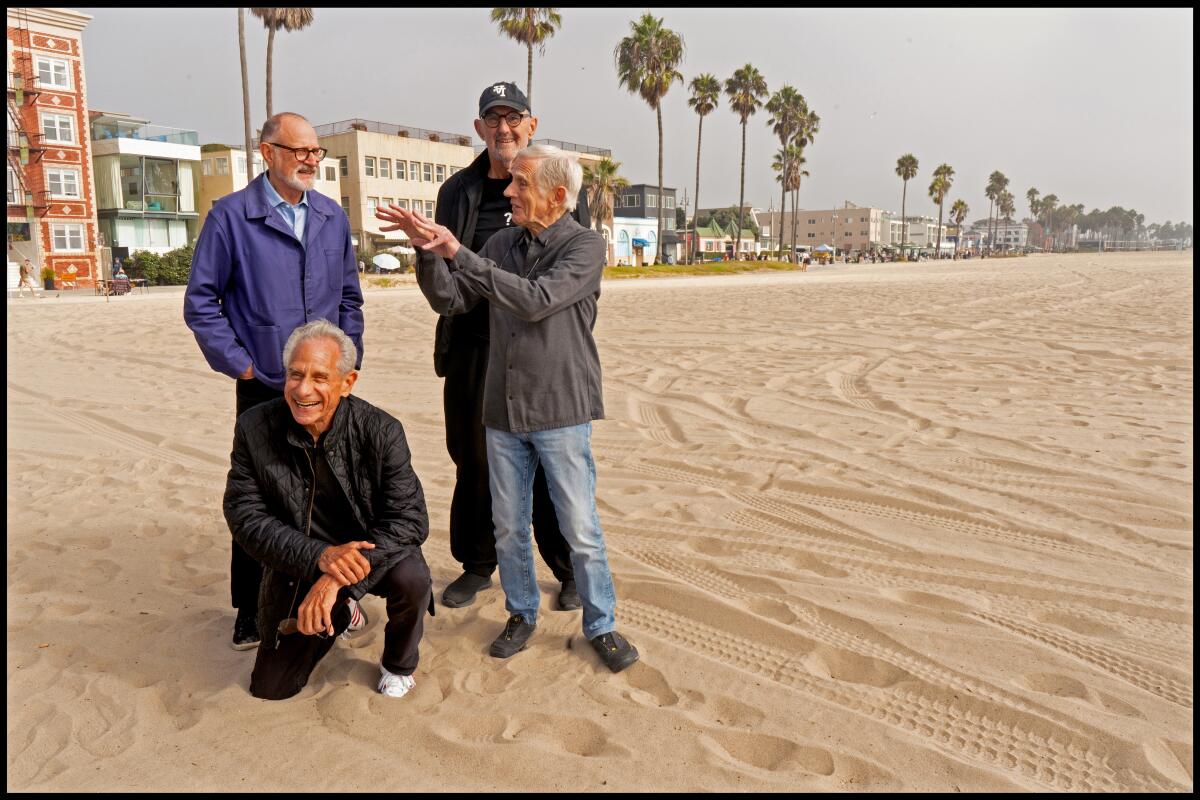
From Venice to the World Stage,” produced by Friends of Residential Treasures: Los Angeles, a non-profit organization. Four architects, now elderly, were reunited for a more subdued photoshoot and an open discussion about their early careers in Los Angeles, and the developments that have taken place since then. The series, which started airing monthly on FORT: LA’s website on July 1.
A resident of Los Angeles, who has experience in producing feature and documentary films, Brown developed the idea after discussing it with Robert Thibodeau, the co-founder of DU Architects based in Venice. Upon further exploration of the concept with Anderton, the idea for a reunion was sparked.
Brown explained that instead of using the original photo, they decided to recreate it as a reason for all the men to gather together again.
As a cinephile, I’d rather immerse myself in a lively, unscripted panel discourse over a traditional documentary format. The latter, with its individual interviews and hefty production, often feels overly structured and lacking the spontaneous charm that group discussions bring to the table.

According to Brown, it’s not just about the architectural works these creatives produced, but more so about the camaraderie and discussions they initiated. He further explains that this camaraderie extends beyond their time, as conversations about topics such as failure, competition, teaching, aging, continue to resonate. Essentially, it’s a deeply human interaction when these peers gather together.
Episode 1 is named “Capturing a Moment in Los Angeles Architecture” and starts by showing four of the original architects – Fisher, Mayne, Moss, and Hodgetts – reenacting a significant photograph for Pildas and engaging in an interview (Howard was interviewed separately, Gehry declined, and Mangurian passed away in 2023). The team discusses the photo’s striking, casual layout, with Pildas looking down from a mound, the abandoned buildings behind the diverse group of architects appearing small in the distance and blending into the sand. They also reminisce about a period when Los Angeles’ chaotic urban landscapes and perceived cultural insignificance provided endless inspiration for creativity and freedom.
Pildas reminisces about the initial photoshoot arrangement instigated by British design editor Beverly Russell, eager to seize “Frank Gehry and some of his associates from Turkey.” (At that time, the global design media was enthralled with L.A., as Anderton points out that her relocation from the U.K. stemmed from a similar task, centered on the “rebellious architects of the West Coast,” for Architectural Review in 1987.)
During that period, many architects were based in garages and warehouses, establishing their studios and partnering with trailblazing and underrecognized artists in the gritty, perilous, overlooked, yet vibrant artistic community of Venice. Later on, these architects would mention the numerous talented artists they encountered or befriended, such as Larry Bell, James Turrell, Ed Ruscha, Fred Eversley, Robert Irwin, Robert Rauschenberg, and Jean-Michel Basquiat, among others.
At the time, Basquiat resided and produced art within Hodgetts’ building. As Hodgetts recalls, “It was an incredible melding of creative power.” There was no public, there were no boundaries, and one didn’t feel restricted. Later, he said, “We all felt like castaways on a desert island.
Pildas, with a background in architecture, design, and later photography, possessed a distinct ability to photograph this particular group. He had previously taken photos of some peculiar projects by Mangurian and Mayne, and was acquainted with many others through both personal and professional relationships. Interestingly enough, he also knew Hodgetts from their high school days in Cincinnati.
Initially, Pildas found that the first photo came off as rigid. To loosen things up, he pulled out a joint, an action accepted by everyone except Hodgetts. The move proved to be successful. Later, according to Pildas, Fisher was seen hugging Gehry’s leg, while the rest gathered close. In a jovial manner, he commented, “Things ended up getting quite friendly.”
Pildas initially noticed that the initial photo felt formal. To create a more relaxed atmosphere, he suggested using a prop (a joint), which was accepted by everyone except Hodgetts. This icebreaker worked wonders. In another picture, as Pildas describes it, Fisher was seen embracing Gehry’s leg, with the others grouped around. Laughing, he quipped, “Things turned out to be quite cozy in the end.
Pildas contends that the photograph carries significantly more depth and sentiment (not to forget nostalgia) than it initially did. He remarks, “At first, it was simply a routine magazine shoot, but now it’s become part of history.” Moss adds, “Its significance, or lack thereof, is proven by its continued impact over the years. If not, it would have been forgotten by now.
Each episode delves into the various aspects of an image, revealing the subsequent narratives – the struggles in preserving authenticity, the vital part journalists play in publicizing their work, the frustrating gap between L.A.’s talented individuals and their clients, and the dynamic, ever-changing essence of Los Angeles. The mood, mirroring the picture, remains casual yet engaging, prioritizing characters and stories over academic theories. Maintaining this approach wasn’t always straightforward, as the group tends to delve into complex, intellectual discussions, notes Anderton with a chuckle. “I aimed for a light-hearted tone,” she says, “and I don’t believe I possess the knack for the scholarly jargon of academia.
As a die-hard cinema enthusiast, I’d describe the dynamic between Brown and Hodgetts as follows: “They were trading witty banter, constantly interrupting each other, fondly recalling their past teaching experiences and heated design debates.” There was an undeniable bond of affection, yet a lingering competitive spirit that refused to fade completely. Yet, according to Hodgetts, it wasn’t about competition but about the pure joy of collaborating and showcasing our shared creations. In essence, it was a truly life-affirming experience for us to come together and make something beautiful.
1. There are some significant instances where Mayne, known for his firm Morphosis and its daring, city-transforming structures like the Caltrans HQ in downtown L.A., shares personal insights about teaching as a way of acting as a father figure he never had (having been abandoned by his dad at an early age). He affectionately acknowledges the crucial impact that his wife Blythe – co-owner of Morphosis – has had on his career.
2. Fisher explains how Gehry was the driving force behind him leaving his job as a display designer at a department store in Cincinnati to relocate to L.A. (at that time). He recalls, “I saw this architect bouncing around on cardboard furniture. I sensed there was something extraordinary happening here, something bubbling up.”
3. Moss shares his challenges in balancing professional responsibilities with reality, while Hodgetts delivers incisive critiques of the others’ work, sometimes eliciting broad smiles, other times causing winces.
In this reunion, it’s unfortunate that Gehry himself isn’t present; he turns 96 this year. As Brown puts it, “At this stage of his life, a trek through sand for a photograph just wasn’t feasible.” Yet, despite his physical absence, his influence remains palpable. One might say he’s still the proverbial ‘elephant in the room.’
In this episode, we delve into how Gehry, who was around a decade older than the rest, significantly influenced and sometimes even overshadowed his peers. This dynamic might have been accentuated by his casual yet commanding presence in the photograph. As Mayne humorously remarks, “Frank takes up a lot of space.” However, everyone respects Gehry’s unwavering resistance to creative compromise, even amidst frequent criticism.
A recurring motif is the poignant feeling of losing the initial taste of liberty experienced back then, along with 1970s Venice, which boasted exceptionally low rents and a charming desolation. Modern architects, regardless of their location, now grapple with greater challenges, significantly higher expenses, and stricter controls.
Fisher laments that the Venice we once knew no longer exists. However, Moss poses a thought – perhaps it’s simply relocated elsewhere. Alluding to Los Angeles as a city where energy and focus frequently change, Moss speculates that creative innovation might now be taking place in distant locations like Tehachapi – “where land is affordable and ambition is thriving,” he suggests.
45 years ago, Pildas was not only apprehending the seven architects, but he was also immersed in documenting the city’s vibrant street life – jazz clubs, colorful characters on the boulevards, crumbling movie theaters, and bohemian artists. This rich tapestry of his 60-year career was showcased in the 2023 documentary “Ave’s America” (now streaming on Prime Video), directed by his former pupil, Patrick Taulère, delving into Pildas’s modest yet profound, deeply human body of work.
After examining the replicated photograph – this time, the architects are grinning, yet the carefree arrogance that once adorned them seems a distant era – Pildas ponders over who the upcoming generation will be, and what path they will take to ascend.
He suggests that perhaps there will be another photo featuring a group of new architects at some point, given this place’s natural inclination towards architecture.” or
“According to him, it’s quite possible that there will be a future photo showcasing more architects due to the area’s inherent affinity for architecture.
FORT: LA strives to share “fertile ground” with Los Angeles residents from all walks of life as its main objective. Established in 2020, it provides architecture tours, scholarships, and an assortment of intriguing activities, ranging from design contests to architecture-inspired wine tastings. As Brown explains, these experiences are presented with a touch of rebellious excitement and discovery – a valuable offering in these unpredictable, uncertain times for the city.
All of a sudden, one might find themselves viewing the city in a fresh perspective, experiencing it differently,” says Brown. “Here lies a space where such unique visions can truly materialize.
Read More
- Clash Royale Best Boss Bandit Champion decks
- Vampire’s Fall 2 redeem codes and how to use them (June 2025)
- Mobile Legends January 2026 Leaks: Upcoming new skins, heroes, events and more
- World Eternal Online promo codes and how to use them (September 2025)
- How to find the Roaming Oak Tree in Heartopia
- Clash Royale Season 79 “Fire and Ice” January 2026 Update and Balance Changes
- Best Arena 9 Decks in Clast Royale
- Clash Royale Furnace Evolution best decks guide
- Best Hero Card Decks in Clash Royale
- FC Mobile 26: EA opens voting for its official Team of the Year (TOTY)
2025-08-14 13:32